Showing posts with label Eastman 5222. Show all posts
Wednesday, April 15, 2020
Argus C-3 Follow-up.
My recent post about the Argus C-3 generated a lot of interest, and comments both on the blog and on social media. There's no doubt that the C-3 was a popular camera into the 1960s, and for some young photographers, it may have been a hand-me-down from a parent that had probably moved to a better camera. Nonetheless, an Argus C-3 can be used to take pretty good photographs, and to show that I can still use one, a shot a roll of Eastman 5222 a few weeks ago. I developed the film in D-96 and the results are excellent. One thing that I quickly found out is that one has to be careful about holding the camera. A finger in the wrong spot gets hit by the cocking lever when the shutter button is pressed. Definitely not an ergonomic camera, but yet, it does work pretty well. Also, when rewinding the film, hold the film catch button down while rewinding - which takes forever, because there is no crank, just a thin knurled knob.
You can watch my Photo Notes Episode 2 on D-96. https://www.youtube.com/watch?v=hDrzi6-qfVU
Here are some photos of Asheville, NC, during our COVID-19 shutdown.
Saturday, February 29, 2020
Leap Day, and some notes about the FPP D-96 Developer
I believe that over the course of the past 16 years, this is the first time I have posted on a leap day, Feb. 29. To underscore the odd day, we got about 2 to 3 inches of snow last night, here in Weaverville, NC. Since we are "in the mountains," snow isn't foreign here, and it certainly isn't as bad as snow-bound Michigan. However, I decided to not drive to the Penland School of Crafts open house today, since that really IS in the mountains, and I'm not too sure about the road conditions. If it were Michigan, it would not be a problem. So, today, I will catch up on negative scanning and image editing.
One new thing that I have tried has been the D-96 film developer from FPP. Michael Raso convinced me to give it a try, especially with b&w emulsions designed for the cinema. Kodak's D-96 is used extensively to develop cinematic b&w films such as the Eastman 5222, or Double-X. Of course, it can also be used for other films, such as T-Max 100. D-96 is used without dilution, and 1 gallon can develop up to 50 rolls of 35mm film.
To date, I have developed four rolls of Eastman 5222 and 1 roll of T-max 100. For most films, it seems that the times are pretty much the same, which makes it amenable to trying it with other films not listed in the FPP chart.
D-96 Development Times From the FPP site:
FILM ISO TEMP TIME (minutes)
100Tmax 100 68F 7.5
400Tmax 400 68F 8
TMZ3200 3200 68F 12.5
FPP Low ISO BW 6 68F 7
FPP SONIC BW 25 68F 8
Ferrania P30 80 68F 9
X2 (Double-X) 200 68F 7.5
400 TX 400 68F 8
Orwo UN54 100 68F 5.5
Orca B/W Lomo 100 68F 6
FP4 125 68F 8
HP5 400 68F 9
FPP Blue Sensitive 6 68F 7.5
Polypan F 50 68F 9
The FPP recommends that you use the developer undiluted and pour the developer back into the container after using. For more information, see the product listing. That's how I am using it, and I'll keep track of how many rolls I get before the results start to indicate that it's time to buy another gallon. As I try other emulsions with D-96, I'll add them to the above list.
D-96 is similar to D-76, but D-76 is best used 1:1 as a one-shot developer, which is how I use it. D-96 apparently gives a bit less contrast, and it differs from D-76 in the ratios of the components (metol, hydroquinone, sodium sulfite, and borax, but also contains sodium bromide.
Some sample images. I'm happy with my results, and look forward to seeing how D-96 does with other films!
Also, see my video here - https://www.youtube.com/watch?v=hDrzi6-qfVU
| Michael Raso and I, and a thumbs up for D-96! |
One new thing that I have tried has been the D-96 film developer from FPP. Michael Raso convinced me to give it a try, especially with b&w emulsions designed for the cinema. Kodak's D-96 is used extensively to develop cinematic b&w films such as the Eastman 5222, or Double-X. Of course, it can also be used for other films, such as T-Max 100. D-96 is used without dilution, and 1 gallon can develop up to 50 rolls of 35mm film.
To date, I have developed four rolls of Eastman 5222 and 1 roll of T-max 100. For most films, it seems that the times are pretty much the same, which makes it amenable to trying it with other films not listed in the FPP chart.
D-96 Development Times From the FPP site:
FILM ISO TEMP TIME (minutes)
100Tmax 100 68F 7.5
400Tmax 400 68F 8
TMZ3200 3200 68F 12.5
FPP Low ISO BW 6 68F 7
FPP SONIC BW 25 68F 8
Ferrania P30 80 68F 9
X2 (Double-X) 200 68F 7.5
400 TX 400 68F 8
Orwo UN54 100 68F 5.5
Orca B/W Lomo 100 68F 6
FP4 125 68F 8
HP5 400 68F 9
FPP Blue Sensitive 6 68F 7.5
Polypan F 50 68F 9
The FPP recommends that you use the developer undiluted and pour the developer back into the container after using. For more information, see the product listing. That's how I am using it, and I'll keep track of how many rolls I get before the results start to indicate that it's time to buy another gallon. As I try other emulsions with D-96, I'll add them to the above list.
D-96 is similar to D-76, but D-76 is best used 1:1 as a one-shot developer, which is how I use it. D-96 apparently gives a bit less contrast, and it differs from D-76 in the ratios of the components (metol, hydroquinone, sodium sulfite, and borax, but also contains sodium bromide.
Some sample images. I'm happy with my results, and look forward to seeing how D-96 does with other films!
![]() |
| Eastman 5222, Nikon FM3a |
![]() |
| Eastman 5222, Nikon FM3a |
![]() |
| Eastman 5222, Nikon FM3a |
![]() |
| Eastman 5222, Nikon FM3a |
![]() |
| T-max 100 (expired) Spotmatic F |
![]() |
| T-max 100 (expired) Spotmatic F |
![]() |
| Eastman 5222, Canon 7 |
![]() |
| Eastman 5222, Canon 7 |
![]() |
| Eastman 5222, Canon 7 |
Also, see my video here - https://www.youtube.com/watch?v=hDrzi6-qfVU
Monday, January 13, 2020
Half-Frame Interlude - the Olympus PEN EE
I interrupt this typical stream of full-frame cameras with a short review of the Olympus PEN EE (Electric Eye) half-frame camera. Olympus is well-known for its line of PEN 35mm half-frame cameras. From the lovely PEN F SLR, to the various flavors of PEN rangefinder and zone-focus bodies, the PEN cameras were well-built, dependable cameras with metal bodies and excellent Zuiko glass. I think the original intent was to make these cameras as ubiquitous as a pen - carried everywhere, ready to use when needed. The half-frame of 18 x 24mm on a roll of 35mm film allowed one to double the number of shots on a roll of film versus a full frame camera. That kind of economy appealed to thrifty shooters, and those that used a PEN as a sort of documentary device. Imagine going on a trip with just a few rolls of 36 exposure film -- a PEN would give you 72 images per roll. Now, imagine carrying this PEN EE with you. No batteries, no adjustments needed, just point and shoot. With its 28mm f/3.5 lens, everything was in focus from 6 feet to infinity. Back in the day, you could shoot Kodachrome with this little camera and get your slides back, properly mounted in half-frame masks on regular 2x2 slides.
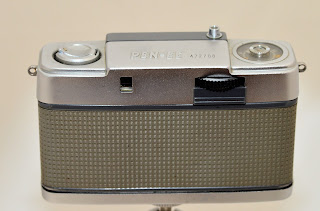
The specifications for the PEN EE
Introduced 1961
Lens 2.8 cm f/3.5 D. Zuiko. It takes 43.5mm screw-in filters.
Aperture f/3.5 - f/22
Shutter speed 1/40 and 1/200 sec auto-selected.
ASA settings - 10, 25, 32,50, 64, 80, 100, 160, 200
Focus - Fixed
Weight - 12.5 ounces (350 gm)
Flash - PC connector for flash, no built-in flash shoe, but a screw-on flash bracket attaches via the tripod socket.
Manual is available at Butkus.org
There's lots of information about the PEN series via the web, so I'm not going to reiterate what's already been put out there. My first foray into half-frame cameras took place over 15 years ago, when I purchased a PEN D, which was a lovely little rangefinder half-frame camera that was built like a tiny tank. I shot a few rolls of film with it, and it sat in a drawer until I sold it a few years later. I had other cameras that I shot with far more, and I didn't appreciate the camera as much as I should have. Since then, a few other half-frame cameras have come my way, such as the Konica EYE and its Soviet-era copy, the Micron, as well as a Canon Demi S (which I have yet to shoot). Then, this PEN EE recently came my way, and I knew that I had to test it out.
While the PEN EE is small, it's not a whole lot smaller than my Olympus Trip 35, which works pretty much the same as the PEN EE. The Trip 35 however, is full-frame, and is manually focused. The PEN EE is tiny enough to fit in a shirt pocket though, and is pretty much as point and shoot as you can get. I only have to set the ASA (ISO) to the proper film speed. I have kept in one of my camera bags and taken it out on various short outings to see how it performs with a roll of Eastman 5222 (Double-X), which is a 200 ISO black and white film.
The PEN EE selenium cell that surrounds the lens provides the metering and power for the exposure system. In dim light, the shutter defaults to 1/40 sec, with the apertures ranging from f/3.5 to f/8, and in brighter conditions, 1/200 sec from f/4.5 to f/22. So, for a 200 ISO film, pretty much any normal situation. I did test out a flash, which the camera sets the shutter speed at 1/40 sec. The flash result seemed pretty satisfactory.
Overall, the PEN EE is easy to use, as you might imagine. Note that in half-frame cameras, the vertical (portrait) orientation is the default, and you must turn the camera 90° for horizontal (landscape) shots.
Here are a series of scans from the Eastman 5222 film. It was developed in D-76, diluted 1:1 for 7.5 minutes. I think that with half-frame, it is best to shoot as fine-grained a film as possible, and there are slower films such as T-max 100 that would be perfect for this camera. The negatives were scanned on my Epson V700 scanner.
Does the PEN EE live up to the idea that a camera could be as easy to use and ubiquitous as a pen? It pretty much does. Before the age of smartphones and tiny digital p&s cameras, the PEN cameras would have been great to always have with you. Yes, the Rollei 35 was about the same size, but it is fiddly compared to the PEN EE. The PEN EE and EES (pretty much the same, but with adjustable focus and and an f/2.8 lens) would have been easily carried along, ready for a snap on a moment's notice. However, I think that you really have to have a mindset that half-frame is right for you. For me, it's a curiosity to play with, and as I noted earlier, my Olympus Trip 35 is full-frame, and gives me results that I am happy with. I am not knocking the cameras -- they are wonderful gems. I just am not the happy half-framer! I think that if you want full-frame with a camera even smaller than the pen, the Olympus XA series is exactly fitting in with the idea of the PEN.
The specifications for the PEN EE
Introduced 1961
Lens 2.8 cm f/3.5 D. Zuiko. It takes 43.5mm screw-in filters.
Aperture f/3.5 - f/22
Shutter speed 1/40 and 1/200 sec auto-selected.
ASA settings - 10, 25, 32,50, 64, 80, 100, 160, 200
Focus - Fixed
Weight - 12.5 ounces (350 gm)
Flash - PC connector for flash, no built-in flash shoe, but a screw-on flash bracket attaches via the tripod socket.
Manual is available at Butkus.org
![]() |
| flash bracket attached with tiny flash unit |
There's lots of information about the PEN series via the web, so I'm not going to reiterate what's already been put out there. My first foray into half-frame cameras took place over 15 years ago, when I purchased a PEN D, which was a lovely little rangefinder half-frame camera that was built like a tiny tank. I shot a few rolls of film with it, and it sat in a drawer until I sold it a few years later. I had other cameras that I shot with far more, and I didn't appreciate the camera as much as I should have. Since then, a few other half-frame cameras have come my way, such as the Konica EYE and its Soviet-era copy, the Micron, as well as a Canon Demi S (which I have yet to shoot). Then, this PEN EE recently came my way, and I knew that I had to test it out.
![]() |
| Not much smaller than the Olympus Trip 35! |
While the PEN EE is small, it's not a whole lot smaller than my Olympus Trip 35, which works pretty much the same as the PEN EE. The Trip 35 however, is full-frame, and is manually focused. The PEN EE is tiny enough to fit in a shirt pocket though, and is pretty much as point and shoot as you can get. I only have to set the ASA (ISO) to the proper film speed. I have kept in one of my camera bags and taken it out on various short outings to see how it performs with a roll of Eastman 5222 (Double-X), which is a 200 ISO black and white film.
The PEN EE selenium cell that surrounds the lens provides the metering and power for the exposure system. In dim light, the shutter defaults to 1/40 sec, with the apertures ranging from f/3.5 to f/8, and in brighter conditions, 1/200 sec from f/4.5 to f/22. So, for a 200 ISO film, pretty much any normal situation. I did test out a flash, which the camera sets the shutter speed at 1/40 sec. The flash result seemed pretty satisfactory.
Overall, the PEN EE is easy to use, as you might imagine. Note that in half-frame cameras, the vertical (portrait) orientation is the default, and you must turn the camera 90° for horizontal (landscape) shots.
Here are a series of scans from the Eastman 5222 film. It was developed in D-76, diluted 1:1 for 7.5 minutes. I think that with half-frame, it is best to shoot as fine-grained a film as possible, and there are slower films such as T-max 100 that would be perfect for this camera. The negatives were scanned on my Epson V700 scanner.
![]() |
| indoors with window light |
![]() |
| drive-by shooting |
![]() |
| indoors with ambient light |
![]() |
| with external flash unit |
![]() |
| Marshall, NC |
![]() |
| Marshall, NC |
![]() |
| Marshall, NC |
![]() |
| French Broad River, Asheville, NC |
![]() |
| French Broad River, Asheville, NC |
![]() |
| French Broad River, Asheville, NC |
Does the PEN EE live up to the idea that a camera could be as easy to use and ubiquitous as a pen? It pretty much does. Before the age of smartphones and tiny digital p&s cameras, the PEN cameras would have been great to always have with you. Yes, the Rollei 35 was about the same size, but it is fiddly compared to the PEN EE. The PEN EE and EES (pretty much the same, but with adjustable focus and and an f/2.8 lens) would have been easily carried along, ready for a snap on a moment's notice. However, I think that you really have to have a mindset that half-frame is right for you. For me, it's a curiosity to play with, and as I noted earlier, my Olympus Trip 35 is full-frame, and gives me results that I am happy with. I am not knocking the cameras -- they are wonderful gems. I just am not the happy half-framer! I think that if you want full-frame with a camera even smaller than the pen, the Olympus XA series is exactly fitting in with the idea of the PEN.
Thursday, April 06, 2017
I Got a Sprocket Rocket in My Pocket
Back in February, I purchased a Lomography Sprocket Rocket from my long-time Flickr and IRL friend, Trish. I don't know why I had not bought one earlier, as they came out in 2012-- but I suppose they looked too much like one of those really cheap, shitty 127 cameras from the 1940s. However, the similarity ends there. The Sprocket Rocket takes 35mm and has a frame size of 24x72mm, and if you remove the mask, it also exposes the sprocket area (hence the name). It's actually a sizable camera, with an all-plastic body and large front housing which contains the 30 mm f/10.8 lens. The shutter is B and I, and the camera has two focus settings - 0.6-1 meter, and 1 meter to infinity. The sunny setting is f/16, and cloudy-flash is f/11 (or close to it). There is a tripod socket on the bottom, so those bulb exposures will be a little easier.
My camera was missing the mask that covers the sprocket area, but it makes no difference, as I scan only the 24mm width, anyways. In use, the camera is quite simple. When advancing the film, wait for the white dot to show up in a window next to the frame counter. When you see it, you have advanced the film to the next 24x72mm frame. To rewind, you simply wind the film back into the cassette - there is no button to release for rewind. The back snaps off and on fairly securely, but I also use some black electrical tape to make sure there are no accidental openings.
I shot one roll of color, which I have yet to develop, and just developed a roll of b&w Eastman 5222 film that I shot in Dexter and Chelsea, MI. Some scans are below. Overall, I am pleased with the results which are far better than I expected. The camera fills a niche which is generally an expensive one -- a true panorama 35mm camera. The 24x72mm frame is pretty well exposed, from corner to corner. There is some distortion, but it's part of the Lomography realm.
I guess my original reaction to the camera as a cheaply-built and overpriced Lomography product was wrong. I don't know of any camera that does what this one does at this size and price. It's a lot of fun, and I look forward to taking it on a bunch of trips this year.
My camera was missing the mask that covers the sprocket area, but it makes no difference, as I scan only the 24mm width, anyways. In use, the camera is quite simple. When advancing the film, wait for the white dot to show up in a window next to the frame counter. When you see it, you have advanced the film to the next 24x72mm frame. To rewind, you simply wind the film back into the cassette - there is no button to release for rewind. The back snaps off and on fairly securely, but I also use some black electrical tape to make sure there are no accidental openings.
I shot one roll of color, which I have yet to develop, and just developed a roll of b&w Eastman 5222 film that I shot in Dexter and Chelsea, MI. Some scans are below. Overall, I am pleased with the results which are far better than I expected. The camera fills a niche which is generally an expensive one -- a true panorama 35mm camera. The 24x72mm frame is pretty well exposed, from corner to corner. There is some distortion, but it's part of the Lomography realm.
I guess my original reaction to the camera as a cheaply-built and overpriced Lomography product was wrong. I don't know of any camera that does what this one does at this size and price. It's a lot of fun, and I look forward to taking it on a bunch of trips this year.
Sunday, March 19, 2017
First Impressions - Minolta Maxxum 5
I have only used a Minolta auto-focus camera a few times in the past -- A neighbor wanted me to sell her Minolta Maxxum 7000 and lenses for her, so I tested everything out with a roll of film before I did so. While that camera had something going for it when it first came out, it was slow and a bit clunky in the user interface, compared to modern AF SLRs. I also have seen a plethora of used Maxxums of various types in thrift shops, etc., sitting there, forlornly waiting for a new owner. As I recently tested a Maxxum QTsi and was quite pleased with the results, it is just a P&S camera. Since then, I acquired a Minolta Maxxum 5 with a 24-85mm lens. Once I put new batteries (2 CR-2) in it, it came to life. It helped that it had a manual, since this is a feature-packed SLR. It features eye-start, and just about every setting one might want to use in a film SLR camera. I am not going to go into a full review of the camera's features and settings, since they are already online elsewhere. One thing that caught my attention right away -- this has to be the lightest, compact and full-featured SLR that I have used. If you have small hands, this is a great choice for an AF SLR. The controls are easily accessed, and the wheel in the front of the camera controls the aperture when you are in A mode, and other settings as you rotate the mode dial are managed via the wheel. The lens focuses quickly and the camera is very responsive to the user.
The Maxxum 5 is the top of the line in the compact SLR bodies, and the larger, more professional-quality Maxxum 7 and Maxxum 9 remain at the top of the Minolta AF SLR bodies, with features that rival and even surpass Nikon and Canon's top models. However, the sun was setting on Minolta as the digi revolution was underway. It's too bad, but on the other hand, you can pick up these SLRs for a fraction of what they originally cost, and the A-series lenses are rather inexpensive. If you are looking for a auto-focus SLR and have no current investment in a system, take a look at the Maxxum 5, 7, or 9.
I shot a few rolls of b&w film for my initial testing, and have no complaints. The camera handles VERY well, and I enjoyed using it.
The Maxxum 5 is the top of the line in the compact SLR bodies, and the larger, more professional-quality Maxxum 7 and Maxxum 9 remain at the top of the Minolta AF SLR bodies, with features that rival and even surpass Nikon and Canon's top models. However, the sun was setting on Minolta as the digi revolution was underway. It's too bad, but on the other hand, you can pick up these SLRs for a fraction of what they originally cost, and the A-series lenses are rather inexpensive. If you are looking for a auto-focus SLR and have no current investment in a system, take a look at the Maxxum 5, 7, or 9.
I shot a few rolls of b&w film for my initial testing, and have no complaints. The camera handles VERY well, and I enjoyed using it.
![]() |
| Eastman 5222 film |
![]() |
| Eastman 5222 film |
![]() |
| Eastman 5222 film |
![]() |
| Eastman 5222 film |
![]() |
| expired Delta 3200 at 1600! |
![]() | |
|
![]() | |
|
Subscribe to:
Posts (Atom)