Showing posts with label expired film. Show all posts

Monday, February 13, 2023

Eastman 5243 Internegative Film

Sometimes it's fun to just try things and see what happens...


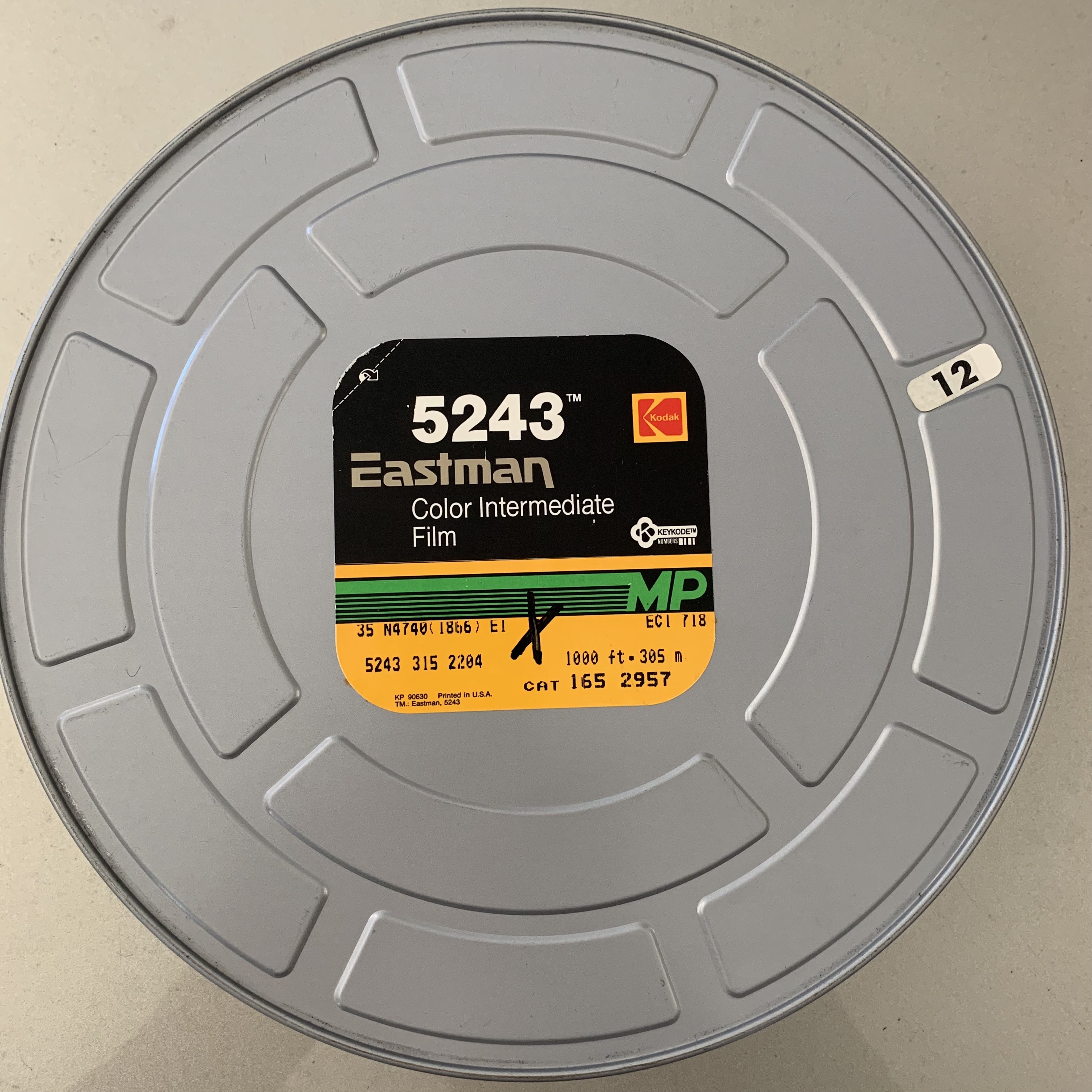
My buddy Bill Pivetta gave me an unopened 1000 ft reel of 35mm motion picture stock last summer, and until recently, it sat in the fridge.  I finally got around to spooling up some of that 1000 ft reel into a 35mm bulk loader, and from that, I loaded up a couple of 35mm cassettes.  The “mystery film” is Eastman 5243 color internegative film.  It’s been really difficult to find much information about it, except that it was used in Star Wars (1977) to produce the final negative for the positive copies for distribution.  The database of film stocks indicates that this film was discontinued in the late 1950s, but that is not the case.  These big reels of film appear to be relatively “recent” - perhaps from the 1980s.  In any case, I was intrigued to see what I might get from this film.  Knowing that similar special-purpose cine films have a low ISO, I decided on an ISO of 1.5, which is 2 stops more exposure than my F4’s lowest ISO setting. So, I just set the exposure compensation dial to +2, giving me an ISO of 1.5 for in-camera metering purposes.  While shooting, I bracketed from +2 to +1 and 0, for an estimated ISO of 1.5, 3.0, and 6.   On a full sunny day, sunny-16 for this film would be about 1 second at f/16, or about 1/15 sec at f/4.  


I shot the roll in the River Arts District, and developed the film in C-41 chemistry along with a roll of Kodak Vision 3 500T.  Before developing, I gave the two rolls a good soak in an alkaline solution of Sodium bicarbonate and Sodium carbonate, and then shook the tank like a cocktail shaker for 4 rinses to get as much remjet off the films as possible - about 99%. I then proceeded to do a typical developer and blix, followed by a series of washes.


before  scanning

The resulting negative has a greenish base, and while the base was rather dense, I could see the negatives, and my eye says the ISO 1.5 was pretty close.  Scanning gave me some interesting results.  For one, it’s obvious that the film has lost some color sensitivity, and I don’t know if the blue-green base color is merely the result of age - which it certainly could be, or a factor of age and storage conditions.  I don’t think the film was refrigerated.  The color matrix in the first image shows how the film now records colors.   The grain is fine, as I would expect from an internegative film.  There is some odd coloration in some frames - and perhaps that’s from age, as this was the beginning of the large roll.  With some post processing in my favorite image editor (Corel Paint Shop Pro), I did some fade correction and exposure correction.  The resulting colors are muted, and some people might find them very appealing.  


5243 color chart after some tweaking


color chart as it's supposed to look (iphone)

I don’t think there would be all that much difference had I developed the film in ECN-2 chemistry.  After all, this is a special purpose, slow cine film that’s probably at least 40 years old.  I may try another roll soon and see how it goes.  However, that’s the beauty of testing a strange film --strange results.   I don’t know if there would be enough interest for me to sell any reloaded 35mm cassettes with the 5243 film at ISO 1.5.  Obviously there’s no guarantee on the results, but if you are interested in acquiring a few rolls of 5243 at a low price, let me know (USA only), as I have almost 1000 feet of it... 


before any corrections


For  comparison, here is a frame from Vision 500T developed in the same tank:

Vision 500T, Nikon FE10.


Wednesday, April 20, 2022

PhotoWorks 200 film - 20 years later


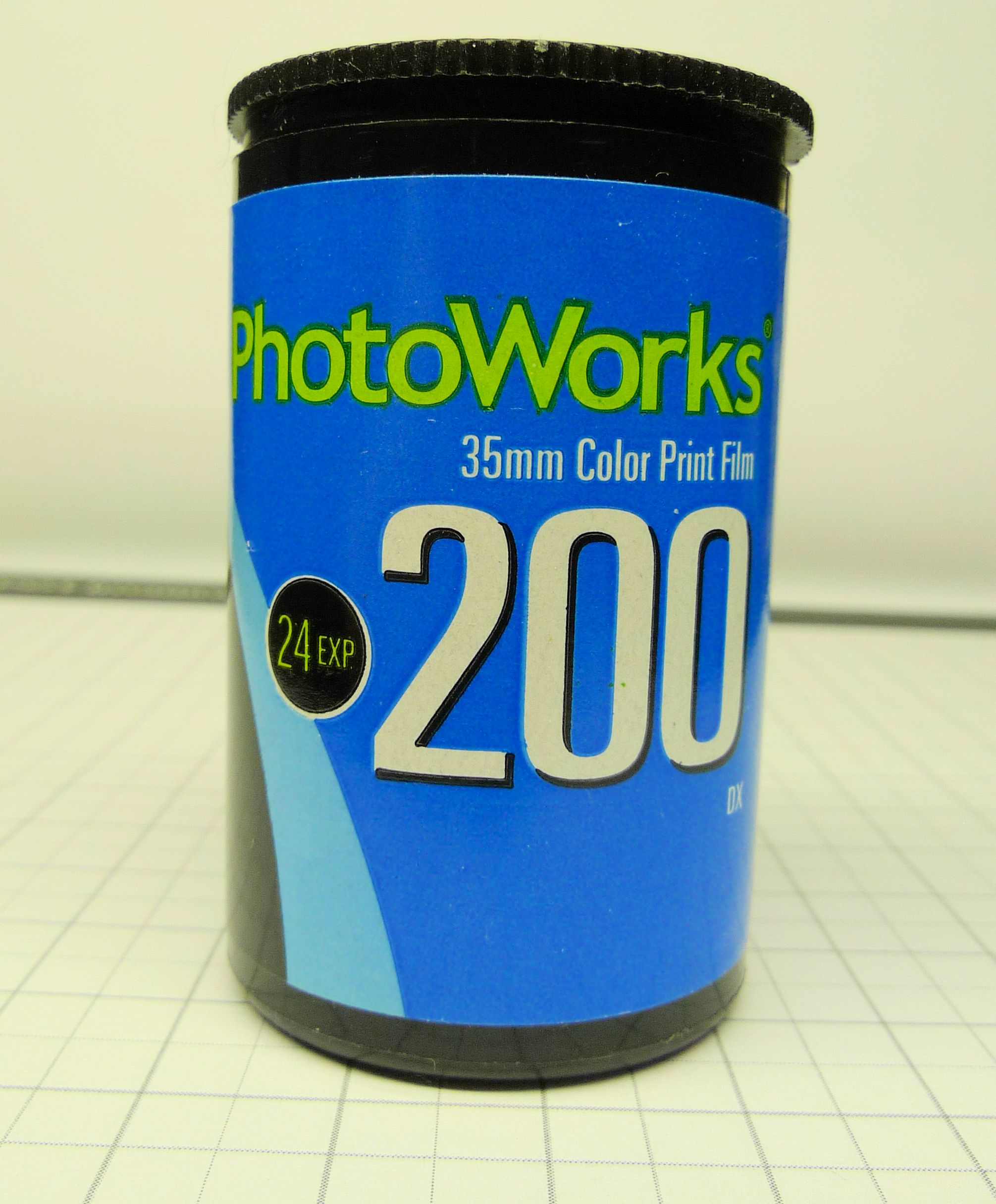
Last year, I picked up a few odd rolls of long-expired color film, and most of it was labeled Seattle Film Works with expiration dates from 2000 to 2002. At one time, Seattle Film Works (SFW) was known for their line of SFW-XL films that were actually Kodak and Agfa cine film with a remjet backing -- and SFW was the only place that would process that film.  I wrote briefly about Seattle Film Works in a previous blog post on ECN-2 process films.  Until the 1990s, SFW films were all ECN-2 stock, but in the mid-late 1990s, the company started switching to C-41 film stocks and did not change the process used on the film canister.  By the year 2000, SFW had morphed into PhotoWorks, with a change in the canister colors and design -- and indicated that the film was C-41. The other change was going from 20 exposure to 24 exposure rolls. Typically, when you sent your "SFW-XL" film to SFW, you received a "free" roll back with your set of prints. In the late 1990s, I used a fair amount of the SFW film and received prints, negatives and slides + the roll of film with every order.  In 2000, a lawsuit claimed that SFW engaged in deceptive practices by claiming the film, now C-41, could only be processed by SFW.  That lawsuit ended with PhotoWorks having to send out thousands of free rolls of the C-41 film to customers.  By 2011, PhotoWorks was gone, its customer list sold to Shutterfly. 


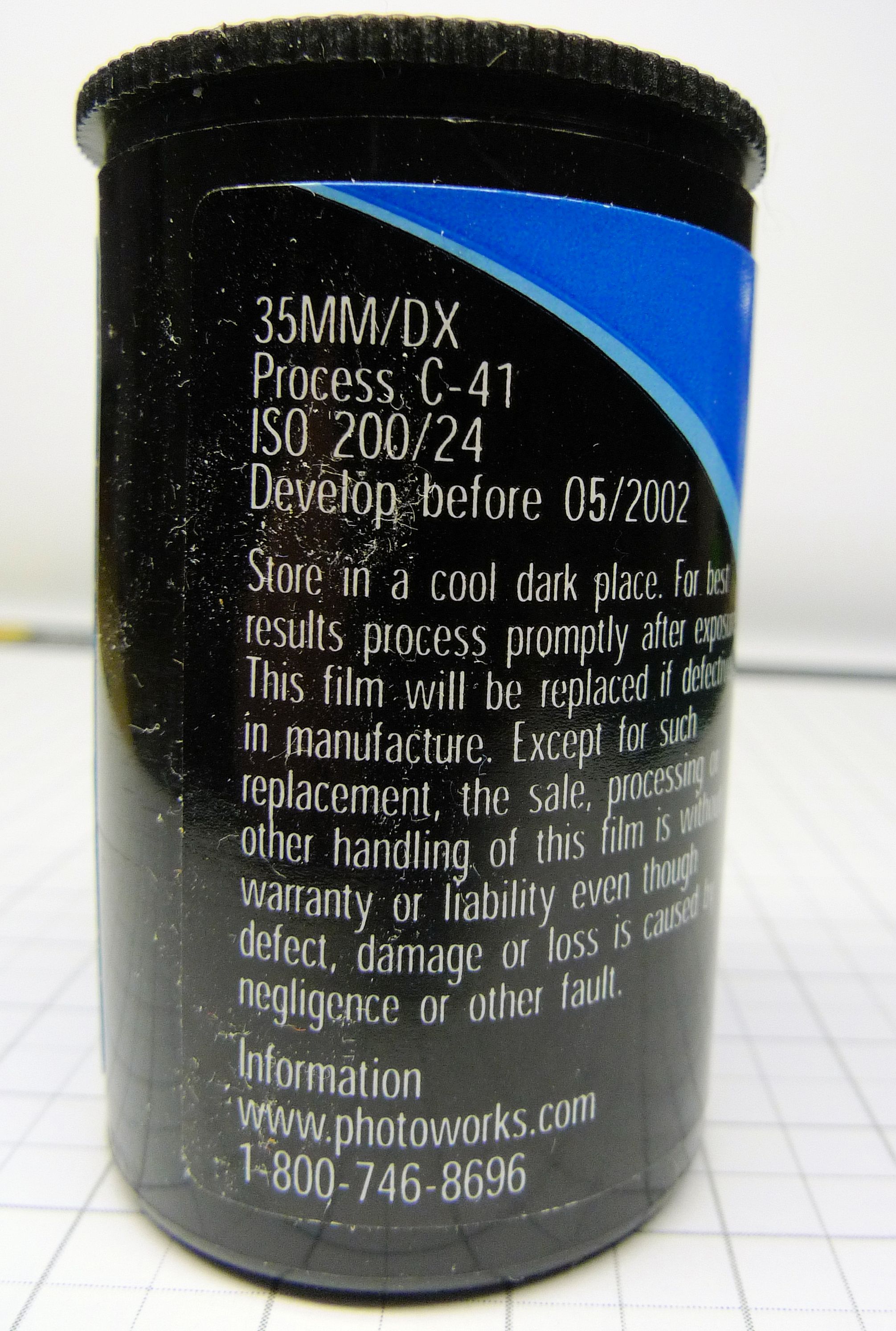
The roll of PhotoWorks 200 was manufactured it Italy - hence it's Ferrania (Solaris) 200 film, and its expiration date was 05/2002.  That puts the film as being made around 2000.  Given its age, I figured that I would rate it at ISO 64.  I loaded the roll into my Ricoh ZF which I reviewed previously in my post on the Tucson Police Dept. camera. After I finished the roll, I developed it in the FPP C-41 kit.  Some of the images are presented below. Overall, I was pretty happy with the results, and the 64 ISO rating was really on target.  


One of the unknowns with any long-expired film is how the film was stored for the past 20 years. More than likely, the film was in a camera bag in a closet, which at least means a relatively stable thermal environment. My experience with expired color films is that to never expect perfect results, and the higher the ISO, the less sensitive the film is over time, as dyes oxidize.  Without making a 1 stop loss/decade for adjusting the ISO, you'll definitely end up with poor results.  If this was the 400 ISO SFW, I'd probably shoot it at ISO 80.  

For expired E-6 (slide) films, it's even more critical to test a roll, if possible,  before shooting anything serious. If the film was stored in a freezer or fridge for most of its life, then low ISO films such as Fujifilm Velvia 50 can often be shot at box speed, or at ISO 32-40. Ektachrome 400 should be rated at least at 200 -- if it was cold stored.  Again, part of the fun with long-expired films is to see what you'll get - but don't use them for once-in-a-lifetime shots.  With the access to color film seemingly restricted at this time, expired films are selling for a lot more.  Don't overpay!  


Friday, December 24, 2021

The world’s first auto-focus camera - Konica C35 AF


Introduced in 1977, Konica manufactured the first auto-focus 35mm camera, the C35 AF.  It was followed by the C35 AF2 in 1980, which really only differs cosmetically, with all features being the same.  I picked this camera up from a box of cameras that my brother-in-law gave to me in July.  All of them had been purchased at an estate sale by him for about $25, and he only wanted the Minolta AF lenses.  There was a variety of cameras ranging from a Nikon F to Instamatics, and all had been stored in a garage, with lots of accumulated grime.  This Konica C35AF2 was fairly cruddy, and had a severe battery corrosion problem.  At first I was going to toss it, but after a while I sat down with it, cleaned it up, and was able to remove the corrosion and battery gunk.  I was pretty surprised that it started working, and after a few months, shows no signs of unreliability.  


About the C35 AF and AF2:

Considering that this camera broke new ground in compact 35mm cameras, the price reflected that.  In 1981, B&H listed the Konica C35 AF2 for $115.95 Compare that to a Pentax K1000 with a 50mm f/2 Takumar lens that was listed by B&H for $139.00.  [January 1981 Popular photography]


Specifications


 The Konica C35 AF is an auto-focus auto-exposure 35mm camera with built-in pop-up flash

    • Lens: Hexanon 38mm f/2.8, 4 elements in 3 groups

    • Shutter: Programmed leaf shutter with 3 speeds-- 1/60s, 1/125s & 1/250s

    • Exposure: Fully automatic, 25 - 400 ISO,  ISO set by turning ring around lens.

    • Meter: CdS

    • Sensitivity: EV9 - EV 17 with 100 asa film

    • Viewfinder: Bright Line 0.41 Magnification

    • Underexposure warning light, Parallax Correction Mark, Focus measuring square

    • Flash: GN14,  Exposure determined by range measured by auto-focus

    • Film Winding: Manual lever-wind + rewind crank

    • Dimensions: 132 x 76 x 54mm

    • Weight: 375 grams

In Use

Of the many AF point and shoots that I have used over the years, the Konica C35 AF stands out as bridging the gap between the manual focus automatic exposure cameras such as the Minolta Hi-Matic G, and the auto-wind, auto-focus, auto-exposure cameras such as the Nikon L35 AF.   It was the first AF camera, and focuses from 1.1m to infinity.  It really does fit comfortably in the hand and is very quiet, due to the manual film advance lever.  If you are in a low light situation, a red led lights up in the viewfinder to alert you to use the flash.  I like that the pop-flash requires one to manually select it.  The viewfinder is bright with easy to see frame-lines and parallax correction markings.  I like that the body is sturdy metal and it has a bit of heft to it.  The filter ring on my camera is dented, otherwise I would use a skylight filter or a yellow filter with b&w film.  It normally takes 46mm screw-in filters, and since the CdS photo cell is within the front lens bezel, it would accurately meter with filters in place.  

Okay, so how has this 40 year old camera worked for me?  I’ve shot two rolls of film with it -- a roll of Tasma NK-II 100 ISO b&w film, and a roll of really expired Kodak Royal 400 rated at 80 ISO.  Every image came out quite satisfactory, even the old Kodak Royal 400 (though I had to adjust the color for fade correction).    It’s not as full featured as one might hope, with only 3 shutter speeds, but under most situations it would work just fine, and the 38mm Hexanon lens is quite good. Right now, I have a roll of expired Kodak Plus-X in it.  It’s definitely a camera to have as an extra in the bag, and yes, it could be a pretty good street camera.  The only downside is that there is no automatic override or B setting.   However, it does what it is supposed to do quietly and competently.  

The going eBay price for this camera is fairly low -- from $25-$85, depending on condition and whether or not it’s from Japan sellers.  It’s 40+ years old, so seals may need replacing (I did that, too).  If it comes with the original lens cap which blocks the viewfinder, that’s a plus.  That’ll keep you from shooting with a lens cap still attached.

I am glad that I took the time to get this camera working.  It’s easy to use, images are in focus, and the lens is great.

Images:



Friday, August 13, 2021

Shooting 41 Years Expired HP-5


I recently acquired a bunch of rolls of Ilford HP-5 that expired in Sept. 1980. Now, you know that I like testing the limits of what one can get from expired film, and a black and white 35mm film that's that old probably is going to be disappointing, right?  Well, follow along and see.

In 1980, I was working on my Master's degree in Entomology at the SUNY College of Environmental Science and Forestry in Syracuse, NY.  It was the year that I spent over 2 weeks on the road to the Southwest on a field trip.  I used a Pentax Spotmatic that I borrowed from my advisor, and shot Kodachrome and Ektachrome along that journey - and I still have those slides.  It was my first experience with the wide open West, and I learned quite a bit on that trip.  I am sure that I did not know a whit about Ilford film back then, as I was so used to the ever-present Kodak, though I know I did shoot some awful GAF slide film prior to 1980.  

In 1980, Jimmy Carter was in the last year of a pivotal presidency.  In 1980, PacMan appeared as an arcade game, and Post-it notes were sold for the first time. That was also the year of the fantastic "Miracle on Ice in lake Placid, NY, as the under-dog USA Hockey team beat the Soviet Union in the winter Olympics. Believe me, that was an exciting game.  It was also the year that Mount St. Helens erupted, causing significant destruction and altering the regional climate for a short time. It was the year the 7 rolls of Ilford HP-5 "expired," locked away in someone's closet or camera bag to resurface 41 years later in a donation of photographic equipment.

As I examined the boxes of film, I realized that Ilford had done some things with the packaging that I had not seen before.  Each plastic canister was sealed with a plastic strip that has to be torn away to open it and remove the film. The film has the typical long "Leica leader" that used to be on 35mm films, but probably stopped by the early 1980s.  The film cassette is reusable, as the ends can easily be removed.  Of course, the box also housed printed instructions on a sheet of paper. Interesting note, is that the instructions tell you to expose at 1/250 sec at f/16 under a full sun.  That's overexposing the film by a stop if it is rated at ISO 400. Also, the film is HP-5, not HP-5+, still rated at 400 ASA.  


At first I thought it would be stupid to test the film, but then I realized it would be a good opportunity to see just what I could do with it.  I have shot long-expired Kodak Verichrome Pan with good results, as well as Kodak Panatomic-X. However, they are not fast films, and age better than a 400 ISO film.  Using my rule of thumb of losing a stop every decade, and factoring in that the film is black and white, I decided to shoot it at ISO 50.  I loaded a Vivitar V3800N SLR with the film and shot it all in one day in Weaverville. The V3800N is one of the cheaper SLRs that appears as many different brandings, but it's certainly capable enough for this simple test. I didn't bracket any of the shots, and used sunny-16 and the camera's meter to adjust my exposures.

In the afternoon, I developed the film in HC-110B for 5 minutes. I chose HC-110 because it seems to limit fogging on old films.  As I pulled the developed film off the reel to hang it to dry, I was really pleased to see that I had images. The film has significant base fog, but I knew that it would scan pretty well.  

I scanned the negs with my Epson V700 scanner, and the thumbnails of the pre-scan looked really good. The film has a slight cupping, like Kodak Tri-X, making the center of the scan a little less sharp. There are some blotchy lines across the length of some of the frames - and I don't know what they are due to.  Here are some of the scans below.You can see that they are little grainy, but overall, not bad.  My guess of shooting it at ISO 50 was correct. I certainly did not expect that the results would be as good as they are.


It's hard to judge the results without knowing the history of how a film was stored over its lifespan.  It could have been in any number of places, and I doubt that any of them would be a freezer.  The exciting fact is that this film, probably produced in 1978 or 79 is still usable (with some adjustment).  

I know that some people wonder why in hell anyone would use long-expired film. I certainly would not use it for anything critical, but part of the fun is seeing how much life that old roll of silver halides still has after all these years.  It's also a of a treasure hunt - sometimes one can find some film that will really amaze with its staying power. Other times, it's a dud.  These rolls of HP-5 are usable, but not without some minor flaws.  However, one person's grainy negative is another person's art niche.  I may put the remaining rolls up on Etsy, so check it out soon.


Thursday, September 10, 2020

The Kodak Brownie Twin 20


This attractive 620 film camera features both waist-level and eye-level viewfinders, hence the Twin part of the name.  The camera was produced from 1959-1964,  and you will often see it for sale in the box with flash, a space for batteries, and the space for a roll of film. The lens has an aperture of f/11, and there is zone focusing.  While there is no B setting, there are three apertures - EV13 - f/11, EV14- f/16, and EV15- F/22.  The shutter speed is approximately 1/100 sec.    The reflex viewfinder is very easy to use, and I find myself preferring it over the eye-level finder.  The camera came with a screw-on flash that uses AG-1 bulbs.  It's quite attractive and modern-looking, in that mid-century style.

I feel the zone focus and ergonomics are the principal attraction to this camera, and if it had B exposure along with a tripod socket, it would certainly rank among the top of my list.  I found that a press-on 33mm Series VI adapter fits over the front of the lens barrel, and allows me to use a yellow filter, which I feel is a great addition for skies.    

Remember to move the switch to Exp. 1-12 after loading the film 
and advancing to frame 1.

The only really oddball thing about this camera is that Kodak expects one to switch a lever on the bottom of the camera to "Load" when rolling on a new roll of film, until exposure 1 pops up in the red window.  Then press  the lever to Exposures 1-12 so that the wind-on stops exactly at the next frame number.  If you forget and start the wind-on in the 1-12 position, you'll never get it where you want it to be.  You then have to switch back to "Load" to get to the next frame number in the red window.  Might as well leave it on Load all the time.  Its sister camera is the Brownie Reflex 20, which has the same features, but lacks the eye-level viewfinder.   That one is definitely worth a try if you should see it in a shop somewhere.

Yellow filter attached with Series VI 33mm adapter

I took the Twin 20 out on an excursion last week to Spruce Pine, NC, and shot a roll of 1997 expired Tmax 400.  I have had good luck with this expired film, and used a yellow filter while shooting in the sun.  I developed it in HC110-B.  I am pretty happy with the results.  Zone focusing worked well, and I kept the aperture at f/11 on all of the shots.