Showing posts with label Michigan. Show all posts

Monday, December 01, 2025

A Tale of Three Westons

Despite this being a photography blog, this post is NOT about any member of the Weston family of photographers. No Edward, Cole, or Brett.  It does however, deal with three towns named Weston in three states.  I suppose that I could go and look for towns named Adams, Evans, Mann, Miller, Stieglitz, or Steichen.  But, hey, I like Weston, okay? According to the USGS Geographic Names Server, there are 31 populated places in the US with the name Weston!  I guess that means I have 28 more states to visit.


Weston, MICHIGAN.  Located just across from Ohio in Lenawee County, Weston Michigan has a population of less than 200. Fairfield Township was founded in 1844, and Weston is an unincorporated community with the township that was originally called Oakford. I could not out why is was named Weston.  The area is largely agricultural, and back in 2014, took this photo of the Weston Post Office.  It's not much of a town, and there are a lot of small towns like this in Michigan and Ohio.

Konica FS-1

Konica FS-1

If your town has a bar and a post office, that's at least something!


Weston, OHIO.  Located within Wood County, Weston has a population around 1,500.  It was founded in 1853, and was originally called Taylortown. Another early variant name was New Westfield. The present name is from Weston Township. A post office called New Westfield was established in 1856, and the name was changed to Weston in 1863. The village was incorporated in 1873.  It sits in an agricultural area about 10 miles W of Bowling Green. It has a large Public Library which serves several other communities with that part of Wood Co.  That part of Ohio is absolutely the flattest place I have been.

Lomo LCA 120, cropped. Kodak Tri-X

I decided to visit Weston while in Bowling Green for a meetup with fellow Film Photography Project menbers on the podcast.  Like I said, I like the name, and headed over there in the morning of Nov. 14.  The main street isn't very long, and most of the businesses and municipal resources are located there.  Surprisingly, the Post Office did not have the name of the town on the front, but it did have the Zip Code.

Leica M2, Fomapan 400 for all of these


Railroads tie many of these small agricultural towns together.  Grain elevators are a common sight.

Weston, WEST VIRGINIA.  The seat of Lewis County, Weston was incorporated in 1846.  In 1818, it was founded as Preston, which was then changed to Fleshersville (ugh!) and changed to Weston in 1819.  The current population is about 4,000.  It's probably most famous for being the site of the Trans-Allegheny Lunatic Asylum, which closed in 1994. It is the largest hand-cut stone building in North America.  Weston is also home to the Museum of American Glass in West Virginia.  

Nikon F75, Fuji color 200

I stopped in Weston in 2024 while driving back home from Pittsburgh. It lies right off US 19, and in my brief stop there, I photographed a few buildings, including the lovely 1930s-built Post Office.  The heyday of Weston was from about 1930 to 1970.  Like many small towns, it has lost population, and is less than half of what it was at its peak. This is not a one-light town. It has beautiful masonry buildings in the main part of the town, and the county courthouse is a brick Italianate design of very modest size.  

Nikon F75, Fuji color 200 

Nikon F75, Fuji color 200 


Nikon F75, Fuji color 200 


There is obviously a lot more to Weston, WV than what I show here.  I think the Lunatic Asylum has tours, which ought to be interesting.

I suppose that if I were about 50, I'd visit every place named Weston and come up with a book. Alas, like so many things, one cannot do everything.  

What Weston have you been to?  I'd love to know.


Thursday, October 30, 2025

Bill Schwab's left us.

Bill Schwab, Photostock 2008

Bill Schwab 1959-2025 

To say that someone left us too early is an understatement.  Bill Schwab, a Michigan-based photographer, died in Scotland yesterday from cardiac arrest while leading one of his photo workshops in Scotland.  Kerik Kouklis, Bill’s closest friend, gave the awful news via his Instagram account. It was heartbreaking news, for sure.  I have known Bill only since 2008, when I went to the second Photostock event in Emmet County, MI. Over the years, as he made Photostock an annual gathering for photographers, it was clear that he valued the spirit of photographic exploration, welcoming photographers of all skill levels, and as he often announced, to leave your ego at the door. Bill put a lot of time and energy and money into hosting Photostock, and because of his work, we were able to meet and listen to some very amazing photographers from all over North America.  Bill, who was from Detroit, gradually moved his base of operations into very rural Emmet County, near Harbor Springs.  I remember those early Photostock events when we basically camped in his woods.  As the annual gatherings grew larger, the Birchwood Inn became the place to be, with those evenings around the fire pits, lots of good conversation and often music with new and old friends, and a good amount of alcohol to keep things lively.  In 2022, he moved the event to Cross Village. The one person responsible for building that great photographic community was Bill Schwab.   I didn’t go every year, but I did attend many of them, the last being in 2022.  When I lived in Michigan, it was just a few hours on the road, but going from NC to northern Michigan is a much longer trip.  

Bill was an alt-process advocate, and when you were at a Photostock, you were likely to be smelling ether with all the tintype practitioners that were there. That was one of the fun aspects - bringing all types of photographers together so that we all learn something new, and in the end, it was the image that matters.  He recognized that photography IS a big tent, and made efforts to be as inclusive as possible.  If it wasn’t for those Photostock gatherings, I would never have met a lot of the people that I now know.  Bill used whatever new technology that became available that would add new dimensions to exploring what photography could do.  I enjoyed his videos on YouTube, and he reached a lot of people through that medium. Best of all though, it was just good to sit down and have a beer with him and talk.  All of us that knew Bill saw his love for photography and how he enjoyed sharing that enthusiasm.  I believe that he made me think more about my photographic practice, and to trust my instincts.

Losing someone like Bill really hurts.  He will be missed most of all by his family.  The photography world lost a good man,  a teacher, a hard-working photographer, and a friend.  

Photostock 2009

Photostock 2013

Photostock 2018


Photostock 2022


Photostock 2022. Everyone in this photo lost a friend. Rest in peace, Bill.

Tuesday, October 17, 2023

Kodak 2238 and a Rollei 35 TE


I first reviewed Kodak 2238 in 2017, and shot it under winter conditions, where the contrast was already quite high.  Also known as Kodak Panchromatic Separation Film for use in the cine world, it’s a low ISO film that’s rated at 12-25 ISO, and does not require a special low-contrast developer to get a proper negative.  That’s what I like about it, since D-76 and D-96 are my favorite developers.  But the other thing I like about 2238 is it’s ultra-fine grain - nearly grainless, and the way it renders landscape scenes.  I loaded a roll into my Rollei 35 TE, which I’ve owned for well over 20 years.  The Tessar lens in that Rollei 35TE is sharp as can be, perfectly suited for a high-definition film like 2238.

Since 2238 is shot at ISO 25, I limited use to daylight photographs, as my Rollei 35 TE shutter no longer operates at speeds below 1/15 sec.  That’s due to the way these cameras are typically stored - with the shutter cocked and the lens retracted into the body.  Long-term storage like that causes the loss of the slow shutter speeds.  

I shot most of the roll of 2238 on a trip to Ludington State Park, Michigan, in mid-September.  It’s a great little camera to keep in my camera shoulder bag, as it takes up very little space, and I have always had great results from it.  While it does need a battery for the meter, I rarely use the meter, and just go with an external meter of sunny-16 estimates.    

Ludington State Park is on the Lake Michigan shoreline about half-way up the west coast of Michigan’s Lower Peninsula. There are lots of sand dunes, inter-dunal ponds and wetlands, as well as Big Sable Point light house at the northern end of the park.  So, it has great lakeshore access as well as a nice road/trail that runs N to the lighthouse.  I mostly shot that day with my Nikon F3HP, but the trusty little Rollei 35 came out towards the end of my day of shooting. 

The film was developed in FPP D-96 for 12 minutes, and the results were what I expected.  It turns out that the roll of 2238 had been loaded nearly a year prior, when I was in Lexington, VA.  That’s what happens when there’s a small camera in my bag — it sometimes can take a year to shoot with it.  Here are a few shots from that roll, all scanned on my Epson V700.


my favorite of the series


I encourage you to try some of these oddball films like Kodak 2238.  They are not what I’d call general-use films, since they are very slow.  But, for detail-rich landscapes, architecture, and a different take on portraiture, they can yield great results depending on the lens and the lighting.  Another good choice for slow films is Rollei RPX 25, which is readily available and can be easily developed.  

Saturday, September 23, 2023

One Roll Review - Svema MZ3

image courtesy of the Film Photography Project

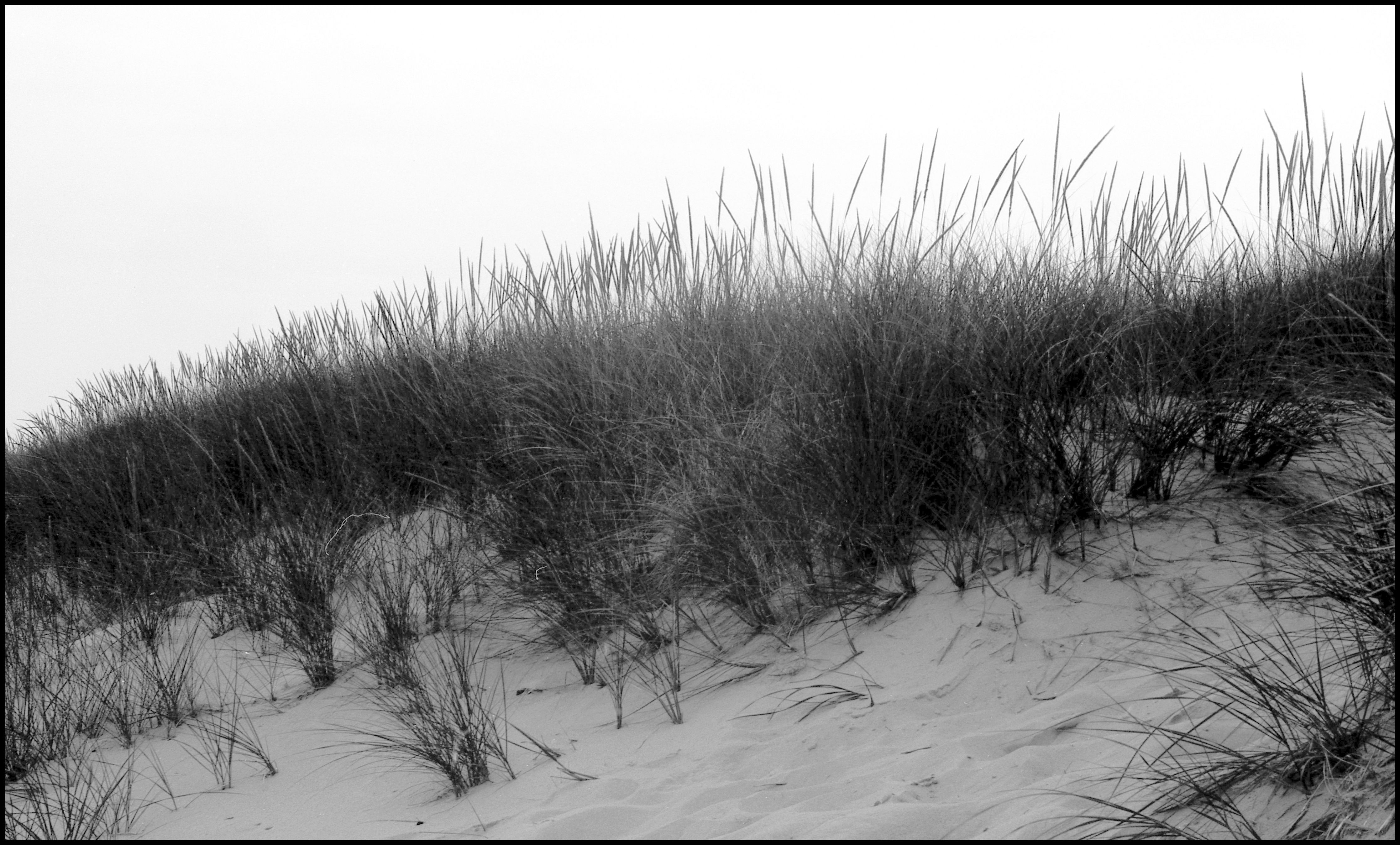
It’s been a few years since I have shot with this film that’s available from the Film Photography Project store. I kept putting off shooting with it until I had a little project.  I decided to put a roll in my camera bag for my trip up to Ludington, MI last week. I knew that I’d have the opportunity to photograph in the dunes near Lake Michigan, so what better use for this ultra-low ISO film?

What is MZ3?

Like several other film stocks available from the FPP store, Svema is the manufacturer of MZ3. It’s an extremely fine-grained blue-sensitive (orthochromatic) film with an ISO of 3. It lacks an anti-halation layer, and the polyester film base is subject to light-piping. Light piping is when the light hitting the exposed film leader is carried by the film base farther into the canister. Usually, it mostly results in some exposure around the sprocket holes, but in severe cases, it can fog the first few frames. Therefore, MZ3 is one of those films that should be loaded either indoors or in the shade, and ought to be stored in opaque film canisters until used. Those new aluminum film cans that I see with some third-party film reloads would be ideal.

Since the MZ3 film is so slow, it’s going to be ideal for landscape, architecture, etc. However, with a fast lens of f/2, one could shoot handheld wide-open on a sunny day. Using sunny-16 as a guide, f/16 in full sun would be about 1/3 of a sec exposure.  The equivalent at f/4 would be 1/30 to 1/60 sec. Years ago, I shot MZ3 with a ND filter to get really long exposures at a busy area in Ann Arbor. Tripod-mounted, of course. 

I loaded the MZ3 into my trusty Nikon F3HP, which I consider to be one of Nikon’s best film SLRs. For me, it’s a great photographic tool that’s never let me down. I used manual exposure and an external light meter to make the photographs on this roll. I also used a tripod, since I was generally shooting at f/16. The ISO dial on the F3 only goes down to ISO 12, and at that setting, the exposure compensation dial only allows about +1.3 stops. So, manual exposure it was. If memory serves correct, most of my shots were around 1/8 sec.

After I returned home, I developed the MZ3 in HC110 dilution H for 9 minutes and 15 seconds. That gave me quite good tonality. Since this is a blue sensitive film, greens are quite dark, providing a lot of contrast between the sand and the vegetation.

light piping along the film rebate at the beginning of the roll

Here are some examples from that roll. Overall, I quite like the results, though some images needed more post-processing than I expected. That’s the fun aspect of these low-ISO oddball films - they are not going to be boring, that’s for sure. I highly recommend that you try this film - and since it does not require special developers to achieve good results, it’s a good choice for a really low-iso film experience.  The MZ3 definitely gave me a look quite different from a 100 ISO panchromatic film.


Sunday, May 31, 2020

Monochrome Mania Issue 2

When I set out to produce my photography zine, I had a pretty good idea of what I wanted it to become. It's a creative outlet for me, as I had been involved in writing and publishing for my entire professional career, and also in my hobbies over the past 30 years. However, a photo zine is somewhat different  - yes - it's a vanity press, but it's a way for me to connect with people with photography, and to get my work in the hands of people at a price that's less than two lattes at a coffee shop.

I had already seen a number of other photo zines, and I can tell you that like anything in photography, they represent a broad range of interests and subject matter. However, they are all out there because people want their work to be seen, on terms that they can control.  We are lacking in print outlets for a lot of photography. The plethora of photography magazines that existed 20 years ago have been decimated by the digital tsunami.  In addition, print publications depend on advertising revenue to be able to publish and pay employees.  Subscriptions fall, advertisers leave, and the print publication goes online -only, and then it may cease to exist altogether.  I am not an online magazine reader.  I like the physicality of a publication, and that it can be read anywhere, as an escape from the ever-present smartphone and computer screens.

So, we now have many photographers that have something to say with their work, and  apart from some curated photography publications, nowhere to publish.  Back in the late 1980s, desktop publishing was just becoming a reality, with the software and laser printing that allowed press-ready work to be done by anyone.  That changed the way things like newsletters and small-market publications were done, not to mention the rest of the publishing industry. I was the editor of an entomological journal, and when I started, I sent physical manuscripts to the typesetters (which were typed in), and by the time I left that position, everything was a digital file, including illustrations, supplied by the authors, which were formatted for publication by the typesetters and sent to production. Now, the journal is only available online, and while I am sure that it saves the organization thousands of dollars, individual papers can be printed out by the user, if necessary.  So, what does that have to do with a photo zine, you ask? 

In my opinion, makers of photo zines are wanting to do exactly the opposite - those of us that produce photo zines recognize that the physical manifestation of an image may be as important as the image.  For those of us that use film - we already know that an image is a tangible thing. It exists whether we print it or not, as a negative or a slide. Yes, we can share it on social media, Flickr, and other online resources after we digitize it, but it may not have the same impact and audience that a print would have. People see an image for a few seconds on a screen, and click "like", and go on.  I think that those of us that produce zines want to do something more than that - we value the tangible, the permanence, and the physical attributes of the image.  Hence, we produce zines to showcase our vision, our interests, and to connect via the printed page. 

page 9, MM #2.

I have had some requests for pdfs of my first Monochrome Mania.  It's still available in print. I'm not giving it away, but at $10, it's pretty cheap. No pdfs will be available, because they are made only to produce the printed copy.  I have so far limited production to 100 copies per issue, and when they are gone, that's it. You may think that only 100 copies is a small number.  If you had any image purchased by 100 people, you'd be really, really happy.  That's kind of how I look at it.  I produce Monochrome Mania as a sort of self-indulgent creative outlet.  This issue number 2 is very different from No. 1. Number 3 will be even more different, as it will be all about "Toy Cameras."  Like other makers of zines, it is a way to share my passion about photography, and get it into your hands at a very low price. 

Issue Number 2 is Michigan Meanderings, and consists of photographs taken in various places in the state of Michigan. Having lived in Michigan for 37 years, I have visited most areas of the state, but seriously photographed places only since about 2006.  Some parts of the state have been shot extensively (Marquette, Ann Arbor), and I have lots more material for other future compilations. Nearly half of the photos in this issue were taken while my friend Marc Akemann and I were on photo trips together from 2008-2017.  I have dedicated this issue to his memory, and wish he were still alive to see it.  I am just about finished developing and scanning rolls of film that he left behind, and I have found a number of the rolls are from our joint trips.  That's a bittersweet experience, and maybe someday I'll be able to put some of them side-by-side with my images from those trips.

Me, taken by Marc, June, 2013


You can purchase Monochrome Mania No. 2 by going to the link on the right side bar, or by clicking here.


Thursday, March 19, 2020

Some Thoughts at a Strange Time

First Day of Spring, 2020

Well, today marks the vernal equinox, and it is my first spring in Western North Carolina. Due to the COVID-19 virus, this has to be the oddest spring that I can remember. Of course, here at my house, we are pretty much keeping to ourselves as we usually do.  Retirement is the perfect time to be able to not have to do anything, but I feel for those that have kids home from school, the people who have to work, and endure the anxiety and uncertainty that this pandemic has caused. It really is unprecedented in the modern era. The rapidity of how things have gone topsy-turvy has amazed me.  No more eating out or going to a bar for a pint in the afternoon (which of course, is a minor thing to us, but no so much for the restaurant industry). The tailspin of our financial markets doesn't surprise me in the least, as I have felt that it's a house of cards for the past 3 years. I am not sure where this will all end up, but I can only hope that efforts to reduce the impact of the virus will have the desired effect, and that the lock-down of our society is only a short hiccup.  However, I do think that the ramifications of what's transpired over the past month (and in future months)  will remain with us for some time - the fragility of our health care system, the gutting of our governmental acuity and the lack of resources to those that need it the most.  It's hard to not have dark thoughts these days, and art isn't immune to these events -- it's often a mirror of the time.

It's a bit trite to say "go lose yourself in what you love to do in these times." I do get it it -- "go do photography and forget about the troubles of the world."  Except that it's not that easy when the troubles are everywhere, not somewhere else.   So, while I can't ignore the current state of affairs, I can try and at least do what I love, and buffer the events a bit.  I generally don't write about current events in RCB, but I think we are all a bit overwhelmed by it all.

So, what about photography?

What I have been doing of late is going back and scanning in b&w negatives from 2008 and earlier.  I'm working on another issue of Monochrome Mania, and I found that I had some really good images that were from rolls that were never scanned in, save for a couple of frames.  One thing that I have found is that you should never think that the scans you did a long time ago are going to be satisfactory later on. This is due partly to better scanners and software, but also due to changing attitudes and how we view our work over time.  In the museum world, it's a fact that changing technologies mean that digital images will be replaced with better versions every decade.  However, that's only part of the story.

From my own experience, I know how easy it is to see a fresh set of images where I connect with the immediacy of the day that I took them.  It doesn't matter whether they are digital-borne or scanned from a freshly developed set of negatives, there is a connection to the event of the making of the images.  That connection often influences our evaluation of the images.  Do you remember when you shot your first roll of film and developed it yourself?  I know I was in high school, and though by my standards today, they were not very good images, at the time, I thought they were great.  It can also be the reverse - in 2008, I shot a lot of film while on a trip to Sleeping Dear Dunes with my buddy Marc Akemann.  We were attending our first Photostock event in Emmet Co., MI, and we took a day to go to Ghost Forest of Sleeping Bear Dunes National Lakeshore.  I shot several rolls of film there that day. One of the rolls was Kodak Technical Pan film, and I don't remember how I developed it - though I suspect is was in Technidol developer.  The negatives were thin and there were lots of spots on them.  I don't think I thought they were very good, and I had other rolls shot from there on APX 100 that I liked much better. Anyhow, I know that at the time, my scanner was not as good as I have now (Epson Perfection V700 Photo), and after scanning in the Tech Pan negatives, I saw many that were really very good images.  After spending a few minutes cleaning up this one negative, I love how the ghost forest looked ghostly.

The ghostly ghost forest. Lensbaby lens, N8008, Kodak TechPan. 2008.

I'll have to have this one printed digitally, as a traditional optical print would be one big pain in the ass to spot and clean up.

A quite different image. Nikon FE, APX 100 film. 2008.

Going back to these older sheets of negatives has allowed me to go on a bit of memory lane as well, and also drove home that I have a LOT of sheets of negatives that I haven't looked at in some time.  If I estimate that on average, I shot a minimum of 100 rolls per year for the past 20 years, that's 2000 sheets of negatives.  Of course, not all of those are worthy of rescanning, but there are lots that I need to look at for material for upcoming zines!

So, to summarize:

It's a good thing to go back and look at images you shot long enough ago that there is no longer an emotional connection to the event of shooting the image. If an image is good, it transcends that connection, and creates a new one - an appreciation of the image itself, not of the event it's associated with.

Review your old work and learn from it.

Re-scanning with better tools and software is a good thing when you can do it.

Our perception of our own work changes with time, and we can get motivated by looking at earlier work we've done.  Maybe it was the camera, the film, the lens, or your vision that helped make an image something truly special.  How has that changed?

Be well, be safe, and document this crazy world.  I hope that you can look at images from 2020 in 2025 and find some images that showed what made the year so special.


Monday, July 01, 2019

Looking Back and Moving On

In two days, it will a year since my best friend, Marc Akemann, left this earth.  I still think of him, and he's still a part of my life.  I have been helping Coleen with Marc's photographic estate, and since I am moving soon, I won't be able to be as helpful as I would have liked to be, but I think my buddy Bill will be able to pick up where I left off.  Lately, I have had some time to scan in a bunch of film that Marc shot but never developed.  The Darkroom developed the C-41 and E-6 film, and I am slowly working on the B&W.  Now that all of my darkroom stuff is packed away, further work will have to wait until after we move. 

One roll of film was shot in 2013, and the roll appears to have shots from two of our trips on it.  I think the following photos were taken at a motel in Mackinaw City or Munising. I think it's the latter, because we both are dressed for cooler weather, and one trip was in June (not cold), and the other, late October.  Any how, Marc had set up his Nikon FA to do self-timer shots of the two of us.  The actual sequence is a bit bizarre, considering that Marc is no longer with us. 


I know that it looks like I am talking to a ghostly Marc, but it's because he was not situated when the shutter fired.  Nonetheless, I think Marc would have agreed that he looks non-corporeal. 

We will be moving to Weaverville, NC on July 20, assuming all goes as planned with the closing on the new house.  We also had great news this evening, as it looks like our house has an offer that will be acceptable to us.  So, I have been busy boxing things up during the past week.  The darkroom is empty, all cleaned up, and is clean enough to wash a baby in.  I still have many books to box up, and oh yeah, the rest of the house needs to be packed.  Our movers arrive on  7/18, and should be done on the 19th.  It's nice to not have to pack in a rush, and get things done in an orderly manner. 

Many Nikon lenses packed up. 

These are just the negatives/slides from 2016-2019
The darkroom, back in early March.

The now empty darkroom

Taken a few weeks ago. Most of the shelves on the sides are now empty.

I am looking forward to moving.  Our new house is only 10 minutes from Asheville, and a mile from Weaverville.  After all this packing/moving/unpacking is over, it will be time for a well-deserved vacation!    We'll miss our friends, of course, as well as some things about Ann Arbor.  It will take a while getting used to our new state, and while I'll miss the beauty of the Michigan lake shores, I'll find new vistas and lots of nature in North Carolina to fill up my viewfinder.