Showing posts with label D-76. Show all posts

Sunday, July 26, 2020

Ultrafine Extreme 100 film - Excellent Value!

Bulk roll packaging (courtesy of Photo Warehouse)
Photo Warehouse, aka Ultrafine Online, has been delivering great film choices for many years, and while I have shot Ultrafine Extreme 100  (UXF 100) quite a few times in the past, I never reviewed it.  I did review its sister film, Ultrafine Extreme 400 in 2018.  That film continues to be my go-to 400 ISO b&w film, and just as COVID hit, I stocked up on several bulk rolls.  I also bought a bulk roll of the UXF 100, and started shooting with it again after a long hiatus.  It hasn't been that long, really, as I have been shooting Kentmere 100, which is what I think the UXF 100 actually is.  Why? I'm 99.9% certain the UXF 400 is Kentmere 400, and after looking at recent negatives and processing times, I'm quite certain that UXF 100 is re-branded Kentmere 100.  That's a good thing, because I have also been happy with my results from Kentmere 100, and the Ultrafine prices for their re-branded films is one of the best film deals out there.  I typically buy Ultrafine-branded b&w film in 100 ft rolls and spool it myself.  If you don't want to buy 100 ft rolls, this film is also extremely affordable at less than $4 per 36 exp. roll!  There is no plastic core with the bulk roll, but I have not experienced any problems while using my Alden film loader.

UXF 100 is a "medium" speed fine-grained panchromatic film that works well in a variety of developers.  My favorite developer for this film is D-76, diluted 1:1, for 11.5 minutes at 20°C.  The film lies extremely flat for scanning, with no curling or warping.  It scans beautifully.  At 100 ISO, it covers a broad array of situations, and has the kind of contrast that I like in a film.  Others have reviewed this film, and they are mostly quite positive.  Alex Luyckx pushed the film to 200 with great results, which is good news for those that like shooting outside the box. 

Ultrafine Extreme 100 is also available in 120, and that has become my preferred 100 ISO film for medium format.  Check out the two quite diverse images below - one from a pinhole camera, and the other from my YashicaMat 124.  In short, this is a budget film that yields excellent results without any quirks, weird developers, or special treatment.  For those that are looking for a film to use in photo classes, I highly recommend  Ultrafine Extreme 100.  The COVID-19 situation has affected the supply chain, so you may want to make sure the film is in stock before your order.

Reems Creek Falls, April 2020, Pinbox Pinhole. UXF 100, 120 size

Flat Iron, Asheville, March 2020, YashicaMat 124, 120 UXF 100

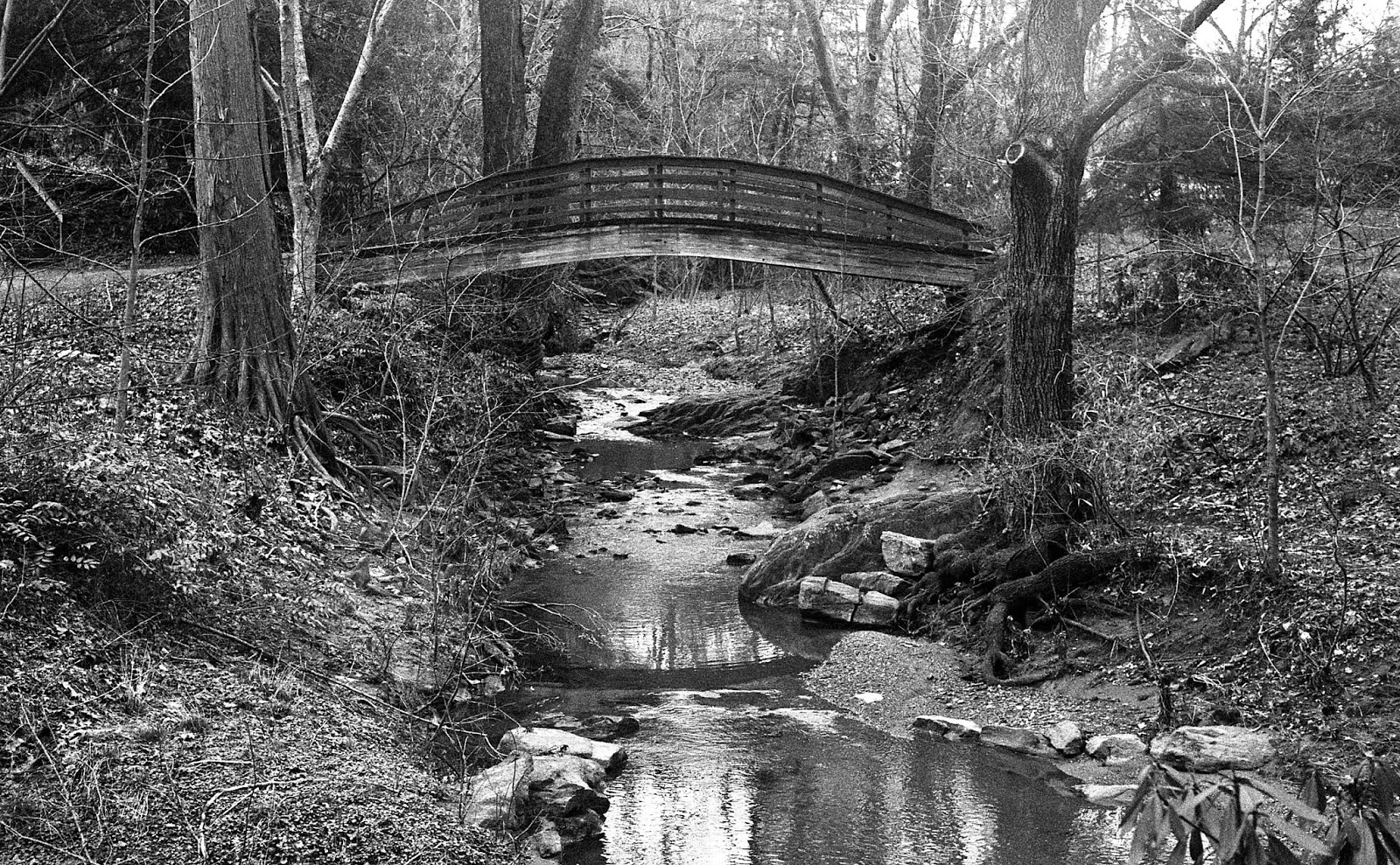
All of the following images were made with a Pentax Spotmatic-F on UXF 100 film. 


Saturday, February 29, 2020

Leap Day, and some notes about the FPP D-96 Developer

I believe that over the course of the past 16 years, this is the first time I have posted on a leap day, Feb. 29.  To underscore the odd day, we got about 2 to 3 inches of snow last night, here in Weaverville, NC.  Since we are "in the mountains," snow isn't foreign here, and it certainly isn't as bad as snow-bound Michigan.  However, I decided to not drive to the Penland School of Crafts open house today, since that really IS in the mountains, and I'm not too sure about the road conditions.  If it were Michigan, it would not be a problem.  So, today, I will catch up on negative scanning and image editing.

Michael Raso and I, and a thumbs up for D-96!

One new thing that I have tried has been the D-96 film developer from FPP.  Michael Raso convinced me to give it a try, especially with b&w emulsions designed for the cinema.  Kodak's D-96 is used extensively to develop cinematic b&w films such as the Eastman 5222, or Double-X.  Of course, it can also be used for other films, such as T-Max 100.  D-96 is used without dilution, and 1 gallon can develop up to 50 rolls of 35mm film.

To date, I have developed four rolls of Eastman 5222 and 1 roll of T-max 100.   For most films, it seems that the times are pretty much the same, which makes it amenable to trying it with other films not listed in the FPP chart.

D-96 Development Times From the FPP site:

FILM             ISO    TEMP    TIME (minutes)
100Tmax          100    68F      7.5 
400Tmax          400    68F      8 
TMZ3200         3200    68F      12.5 
FPP Low ISO BW     6    68F      7 
FPP SONIC BW      25    68F      8 
Ferrania P30      80    68F      9 
X2 (Double-X)    200    68F      7.5 
400 TX           400    68F      8 
Orwo UN54        100    68F      5.5 
Orca B/W Lomo    100    68F      6 
FP4              125    68F      8 
HP5              400    68F      9 
FPP Blue Sensitive 6    68F      7.5 
Polypan F         50    68F      9  

The FPP recommends that you use the developer undiluted and pour the developer back into the container after using.  For more information, see the product listing.  That's how I am using it, and I'll keep track of how many rolls I get before the results start to indicate that it's time to buy another gallon.  As I try other emulsions with D-96, I'll add them to the above list.

D-96 is similar to D-76, but D-76 is best used 1:1 as a one-shot developer, which is how I use it.  D-96 apparently gives a bit less contrast, and it differs from D-76 in the ratios of the components (metol, hydroquinone, sodium sulfite, and borax, but also contains sodium bromide.

Some sample images.  I'm happy with my results, and look forward to seeing how D-96 does with other films!

Eastman 5222,  Nikon FM3a

Eastman 5222, Nikon FM3a

Eastman 5222Nikon FM3a

Eastman 5222Nikon FM3a

T-max 100 (expired) Spotmatic F

Eastman 5222, Canon 7

Eastman 5222, Canon 7

Eastman 5222, Canon 7

Also, see my video here - https://www.youtube.com/watch?v=hDrzi6-qfVU

Wednesday, April 25, 2018

Tasma NK-2 Film Review

Over the past few years I have been able to sample the interesting films from the Film Photography Project store.  The Svema films such as the FN64 and Svema 400 are really nice films in my opinion, and I have been using them rather frequently.  One film that I have not tried until now is the Tasma NK-2 100 ISO b&w film.  I am not sure why I hadn't tried it earlier, but after shooting two rolls of it in the past week, I feel that I can offer a quick review.

First of all, the Tasma film originates from Russia, and is described as a b&w motion picture film.  The Russian site says that the factory dates from 1933, so Tasma has a long history. The film is on a PET base, not acetate, and consequently is extremely tough and will not tear like an acetate-based film.  It's also thinner than typical 35mm films, much like the Svema stocks that I have used, but seems not as flimsy as the Svema.  The Tasma NK-2 film is fresh stuff, according to the FPP site, and has a sort of cult-status. 

The Tasma NK-2 rolls are in 24-exposure cassettes from the FPP, and are DX-coded.  I would prefer 36-exposure rolls, but then again, with these limited-availability films, the shorter rolls are a good idea, especially for testing.  The film loaded easily onto the take-up spool in the Nikon F3HP and the Yashica FX-7 cameras that I used.  I set the ISO on the cameras to the box speed of 100. 

DEVELOPING

I checked the Massive Development Chart, and the information on the Tasma NK-2 seemed rather odd, so I consulted the FPP pages on Flickr, and found two developers that I use: D-76 and XTOL.  Leslie Lazenby's recommendation was XTOL stock at 7.25 minutes.  Another photographer (Tom Napier) recommended D-76 straight for 7 minutes.   I find the MDC listing a bit odd, as I have only seen examples with people shooting it at box speed.

Other developers and times that I have found (all at 20°C):
HC-110 B for 10 min
D76 Stock for 10 min
Diafine - 4 min each in A & B

I developed in D-76 for 10 minutes, and did a water stop, followed by 7 minutes in fixer.  I washed in water and used Permawash to remove any fixer followed by a good rinse.  Both rolls came out beautifully. The film dries perfectly flat, and scans beautifully on my Espon V700.

Nikon F3HP with 19mm Vivitar lens:


Yashica FX-7 Super with 50mm f/2 lens.


Overall, the Tasma NK-2 is a very easy film to work with, especially now that I have a developer or two that I can use to get satisfactory results.  The tonality is certainly acceptable, and it is fine-grained.  I can see no reason why anyone would not want to try some.  The fact that it scans so well should be a key point in using it.  I think a bulk roll of it from the FPP store is next on my list.