Showing posts with label Pentax Spotmatic F. Show all posts

Friday, March 05, 2021

One Roll Review - Adox HR-50

I purchased a bunch of  "new to me" film stocks last year, and I am slowly shooting these low-iso films.  I aim to update the first Monochrome Mania with an additional review of films that are currently available, after I have tested them all. These one-roll reviews are sort of a preliminary report of what I hope to be more thorough testing.


Adox HR-50 is certainly a film that should be of interest to black and white enthusiasts.  According to the Adox literature, the film is "based on an emulsion commonly available for technical purposes, featuring an ultrafine grain and superpanchromatical sensitization."  I like that term "superpanchromatical"  I am going to have to use it sometimes and say, "Wow! Superpanchromatical, Dude!"

HR-50 Spectral Response


In addition,  Adox  states "ADOX HR-50 is especially suitable for street and landscape photography. In Portrait photography we recomend our dedicated HR-50 developer.ADOX modifies this film from the master roll and finishes it to 35mm, 120 and sheets (4×5). The film´s speed is enhanced to 50 ASA using ADOX´s new SPEED BOOST- technology. The gamma is reduced so it becomes perfectly usable for pictorial photography in regular developers. ADOX HR-50 can be used as an Infrared film and responds extremely well to any sort of filtration (yellow, orange, red, blue, green)."


Fact sheet - https://www.fotoimpex.com/shop/images/products/media/63360_5_PDF-Datasheet.pdf

Film facts:

  • Emulsion: Superpanchromatical
  • Resolution: Up to 280 lp/mm at an image contrast of 1000:1
  • ISO: 50/17°
  • Base: 0.1mm PET
  • Anti Halation: Combined AHU with NC/AH on backside* ( AHU=Anti-Halation Underlayer, NC=No Curling, AH=Anti-Halation)

I purchased two rolls of the HR-50 and a bottle of its special developer from B&H. Usually, I try to stick to developers that I commonly use, but in this instance, it seems that the HR Developer gives the best results. In developing a roll of the HR-50 in a single reel tank, I needed only 6 ml of developer and 294 of water.  

I shot the first roll in November of 2020 and Feb. 2021 in my Pentax Spotmatic F. No filters were used. I plan on using roll 2 during the summer with a 25A red filter to see what I get with green vegetation on a sunny day.

This film reminds me a great deal of Kodak's Technical Pan Film. The clear PET base makes scanning really easy, and the spectral response is similar to TechPan, which is sensitive into the near-IR end of the spectrum. The HR developer reminds me a bit of the Kodak Technidol liquid, but I have no idea what the HR-formula contains. I sense that the HR-50 film would be a high-contrast film if developed with anything other than the HR Developer, much like Tech Pan.  

This film is really sharp and virtually grainless, and I found that in shaded conditions, there is a really smooth tonality.  In stark sunlit conditions, the highlights appear somewhat overexposed, and shadows dark. That could be due to my processing or my metering, but I do like the look of this film. Midtones, do look pretty good, though.  

I think that if you are looking for a pictorial replacement for Tech Pan, the Adox HR-50 should be a great candidate.  The preliminary results from it certainly encourage me to do more testing. It's a faster film than Tech Pan, for sure.  I may also try developing some in POTA, just to see how it compares, and likewise, I will try developing some Tech Pan (I still have a lot of it) in the HR Developer and see what I get from that.

As of this writing (3-5-2021),  it appears that HR-50 is no longer offered through US retailers, though I see it for sale in the EU. Drat!  Now I wish that I had bought more of this nice film.

Some Examples:


From the Blue Ridge Parkway, November 2020

dying elephant-ear leaves

These are all from a visit to Dillsboro, NC in late February, 2021.

Dillsboro, NC RR crossing. 

Restful place on the other side of the tracks

We sell masks

All others pay cash

mirror view

Rails, roads, and mountains


Sunday, July 12, 2020

Lomography's Lomo Kino Films - Potsdam and Berlin


It's been quite a while since I reviewed a b&w film from Lomography.  Back in 2011, I reviewed Lady  and Earle Grey films. Since then, Lomography has really expanded their line of film offerings, especially in the color emulsions, some of which I have also reviewed.   Lomography's style of branding and their target audience- young, adventurous and film-curious, has made an impact on how film is marketed.  Few people get excited if I asked them about Fompapan 100, but slap a different brand name on it with attractive packaging, and the film gets sought after.  So too, have Lomography's "new" black and white emulsions, under the branding of Lomography Kino films, come into the hands of people that would never have heard of ORWO cine films.  I'll give Lomography credit -- I like their advertising and how they hype up an emulsion, and that's okay.  If it gets more people interested in trying something new, that's great.  Some may even find that a particular emulsion provides an opportunity to be creative with a result that matches their vision.  

This review will cover the two emulsions that Lomography has released under the "kino" name:  Berlin - ISO 400, and Potsdam - ISO 100.  First of all what exactly does Lomography mean by the "kino" (cinema) label?  Who makes this film?   Here's Lomography's description for the Berlin: 
"A Refined Formula for True Film Lovers
Inspired by the New German Cinema sweeping through Berlin in the 1960s, our original Berlin Kino Film emulsion was an utter blockbuster. However, as German cinema evolved through time, adapting to meet the innovatory spirit of its founding fathers, so did our film formula. Refined and brimming with greater artistic control, the Berlin Kino B&W 400 2019 Formula will allow you to capture moments of your life in an eternalized enchanting monochrome. "

and the Potsdam:

 "A Legendary Roll of German Cine Film Reborn
Inspired by the New German Cinema sweeping through Europe in the 1960s, Lomography’s Kino Films are extracted from rolls of cine film produced by a legendary German company that has been changing the face of cinema since the early 1900s. Originally used to make moody monochrome movies, their gorgeous black and white tones lend a timeless effect to cinematic scenes."  

Certainly attractive descriptions of the cine films that are produced by Orwo - N 74 Plus and UN 54:
"Product description: ORWO N 74 plus (Negative Film) is a high speed black-and-white panchromatic camera film for both outdoor and indoor usage. Its wide exposure latitude makes it especially suitable for use under low light illumination and difficult light conditions. 
Applications include documentary films, news coverage, underwater and industrial cinematography. Use of N 74 plus is also recommended under normal light conditions when greater depth of field is needed. The N 74 plus has improved slippage, extremely low shedding and excellent antistatic qualities.  Compare To: Eastman Double X (250 ASA)"

"Product description:  ORWO Film UN 54 (Universal Negative) is a panchromatic medium speed black-and-white negative camera film for both outdoor and indoor usage. According to the ORWO Instruction 4185 the UN 54 film can be processed as black and white reversal film and be used to produce direct positives.   Compare To:  Eastman PLUS X (80 ASA)"

Now you see the difference between descriptions to two different audiences - the film hobbyist and the professional  cine film user.  Based upon the two different descriptions, which would you choose, not knowing they are the same product?  Lomography's, I am sure.   This is an example of many of the "new" films are coming to market for the 35mm shooter.  Whether it's from Lomography, Cinestill, Film Photography Project, Washi, or others - cine films are finding their way into the hands of avocational and hobbyist photographers, and it's all good.

My experience with these films goes back a few years, as I received samples  of the ORWO N74 Plus and UN 54 films in 2016. I'll compare this latest batch of Lomo films with the ones that I received from ORWO.

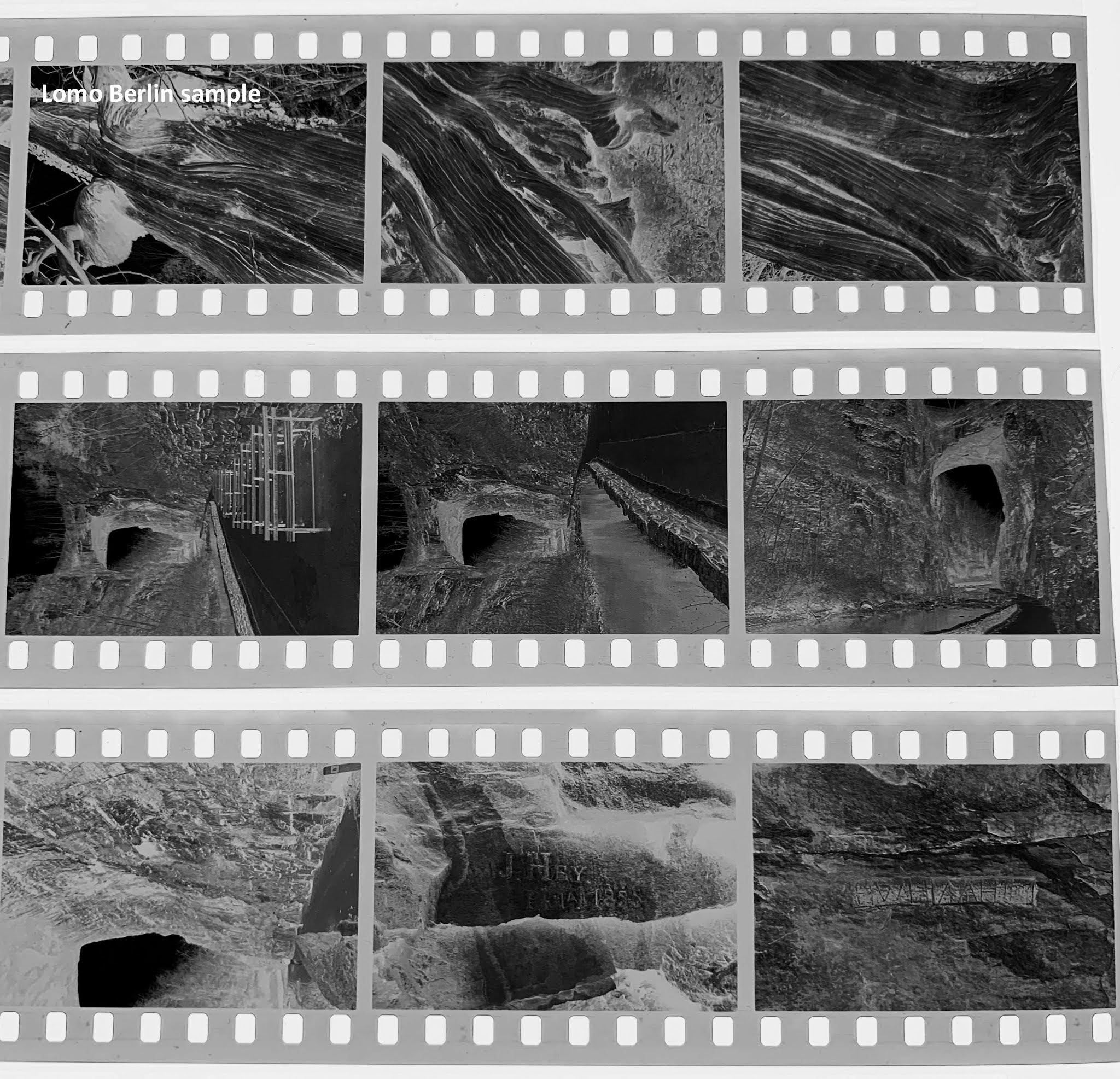
Lomography Berlin Kino 400 - As Lomography touts - "Capture life’s most elusive moments in everlasting monochrome charm with the 2019 emulsion of our iconic black and white cine film."   I had not tried the earlier Berlin emulsion, so I can't comment on it.   Was the prior emulsion "old stock" from ORWO?  Hard to say, so it's all just conjecture, but my film cassettes do state "New Improved Formula!"   I bought them from B&H back in late 2019.  I love the packaging and the fact that Lomography provides developing information.   I shot my first roll in February in my FM3a,  and the second in my Nikon FE2 in June.  I compared those negatives with a roll of actual ORWO N74+ that I shot in 2016.  These are not the same films.  The N 74+ from 2016 has the typical cine sprocket perfs which are rounded, whereas the Berlin 400 2019 has standard 35mm squared-off perfs.  So, is the Berlin 400 I received something else, and NOT N74+?  Some research reveals that Filmotec (the branding for the ORWO cine film) released N-75 in 2019, with some improvements, rated at 400 ISO in Daylight, 320 ISO for Tungsten lighting.  It's also supposed to have  additional anti-halation undercoat (AHU).  That may explain the difference, as well as my 2016 film has "Filmotec ORWO N74 813717 79A06" in the film rebate. The Lomography film has no film information printed in the rebate.  I feel that the film base is quite dark and darker in the two Berlin rolls that I shot, whereas the ORWO N74+ has a lighter gray film base.  The negatives fit nicely into my scanner holder, without cupping or curling, so that is a plus.  Scan-wise, I think the results are very good, though there is some grain when developed in straight D-76.   The one thing I didn't care for was that Lomography uses a two-piece plastic cassette for this film.  I ended up prying it apart in the dark to remove the film, which isn't optimal.   So, I am fairly sure that the Berlin Kino 2019 emulsion is ORWO N75. Is the New Improved Formula batch that I received the same? That I do not know.

Orwo N 74+ from 2016

Berlin sample 2 with darker base, regular sprockets

Berlin sample 1 with dark base, regular sprockets


Lomography Potsdam Kino 100 - Note that because this film can be developed as a negative or a positive film, it has quite a write-up on the Lomography site.   I have not processed it as a positive, but for a cine film, that is a real plus for those shooting the 16mm version.  I shot my first roll in February in my Nikon FM3a, and the second roll in my Pentax Spotmatic F in June. I compared those negatives to a roll of ORWO UN54 that I shot in 2016.  They all appear to be the same film, except that the ORWO has "Filmotec ORWO UN54 512912 14A11" on the film rebate.  I really like this film, as the scans are beautiful, and there is something about the tonality I really like.  The Potsdam film was developed in straight D-76 for 5 min 45 sec, and the UN54 was done in D76 1:1 for 7 minutes. Results are comparable. Standard metal cassettes are used for this film, or at least for the rolls that I purchased.

Potsdam sample

UN 54 from 2016

Overall impressions - I have other 400 ISO films that I like better than the Berlin 400. It's not bad, it's just that I am not liking the darker film base that to my eye, seems like base fog, and the more noticeable grain.  I much prefer Kentmere 400 and HP-5.  The Potsdam film reminds me a bit of Plus-X, and I do like its rendition of shadow areas.  Of the two, it's one that I would purchase again for landscape photography. 

As with any film - there will be people that find Berlin 400 or Potsdam 100 perfect for what they shoot, and others that won't like it as much as some other emulsion, which is one of the great things about shooting with film.  Try them yourself and see what you think.  It's also important to note that I give kudos to Lomography for providing more information on development, along with examples from different developers.  

A few sample images - scanned with my Epson V700 scanner, post processed with Paint Shop Pro 64-bit.

Berlin 400, Natural Bridge, VA Feb. 2020

Berlin 400, Asheville, NC Jan. 2020

Berlin 400, Natural Bridge, VA, Feb. 2020

ORWO N74+, 2016, Nikon FG

Berlin 400, NC, June 2020

Berlin 400, NC, June 2020

ORWO UN 54, Cranbrook, MI, Pentax K1000, 2016

UN 54, MI, Pentax K1000, 2016

Potsdam 100, Dutchess Co., NY, Feb. 2020

Potsdam 100, Sharon, CT. Feb. 2020

Potsdam 100, Asheville, NC June 2020

Potsdam 100, Asheville, NC June 2020

In the end, both of these films are fine films to shoot with, giving one ever more reasons to shoot film!

Not a fan of the plastic 2-piece cassette!

Saturday, February 22, 2020

Those were the days...

I recently started scanning in some of my 35mm slides from 1980.  That was my first trip to the Southwestern US.  At the time, I was a graduate student at SUNY-ESF in Syracuse, NY, and was working on a master's degree in entomology.  Roy Norton, a professor in the department asked if I wanted to go on a two-week trip to the Sonoran Desert,  camping out along the way, and collecting insects at many locations (none from the national parks, of course).  It was a great trip in Roy's Ford Pinto station wagon, the back crammed with gear and supplies.  It's the trip where I learned to drive a manual-shift car, and my introduction to a real road trip across the USA.  We hit a lot of traditional destinations - Mesa Verde, Grand Canyon, Great Sand Dunes National Monument, Monument Valley, the Painted Desert, Flagstaff, Tuscon, Organ Pipe Cactus National Park, and Saguaro National Park. Mostly we took secondary roads once we got into Colorado, and I wish that I had kept a journal of that trip.  I did take a borrowed Pentax Spotmatic camera, which was certainly an upgarade over my old Exa Ia SLR.    There were no electronics, we navigated with road maps, and we always carried plenty of water. 

1980 is the year that I think everything started to change.  I wish that I had been thinking as a photographer at the time and shot some of the town that we went through. The funky old towns hadn't yet been ravaged by Walmarts, and the uniformity we see today of chain stores and restaurants along strips had yet to happen.  Sure, we stopped at McDonald's when we were traveling, but we ate on a budget, and I have a memory of stopping somewhere in Arkansas for bread to make sandwiches (PB&J, of course), and all the store had was that awful white Wonder bread.  At the Grand Canyon, we camped at one of the campsites- and I found that the 25-cent shower was certainly a quick one.  That low-alcohol Coors sure tasted pretty good, too.

The trip was a great success, and I have a fair number of slides from it.  I scanned a few slides earlier this week, and all of the scans require minutes of removing dust spots.  I shot Ektachrome and Kodachrome, and all of the slides have aged pretty well. Over 40 years, they have been moved around, and at some point in the mid-1980s, I transferred them from the slide boxes to plastic storage sheets in binders.  Now that I have more time, I'll continue to scan the slides in, and I am finding that I did pretty well with most of my shots.  It just takes some time to clean up the images after the scan.

Here are a few... some have not been cleaned up.

Great Sand Dunes National Monument

Great Sand Dunes National Monument

Great Sand Dunes National Monument

Great Sand Dunes National Monument

near Oak Creek Canyon, AZ

The Grand Canyon, of course

Arizona Snow Bowl near Flagstaff

Monument Valley, converted from color slide.

Saturday, February 01, 2020

The Pentax Spotmatic F - still going strong.

My Spotmatic F and a selection of lovely Takumar lenses
I have used/owned many Pentax SLRs over the past 40+ years.  I used a borrowed Pentax Spotmatic F  from 1978 to 1980 to document my work on sand wasps in graduate school. Later, in 1983, I purchased a K-mount Pentax MG at a Service Merchandise in Ann Arbor, MI.  Similar to the Pentax ME, it got me through nearly 20 years of half-assed photography, until I started on my venture to be a real photographer in 2000.  Since then, I have had many Pentax SLRs come and go, and while I am mostly a dedicated Nikon user, I have a soft spot for the Spotmatic.  In terms of quality, features, and ergonomics, the last M42-mount camera from Pentax, the Spotmatic F, is the camera that I have kept for the past few years, and will keep as a user.  I don't shoot with it that often, but lately, I have been using it more in jaunts around town.  I believe it's a far better camera than the K1000, which has received so much adoration, and yet, lacks significant features.  While the K-mount makes it easier and quicker to change lenses, it's not a big deal to work with screw-mount cameras. 

While the Spotmatic F appeared in 1973 and offered full-aperture metering with the matching lenses, it was certainly behind the curve compared to Nikon and Minolta.  Any M-42 lens can be used, but unless it has the additional tab for the open-aperture metering, one has to switch the metering button upward and use stop-down metering on the camera. 

Despite those drawbacks, I find using the Spotmatic F to be very easy and comfortable in the hands.  I recently took a series of photos around Beaver Lake as well as downtown Asheville, and the results were excellent.  I have a nice series of lenses. Besides the 50mm 1.4, I have the 28mm/3.5, 35mm /3.5, and 135mm/2.5, which is a wonderful lens.  All are in excellent condition, and make for a nice kit.  In addition, I have other M-42 lenses, such as the Helios 44 from a Zenit 12XP.

If you are interested in trying any of the old M-42 SLRs, you can't wrong with the Spotmatic F.  While there are a plethora of M-42 SLR bodies out there by Ricoh, Chinon, Praktica, Mamiya, Zenit, etc., none of them have the finish and feel of a Spotmatic. 

Pentax Spotmatic Resouces:


A few recent images...
Fomapan 400:


Ilford Ortho Plus 80: