Showing posts with label 35mm photography. Show all posts

Wednesday, September 29, 2021

DOOMO D light meter review

The DOOMO D meter matches the lines and finish of a Leica M2

Lately, we have all seen a number of extremely-compact shoe-mountable light meters such as the one from Raveni Labs, and the KEKS EM01.  These little wonders use a small OLED screen to provide the exposure information, with tiny buttons to change settings, etc.  My biggest problem with these ultra-tiny meters is that the screens are sometimes difficult to read, and that they are small enough to well,... lose.  I have been using handheld meters such as the Gossen Pilot Selenium meters (which work quite well) and the Sekonic L-208 Twin-Mate, a modern, still-in-production light meter.  I originally wanted a Voigtlander VC Speed Meter II, but with a price at over $200, it was more than I wanted to pay.

DOOMO D meter

Now, I think I have found a favorite light meter for my Leica M2. It's the DOOMO Meter D, which at first glance looks a lot like the Voigtlander VC II.  First of all, it has exactly the layout I wanted - an analog dial approach, just as you would find on a camera, with +/- red LEDs and a green one for the "correct" exposure.  It sits in the accessory shoe on the Leica perfectly, and looks like it's part of the camera.  The dials are easy to move, and the LEDS are easy to see in bright light.  On top of that, it has a metal case that looks robust and well-finished, and a perfect match for any classic camera.  However, looks are not everything. It also has to work well, be easy to use, and I need to have confidence in its accuracy.  The DOOMO D meter does all those things. 


Upon receipt of the DOOMO D meter  from Cameractive (direct from China), I was pleased to see it well-packaged in a black box.  Now, I am a pretty experienced photographer and familiar with all sorts of gadgets. The only information in the box is a small card that has brief instructions on inserting a battery (CR-1632 coin cell that is not included) and QR codes to take you to the online manual. I had no trouble figuring the rest out without looking online. The package also includes two shoe mounts, screws, a small black stick-on circle, and a small screwdriver.  My only quibble is that while the slotted head screwdriver fits the Phillips-head screws, it should be replaced by an actual Phillips head screwdriver.  However, if you need to use the manual, the online manual has all you need. If you have used a camera with built-in light meter such as a Nikon FM, then the controls don't need much explanation.  You set your film's ISO on the left wheel, - which ranges from 25-6400, and that wheel also has your aperture settings (f/1- f/22), while the right wheel has the shutter speeds (1 sec - 1/2000).  If like me, you are an aperture priority person, I set my aperture and move the shutter speed dial until it the LED shows green, or +/- 1 stop, and then I set my shutter speed on the camera to match.  Now the funny thing is -- it's entirely possible to forget that you have to adjust the camera settings to match what the DOOMO light meter is at.  I had a brain fart like that a couple of times, forgetting to transfer the meter settings to the camera. That's not a meter problem, it's a human problem!


You can attach the shoe connector to either the right side or the center, and the screws hold it firmly in place to the body of the meter. For my Leica M2, the meter needs to hang to the left of the shoe, and the placement is absolutely perfect.  

online manual


Results. After shooting three rolls of film with the DOOMO D light meter, I feel very confident in its metering accuracy.  It's made me use my M2 more often, and at only a hair over 2 ounces in weight, it's not even noticeable as an add-on.  The metering is easy - press the black button on the rear to activate the meter, and adjust accordingly for your exposure.  The meter has a 30° angle of view for the sensing, and that seems to work quite well.  The advertised battery life is 60 hours of continuous use, and that's a lot of shooting.  I recommend having a spare, just in case. You can get a package of 10 CR-1632 3V cells on Amazon for less than $6. That's the price of one at the hardware store.

underside of meter. The battery compartment is
securely closed with a screw.


Overall, I found the DOOMO D light meter to be just what I wanted - simple, accurate, stylish, and well-made.  For me, it's a perfect fit for my Leica, and I highly recommend it if you want an analog-style meter.   It's available directly from Cameractive as well as Doomo and some eBay sellers.  Also, take a look at the Doomo Instagram account, as well.  At a price of $125, I think it's very affordable and probably the least expensive accessory for your Leica that you will ever find. I thank Zhang at Cameractive for contacting me and sending the meter to review.  

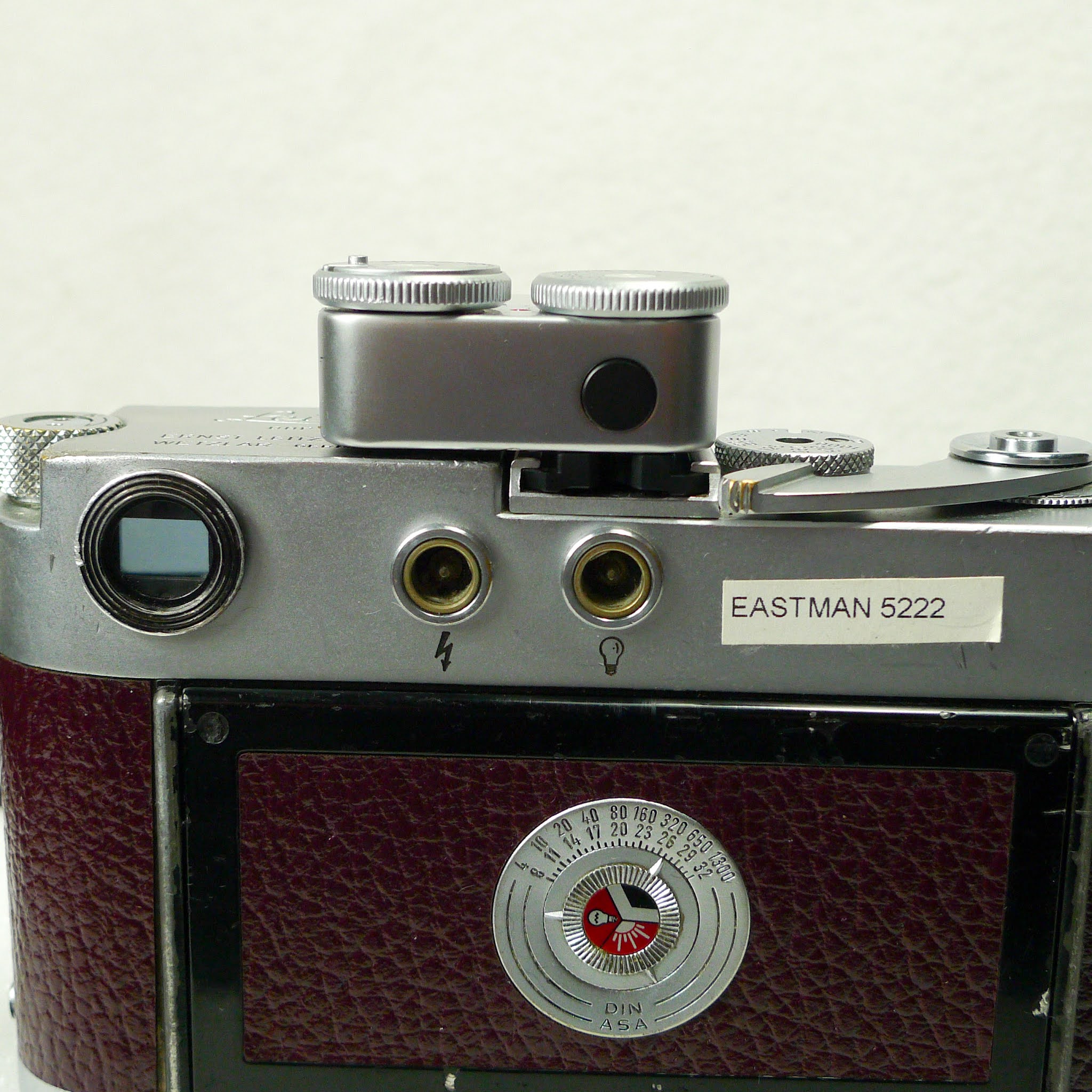
rear view of the DOOMO D meter


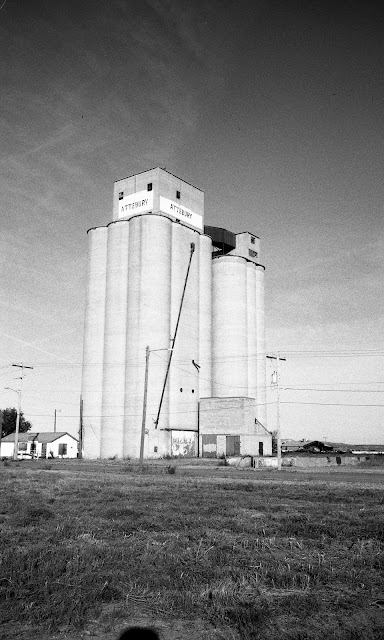
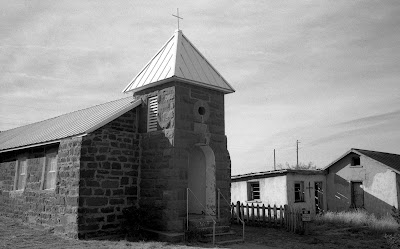
Some images from the M2 with Ultrafine Extreme 400 film, using the DOOMO D meter


More images from my October 2021 trip to the Southwest US.  The Leica and DOOMO D meter make a great pair.

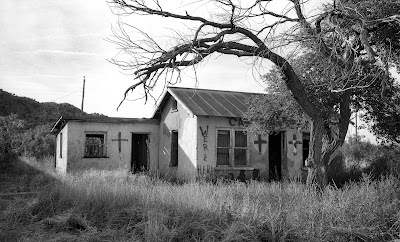
Tucumcari, NM, FPP Frankenstein 200 film

Cuervo, NM, FPP Frankenstein 200 film  

Cuervo, NM, FPP Frankenstein 200 film

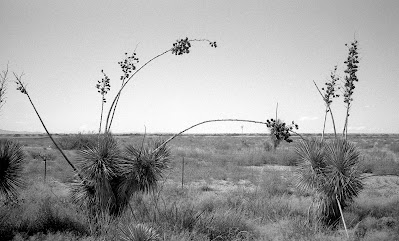
Lordsburg, NM, Fomapan 100

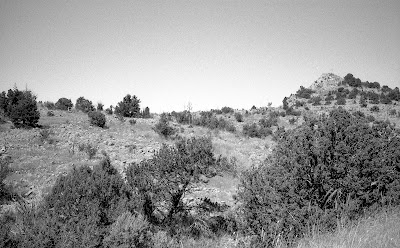
Gila National Forest, NM, Fomapan 100

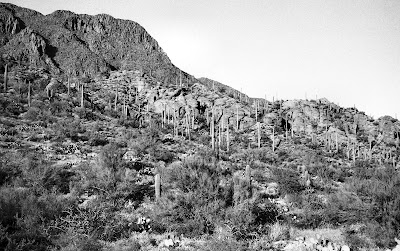
Gates Pass Rd., Tucson, AZ,  Fomapan 100


Thursday, February 18, 2021

Widening Your Horizon

Vance Birthplace, Reems Creek, NC 2019. Sprocket Rocket, Fuji Superia 400

One of the important aspects of photography is determining how much of a scene will appear in your image. Not only that, but the aspect ratio in which the scene was recorded (whether film or digital), is also an important decision.  We often see different aspect ratios available on digital cameras - 1:1 (square) 3:2, 4:3, 16:9, etc.  With film, the original aspect ratio of the medium is square 1:1 (24x24 mm for 35 mm, or 6x6 cm in 120), 2x3 (24 x 36mm for 35mm) 3x4 (18 x 24 mm in 35mm half-frame), and in medium format, 6x4.5, 6x7, 6x8, 6x9, and 6 x 17. Large format of course, is 4x5, 5x7, 8x10, etc., but not a part of this discussion.  I only mention digital here because you can choose a wider aspect ratio in-camera, but at the cost of pixels. Panoramic format is generally considered to be about twice as wide as high, so an aspect ratio of 16:9 is pretty close in the digital world. 

I'm going to discuss 35mm film formats, since that's the most-often used film, and the panoramic options are more affordable.  To get more of a landscape in your image, one can go the wide-angle route, using lenses with short focal lengths such as 28mm down to 16mm.  My favorite wide focal length is 24mm, because it's not so wide that there is going to be major distortion in perspective, compared to 19mm or 20mm.  However, the problem with just using a wide-angle lens is that all of the scene, from sky to foreground is there, unless you crop it out.  The better solution to a wide-scape is to use a wider frame of film for the scene.

While a standard 35mm still negative image area is 24 x 36 mm, there are other formats that will affect the area of the scene captured.  You may often hear about panoramic format images from 35mm and the typical, easy way to do that is simply to mask a 35mm frame so that it ends up with the negative area that is about 15mm high x 36mm wide.  There are many 35mm point and shoots and a few SLRs that do this trick by using a horizontal mask at the top and bottom of the frame. It works quite well, but the downside is that you have also lost some resolution, as you are cropping the 35mm frame to a much smaller area.  Making enlargements will often be grainier and less sharp. However, with a wide-angle lens and a good exposure on fine-grained film, the result can be quite acceptable.   

Lake Michigan Dunes, 2007. Ansco Pix Panorama, Delta 400 film

The better way to present a wider-aspect ratio image is to increase the frame size. To do this, the camera needs to have a wider film gate, and a lens that will work with the wider image circle. There are several options for this, and most of them are expensive. The one camera that's probably most coveted for wide shots is the Hasselblad X-Pan (made by Fujifilm, and also known as the Fujifilm TX-1). The negative area for that camera is 24 x 65mm, almost double the frame width of a typical 35mm.  The price of such a camera now is beyond the means for most of us. So, what other choices are there?  Well, fear not.  My list that follows are low-cost solutions to the panoramic problem.

Ansco Pix Panorama 

The low-fi way to do it.

The removeable panoramic mask in the camera

This is the low-fi, low-cost way to shoot a cropped frame panoramic. Amazingly enough, the images are better than one might expect. They have the toy camera aesthetic, and with the 27mm lens, one gets a true wide-angle for the best result with the cropped 13x36mm negative.  The shutter speed is about 1/125 sec, with an F/11 aperture.  The panorama mask is removeable so that you can also get standard 24x36mm negatives.   Ebay prices are quite low, ranging from $5 to $20.  Ansco Pix Panorama  cameras are quite common (not made by Ansco, but by Haking in China), so don't overpay for one.  Due their easily pocketable size, they provide a fun and easy way to get a panoramic look.  On sunny days, ISO 100 films should be just fine, otherwise ISO 200 or 400 films.  Kodak's Tmax 100 for b&w would be a good choice for sunny conditions. There are many other 35mm cameras with a panorama mask and wide-angle lens, such as the Ricoh R1, Minolta Freedom Vista, Olympus Trip Panorama, Yashica Microtek Zoom 70,  Nikon Lite Touch AF 600, Vivitar IC101, Vivitar T200, Vivitar PN 2011, Pentax UC-1, etc. 

Lower harbor, Marquette, MI. 2014. Yashica Microtek Zoom 70.
Konica VX 400 film.


Curvilinear, 2013. Nikon F-50D with the pano mask, Tmax 100 film


Lomography Sprocket Rocket


Lomography's Sprocket Rocket is a great plastic fantastic panoramic camera, which I discussed in 2017.   The Sprocket Rocket's real frame size is actually wider than the X-Pan, at 24 x 72mm, or two full 35mm frames.   With its 30mm f/11 and f/16 lens and only Instant (1/100) and B shutter speeds, it's limited in the ways that an X-Pan is not.  However, it does have a tripod socket, so lengthy exposures are possible.  Best of all, it's an easy to carry-around camera that takes pretty darn good images. There's some vignetting, some blurred edges, and a bit of distortion, but I love the images that I get from this camera.  I do not care about showing the sprockets, and they are cropped in my scanner frame, anyway.  With a 36 exposure roll of film, you will get about 16 shots.   I have found that using 200-400 ISO film works great in most conditions.  My favorite film to use with this camera is Eastman 5222 (Double-X).  

Cloudgate, Chicago, 2017. Sprocket Rocket, Eastman 5222


Holga 135 Pan


The Holga 135 Pan looks much like an elongated  Holga 120N.  It has a removable 55mm f/8 lens plus an f/236 pinhole lens.  The frame size is 24 x 72 mm - again, a tad wider than the X-Pan. It's zone focus, and has two shutter speeds - ca. 1/100 sec and Bulb.  It also has a tripod socket and a hot shoe for flash.  I have used mine as a pinhole camera and also with the regular lens, and I prefer the 55mm lens. I reviewed the camera back in 2012.  I don't think the images are as sharp as the Sprocket Rocket, which is due to the Holga lens. However, if you want to shoot wide with a toy camera, it's one to consider, and it's definitely given me some memorable images.

Great Lakes Freighter, 2012. Holga 135 Pan, Superia 200

Angell Hall, 2012. Holga 135 pan, Vista 100 film


Holga 120N 35mm Adapter

I reviewed this solution in 2010, and the resulting frame size is 24 x 55 mm, because you are using the 35mm film in a 120 film body.  The biggest drawback in my opinion is the frame counting is tedious, and you can't rewind the film without taking the camera into a dark bag and unloading it.  You can also put 35mm in film other medium format cameras, and only a 6x9 format makes this desirable.  There are many hacks for doing this, but in most of the instances, you can't rewind the film in camera, which does make this method cumbersome.  In addition, the medium-format lenses are typicall "normal" and not wide, so the effect won't be quite the same as a panoramic camera.


Result from the Holga 35mm adapter, 2010.


Other Medium Format Camera Adapters -

Using a 35mm adapter in a Pentax 6x7 ought to give nice results if you use it with a wide-angle lens such as the 45 or 55 mm lens. There are 3D printed adapters available online.  One photographer has blogged about his impressive results.  A Mamiya RB67  can also be modified to work with 35mm, and as with the Pentax 67, there are some online sources for a DIY or finished product.  Again, all of these adapters require you to rewind the film back into the cassette by using a dark bag or darkroom. If you already have a Pentax 6x7, then the adapter is a low-cost entry into 35mm panoramas. I plan on trying one out this year.

Horizon Panoramic Camera

Horizont (Horizon) 35mm swing-lens panoramic camera

The other option is to use a swing-lens panoramic camera that does not distort the images the way toy cameras are prone to do. The Horizont cameras, manufactured by Krasnogorsky Mechanicheskiy Zavod (KMZ) in the Former Soviet Union (FSU), debuted in 1966, and use 35mm film with a 24 x 58 mm framze size.  KMZ is also known for its line of Zenit 35mm cameras.  The Horizont features an 28mm f/2.8 Industar lens and four shutter speeds, ranging from 1/30 to 1/250 sec. It was replaced by the Horizon 202 in 1989, and then by the Horizon S3Pro in 2003.  Lomography now sells the Horizon Perfekt, which has an ABS plastic body, easier controls, more streamlined shape, and is made in the Zenit factory.  Another model from Lomography is the Horizon Kompakt which has only 1 shutter speed and an f/8 aperture. A new Horizon Perfekt will set you back about $350, with the older models going for less.  The Horizont will give you sharp images, and is a heck of a lot cheaper than the Widelux or Noblex swing-lens panoramic cameras.    My Horizont arrived the other day from an eBay seller, and I am just testing it out now.

To sum it all up, shooting a scene on a wider negative provides a much different view than a standard 35mm frame, even if a wide-angle lens is used.  You can of course, crop any image to get a wider aspect ratio, but cropping is at the loss of image area, whether film or pixels. A wider negative in panoramic format presents the viewer with a more dynamic depiction of a scene.

Of course, you do not have to shoot panoramas horizontally.  Vertical shots are really fun, and provide a definite vertically dominant image.

A triptych from 3 vertical Ansco Pix Panorama shots, 2007.

About Medium Format Panoramas

If you want to really go with film real estate, you can choose among medium-format cameras, with 6x12 and 6x18 cm being very amazing, and also very expensive.  However, there are a number of people that have produced 6x12 cameras using 3D printing.  The Kraken 6x12 from Graham Young is a good example. This makes shooting wide in medium format much more accessible. Lomography's Belair also does 6x12 at a reasonable price, but my sample of the camera never seemed to focus accurately, and I really never warmed to to it.  Of course, there are Widelux and Noblex cameras that use 120, and are pricey.  The cheapest 6x12 would be the Holga 120 Pan that has a 90mm lens and the typical Holga construction.  However, it's probably no longer in production. On the higher end of the scale, Linhoff and Fujifilm have the extreme wide panoramic cameras with prices and image quality to match. 


  More Images!


The wide-angle image from the Ansco Pix without the
panorama mask in place. 2008. 


April 2017 Festifools. Sprocket Rocket, Kodak Gold 200.


Smithfield Cemetery, 2020. Sprocket Rocket, expired
Ektachrome Elite 200


Parker Mill, 2010. Holga 35mm adapter.


Pergola, Biltmore, 2021.  Sprocket Rocket on Ultrafine 400

Landscape, Biltmore, 2021.  Sprocket Rocket on Ultrafine 400


Skeleton, 2015. Holga 135 Pan, Tmax 100


Perspective, 2006. Ansco Pix Panorama. Ilford HP-5


Black Rocks, Marquette 2006. Ansco Pix Panorama, Delta 400 


Sunday, July 12, 2020

Lomography's Lomo Kino Films - Potsdam and Berlin


It's been quite a while since I reviewed a b&w film from Lomography.  Back in 2011, I reviewed Lady  and Earle Grey films. Since then, Lomography has really expanded their line of film offerings, especially in the color emulsions, some of which I have also reviewed.   Lomography's style of branding and their target audience- young, adventurous and film-curious, has made an impact on how film is marketed.  Few people get excited if I asked them about Fompapan 100, but slap a different brand name on it with attractive packaging, and the film gets sought after.  So too, have Lomography's "new" black and white emulsions, under the branding of Lomography Kino films, come into the hands of people that would never have heard of ORWO cine films.  I'll give Lomography credit -- I like their advertising and how they hype up an emulsion, and that's okay.  If it gets more people interested in trying something new, that's great.  Some may even find that a particular emulsion provides an opportunity to be creative with a result that matches their vision.  

This review will cover the two emulsions that Lomography has released under the "kino" name:  Berlin - ISO 400, and Potsdam - ISO 100.  First of all what exactly does Lomography mean by the "kino" (cinema) label?  Who makes this film?   Here's Lomography's description for the Berlin: 
"A Refined Formula for True Film Lovers
Inspired by the New German Cinema sweeping through Berlin in the 1960s, our original Berlin Kino Film emulsion was an utter blockbuster. However, as German cinema evolved through time, adapting to meet the innovatory spirit of its founding fathers, so did our film formula. Refined and brimming with greater artistic control, the Berlin Kino B&W 400 2019 Formula will allow you to capture moments of your life in an eternalized enchanting monochrome. "

and the Potsdam:

 "A Legendary Roll of German Cine Film Reborn
Inspired by the New German Cinema sweeping through Europe in the 1960s, Lomography’s Kino Films are extracted from rolls of cine film produced by a legendary German company that has been changing the face of cinema since the early 1900s. Originally used to make moody monochrome movies, their gorgeous black and white tones lend a timeless effect to cinematic scenes."  

Certainly attractive descriptions of the cine films that are produced by Orwo - N 74 Plus and UN 54:
"Product description: ORWO N 74 plus (Negative Film) is a high speed black-and-white panchromatic camera film for both outdoor and indoor usage. Its wide exposure latitude makes it especially suitable for use under low light illumination and difficult light conditions. 
Applications include documentary films, news coverage, underwater and industrial cinematography. Use of N 74 plus is also recommended under normal light conditions when greater depth of field is needed. The N 74 plus has improved slippage, extremely low shedding and excellent antistatic qualities.  Compare To: Eastman Double X (250 ASA)"

"Product description:  ORWO Film UN 54 (Universal Negative) is a panchromatic medium speed black-and-white negative camera film for both outdoor and indoor usage. According to the ORWO Instruction 4185 the UN 54 film can be processed as black and white reversal film and be used to produce direct positives.   Compare To:  Eastman PLUS X (80 ASA)"

Now you see the difference between descriptions to two different audiences - the film hobbyist and the professional  cine film user.  Based upon the two different descriptions, which would you choose, not knowing they are the same product?  Lomography's, I am sure.   This is an example of many of the "new" films are coming to market for the 35mm shooter.  Whether it's from Lomography, Cinestill, Film Photography Project, Washi, or others - cine films are finding their way into the hands of avocational and hobbyist photographers, and it's all good.

My experience with these films goes back a few years, as I received samples  of the ORWO N74 Plus and UN 54 films in 2016. I'll compare this latest batch of Lomo films with the ones that I received from ORWO.

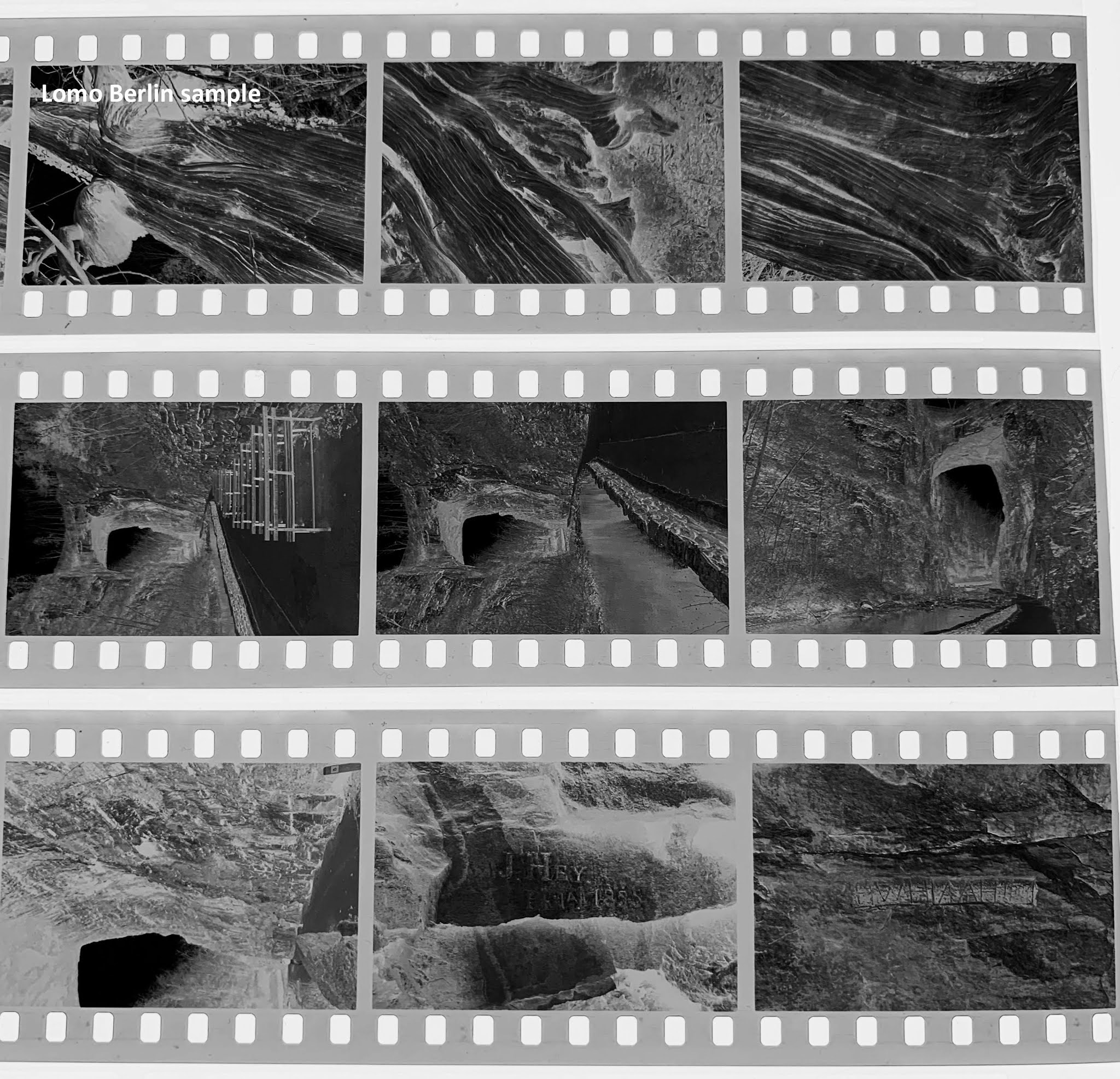
Lomography Berlin Kino 400 - As Lomography touts - "Capture life’s most elusive moments in everlasting monochrome charm with the 2019 emulsion of our iconic black and white cine film."   I had not tried the earlier Berlin emulsion, so I can't comment on it.   Was the prior emulsion "old stock" from ORWO?  Hard to say, so it's all just conjecture, but my film cassettes do state "New Improved Formula!"   I bought them from B&H back in late 2019.  I love the packaging and the fact that Lomography provides developing information.   I shot my first roll in February in my FM3a,  and the second in my Nikon FE2 in June.  I compared those negatives with a roll of actual ORWO N74+ that I shot in 2016.  These are not the same films.  The N 74+ from 2016 has the typical cine sprocket perfs which are rounded, whereas the Berlin 400 2019 has standard 35mm squared-off perfs.  So, is the Berlin 400 I received something else, and NOT N74+?  Some research reveals that Filmotec (the branding for the ORWO cine film) released N-75 in 2019, with some improvements, rated at 400 ISO in Daylight, 320 ISO for Tungsten lighting.  It's also supposed to have  additional anti-halation undercoat (AHU).  That may explain the difference, as well as my 2016 film has "Filmotec ORWO N74 813717 79A06" in the film rebate. The Lomography film has no film information printed in the rebate.  I feel that the film base is quite dark and darker in the two Berlin rolls that I shot, whereas the ORWO N74+ has a lighter gray film base.  The negatives fit nicely into my scanner holder, without cupping or curling, so that is a plus.  Scan-wise, I think the results are very good, though there is some grain when developed in straight D-76.   The one thing I didn't care for was that Lomography uses a two-piece plastic cassette for this film.  I ended up prying it apart in the dark to remove the film, which isn't optimal.   So, I am fairly sure that the Berlin Kino 2019 emulsion is ORWO N75. Is the New Improved Formula batch that I received the same? That I do not know.

Orwo N 74+ from 2016

Berlin sample 2 with darker base, regular sprockets

Berlin sample 1 with dark base, regular sprockets


Lomography Potsdam Kino 100 - Note that because this film can be developed as a negative or a positive film, it has quite a write-up on the Lomography site.   I have not processed it as a positive, but for a cine film, that is a real plus for those shooting the 16mm version.  I shot my first roll in February in my Nikon FM3a, and the second roll in my Pentax Spotmatic F in June. I compared those negatives to a roll of ORWO UN54 that I shot in 2016.  They all appear to be the same film, except that the ORWO has "Filmotec ORWO UN54 512912 14A11" on the film rebate.  I really like this film, as the scans are beautiful, and there is something about the tonality I really like.  The Potsdam film was developed in straight D-76 for 5 min 45 sec, and the UN54 was done in D76 1:1 for 7 minutes. Results are comparable. Standard metal cassettes are used for this film, or at least for the rolls that I purchased.

Potsdam sample

UN 54 from 2016

Overall impressions - I have other 400 ISO films that I like better than the Berlin 400. It's not bad, it's just that I am not liking the darker film base that to my eye, seems like base fog, and the more noticeable grain.  I much prefer Kentmere 400 and HP-5.  The Potsdam film reminds me a bit of Plus-X, and I do like its rendition of shadow areas.  Of the two, it's one that I would purchase again for landscape photography. 

As with any film - there will be people that find Berlin 400 or Potsdam 100 perfect for what they shoot, and others that won't like it as much as some other emulsion, which is one of the great things about shooting with film.  Try them yourself and see what you think.  It's also important to note that I give kudos to Lomography for providing more information on development, along with examples from different developers.  

A few sample images - scanned with my Epson V700 scanner, post processed with Paint Shop Pro 64-bit.

Berlin 400, Natural Bridge, VA Feb. 2020

Berlin 400, Asheville, NC Jan. 2020

Berlin 400, Natural Bridge, VA, Feb. 2020

ORWO N74+, 2016, Nikon FG

Berlin 400, NC, June 2020

Berlin 400, NC, June 2020

ORWO UN 54, Cranbrook, MI, Pentax K1000, 2016

UN 54, MI, Pentax K1000, 2016

Potsdam 100, Dutchess Co., NY, Feb. 2020

Potsdam 100, Sharon, CT. Feb. 2020

Potsdam 100, Asheville, NC June 2020

Potsdam 100, Asheville, NC June 2020

In the end, both of these films are fine films to shoot with, giving one ever more reasons to shoot film!

Not a fan of the plastic 2-piece cassette!