Showing posts with label Pentax. Show all posts

Wednesday, April 16, 2025

When is “good enough” good enough?


A clean, working Spotmatic SP is a great SLR, even at 60 years old


I got to thinking about this recently, after I received a Ricoh KR-10 Super via eBay.  I paid less than $30 before shipping, so it was definitely a bargain.  I last used a Ricoh K-mount body about a decade ago, and had sort of forgotten how good it was.  Now, if you’ve been following Random Camera Blog for a while, you’ll know that I use Nikon gear for about 75% of my photography.  But that doesn’t mean other SLR systems are not as good as Nikon’s nor does it mean that you need a Nikon or a Canon system to take great photographs.  In the realm of 35mm film SLRs there are a lot of choices out there.  Some of them are peculiar and do not have a big “ecosystem” of accessories and lenses.  For example, Topcon and Miranda featured well-built bodies and enough lenses to satisfy the needs of most photographers. Yet today, they certainly are niche cameras and are rarely seen.  Why is that?  They were certainly “good enough.”  However, in the mid-1970s, as branding became increasingly popular, it was the Pentax Spotmatics, Minolta SRTs, Canon, and Nikons that attracted the most interest.  The cool kids had Spotmatics, the pros had Nikons, and all the rest were there for the remaining market share.  By the mid-1980s, Olympus, Canon, Nikon, Pentax and Minolta were the predominant SLR brands, with a smattering of other runner-ups.  The K-mount of Pentax was where one could find new, less-expensive cameras - not made by Pentax.  So, enter Cosina, Ricoh, and Chinon - three Japanese companies that were also OEM suppliers to some other brands.  Even today, when looking for either M42 mount or K-mount SLRs on the used market, these three companies are less-expensive options to the Pentax SLRs.  That really can’t be said of Nikon, Canon, Olympus or Minolta.  

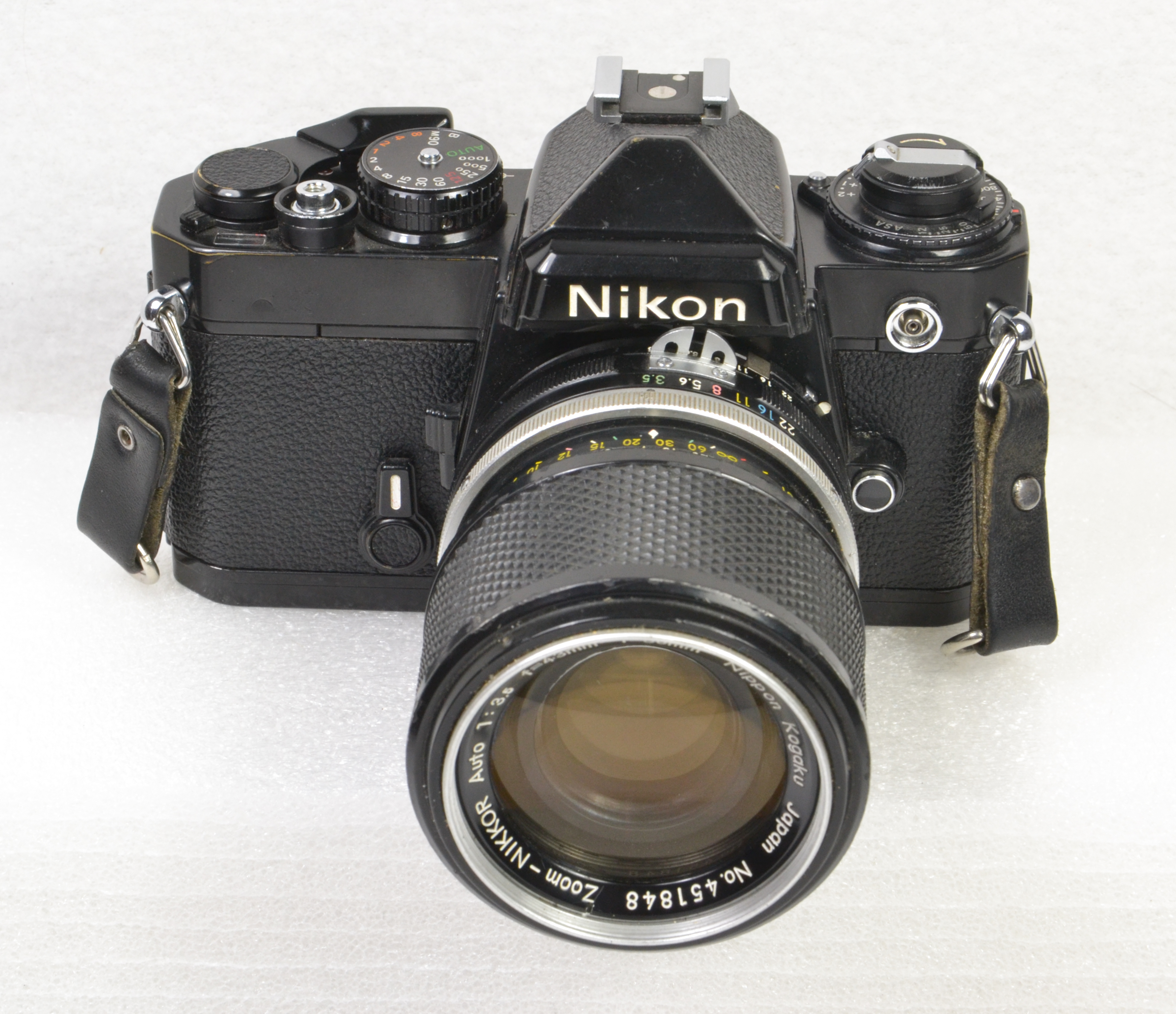
Now, as a long-time Nikon user, I know my Nikon SLRs, and the strengths of any particular body compared to others.  The last non-AF Nikon bodies were the FM3A, the FM10 and FE10.  The FM3A is an outstanding camera body that continued in the Nikon heritage of the FE and FM2N, and can operate without batteries, if necessary.  Good used FM3A examples still go for nearly $800.  However, the FE10 and FM10, made by Cosina for Nikon, are plastic-bodied SLRs that are not too different from the Vivitar V3000, made by Cosina.  But, having used them, they are certainly good enough for everyday use.  They sell for a fraction of the FM3A, and less than a good used FE model.  Some photographers have derided them as being “too plasticky.”  Well, the same could be said for the auto-focus Nikon N55, 60, 65, and 75, and those were made by Nikon.  Today, if Nikon offered a new FE-10 type of SLR, I guarantee that it would sell.  Sure it’s not going to be as robust as a FM2, but it will be good enough for most.  Again, spend money on lenses!

The Miranda Sensorex is a classic, but never popular

My point here is that a camera is often only as good as the lenses available for it. Topcon and Miranda bodies are well-made, but there are very few options for lenses.  The Pentax and other  M42  and K mount bodies have a plethora of available lenses, made by many manufacturers.  Canon’s FD-mount SLRs likewise had a lot of third-party options, and so did Minolta, Olympus, and to a lesser extent, Konica’s AR-mount.  Oh yes, and so does Nikon.  What that means for the new users today is that you should not discount the other brands, which you can often purchase at lower prices than the “name brands.” Going back to the beginning, the Ricoh KR-10 Super has a lot more features than the Pentax K1000.  I know the K1000 gets all the attention because it’s a “beginner’s SLR.” It certainly is, but it lacks even a self-timer! Yet they sell for well over $200 used.  For that price you could easily buy a Spotmatic with a 50mm lens, and have money left over for more film.  I don’t see how a Spotmatic F is not a good “beginner” camera, as it is pretty much identical to the K1000, but it has a M42 screw mount lens rather than the bayonet K-mount.  It also includes a self-timer, stop-down depth of field viewing, and can accept many lenses for the M42 mount. A bargain, and is certainly more than “good enough.”  

The KR-5 is a bargain

The Ricoh KR-10 and the Sears KSX (made by Ricoh) are two very good K-mount SLRs made in the 1980s.  While they don’t have PENTAX on the front of the prism, they are better cameras than the 40-year old Pentax ME, which suffers from electronic problems. Some sleuthing online will provide you with some bargains, once you know what to look for. Again, by saving money, you can purchase additional lenses, since most of these cameras come with a 50mm f/2 normal lens.  Buy a 28mm wide-angle, or maybe a 28-70mm zoom lens and see what a difference it makes in how and what you photograph.  There are plenty of K-mount options out there.  My first K-mount SLR was a Pentax MG, which I purchased at Service Merchandise in 1983. It came with a 50mm f/2 SMC Pentax  and a 135mm f/2.8 SMC Pentax lens and a 2x teleconverter.  I don’t recall what I paid for it, but I used that camera until 2000.  I remember buying a used Pentax SMC 28-80 zoom for it that had close-up capabilities, and was amazed at what a difference it made in my photography.

If you are just getting into using a 35mm SLR, and want that “analog feel,” you probably don’t already have an established preference.  There are a lot of good used SLRs out there that won’t cost you much. Popularity drives up the price, but if you stick with the same lens-mount ecosystem, you can find cheaper alternatives that are “good enough.”   Here is a list of mounts  and cheaper alternatives:


The Spotmatic F was the last M42 mount from Pentax


M42 mount cameras 

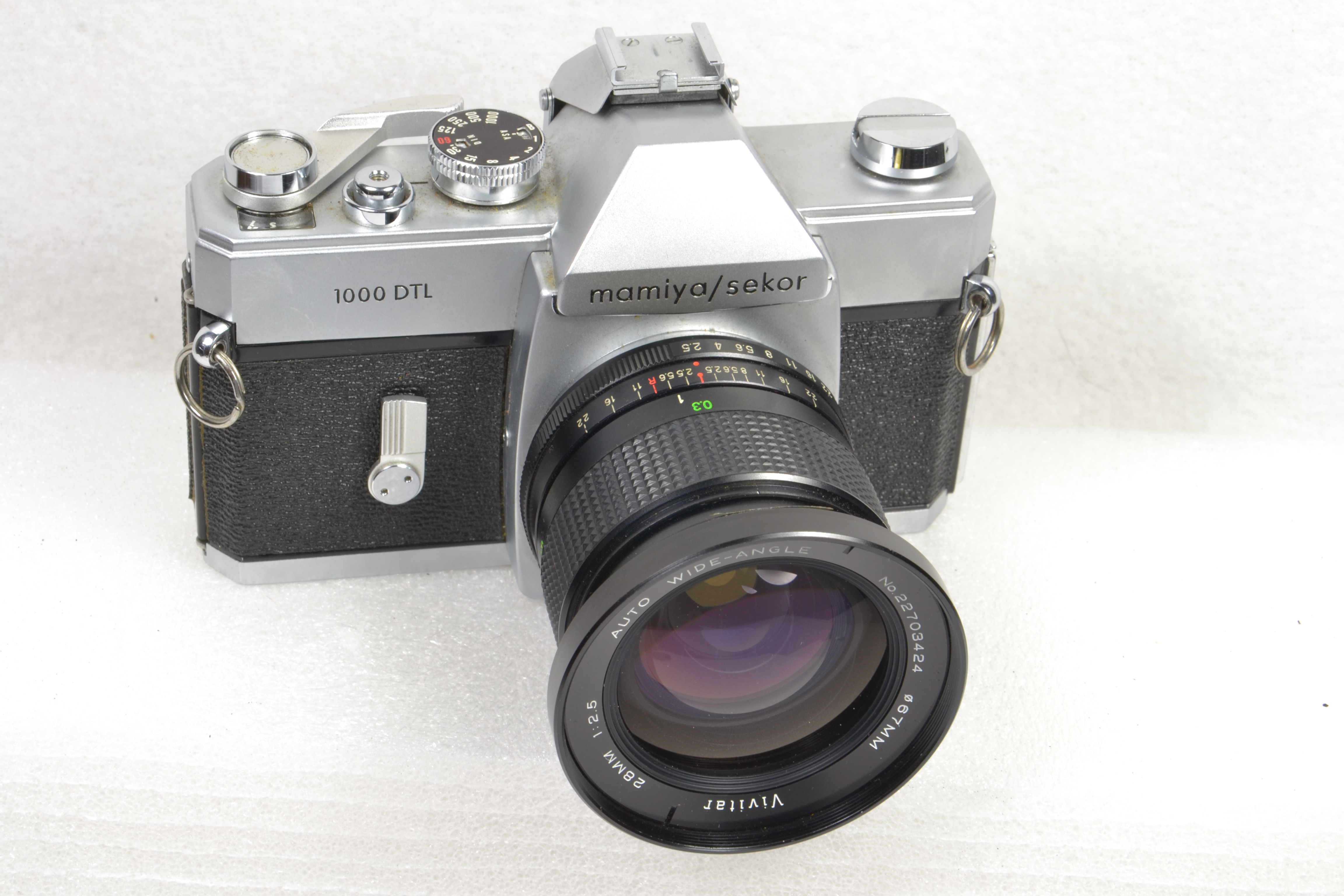
The M42 screw mount was introduced in the 1950s by Praktica, and the Pentax Spotmatic is the king of M42 mount SLRs. Some of these are now rising in price, but generally, you should be able to pay less than $60 for a Spotmatic SP.  The Spotmatic SP II  is a lot like a K1000, and costs less. However, if not having a TTL meter is okay, I highly recommend the Pentax S3 or H3 bodies. Don’t ignore the Mamiya 500DTL or 1000DTL models. Fujica’s ST701 and ST 801 models are usually good purchases, too. Also, look for good examples of the Ricoh Singlex, Vivitar 250/SL, or Chinon CS-4.  The Yashica TL Electro X SLR is an excellent camera body, too.  For European-manufactured cameras, the Zenit 12XP and Praktica Super TL are good choices.

The Mamiya 1000DTL 

The Chinon CS - basic, but rugged.

The Praktica MTL3 is a solid, no-frills SLR.


K-Mount cameras

Pentax’s K-mount was also adopted by Chinon, Cosina, and Ricoh. This year marks the 50th anniversary of the K-mount!  Instead of paying over $200 for a K1000, you should look for a Ricoh KR-10 Super or Sears KSX.  Even cheaper would be a Vivitar V3800.  The Chinon CM-4 is also a bargain.  Later Pentax models with lots of plastic, such as the ZX-M are also going to be relatively inexpensive. Of course, if you have M42 lenses, the K-mount adapter allows you to use them in stop-down mode on the K-mount bodies.

While the K1000 gets a lot of love, it's not the best choice.


The Sears KS 500 is a Ricoh. Not a bad starter SLR.


The Ricoh XR-P has all the features!

Nikon F-mount

If you want the heavy metal experience without a hefty price, I recommend the Nikkormats.  The best choice would be the Nikkormat FT-3, but the FT2 and EL are also good choices, if you don’t mind doing the “Nikon twist” with Non-AI lenses.  Otherwise, the Nikon FG, FA, and FE sell at fairly low prices.  Stay away from the Nikon EM. They are prone to failure, and have very little to offer in the way of control. For autofocus bodies, the N8008, N90, N2002, N80, and N75 are inexpensive choices.  You don’t need a F100 or an F5 to take great photos!  If you are already using a Nikon DSLR, it's easy to use a Nikon AF film body.


The Nikon FE remains a popular entry in the Nikon world

 The FM10 works well.

The Nikon FG is remarkably small and full-featured


The FM2N is a lifetime camera. It ought to last.


The Nikkormat FTN is a heavy metal classic.


Canon 

I’ve shot a lot of Canon manual SLRs in my past, and the FTb QL was a favorite, because it was so reliable. They’ll be cheaper than the much-championed AE-1.  The Cosina-made Canon T60 is also a good choice.   It’s of modern design, has nice ergonomics, and is also quite similar to the Nikon FE-10 in operation. For EOS bodies, the Elan II, and many of the Rebel models will do the trick. If you already have a Canon EOS digital body, using the Rebel-series film bodies will be an easy switch. 


The Canon TL QL is a basic, but quite usable SLR


The Canon T60 is a joy to use.


Minolta (SR/MC/MD mount)

The classic mechanical Minolta SRT series offer good value, and the lenses are still relatively inexpensive.  A working SRT 101, 202, etc.,  are great cameras, and are quite plentiful. Going a bit later, the Minolta X-7A (also known as the X-370) is a good choice for an inexpensive aperture-priority SLR.  While the Minolta X-700 was a wonderful multi-mode SLR, it is prone to bad capacitors over time, so you never know when one might suffer from that malady.  However, the X7A was produced in the late 1980s, and as electronic Minolta SLRs go, it’s capable of great images with the range of Minolta glass that is available.  


The Minolta X-700 is a great SLR, so long as the capacitors last.


The SRT series are robust, with a great lens selection.

Ultimately, your choice of what is good enough may change the longer that you engage in photography.  One photographer’s choice of what is good enough might be a Holga, and another’s might be a Leica M6.  However you evaluate your needs,  you don’t need the top camera model to become a proficient photographer. But if you are just beginning film photography, there are a lot of choices of SLRs, and with some research and diligence, you ought to be able to get a reliable camera for less than $60. It might not be a Canon AE-1, a Pentax K1000, or a Nikon F3, but it will be more than good enough for learning photography. With a couple of lenses and a lot of film, you’ll be starting a great adventure.  


Saturday, October 01, 2022

Moving from 50mm to 35mm as the “normal” lens


Nikon FE 10 with Series E 35mm f/2.5 lens

For the good part of almost 50 years, I have considered a 50mm lens to be my “normal lens” for a lot of my photography, no matter what 35mm system I used.  For good reason, the 50mm lens was typically the “kit lens” and what was affordable at the time.  My first SLR was an Exakta Exa 2a with a 50mm f/2.8 Meyer-Optik Domiplan.  Cheap at the time (1974), and that's the ONLY lens I had for that camera for nearly a decade.  My second SLR was a Pentax ME in 1983, and I bought it with a Takumar 50mm f/2, and a 135mm f/2.8 lens at Service Merchandise in Ann Arbor, MI.  Again, that 50mm lens was my main lens until the year 2000, when I decided that I was going to get serious about photography. Since then,  the many SLR cameras and systems that I have owned have always had the 50mm prime lens as  my every-day lens.  You name it – Pentax K-mount and M-42 bodies, Minolta SLRs, Olympus, Miranda, Zenit, Nikon, Canon, Yashica, Fujica, Topcon – all had a 50mm lens as the primary lens.  Now, within that 50mm range, are lots of variations, and some amazing glass.  While I most often liked using a 50mm f/1.4 because of low-light shooting as well as shallow depth of field, some of the lenses such as the Minolta 58mm f/1.4 really is a fantastic lens.  However, I am a Nikon guy for the most part (aside from my Pentax Spotmatic love), and my typical lens has been anything from a 50mm f/2 (one of the sharpest lenses on the planet), to the pretty good 50mm f/1.8, to the every-day use 50mm f/1.4, and the 55mm f/1.2 Nikkor – which is a bit of a beast.   Now I have a LOT of different lenses, and use them according to the situation.  However, I'll bet that 70% of my images have been taken with a 50mm lens.  

35mm f/3.5 Super Takumar, Kentmere 400 film

A 50mm lens typically has a field of view of 39°, whereas a 35mm lens has a field of view of 62° - certainly wider, but not as wide as 28mm, which has a field of view of 74°.  A 16mm fisheye lens has a 180° field of view, in case you are interested.  So, with that significantly wider view, the 35mm lens shines in being able to capture more in a scene, if that appeals to you.  For one thing, you don't have to back off as much to get things in the frame, making it a great choice for street photography.  I find that it's also great for natural scenes as well, and for landscapes, it gives a more normal view.

35mm f/2 Super Takumar. Ultrafine Extreme 100 film


35mm f/2 Super Takumar, Ilford HP-5

Previously, the only camera that almost always was paired with a 35mm lens is my Leica M2 and the fantastic 35mm f/1.4 Summilux.  A great travel combo, and that should have told me something, right?  So, I am starting to change.  This summer, I used a 35mm f/3.5 on my Pentax Spotmatic, and really came to appreciate the slightly wider view on my Takumar Trek (see previous posts).  I started using my 35mm f/2 Nikkor on my Nikon bodies, and it's a fantastic lens.  Again, I used it on a recent trip to Lexington for a lot of my photography, and that slightly wider view became my “normal” view. For street photography and landscapes, as well as architecture, 35mm is a great choice.  It's hard to believe that it's taken me this many years to fully grasp how great a 35mm lens is for what I like to shoot.   

Leica M2, 35mm f/1.4 Summilux, Fomapan 100.

For a lot of things, the 50mm range is still very useful, and I'd never give them up.  But for travel, street photography, and the types of subjects that I enjoy, I'll be using 35mm lenses a lot more.    I am a prime lens enthusiast, but if you have a 35-70mm zoom, that'll work too.  In the Nikon world, there are several different 35mm lenses – if one looks at old and new, and in many cases, the lenses have not changed appreciably from non-AI (non Auto Indexing – see my post on Nikkormats for a full explanation) to the AIS versions, except for coatings.  In the auto-focus world, there are fewer choices, and I assume that there have been some changes made.  

35mm f/2 Nikkor, Ilford HP-5


NIKON 35s:

Nikon F with the 35mm f/2.8 and the 35mm f/2 non-AI lenses


    • 35 mm f/2.8 Nikkor  - introduced in 1959, this lens was a non-AI lens.  I have one that I keep on my plain prism Nikon F.  By later standards, it's not the greatest 35, but it's okay.

    • 35mm f/3.5 PC Nikkor – This is a perspective control lens, as the front elements are able to shift along one plane to keep the camera parallel to the subject, so it's a special lens for architecture, and could also be used on a bellows for product photography.

    • 35mm f/2 Nikkor – This faster 35mm lens is optically superior to the f/2.8, and was hugely popular with photojournalists. It's that wider view that aids when closer to the subject, and the more modern AIS version is what I am using.  

    • 35mm f/1.4 – Introduced as a non-AI lens, this was also popular with professionals, and is sharp corner to corner.  A highly regarded lens that remains popular in whatever version. Alas, I have never used one.

All these non-AI versions above were upgraded to AI mounts in 1977. Then again, in 1982, to AIS.  

Nikon FM3A with the 35mm f/2 AI lens

    • 35mm f/2.5 Series E – actually, a nice lightweight and compact lens that works well with the compact bodies such as the FG, EM, and FE10.   

    • 35-70mm f/3.3-4.5 – if you want a short zoom – this is a good choice.  Very sharp at all focal lengths.

    • 36-72mm f/3.5 Series E lens – a short, lightweight constant aperture zoom.  I consider it to be underrated. 

 Nikon AF lenses

    • 35-70mm f/3.3-4.5 AF  and AF-D– A good choice for a carry-all short zoom. 

    • 35mm f/2 AF and AF-D - Excellent, like the manual version, but also focuses closer.  

    • 35-70mm f/2.8 AF and AF-D – a big lens with a 62mm front filter ring, this push-pull zoom is very sharp, and at the 35mm end, it is cable of 1:4 closeups.  Add a diopter on the front for even more magnification.  This is a great lens, though I consider it to be very beefy as short zooms go.

    • 35-80mm f/4.5-5.6 AF-D – A kit lens that Nikon sold with The N50 ad N70 cameras, it's not fast nor great, but like any kit lens, it will do well enough for the users it was intended for.

PENTAX

My favorite SP body with the diminutive 35mm f/3.5


Spotmatic (M-42)

    • 35mm f/3.5 Super-Takumar – compact, and while not fast, it's great!

    • 35mm f/2 Super Takumar  – with a 67mm filter ring, this is not a tiny lens, but it is fast.  I highly recommend it if you can find one.

The two 35s from Asahi Pentax in M-42 mount


M-42 non-Pentax

Due to the longevity and sheer numbers of cameras that used the M-42 mount, you'll find a variety of 35mm f/2.8 lenses available.  They may have the names Albinar, Chinon, Vivitar, Makinon, Soligor, as well as Carl Zeiss Jena Flektogon, Meyer Optik Primagon, etc.  There is a fast 35mm f/1.9 old Vivitar lens that is supposedly very good.  If the thrill is in the hunt, you'll have fun looking for 35mm screw-mount lenses.

Soligor 35mm f/3.5 M-42 mount lens

K-mount

Pentax released a number of lenses in K-M, K-A (to be able to operate in P mode), as well as AF and Digital versions.  I am only listing the manual lenses.

    • 35mm f/2

    • 35mm f/2.8

    • M-35mm f/1.4 (58mm filter ring)

    • M-35mm f/2.8, M-35mm f/2 – both have 49mm filter rings

    • M-zoom 35-70 f/2.8-3.5

    • A-zoom 35-70mm f/4

    • A-zoom 35-70mm f/3.5-4.5

non-Pentax K-mount

    • Tokina SL 35mm f/2.8

    • Chinon  35-70mm f/3.5-4.5 MC Macro zoom

    • Rikenon P Zoom 35-70mm f/3.5-4.5 Macro (maybe the same lens as the Chinon?)

MINOLTA

    • 35mm f/1.8 MD 

    • 35mm f/2.8 MD – I have used one of these, but it's been a while.  Like many MD lenses, it was also made earlier with an MC desgnation.

    • 35mm f/1.4 and 35mm f/2 Maxxum (now Sony Alpha) 

CANON

    • FL-mount (can be used with FD cameras, too)

    • FL 35mm f/2.5 – 58mm filter

    • FL-35mm f/3.5 – 48mm filter

    • FL-35mm f/2.8 “pancake” lens, 48mm filter

FD-mount

    • FD- 35mm f/2 S.S.C.  55mm filter

    • FD- 35mm f/3.5 S.S.C. 55Mm filter

    • FD- 35mm f/28 TILT-SHIFT  S.S.C.  - tilts and shifts – fantastic choice for architecture.  

    • FD -35mm f/2.8 S.S.C. 52mm filter

    • FD- 35-70mm f/3.5 zoom – with its “macro” setting, it can provide some very good close-ups.

EOS-mount 

    • EF- 35mm f/2

    • EF -35mm f/1.4 USM L – expensive!

OLYMPUS

    • OM Zuiko 35mm f/2

    • OM Zuiko 35mm f/2.8

    • OM Zuiko Shift 35mm f/2.8  - a perspective control lens

While I haven't listed every single 35mm lens out there, this list is at least be a starting point.  There are lots of 35-70mm zoom lenses that I have not listed, and that may be a good choice for you, but remember, those zooms won't usually have as large an aperture as a prime lens. 

Last, but not least, Leica R4 with a 35-70mm f/3.5 Vario-Elmar


No matter what 35mm SLR system you use, or rangefinders with the M-39 Leica thread mount  or Leica M mount, there exists a 35mm lens to get you a bit wider view.  


Saturday, February 01, 2020

The Pentax Spotmatic F - still going strong.

My Spotmatic F and a selection of lovely Takumar lenses
I have used/owned many Pentax SLRs over the past 40+ years.  I used a borrowed Pentax Spotmatic F  from 1978 to 1980 to document my work on sand wasps in graduate school. Later, in 1983, I purchased a K-mount Pentax MG at a Service Merchandise in Ann Arbor, MI.  Similar to the Pentax ME, it got me through nearly 20 years of half-assed photography, until I started on my venture to be a real photographer in 2000.  Since then, I have had many Pentax SLRs come and go, and while I am mostly a dedicated Nikon user, I have a soft spot for the Spotmatic.  In terms of quality, features, and ergonomics, the last M42-mount camera from Pentax, the Spotmatic F, is the camera that I have kept for the past few years, and will keep as a user.  I don't shoot with it that often, but lately, I have been using it more in jaunts around town.  I believe it's a far better camera than the K1000, which has received so much adoration, and yet, lacks significant features.  While the K-mount makes it easier and quicker to change lenses, it's not a big deal to work with screw-mount cameras. 

While the Spotmatic F appeared in 1973 and offered full-aperture metering with the matching lenses, it was certainly behind the curve compared to Nikon and Minolta.  Any M-42 lens can be used, but unless it has the additional tab for the open-aperture metering, one has to switch the metering button upward and use stop-down metering on the camera. 

Despite those drawbacks, I find using the Spotmatic F to be very easy and comfortable in the hands.  I recently took a series of photos around Beaver Lake as well as downtown Asheville, and the results were excellent.  I have a nice series of lenses. Besides the 50mm 1.4, I have the 28mm/3.5, 35mm /3.5, and 135mm/2.5, which is a wonderful lens.  All are in excellent condition, and make for a nice kit.  In addition, I have other M-42 lenses, such as the Helios 44 from a Zenit 12XP.

If you are interested in trying any of the old M-42 SLRs, you can't wrong with the Spotmatic F.  While there are a plethora of M-42 SLR bodies out there by Ricoh, Chinon, Praktica, Mamiya, Zenit, etc., none of them have the finish and feel of a Spotmatic. 

Pentax Spotmatic Resouces:


A few recent images...
Fomapan 400:


Ilford Ortho Plus 80:


Thursday, September 19, 2019

Batteries and Cameras!

I thought it might be useful to publish a post with useful information about film cameras and batteries.  After handling many hundreds of cameras over the course of years of  selling estates and getting cameras ready for the FPP School Donation Program, as well as doing my own thing with my own photography, I find that it's been an overlooked topic, so I hope that you find this a helpful resource.
A typical manual SLR needs just  1.5 - 3V to run the exposure system

One of the things about using film vs digital cameras, is that in general, film cameras need far less power than their digital counterparts. Don't forget that that digital wonder is basically a small computer with a viewing screen, operating an auto-focus system.  All that takes a considerable amount of stored energy in a battery such that digital cameras usually operate with rechargeable Lithium-ion (Li-on) or Nickel-Metal Hydride (NiMH) batteries.  Since film cameras usually need far less power, they typically use small button or penlight cells. In fact, film cameras that lack meters or any electrical operation do not need any battery power at all. A Nikon F only needs a couple of button cells to operate the Photomic head with a meter.  It can easily be used without any battery power whatsoever. An Argus C3 doesn't need a battery, nor does a Leica M3.  Most SLR cameras that were sold before the late 1970s only need a battery to power the light meter, and lacking that, work just fine without power, although you may need an external light meter or maybe you just want to use Sunny-16 or the Black Cat Exposure Chart.  Once the 1980s kicked in, cameras became more sophisticated, and required more power, especially if the camera is an auto-focus model.  All those little motors in the lenses, film winding/rewinding, exposure systems, and flashes require more power, which led to larger batteries or battery packs in the camera bodies.  In many SLR systems, an external winder may use 4-8 AA cells, which of course adds significant weight.  As manufacturers refined the winding systems, by the time auto-focus SLRs became available, the power to run them was contained in a 6V battery, or 2 3V batteries that fit easily into the grip.

Adding automation requires more computing/battery power.

Light meters have typically required one or two button cells in a camera. Before the 1980s, cameras that required power for the light meter almost always used Mercury cells.  The reason is that Mercury cells gave out a continuous 1.35 V and lasted a long time, and when they went dead, that was it. There was no slow decline in voltage that would give bad meter readings. Then, Mercury compounds were found to leach into the waste systems in landfills, etc., and the Mercury cells were banned.  Probably far more cells were used in those light-up sneakers that kids wore than all the cameras ever made. Anyhow, that was the end of them, and older cameras that used those cells were often replaced with newer models by the owners, or the owners scoured the stores for old stock Mercury cells. Old stock cells were still available online until at least 2002.

Cell versus Battery
People often call 1.5 v cells batteries, but technically, they are not. A battery is a group of cells producing a larger output of power than a single cell.  Button cells, AA, AAA, C, D cells are not batteries.  A 9V transistor battery IS a battery, as are any of the batteries that are more than 1.35 or 1.5V. Your 12 volt car battery contains a bunch of lead-acid powered cells that when joined together, provides 12 volts. Generally, we just lump these power sources under the term battery in common usage, but it's good to know the difference.


Button Cells
Button cells are extremely common in film cameras, especially SLRs, where they typically power the meter and some electronics.  They are ubiquitous, and their compact size and 1.5V output usually has them installed in cameras in pairs, so that they provide a 3V output.  The most common size is the Alkaline LR-44 cell, followed by the 76S - which is identical in size to the LR-44, but is a Silver-Oxide cell that provides 1.55V with a longer life than the LR-44. A less common button cell in later cameras is the PX-625A. It's now mostly used to replace the PX-625 Mercury cells, but it has a higher voltage than the cell it replaces which may cause meters to be a stop or so off in the readout.

AAA and AA cells
Yes, these are what us old-timers call penlight batteries.  They are most typically used to power flashes, and in many older point-and shoots, they provide all the power for the camera functions.  Some auto-focus SLRs used them too. The Nikon F100, N90, N8008, and the N2000 all use AA cells as they provide enough power for many rolls of film before they poop out.  In addition, the AA and AAA cells are easy to find, unlike some of the esoteric batteries that I will now discuss.

Lithium batteries.
These batteries use more modern technology to deliver lots of power yet, remain compact enough to use in a camera. The late 1980s saw these start to be used in a variety of caameras, but most notably in consumer-level auto-focus SLR cameras. There are a bewildering number of battery types out there, and sometimes you'll find an oddball battery that may cost as much as your $15 Nikon that you found at the thrift shop.

Nickel Metal Hydride - NiMH Batteries
Typically, these are rechargeable cells, such as AA and AAA.  They can be used in place of the Alkaline cells of the same size, and the prices are very low.  They make a lot of sense for power-hungry flash units, and can usually be recharged a at least a hundred times before they need to be replaced.

Oddball Alkaline batteries 
The first one that comes to mind is the 6V 4LR44 battery which is used in the Canon AE-1 and AE-1 Program, as well as the Pentax 6x7.  Another is the 6V PX27G.  In some cases you can take 4 LR-44 cells and tape them together to replace a 4LR44 battery (which seems to be the reason for that designation).  If you have a Yashica rangefinder camera, you'll also be looking for oddball cells, so look at http://yashica-guy.com/document/chrono2.html for more information on your Yashica rangefinder camera.

Nickel-Cadmium cells
NiCds were popular in the 1970-80s for rechargeable battery packs, especially in professional cameras such as the Hasselblad EL, the Rolleiflex SLX, and in various flash units.  They fell out of favor when Lithium-ion and Ni-MH cells became more common and cheaper in the 1990s.  NiCds also have fewer recharge cycles than the newer technologies.  However, in some of the cameras that required them, you can still source re-built NiCd packs.  Cadmium is a toxic metal, and the old cells need to be disposed of safely.  Some cameras that took AA alkaline cells warn against using NiCd cells because they typically only provide 1.2V each.

What about those cameras (and light meters) that used Mercury Cells?
There are a few solutions:
1. Replace the cell(s) with an Alkaline equivalent.  The PX-625A is going to be the most common replacement.  Of course, it will provide 1.5, not 1.3 volts, and may affect your meter reading.  Some cameras use a circuit that the higher voltage still gives an accurate reading. You can compensate with the cameras that are affected by setting your ISO dial to a one stop lower setting.  That is, if you are using ISO 400 film, set the dial to ISO 200.  To be honest, with C-41 films and most black and white films, there is enough latitude that it won't make a huge difference.  You can check it against sunny-16 using a gray card and see what your meter reads. If it's off, you'll know what direction to change it.
2. Replace with a Wein cell - these are basically a modified Zinc-air hearing aid cell with an adaptor to fit the PX-625 chamber.
3. Replace with an appropriate-sized Zinc-air hearing aid cell, and use a spacer to keep the cell in place in the battery chamber. The Duracell 675 hearing aid battery will work in many of the cameras and light meters that require a mercury cell. You may have to shim it in place to not move around.
4. Purchase an MR-9 adapter (http://www.criscam.com/) and use a 76S or LR-44 cell.  The MR-9 adapter contains a diode that drops the voltage to 1.3V, and while it may seem a bit pricey, it can be moved from camera to camera as needed.  It's the best solution if you want to use a Luna Pro light meter.
5. You can use the camera without powering the light meter, and use an external meter instead.  However, some cameras, such as the Nikon FE, require power to fire the shutter at any speed because the aperture-priority mode requires power, whereas the Nikon FM is fully manual, and the shutter can work without power. The Pentax K1000 and the Pentax Spotmatics are also fine without using a battery for the meter, as are most M42-mount SLRs.  Many of the older Canon  SLRs such as the FTb work fine battery-less.  You just have to use an external meter.


NOT ALL CAMERAS NEEDED BATTERIES FOR METER POWER
There are numerous cameras that used solar cells to power the exposure system.  The Olympus Trip 35, Konica EYE, and the Canon DEMI are good examples.  Most of the examples date from the 1960s and 70s.  A ring of cells around the front of the lens is a sure bet that the camera is powered by a Selenium meter.

STORAGE
It makes good sense to store your camera without the cells or battery in it if you are not going to use it for awhile.  This holds especially true for cameras that use AA aand AAA cells - which will leak over time and ruin the camera.  I can't stress this enough. I have seen far too many contacts ruined to the point of no-return by leaking AA cells.  Whether it's a camera or a flash unit, remove the cells before you put it away for any length of time.  Button cells seem much less likely to cause problems in storage, nor do Lithium batteries.  The real culprits are the AA and AAA cells which can do the damage when they leak over time.

You can store fresh batteries in in the fridge if you wish to prolong their storage life, but I have never tried it to see if it makes a difference.  Certainly high-heat will degrade them, since chemical reactions are accelerated by higher temperatures.


BUYING BATTERIES
With the advent of digital photography, the market for camera batteries shifted to rechargeables, and the prices for non-rechargeable camera batteries have gone up.  If you look for a CR123A battery at your local store, be prepared for sticker shock.  I buy most of my button cells and Lithium batteries online, either via Amazon or eBay.  A pack of 100 LR-44 cells can be had for less than $15 online.  There are plenty of online sources for batteries, but I still buy my AA and AAA cells  locally.

BATTERY CROSS-REFERENCE CHART - Not all manufacturers use the same numeric designation for a particular size, but this chart will be helpful.


CAMERAS AND POWER SOURCES (obviously NOT a complete list, but it's a starting point)

PX-625 Mercury cells:
NIKON - F Photomic prism, Nikkormat FT, FTN;
CANON- QL-17, EXEE, F-1, FT QL, FTb, FX, Canonet 28, TL, TLb, TX
OLYMPUS - OM-1
LEICA - CL
MINOLTA - SR-T series, Hi-Matic 7, 7S, 7SII, 9;
PETRI - Color 35,
KONICA - Auto S, Auto S2, Auto S3, Autoreflex T, Autoreflex TC, C35, FP,
KOWA SE, SET; ROLLEI 35,  YASHICA TL-Electro-X,

PX-400 Mercury cells 
A great number of Pentax Spotmatics used this size Mercury cell.  However, you can use a silver-oxide cell without fear of affecting the exposure accuracy.  The Spotmatics use a bridge circuit so that whether the source is 1.35V or 1.5V, you'll get the same result.  I recommend using a 392 (LR-41) silver-oxide cell for the Spotmatic SP series, and a PX625A for the Spotmatic F.

PX-27 Mercury batteries (5.6V)
MINOX LX, Minox 35 series;
ROLLEI 35 TE, ROLLEI 35 SE, ROLLEI 35 LED

LR-44 or S-76 cells (1.5V) 
(Typically there are 2 in series, for 3V total. You can often use a 1/3N battery, which replaces 2 LR-44 cells. They tend to be more expensive than the 2 LR-44s , though.)

NIKON - Nikkormat FT2, FT3; Nikon FM, FE, F2, F3, FM2, FM2N, FE2, FA, EM, FG, FG-20, FM3A, FM-10
CANON - T60
OLYMPUS - XA series, OM-2, OM-10, OM-4, OM-PC
PENTAX - K1000, ME, MG, LX, Super Program, P30T,
MINOLTA - X370, X570, X700; CLE, XD series, XG series,
LEICA- R4
YASHICA - CONTAX - Contax 139, Yashica FX D, FX-3, FX-7,
KONICA - FP-1

AA
CANON- AF35ML, Sure Shot AF10, T-50, T-70, T-90
NIKON - N4004, N8008, N90, F100, F4, F5, L135AF,
KONICA- FS-1, MG, TC-X
MINOLTA 9000

AAA 
CANON AL-1,
KONICA FT-1
MINOLTA MAXXUM 5000, 7000
NIKON N2020

4LR44 (6V)(= PX28, A544, 476A)
CANON AE-1, AE-1P, A-1, New F-1, AT-1, AV-1
NIKON Nikkormat EL, EL2
YASHICA Electro 35CC, Yashica FR, Yashica FX-1,

CR-2 Batteries (3V) (Most SLRs use 2)
NIKON- APS Pronea 6i, N55, N65, N75
PENTAX - MZ-S, Z-5, MZ-10, ZX-10,
CANON-  Rebel 2000,  Rebel K2, EOS IX, Sure Shot 130u, Sure Shot Classic 120
MINOLTA - QTSi, XTSi, Maxxum 5, HTSi 
CONTAX G1, G2, T3,


CR-123A (3V) (Most SLRs use 2)
NIKON - N60, N80, N70, One-Touch 90 Zoom,
CANON - EOS Rebel G, ELAN 7, EOS 30v, Sure-Shot 105 zoom, Sure Shot 60 zoom, Sure Shot 70 zoom, Sure Shot 80 zoom, Sure Shot A-1, WP-1, Sure Shot M, Sure Shot Max
MINOLTA - Maxxum 7, Maxxum 9
YASHICA T4
CONTAX T2,


CR-223 or DL223A (6V)
may replace 2 CR-123 in some cameras

2CR-5 (6V)
CANON- EOS 650, EOS 620, 750, 850, 100, EOS 3, A2E, Sure Shot Zoom XL, EOS-1V
NIKON - N50, N6006
MINOLTA - 7000i, 9xi
PENTAX- SFX, SF-1; SF-7, SF-10;
KONICA Hexar, Yashica T2


Okay, you have read this far!  If you have a fully manual, non-meter camera such as this one, no battery needed!   You are ready for that desert island trip.
Friday, August 05, 2016

Buying an AF 35mm Film SLR.

What is the best SLR system camera? This is a question that we used to see a lot, back  before digital began its takeover.  If you are just getting into film, my first response would be - "What DSLR are you using?"  If you are using a Canon EOS DSLR, then you should look at the pre-digital EOS models.  If you are using a Nikon, then by all means, look at Nikon AF models.  If you are using Pentax,  Pentax AF models, and Sony Alpha DSLR -- Minolta AF cameras (Maxxum series).   Essentially, those are the only DSLR systems with compatible lenses for the film bodies. There is one caveat, though.  If you are using a lens designed specifically for the APS-C form factor, such as a Canon EF-S lens, or a Nikon DX lens, you will get a vignetted image when used with a full-frame SLR.    Why would you want to use a later AF-system when there are so many robust metal-bodied cameras out there?  Here are a few reasons to look at more recent cameras.

Control Layout  
For one, let's say you are using a Nikon D7000 DSLR and are thinking about buying a film body.  If you look at the controls and ergonomics of most of the better Nikon DSLRs, they are pretty similar to the Nikon F100.  LCD displays, control dials and buttons are similar.   They can use the same AF-D and FX lenses (non-DX, of course).  In fact, the F100 is perhaps the best advanced film SLR from Nikon in terms of cost and features.   Today, you can pick one up for a fraction of what they used to go for.   If your cameras have similar control layouts, you learn how to use them more quickly.

Lenses
Again, if you can share the lenses between your DSLR and your film SLR, you are also saving money and avoiding duplication.  You can bring a film body along loaded with B&W, and use the DSLR for color.  Swap out lenses as needed.

Newer Technology
While much can be said in favor of the older cameras, newer cameras offer more features, better metering, and often, ease of use.  Being able to bracket your exposures automatically is a great feature that won't be found in older manual cameras.  Having spot metering as well as other modes is very useful. If you are used to auto-focus, the AF film bodies will be appreciated.

Fewer Miles
As much as I like older cameras, and still continue to use them, you have to remember that a model that appeared in 1970 is now almost 50 years old.  It may have been through many owners, or used a lot, or used a few times and then sat on a shelf for the last 30 years.  Meanwhile, a late-model AF SLR may only be 15 years old or less.

Price
Here's the great advantage. Yes, the later 35mm film camera SLRs often have a lot of plastic.  But they may have titanium frames, be weather-sealed, etc.  You will also find them to be incredibly cheap on the used market, whether it's ebay, a resale shop, or a garage sale.  They are not old enough to be called classics, and they are plentiful.

Built-In Flash
While we take a built-in flash for granted on modern cameras, it was only the AF bodies that started featuring them.  They may not be the best flash option for all instances, but they are handy to have for fill flash.  Not all AF bodies have a built-in flash, though. Nikon's pro-level cameras do not have them.

Camera Recommendations
Canon - The EOS mount is very popular, and Canon was the first to really exploit the low-end AF SLR market with their Canon Rebel series.  They are low-cost bodies, and most of them should still work well.  They are also cheap, with  bodies often selling for $10 US.   The 35-80mm EF lens was a mainstay with them.  You can use therm in manual as well as the other auto-modes.  However, there are many different EOS 35mm film bodies that are more "professional" that have a better build and more features.  The Canon EOS Elan II is a wonderful body.

Minolta - Sony bought Konica/Minolta and kept the Alpha mount from the Minolta Maxxum series of cameras.  There are many, many orphaned Maxxum bodies out there that sell for the price of a Starbucks Mocha.  Minolta was the undisputed king of features on AF bodies.  The low-end models such as the QTsi, are quite plasticky.  Higher-end models such as the Maxxum 9 or 7 are very full-featured.  I have only personally used the Maxxum 7000, which was the very first real AF SLR.   That model of course, is quite old and slow.  The Minolta Maxxum 9xi has a top shutter speed of 1/12,000 sec.  This may be helpful in deciding on a purchase.

Nikon - This is a group that I know well.  Nikon's early AF SLRs are fully compatible with manual Nikkors, and the N2020 and N8008 are typical examples.  The 8008 has an excellent viewfinder.  Later, Nikon's amateur-level AF SLRS deleted some features, such as the ability to meter with manual lenses. That is the case with the N55, N60, N65, N75, and N80  models.  If you are only using AF lenses, this isn't a problem.  Of course, there is the behemoth F4 and the expensive F5, and F6 models.  I would stay away from the N70, as Nikon departed from sanity on that design. The N90 is an amazingly timeless camera that works very well with most lenses.  However, the F100 remains my favorite. It uses manual and all AF lenses, including  G-lenses (lack an aperture ring like the Canon EF lenses).  You can often pick up an N65 body for about $10-$15.

Pentax - The K-mount system just amazes me as it just keeps chugging along.  While the lens selection may not compare as favorably as Nikon and Canon, you can use the manual lenses on many bodies just fine.  As far as AF camera bodies go, I have reviewed a few, and yes, the cameras are plasticky, but they seem to work well, and are bargains.  Some of the low-end models MZ-30, 50, 60 will only fire with AF lenses attached.  I recommend the ZX-5 if you want to have a low-cost camera that will use manual and AF lenses.  Perhaps the best of the bunch might be the MZ-S, with its Magnesium-alloy body.

So, there you go with some options.  Get a body, some film, and fire way!