Showing posts with label 35mm SLR. Show all posts

Friday, May 01, 2026

A Pentax P3 SLR


Over the past year, I’ve rekindled my love for Pentax K-mount cameras and other brands that use the K-mount, introduced by Pentax in 1975.  I’ve been working on a book about the M42-mount Spotmatics and other brands, so I suppose it’s a natural evolution to delve into the K-mount universe.  My first K-mount camera was a Pentax MG, back in 1982 or ’83.  I used that camera until 2000.  In the past year, I’ve acquired a Pentax KX and some other K-mount non-Pentax film bodies.  Earlier this year, I found a pretty nice example of the Pentax K2.  The K2, KX, and KM were the first wave of K-mount bodies in 1975.  They are all quite different from one another, as it seems Pentax was testing to see what consumers were willing to buy.  The K1000 and subsequent "M" models started appearing on the market in 1976.  Forward to 1985, when camera automation had become widespread, and camera-body autofocus was just starting among SLRs with the Minolta Maxxum 7000.  That’s the year that Pentax introduced the P3 in the US-market (P30 elsewhere in the world).  

The P3 SLR certainly was not breaking new ground, but it was a return to a more traditional manual-style body, incorporating a manual shutter speed dial and auto setting on the top deck of the camera.  The camera uses manual focus. The body incorporated a lot of ABS plastic, but retained a sleek classic appearance.  I think the P3 is a very nice-looking SLR, but there are a few caveats about the camera’s operation.

  •  It requires DX-coded film cassettes to set the ISO speed. Cassettes without a DX code will be assigned the default ISO of 100. There is no manual ISO control.
  • There is no provision for a remote or cable release for the shutter (later models may have a cable release socket near the lens mount).
  • Flash-sync is 1/100 sec.
  • No exposure compensation dial.
A very clean design as shown here.


Despite the above, this is a camera that can be easily used almost as a point and shoot in Program mode.  The ISO range for the DX coding is 25-1600.  You can use any Pentax K-A lens in Program mode, which sets the aperture and shutter speed.  If you use the camera with a Pentax M or K lens, the camera’s Program mode defaults to Aperture Priority. You can also shoot in Manual mode.

The P3 has a depth-of-field preview lever on the right side of the lens, and a mirror-lockup button on the left. There is a red LED that flashes when you use the self-timer, which is about 12 seconds.  The on-off and self-timer switch are the the top deck on the left side of the camera.  The hot-shoe on the top of the prism housing allows the use of manual and some automated Pentax flash units.  

I really like the look of this camera.


I purchased my example on the big auction site for $28.00 (not including tax and shipping), and it came with a Rikenon 50mm f/2.2 lens.  The camera was sold as “untested” but it looked to be in excellent condition (and it is).  I popped in 2 LR-44 cells and the camera came to life.  You do need batteries to use this camera. It will not work without power.   I attached a SMC Pentax-A 50mm f/2 lens on the body and set out to shoot a roll of Fuji Acros 100. 

I happen to have a physical manual for the P3, but you can find one online at Butkus.org.


Impressions from using the camera

I like the way the camera feels in the hand.  There’s a small grip on the right side that aids in holding the camera.  The metal and plastic film advance sits unobtrusively, but it’s easy to advance the film.  Same for the film rewind - it’s almost flush with the top deck.  It took me some time to get used to the Program mode automatically setting the aperture and shutter speed. I understand that in that mode, the shutter speed goes from 8 seconds to 1/1000 sec.There is also a B setting and 1/100 flash setting. The viewfinder shows about 92% of the field of view.  The split-microprism at the center of the viewfinder is easy to use for focusing.  

As K-mount cameras go, the P3 is a good example of automation without unnecessary features that a lot of people might not use.  For me, the only thing that I really miss is being able to manually set the ISO.  I shoot a lot of hand-rolled film, but it’s not something that the vast number of users would do.  

The P3/30 was quite popular - Pentax sold it from 1985 to 1997, with over 3 million units sold. It was intended for people that wanted an easy-to-use SLR. As a result, there are many for sale online at pretty low prices.  It’s not an ancient camera, so most of them ought to work properly.  

The P3 is one of those cameras that probably don’t get as much love as some earlier K-mount models, such as the very compact ME.  But it does not have the ME’s faults, either.  You can shoot in Program mode or fully manual. The mirror-lockup is a useful feature when you want to make a longer exposure on a tripod and no cable release.   My first reaction to the camera was that it was awfully simple.  However, after shooting with it, I have a much higher regard for it.  Whether you have a P3 or a P30, they’ll work the same, and give you a very solid SLR body that accepts K-mount lenses.  


A few shots from the first roll. All shot near Barnardsville, NC. All on expired Fuji Acros 100.


Wednesday, April 16, 2025

When is “good enough” good enough?


A clean, working Spotmatic SP is a great SLR, even at 60 years old


I got to thinking about this recently, after I received a Ricoh KR-10 Super via eBay.  I paid less than $30 before shipping, so it was definitely a bargain.  I last used a Ricoh K-mount body about a decade ago, and had sort of forgotten how good it was.  Now, if you’ve been following Random Camera Blog for a while, you’ll know that I use Nikon gear for about 75% of my photography.  But that doesn’t mean other SLR systems are not as good as Nikon’s nor does it mean that you need a Nikon or a Canon system to take great photographs.  In the realm of 35mm film SLRs there are a lot of choices out there.  Some of them are peculiar and do not have a big “ecosystem” of accessories and lenses.  For example, Topcon and Miranda featured well-built bodies and enough lenses to satisfy the needs of most photographers. Yet today, they certainly are niche cameras and are rarely seen.  Why is that?  They were certainly “good enough.”  However, in the mid-1970s, as branding became increasingly popular, it was the Pentax Spotmatics, Minolta SRTs, Canon, and Nikons that attracted the most interest.  The cool kids had Spotmatics, the pros had Nikons, and all the rest were there for the remaining market share.  By the mid-1980s, Olympus, Canon, Nikon, Pentax and Minolta were the predominant SLR brands, with a smattering of other runner-ups.  The K-mount of Pentax was where one could find new, less-expensive cameras - not made by Pentax.  So, enter Cosina, Ricoh, and Chinon - three Japanese companies that were also OEM suppliers to some other brands.  Even today, when looking for either M42 mount or K-mount SLRs on the used market, these three companies are less-expensive options to the Pentax SLRs.  That really can’t be said of Nikon, Canon, Olympus or Minolta.  

Now, as a long-time Nikon user, I know my Nikon SLRs, and the strengths of any particular body compared to others.  The last non-AF Nikon bodies were the FM3A, the FM10 and FE10.  The FM3A is an outstanding camera body that continued in the Nikon heritage of the FE and FM2N, and can operate without batteries, if necessary.  Good used FM3A examples still go for nearly $800.  However, the FE10 and FM10, made by Cosina for Nikon, are plastic-bodied SLRs that are not too different from the Vivitar V3000, made by Cosina.  But, having used them, they are certainly good enough for everyday use.  They sell for a fraction of the FM3A, and less than a good used FE model.  Some photographers have derided them as being “too plasticky.”  Well, the same could be said for the auto-focus Nikon N55, 60, 65, and 75, and those were made by Nikon.  Today, if Nikon offered a new FE-10 type of SLR, I guarantee that it would sell.  Sure it’s not going to be as robust as a FM2, but it will be good enough for most.  Again, spend money on lenses!

The Miranda Sensorex is a classic, but never popular

My point here is that a camera is often only as good as the lenses available for it. Topcon and Miranda bodies are well-made, but there are very few options for lenses.  The Pentax and other  M42  and K mount bodies have a plethora of available lenses, made by many manufacturers.  Canon’s FD-mount SLRs likewise had a lot of third-party options, and so did Minolta, Olympus, and to a lesser extent, Konica’s AR-mount.  Oh yes, and so does Nikon.  What that means for the new users today is that you should not discount the other brands, which you can often purchase at lower prices than the “name brands.” Going back to the beginning, the Ricoh KR-10 Super has a lot more features than the Pentax K1000.  I know the K1000 gets all the attention because it’s a “beginner’s SLR.” It certainly is, but it lacks even a self-timer! Yet they sell for well over $200 used.  For that price you could easily buy a Spotmatic with a 50mm lens, and have money left over for more film.  I don’t see how a Spotmatic F is not a good “beginner” camera, as it is pretty much identical to the K1000, but it has a M42 screw mount lens rather than the bayonet K-mount.  It also includes a self-timer, stop-down depth of field viewing, and can accept many lenses for the M42 mount. A bargain, and is certainly more than “good enough.”  

The KR-5 is a bargain

The Ricoh KR-10 and the Sears KSX (made by Ricoh) are two very good K-mount SLRs made in the 1980s.  While they don’t have PENTAX on the front of the prism, they are better cameras than the 40-year old Pentax ME, which suffers from electronic problems. Some sleuthing online will provide you with some bargains, once you know what to look for. Again, by saving money, you can purchase additional lenses, since most of these cameras come with a 50mm f/2 normal lens.  Buy a 28mm wide-angle, or maybe a 28-70mm zoom lens and see what a difference it makes in how and what you photograph.  There are plenty of K-mount options out there.  My first K-mount SLR was a Pentax MG, which I purchased at Service Merchandise in 1983. It came with a 50mm f/2 SMC Pentax  and a 135mm f/2.8 SMC Pentax lens and a 2x teleconverter.  I don’t recall what I paid for it, but I used that camera until 2000.  I remember buying a used Pentax SMC 28-80 zoom for it that had close-up capabilities, and was amazed at what a difference it made in my photography.

If you are just getting into using a 35mm SLR, and want that “analog feel,” you probably don’t already have an established preference.  There are a lot of good used SLRs out there that won’t cost you much. Popularity drives up the price, but if you stick with the same lens-mount ecosystem, you can find cheaper alternatives that are “good enough.”   Here is a list of mounts  and cheaper alternatives:


The Spotmatic F was the last M42 mount from Pentax


M42 mount cameras 

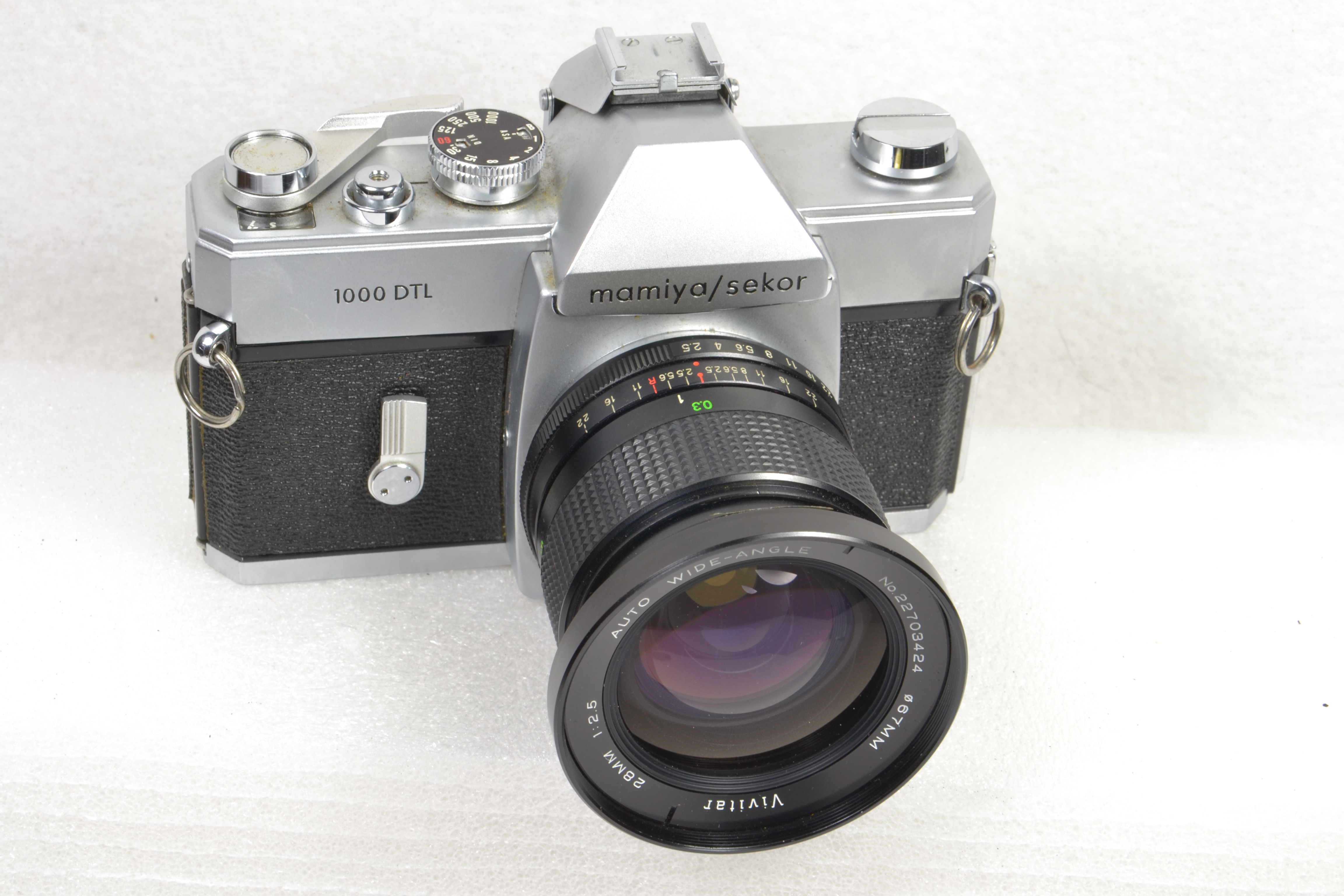
The M42 screw mount was introduced in the 1950s by Praktica, and the Pentax Spotmatic is the king of M42 mount SLRs. Some of these are now rising in price, but generally, you should be able to pay less than $60 for a Spotmatic SP.  The Spotmatic SP II  is a lot like a K1000, and costs less. However, if not having a TTL meter is okay, I highly recommend the Pentax S3 or H3 bodies. Don’t ignore the Mamiya 500DTL or 1000DTL models. Fujica’s ST701 and ST 801 models are usually good purchases, too. Also, look for good examples of the Ricoh Singlex, Vivitar 250/SL, or Chinon CS-4.  The Yashica TL Electro X SLR is an excellent camera body, too.  For European-manufactured cameras, the Zenit 12XP and Praktica Super TL are good choices.

The Mamiya 1000DTL 

The Chinon CS - basic, but rugged.

The Praktica MTL3 is a solid, no-frills SLR.


K-Mount cameras

Pentax’s K-mount was also adopted by Chinon, Cosina, and Ricoh. This year marks the 50th anniversary of the K-mount!  Instead of paying over $200 for a K1000, you should look for a Ricoh KR-10 Super or Sears KSX.  Even cheaper would be a Vivitar V3800.  The Chinon CM-4 is also a bargain.  Later Pentax models with lots of plastic, such as the ZX-M are also going to be relatively inexpensive. Of course, if you have M42 lenses, the K-mount adapter allows you to use them in stop-down mode on the K-mount bodies.

While the K1000 gets a lot of love, it's not the best choice.


The Sears KS 500 is a Ricoh. Not a bad starter SLR.


The Ricoh XR-P has all the features!

Nikon F-mount

If you want the heavy metal experience without a hefty price, I recommend the Nikkormats.  The best choice would be the Nikkormat FT-3, but the FT2 and EL are also good choices, if you don’t mind doing the “Nikon twist” with Non-AI lenses.  Otherwise, the Nikon FG, FA, and FE sell at fairly low prices.  Stay away from the Nikon EM. They are prone to failure, and have very little to offer in the way of control. For autofocus bodies, the N8008, N90, N2002, N80, and N75 are inexpensive choices.  You don’t need a F100 or an F5 to take great photos!  If you are already using a Nikon DSLR, it's easy to use a Nikon AF film body.


The Nikon FE remains a popular entry in the Nikon world

 The FM10 works well.

The Nikon FG is remarkably small and full-featured


The FM2N is a lifetime camera. It ought to last.


The Nikkormat FTN is a heavy metal classic.


Canon 

I’ve shot a lot of Canon manual SLRs in my past, and the FTb QL was a favorite, because it was so reliable. They’ll be cheaper than the much-championed AE-1.  The Cosina-made Canon T60 is also a good choice.   It’s of modern design, has nice ergonomics, and is also quite similar to the Nikon FE-10 in operation. For EOS bodies, the Elan II, and many of the Rebel models will do the trick. If you already have a Canon EOS digital body, using the Rebel-series film bodies will be an easy switch. 


The Canon TL QL is a basic, but quite usable SLR


The Canon T60 is a joy to use.


Minolta (SR/MC/MD mount)

The classic mechanical Minolta SRT series offer good value, and the lenses are still relatively inexpensive.  A working SRT 101, 202, etc.,  are great cameras, and are quite plentiful. Going a bit later, the Minolta X-7A (also known as the X-370) is a good choice for an inexpensive aperture-priority SLR.  While the Minolta X-700 was a wonderful multi-mode SLR, it is prone to bad capacitors over time, so you never know when one might suffer from that malady.  However, the X7A was produced in the late 1980s, and as electronic Minolta SLRs go, it’s capable of great images with the range of Minolta glass that is available.  


The Minolta X-700 is a great SLR, so long as the capacitors last.


The SRT series are robust, with a great lens selection.

Ultimately, your choice of what is good enough may change the longer that you engage in photography.  One photographer’s choice of what is good enough might be a Holga, and another’s might be a Leica M6.  However you evaluate your needs,  you don’t need the top camera model to become a proficient photographer. But if you are just beginning film photography, there are a lot of choices of SLRs, and with some research and diligence, you ought to be able to get a reliable camera for less than $60. It might not be a Canon AE-1, a Pentax K1000, or a Nikon F3, but it will be more than good enough for learning photography. With a couple of lenses and a lot of film, you’ll be starting a great adventure.  


Wednesday, February 01, 2023

Becoming a Confident Photographer


Over the years that I have been writing this blog (since late 2004), it’s become sort of a series of articles about cameras, film, lenses, and some how-to posts.  Occasionally, I dip into travelogues and news about the field.   A few times, I discuss more intangible things.  Back in early November, I visited Manteo, NC and the Outer Banks.  Although we have lived in NC since mid-2019, it was my first trip to coastal NC since our move here, which is a 7-8 hour drive, or 444 miles to Manteo.  It’s been nearly 30 years since I’d been to the Outer Banks, and while I have some memories from that trip, I was never in one place long enough to really appreciate the area, and it was before I was a serious photographer.  

This trip was a good getaway for 4 nights in Manteo, the largest town on Roanoke Island  - and the gateway to the Outer Banks.  I had brought my Nikon F3HP and my Nikon FE, my Fujica GL690, as well as some toy cameras, including the Ansco Pix Panorama and the Lomo Sprocket Rocket.  The only digital was my iPhone.  Early November may seem like an odd time to visit the Outer Banks, but most of the tourists are gone, the weather is usually good, and lodging is a bit cheaper.  We rented a cottage right in Manteo, and everything was walkable to the waterfront. I used the F3 only with b&w film, and the FE had only Kodak Pro Image 100.  Most of the film I shoot is b&w, no matter the format, but having one camera with color for colorful subjects is always a good idea.

Bodie Island Lighthouse, Ansco Pix Panorama, Kentmere 100

On a trip such as this one, I tend to stick to a couple of films, and I chose HP-5+ and Kentmere 100 for the F3.  My main lens was the 35mm f/2 Nikkor, but I occasionally used other lenses when I thought it was necessary - the 24mm f/2.8 Nikkor, 56mm f/1.6 Lensbaby Velvet, 85mm f/2 Nikkor, and the 75-150mm f/4 Series E telephoto.   For the FE, I only used the 50mm f/2 Nikkor.  The only other b&w film I shot was a roll of Rollei RPX 25, on a dramatic windy day along the coast of the Cape Hatteras National Seashore. 

Elizabeth II, Nikon F3HP, Series E 75-150 zoom, HP-5

Now, what does the title of this post have to do with the above information?  Well, as I was shooting the scenes that I encountered, I was quite sure that I would get some really good photographs.  I was confident in my equipment and lens choices, I was using films that I had a long experience with, and I was confident in my decisions of aperture and points of view.  This is not always the case for many photographers, and certainly, not true of me years ago.  Confidence really only comes with experience.  Had I used a camera that I was less familiar with, or a different film stock that I was unsure about, a good photo might not have resulted.  

big winds, big waves.  Nikon F3HP, HP-5.


To people getting started in photography, and especially in using film, you should try keeping things simple until you understand the capabilities and limitations of the equipment and films that you are using.  It doesn't just end with the film stock, but how it's developed.  There are a lot of folks that would have had some great images, but screwed up in the film developing.  It's less likely to happen if you are consistent in your film, techniques, and developers.  

Nikon F3HP, Lensbaby Velvet 56, HP-5

Let me explain via my way of working.  I have owned my Nikon F3HP since 2008, and it's still in mint condition because I have certainly taken care with it.  While I have many other Nikon bodies, I'm very fond of the F3 because of the way it handles, and it's very dependable.  Because I wear glasses, I really appreciate the high-eyepoint prism and viewfinder.  So, I see pretty much all of what is going to be in the negative.  Second, the 35mm f/2 Nikkor has become my walk-around lens with this camera, and I know that the lens is going to render things perfectly.  I used Kentmere 100 and the HP-5+ because I like the results with those films, and I have always had good experiences with them in the developing tanks, plus they scan really well.  There have been times when I might try any number of odd films, but on a trip such as this one, I stayed with the tried and true to get the images I wanted.  Was I confident in my ability? Of course, I was.  When I ended up looking at the negatives,  and then the scans, I was really happy to see that everything came out the way I had envisioned.  

Cape Hatteras National Seashore, Nikon F3HP, RPX25


Now, to throw some uncertainty in -- I was also shooting with an Ansco Pix Panorama camera - a toy camera with a 2 element 28mm lens and a 13x36mm cropped frame. I had loaded it with Kentmere 100 - which on a sunny day is perfect, but in the days at the Outer Banks, I had only used it on cloudy days.  I didn't know if anything that I shot with it would be satisfactory.  But, that's one of the joys of using such cameras - any time things work out great with it, it's as if I have been given a gift.  I was confident in my choice of image framing, but to have satisfactory results was indeed, a great thing.  I also shot a roll of Lomochrome Purple in my Sprocket Rocket, which gives me a 24x72mm panoramic negative.  In this case, I really had no idea of how the images might appear, since it’s a strange film, and a pretty simple camera.  But then again, it’s always a bonus when those things work out.  One also has to be able to not over-think things and just let it play out. After I developed the film and scanned it in, it was apparent that while there were a handful of shots I really liked, that film isn’t the best for overcast days.

Bodie Is. Lighthouse, Sprocket Rocket, Lomochrome Purple


Becoming a confident photographer is not always going to result in great images, because well, that’s the thing about photography.  Just when you think you are doing great, it’s always possible for the photo gods to thwart you with any number of things to mess you up - such as setting the camera at the highest shutter speed instead of A (for aperture priority) and not realizing it because you are so enamored with the scenes in front of you.  Forgetting what film was in the camera and using a red filter with a color film,  forgetting to change the ISO setting for the new roll of film, or realizing that after the 36th frame, that the film never got properly seated in the take-up spool, and you have been shooting blanks for the past hour.  Then of course, are the darkroom foibles.  The thing is, each of these missteps are bits of experience, and make one a more confident and more competent photographer.  If any photographer tells you that none of these things have ever happened to them, it’s quite possible that he or she is lying, or that they haven’t been doing it long enough.  


My point is, becoming confident is achieved by using your tools every day, and keeping the process of photography simple.  I can say this, after 20+ years of serious photography-- that while trying different films and developers is perfectly okay, you’ll eventually decide on what films give you results consistent with your expectations.  Stick with them.  The same goes for cameras and lenses.  I’m a poor example of that aspect, but in my years of experience, it’s helped me to be able to know all about different cameras and films, because I do like to educate others about photography.  But in the end, I know exactly what gear that I’ll take to get the shots I want.  

hunting cabin, Alligator River NWR, Nikon FE, Pro Image 100

Having confidence in your equipment is important.  If you are starting out in photography, nothing is more discouraging than a camera that isn’t working properly.  There is a reason why a an SLR such as the Pentax K1000 has been recommended as a starter SLR - there are very few things that can go wrong, because the camera is so limited in its suite of controls - but it does have the basics.  A K1000 isn’t my favorite camera by any means, but one that works properly with a decent lens puts the basic elements of control - aperture, shutter speed, and focus at your fingertips.  You need only to compose and pick the best choice for exposure to make an image.  Use a bare-bones SLR and one or two film types for a year, and you’ll be amazed at how much better a photographer you are at the end of the year - and I mean use it every day, when possible  The same can be said for any camera, whether it is film or digital.  Use it with the same lens, and shoot almost every day, and see how you progress.  

Moon Jellyfish, NC Aquarium, Nikon FE, Pro Image 100


The world of photography is a huge umbrella, with all sorts of niche endeavors, types of equipment, digital and film, alt-process, hybrid workflows, and then types of subject matter.  You cannot possibly do it all, but whatever you do, become good at doing it.  Maybe it’s large format - which is something that I have never really had the patience for.  Maybe you are really into alternative processes, and all the best to you going down that rabbit hole, which is part alchemy and mastering the technical aspects.  I have respect for anyone that chooses to do things the hard way and can produce wonderful images.   That’s what I love about photography - there really is no "best way" - there are just ways that work for the person doing it.  For a long time it was considered that knowing and practicing the Zone System would lead you into producing better results.  I don’t think a lot of street photographers would agree with that, but if you want to use the Zone System, go for it.  There’s merit in knowing enough about it to at least understand it and applying the principles when it seems necessary.  However, millions of photographs have been made without ever thinking about the Zone System. 


salt marsh and islands, Manteo, Nikon F3HP, HP-5

Another interesting choice is not just the film size, but the aspect ratio of the images.  Square format (6x6) on 120 film is a favorite for many, but then there are those that prefer 6x7 or 6x9, or 6x17! Each of those negative sizes are different ways of seeing, and the same scene shot in each format has very different qualities.  You may find that you like square format the best, because you don’t have to worry about landscape vs portrait orientation.  

Manteo marina, Nikon F3HP, Kentmere 100

Every choice you make has an effect on the final image, from pre-visualization (if you do that), to camera, lens, film stock, filters, tripod or not, lighting, scene choice, and intangible factors such as mood (including yours, of course), intent of the photograph, and so on.  At some point, the factors that you can control become secondary to the point of the image.  It’s not that they don’t matter - but if you are a confident photographer, you hardly have to think about them, and instead think about the image.  

worn dock, Manteo, Nikon F3HP, Kentmere 100


Manteo, Nikon F3HP, Kentmere 100


If you become confident in yourself and your gear, I think you’ll find that it becomes a lot more fun to go out and make images, and your results will also be more rewarding.  At it’s most basic level, photography is pretty simple. Don’t worry so much about gear - though it is important, but the most important tool in photography is located between the ears and behind the eyes.

Nags Head Preserve, Nikon F3HP, Lensbaby Velvet 56, Kentmere 100


Saturday, March 26, 2022

The Nikon Nikkormat - Today's Bargain?

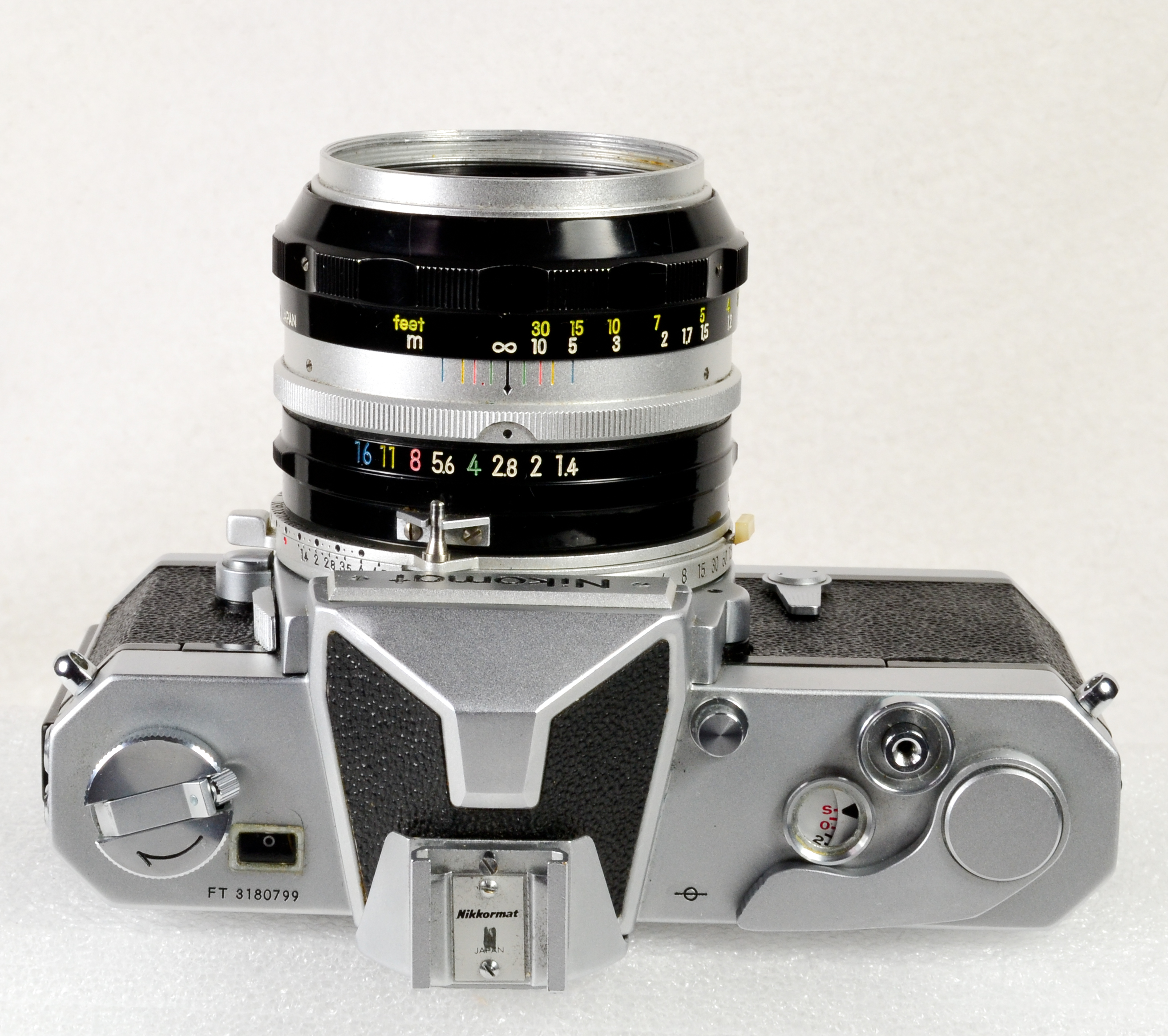
As a 20+ year Nikon user, I've probably handled almost every Nikon film SLR that's been produced, except for an F5 and F6. It was probably about 21 years ago that I handled a Nikkormat for the first time -- a co-worker’s Nikkormat FTN.   About a year later, I acquired a Nikkormat FT2, which I used quite a bit doing macro and nature photography.  The fully mechanical Nikkormats differ from all other Nikons because the shutter speed dial is located around the base of the lens mount. If you have used an Olympus OM-1, you would feel quite at home handling the heavier and more robust Nikkormats.

Shutter speed dial. Also note the cold-shoe over the prism

The first Nikkormats were introduced in 1965, and were sold as a cheaper alternative to the Nikon F.  You sometimes see Nikomats, which were for Japan's market, but are the same cameras in all respects except for the name on the front.  I suppose Nippon Kokagu thought of the Nikkormats as "amateur" cameras, since they were not a modular system like the F, yet they produced the same results.  Obviously, a lot of pros used them as well, since they were solid cameras at a lower price point.
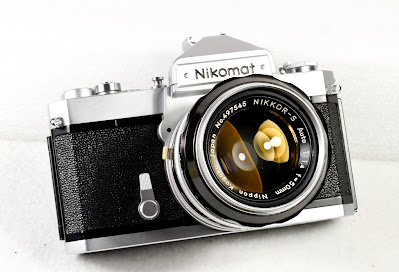
Nikomat, AKA Nikkormat

The Nikkormats were designed to be reliable, robust SLRs with non-removable prisms, and with less bulk than a Nikon F with a metering prism.  They also differ from the F in having a Copal-square vertical metal shutter with speeds up to 1/1000 sec.  In addition, the back of the camera is hinged, making for easier film-loading.  

THE NIKKORMAT LINE-UP
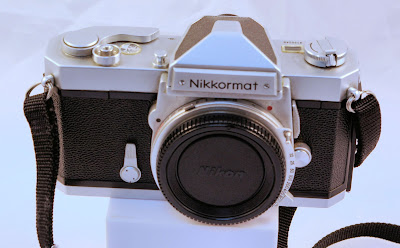
Nikkormat FT

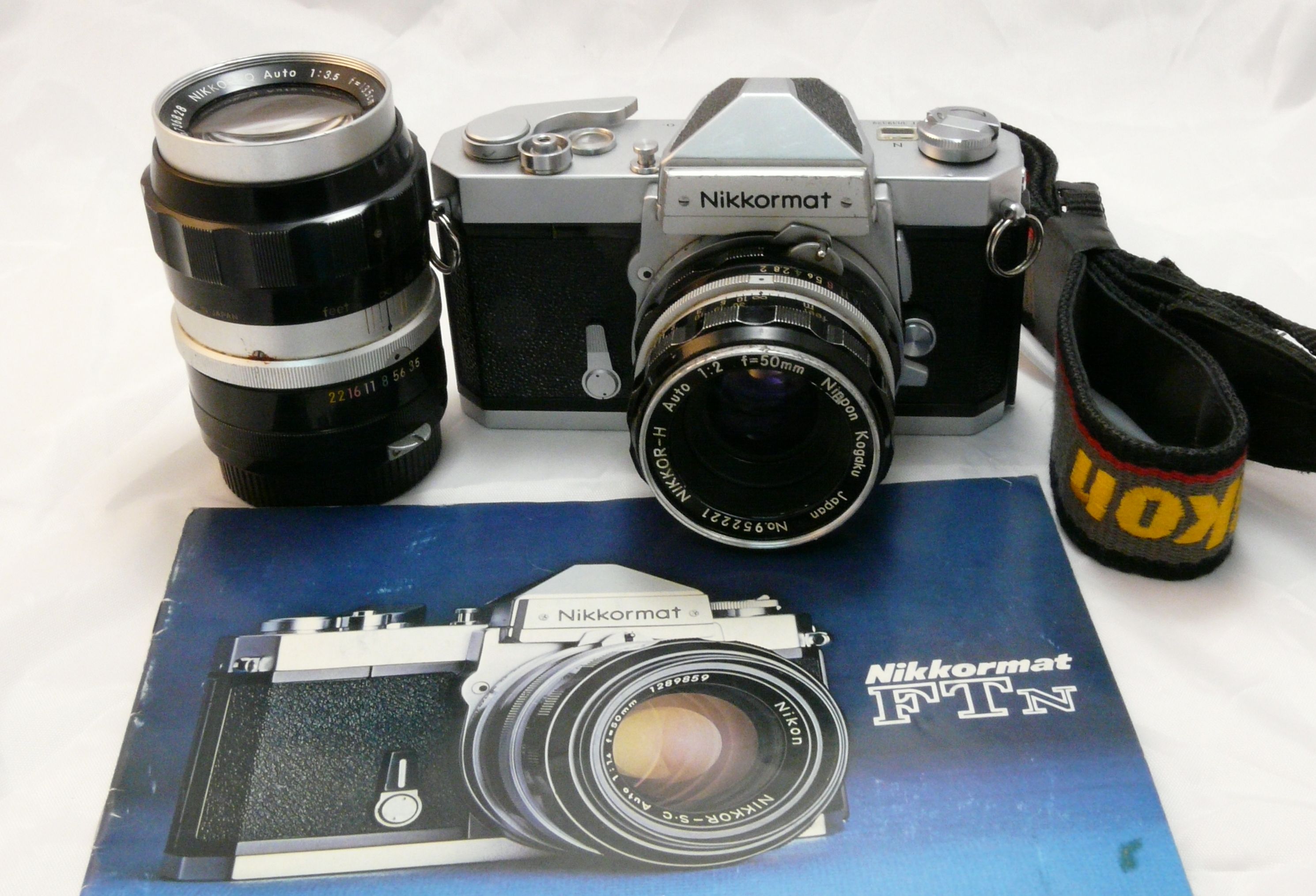
Nikkormat FT -  1/125 flash, sync, ISO settings 12-1600, a cold-shoe is attached separately to the prism via a ring around the eyepiece. In fact, you often see FT's without a cold shoe attached.  Depth of field preview, mirror lock up, built-in exposure meter, X and M flash sync, 1.3V PX-625 mercury cell for the meter.  The FT requires you to also set the film ISO when you set the maximum lens aperture.  That inconvenience was fixed with the FTN model.
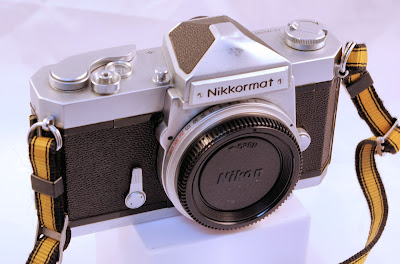
Nikkormat FS

Nikkormat FS - basically a stripped-down version of the FT without a meter, so there are no indicators for exposure, and no battery. There is also no mirror lock-up. Since there is no metering, there is no indexing prong, making this camera able to use just about any F-mount lens, but of course, with no built-in metering.  They are less commonly encountered than any of the other Nikkormat models, and are now collectibles.  Still, using one is pretty simple, much like using a Nikon F with the eye-level, non-metered prism, but with 92% coverage in the viewfinder. I reviewed this camera in 2013.
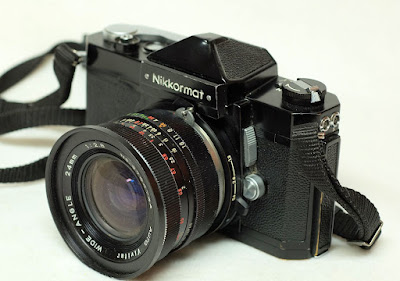
Black Nikkormat FTN


Nikkormat FTN - Introduced in 1967, it improved upon the FT with center-weighted metering, shutter speed seen in the viewfinder, and +/- indicators in viewfinder for metering.  Still, the cold shoe is an accessory.  Later production saw a plastic cover on the film advance lever.  This is the most commonly seen Nikkormat as the production run was from 1967-1975.  I have bought and sold a lot of them.
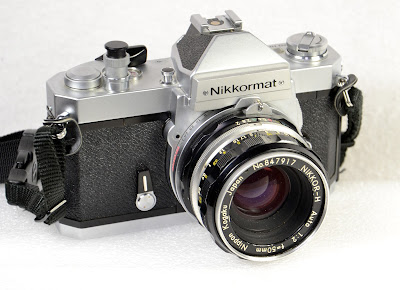
Nikkormat FT2 - my current shooter

Black Nikkormat FT2

Nikkormat FT2 - This model was produced from 1975-78, and featured a built-in prism-mounted hot shoe and the use of a 1.5V LR-44 cell for the meter. A locking film speed selector prevents accidental changes, and the PC flash connector will auto switch for X or M sync, if necessary.  This is my favorite model of the Nikkormats, and one that I always seem to have around at one point or another, if only to use some good old non-AI lenses.
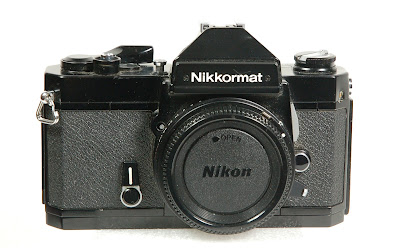
Black Nikkormat FT3

Nikkormat FT3 - Produced for only a short time (1977-1979), as the Nikon FM was released in 1977.  The FT3 is auto-indexing, so there is no coupling prong on the front.  It uses a 1.5 v silver-oxide cell, and all other features are similar to the FT2.  It was the last fully-manual Nikkormat, and the last one with the shutter speed ring around the lens mount.
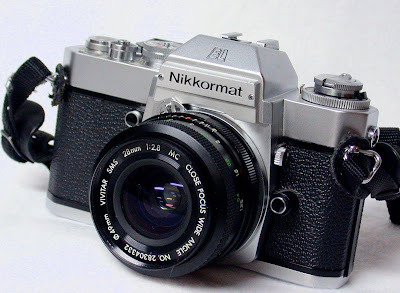
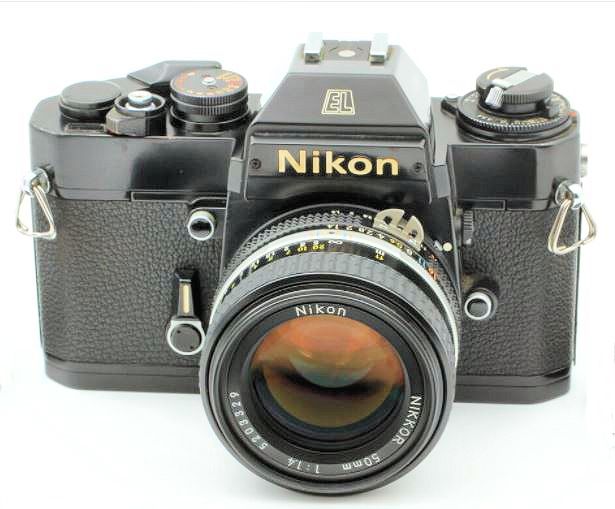
Nikkormat EL

Nikkormat EL - The Nikkormat EL was introduced in 1972, and is a completely different beast from the fully manual Nikkormats above.  It uses a 6v PX-28 battery that inserts into the interior of the camera via the mirror box.  The shutter is an all-electronic Copal square shutter that requires power to function.  The EL is an aperture-priority camera, with shutter speeds of B, 4 sec- 1/1000 sec. There is no exposure compensation dial.  60/40% center-weighted metering, mirror lock-up, ISO settings from 25-1600, built-in hot shoe, and a battery test button.  The Nikkormat EL is roughly equivalent to the Nikon FE, except that it uses non-AI lenses, and is a more robust camera. The shutter speed is on a dial on the top deck of the camera where "it's supposed to be" like all other non-Nikkormat F series models.

Nikkormat ELw - quite rare, and it was the first "Nikkormat" that could use an  autowinder, the AW-1.  It was only produced between 1976 and 1977.  I have never seen one in person. 
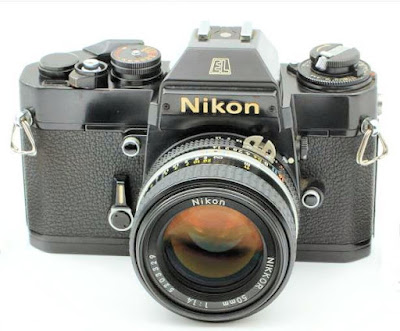
Nikon EL2 - nice if you can find one!

The Nikon EL2 is often categorized with the Nikkormats. However, the camera has Nikon on the front, not Nikkormat.  It’s an AI body, so there is no metering prong as with the EL.  It also has an exposure compensation dial. It also had a short run of production, from 1977-78, most likely because the Nikon FE was the better option for an aperture-priority camera. It can also use the AW-1 autowinder.
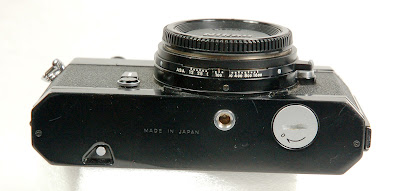

Nikkormats have ISO settings from 12-1600


Using Non-AI  Nikon camera bodies

Any old-timers (like me) that have used the older Nikon bodies are familiar with the mounting of lenses on non-AI (non Auto-indexing) bodies - which would be the Nikon F, F2, and Nikkormats up to the FT2 and EL.  For these cameras, you need to do the "Nikon twist." That involves the following:

1. Set the aperture of the lens to f/5.6

2. make sure the indexing prong is properly situated at the front of the camera (at the index dot)

3. Press the lens into the lens mount

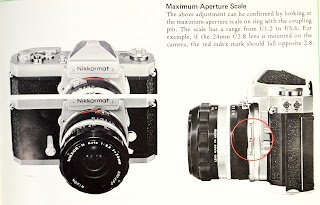
4. As the lens is inserted, and the bunny ears (indexing tab) have captured the indexing prong, twist the lens to the left, and then the aperture all to way to the minimum (f/16 or f/22) and then right, to the maximum aperture.

This process tells the camera the maximum aperture of the lens, which is why they are called non-AI.  Non-AI lenses have solid bunny ears and no metering ridge at the edge of the lens barrel.  Auto-indexing (AI) lenses have holes in the bunny ears, as do AI-S lenses.  AI and AI-S lenses with the bunny ears can be used on non-AI bodies, but non-AI lenses cannot be used on most AI bodies because they lack the metering ridge.  In fact, unless a non-AI lens has been modified, it will break the metering tab on the body of the camera, with the following exceptions: Nikkormat FT3, Nikon FM, FE, EL2, and F3. In these cameras, a small chrome button at the edge of the lens mount is pressed to release the metering tab so that you can mount a non-AI lens - but you'll have to use stop-down metering for a proper exposure on those cameras.  


The Nikkormats are solidly-built SLRs that are certainly quite reliable, but as the years have passed by, the major problem is that the resistor ring that controls the input into the light meter may have deteriorated, and there are no new replacement parts.  What I often see is what is called a "jumpy" meter.  The needle in the viewfinder will be erratic at first, and will sometimes settle down to what the true exposure should be.  If the resistor is in really bad shape, the meter will just give you a crazy value that is obviously wrong, or not move at all. The shutters are reliable, as are all other operations in the fully manual Nikkormat F series.  They are "beasts" that are certainly heavier than the Nikon FM and subsequent smaller-bodied SLRs. Yet, they have a retro charm that many people find appealing.  
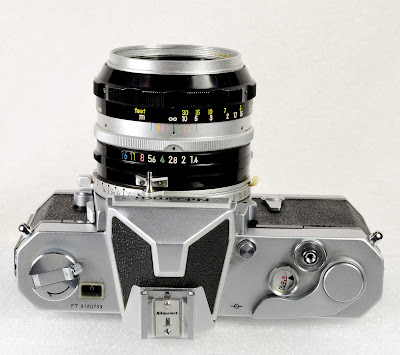
The clean top deck of a Nikkormat FT. 

Are Nikkormats a good buy today?

Given the low prices that most of the Nikkormats sell for on eBay, I would say that if you are looking for a fully manual SLR, the Nikkormat FT2 and FT3 are obvious choices due to the use of 1.5V cells to power the meter.  You can use a 1.5V PX625A for the FT and FTN and adjust for the slightly-off exposure. You can also use an external meter, a phone app, or sunny-16 to shoot and not use a battery, or if the meter's not working.  I think the biggest drawback for novice users of these cameras would be the unfamiliarity of the non-AI meter coupling procedure.  Most of these cameras are around 50 years old or more, and although I have had many pass through my hands in good working condition, some of them have been affected by salt water corrosion, misuse, banged about, or just beat-up by years of use.  
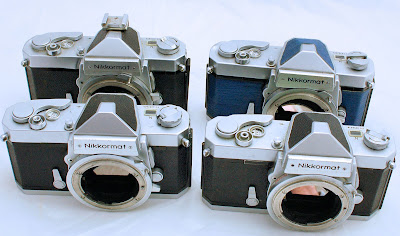
Four FTN bodies that I sold for parts/repair

Since they are fully manual, with the exception of the EL series, there are fewer things to go wrong, and like any camera from the late 1960s to early 70s, caveat emptor.   Having said that, aside from the metering, most Nikkormats have a lot of life left in them. You can pick up a pretty nice Nikkormat FTN on eBay for less than $50.  Black models seem to sell for a bit more than the chrome ones.  A Nikkormat FT2 with a lens will sell for about $50-125, and an FT3 usually sells for $100-$175.  Nikkormat EL prices range from $25-150.

Some Non-AI Lenses on the Nikkormats

My all-time favorite non-AI lens is the 50mm f/2.0 Nikkor-H.  While not as fast as the 50mm f/1.4 Nikkor-S, it is a lens with no aberration, extremely good resolution, and will close-focus to 2 feet.  It has a 52mm filter diameter, and has an aperture range of f/2-f/16.  They are easy to find on the used market, and definitely worth more than they typically sell for. The very earliest version of this lens will have Nippon Kokagu on the front, labeled as a Nikkor-S, with the focal length given as 5 cm.  The focus distances are in feet only.  It was the first lens to be released with the Nikon F in 1959.

The letters after the Nikkor, such as H, S, etc., refer to the number of elements in the lens - Q=4, P=5, H=6, S=7, O=8, N=9. These designations did not carry over to the AI lenses and beyond. They are just called Nikkors.

Non-AI lenses to have -

20mm Nikkor-UD f/3.5 - amazing lens for its time, and that ultra-wide view is great. It has a 72mm filter thread.

24mm Nikkor-N f/2.8 - 24mm is my favorite for wide without too much distortion.

28mm Nikkor-H f/3.5 - fantastic normal wide without distortion. Compact, with great results.

35mm Nikkor-O, f/2.0 - a larger lens than the 50mm, it focuses from 1 ft - infinity.  

50mm Nikkor-S, f/1.4 - Pretty much an every-day lens, and with the wider aperture, great for low-light. There are two versions - one with sharply angled bunny ears, and one with the typical bunny ears.  I have one that was factory-modified to be an AI lens, and it's a wonderful lens to use on my Nikon FM3A.  

55mm Micro-Nikkor f/3.5 - this is the original Nikon Micro-Nikkor, and it's as sharp as a tack with a minimum aperture of f/32! It focuses on its own to 1/2 life size and with the M extension tube, it goes to 1:1.  Great on a bellows, or with other sizes of extension tubes.

85mm Nikkor-H, f/1.8 - A great lens for portraits.  The minimum aperture is f/22.  

105mm Nikkor-P, f/2.5 - Fantastic lens that continues to be great for portraits, nature, etc.  Add an extension tube for great close-ups.

135mm Nikkor-Q, f/3.5 - a more compact lens than the 135mm f/2.8, it's never as popular as it was in the 1960s.  Yet, it has its uses, and they are pretty cheap.  The 135mm f/2.8 is a huge lens with its a sliding lens hood.  If it matters, I find the Tamron 135mm f/2.5 Adaptall-II lens to be superior and smaller.

200mm Nikkor-Q, f/4 - an  under-appreciated lens that works wonderfully with either a diopter or an extension tube for butterflies, etc.  There are several versions of this lens, but the original with the silver and black barrel typically sells for very little.  Minimum aperture is f/22.

80-200mm f/4.5 Zoom-Nikkor-C.   A true zoom lens, with focus staying the same as you zoom in or out from your subject. Minimum aperture is f/32! 

Building a kit with all of the lenses above will likely cost less than one of today's digital mirrorless Nikkor zooms.  Except for the 20mm, all take 52mm filters.  They are made of metal and glass, with no plastic, no rubberized grip, and all-manual everything.  The later models, with a C designation, have better multi-coated surfaces, but all are excellent for black and white photography.

For further reading:

Peterson, B. Moose. 2000. Nikon System Handbook, 6th ed. Silver Pixel Press, NY.

Cooper, Joseph D.  1969. Nikon Nikkormat Handbook, Amphoto, NY.

Comon, Paul. 1996. Nikon Classic Cameras, F, FE, FE2, FA, and Nikkormat F series. Magic Lantern Guides, Silver Pixel press, NY

Stafford, Simon, Hillebrand and Hauschild, 2004.The New Nikon Compendium.  Lark Books, NY.

https://mir.com.my/rb/photography/hardware/classics/nikkormat/html/history.htm - a good starting point online for Nikkormat information