Showing posts with label Nikon. Show all posts

Thursday, April 24, 2025

The Nikon F3 - Only 45 years?

 45 years, pfft.


My F3HP was manufactured in 1994


This morning, I was scanning my IG feed, and saw a post from somewhere about this being the 45th anniversary of the introduction of the Nikon F3.  I hadn't thought too much about it, but I do have a T-shirt from Mike Padua's Shoot Film Co. with 1980 and a drawing of the Nikon F3.  It's an excellent T-shirt- heavy duty and well-made.

courtesy of Shoot Film Co.


I've owned my example of the Nikon F3HP since 2008, when I was given the mint-condition camera from my mentor, William Brudon. At the time, I had been using a beat-up F3 that I'd purchased on eBay a year before.  To say I was amazed  by this gift from my friend was an understatement. I don't think Bill had even run ten rolls of film through it. Over the years, it's become more and more my go-to camera for travel because I can always rely on it to perform flawlessly.  

Sept. 2023, AuSable Point Lighthouse, Ludington, MI. Nikon F3HP, SHD 100 film.

My F3HP's serial number is 1957804, and the date code under the rear door hinge is 64VN. According to this site my camera was manufactured in June, 1994.  So, it's really only 31 years old, but looks like it was made yesterday. I love the high-eyepoint viewfinder, which is perfect for a glasses wearer. As you can see in this photo of my camera, it currently has the old Nikkor-H 50mm f/2 lens attached.  It was converted to AI by the Nikon factory.  It remains one of the best 50mm lenses made, period.

I don't know how many rolls of film I have shot with this camera. More than 50, and less than 150, I suppose. In any case, it's a fine camera that is a joy to use.  It was made to be a professional's SLR, and as SLRs go, it had a long manufacturing run, from 1980 - 2000.  Even then, it was available as a new camera into the digital age.  

Ludington, MI, Sept. 2023. Nikon F3HP, Kodak XX.


If you want to know more about Nikon's F3, this site has a lot of great information in one place. https://www.mir.com.my/rb/photography/hardwares/classics/nikonf3ver2/index.htm

If you have never used a Nikon F3 before, it's an easy camera to work with.  The controls are obvious, with butter smooth operation.  All you can expect from a pro-grade SLR.

Floyd, VA, July 2024. Nikon F3HP, Ilford HP-5.


Wednesday, April 16, 2025

When is “good enough” good enough?


A clean, working Spotmatic SP is a great SLR, even at 60 years old


I got to thinking about this recently, after I received a Ricoh KR-10 Super via eBay.  I paid less than $30 before shipping, so it was definitely a bargain.  I last used a Ricoh K-mount body about a decade ago, and had sort of forgotten how good it was.  Now, if you’ve been following Random Camera Blog for a while, you’ll know that I use Nikon gear for about 75% of my photography.  But that doesn’t mean other SLR systems are not as good as Nikon’s nor does it mean that you need a Nikon or a Canon system to take great photographs.  In the realm of 35mm film SLRs there are a lot of choices out there.  Some of them are peculiar and do not have a big “ecosystem” of accessories and lenses.  For example, Topcon and Miranda featured well-built bodies and enough lenses to satisfy the needs of most photographers. Yet today, they certainly are niche cameras and are rarely seen.  Why is that?  They were certainly “good enough.”  However, in the mid-1970s, as branding became increasingly popular, it was the Pentax Spotmatics, Minolta SRTs, Canon, and Nikons that attracted the most interest.  The cool kids had Spotmatics, the pros had Nikons, and all the rest were there for the remaining market share.  By the mid-1980s, Olympus, Canon, Nikon, Pentax and Minolta were the predominant SLR brands, with a smattering of other runner-ups.  The K-mount of Pentax was where one could find new, less-expensive cameras - not made by Pentax.  So, enter Cosina, Ricoh, and Chinon - three Japanese companies that were also OEM suppliers to some other brands.  Even today, when looking for either M42 mount or K-mount SLRs on the used market, these three companies are less-expensive options to the Pentax SLRs.  That really can’t be said of Nikon, Canon, Olympus or Minolta.  

Now, as a long-time Nikon user, I know my Nikon SLRs, and the strengths of any particular body compared to others.  The last non-AF Nikon bodies were the FM3A, the FM10 and FE10.  The FM3A is an outstanding camera body that continued in the Nikon heritage of the FE and FM2N, and can operate without batteries, if necessary.  Good used FM3A examples still go for nearly $800.  However, the FE10 and FM10, made by Cosina for Nikon, are plastic-bodied SLRs that are not too different from the Vivitar V3000, made by Cosina.  But, having used them, they are certainly good enough for everyday use.  They sell for a fraction of the FM3A, and less than a good used FE model.  Some photographers have derided them as being “too plasticky.”  Well, the same could be said for the auto-focus Nikon N55, 60, 65, and 75, and those were made by Nikon.  Today, if Nikon offered a new FE-10 type of SLR, I guarantee that it would sell.  Sure it’s not going to be as robust as a FM2, but it will be good enough for most.  Again, spend money on lenses!

The Miranda Sensorex is a classic, but never popular

My point here is that a camera is often only as good as the lenses available for it. Topcon and Miranda bodies are well-made, but there are very few options for lenses.  The Pentax and other  M42  and K mount bodies have a plethora of available lenses, made by many manufacturers.  Canon’s FD-mount SLRs likewise had a lot of third-party options, and so did Minolta, Olympus, and to a lesser extent, Konica’s AR-mount.  Oh yes, and so does Nikon.  What that means for the new users today is that you should not discount the other brands, which you can often purchase at lower prices than the “name brands.” Going back to the beginning, the Ricoh KR-10 Super has a lot more features than the Pentax K1000.  I know the K1000 gets all the attention because it’s a “beginner’s SLR.” It certainly is, but it lacks even a self-timer! Yet they sell for well over $200 used.  For that price you could easily buy a Spotmatic with a 50mm lens, and have money left over for more film.  I don’t see how a Spotmatic F is not a good “beginner” camera, as it is pretty much identical to the K1000, but it has a M42 screw mount lens rather than the bayonet K-mount.  It also includes a self-timer, stop-down depth of field viewing, and can accept many lenses for the M42 mount. A bargain, and is certainly more than “good enough.”  

The KR-5 is a bargain

The Ricoh KR-10 and the Sears KSX (made by Ricoh) are two very good K-mount SLRs made in the 1980s.  While they don’t have PENTAX on the front of the prism, they are better cameras than the 40-year old Pentax ME, which suffers from electronic problems. Some sleuthing online will provide you with some bargains, once you know what to look for. Again, by saving money, you can purchase additional lenses, since most of these cameras come with a 50mm f/2 normal lens.  Buy a 28mm wide-angle, or maybe a 28-70mm zoom lens and see what a difference it makes in how and what you photograph.  There are plenty of K-mount options out there.  My first K-mount SLR was a Pentax MG, which I purchased at Service Merchandise in 1983. It came with a 50mm f/2 SMC Pentax  and a 135mm f/2.8 SMC Pentax lens and a 2x teleconverter.  I don’t recall what I paid for it, but I used that camera until 2000.  I remember buying a used Pentax SMC 28-80 zoom for it that had close-up capabilities, and was amazed at what a difference it made in my photography.

If you are just getting into using a 35mm SLR, and want that “analog feel,” you probably don’t already have an established preference.  There are a lot of good used SLRs out there that won’t cost you much. Popularity drives up the price, but if you stick with the same lens-mount ecosystem, you can find cheaper alternatives that are “good enough.”   Here is a list of mounts  and cheaper alternatives:


The Spotmatic F was the last M42 mount from Pentax


M42 mount cameras 

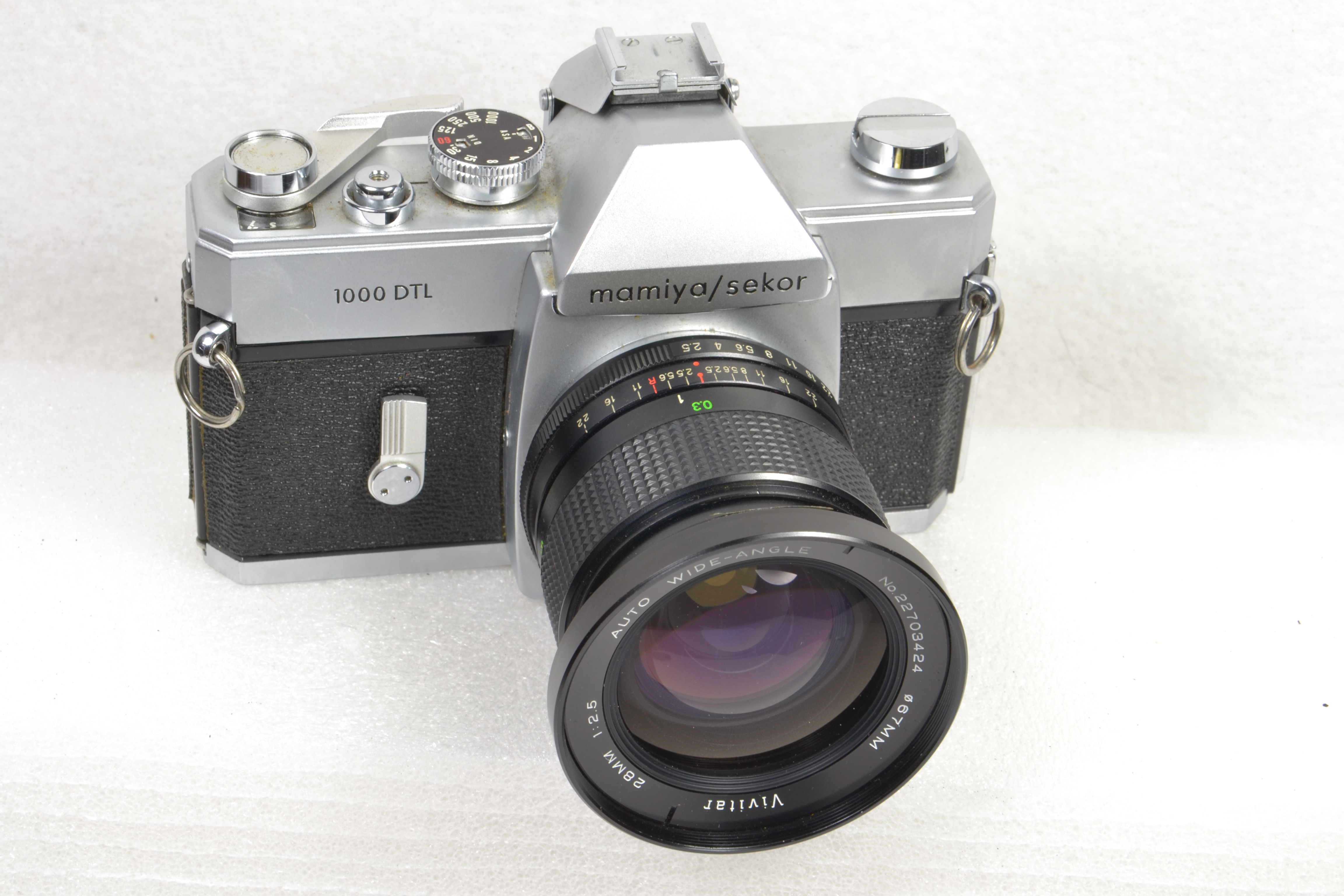
The M42 screw mount was introduced in the 1950s by Praktica, and the Pentax Spotmatic is the king of M42 mount SLRs. Some of these are now rising in price, but generally, you should be able to pay less than $60 for a Spotmatic SP.  The Spotmatic SP II  is a lot like a K1000, and costs less. However, if not having a TTL meter is okay, I highly recommend the Pentax S3 or H3 bodies. Don’t ignore the Mamiya 500DTL or 1000DTL models. Fujica’s ST701 and ST 801 models are usually good purchases, too. Also, look for good examples of the Ricoh Singlex, Vivitar 250/SL, or Chinon CS-4.  The Yashica TL Electro X SLR is an excellent camera body, too.  For European-manufactured cameras, the Zenit 12XP and Praktica Super TL are good choices.

The Mamiya 1000DTL 

The Chinon CS - basic, but rugged.

The Praktica MTL3 is a solid, no-frills SLR.


K-Mount cameras

Pentax’s K-mount was also adopted by Chinon, Cosina, and Ricoh. This year marks the 50th anniversary of the K-mount!  Instead of paying over $200 for a K1000, you should look for a Ricoh KR-10 Super or Sears KSX.  Even cheaper would be a Vivitar V3800.  The Chinon CM-4 is also a bargain.  Later Pentax models with lots of plastic, such as the ZX-M are also going to be relatively inexpensive. Of course, if you have M42 lenses, the K-mount adapter allows you to use them in stop-down mode on the K-mount bodies.

While the K1000 gets a lot of love, it's not the best choice.


The Sears KS 500 is a Ricoh. Not a bad starter SLR.


The Ricoh XR-P has all the features!

Nikon F-mount

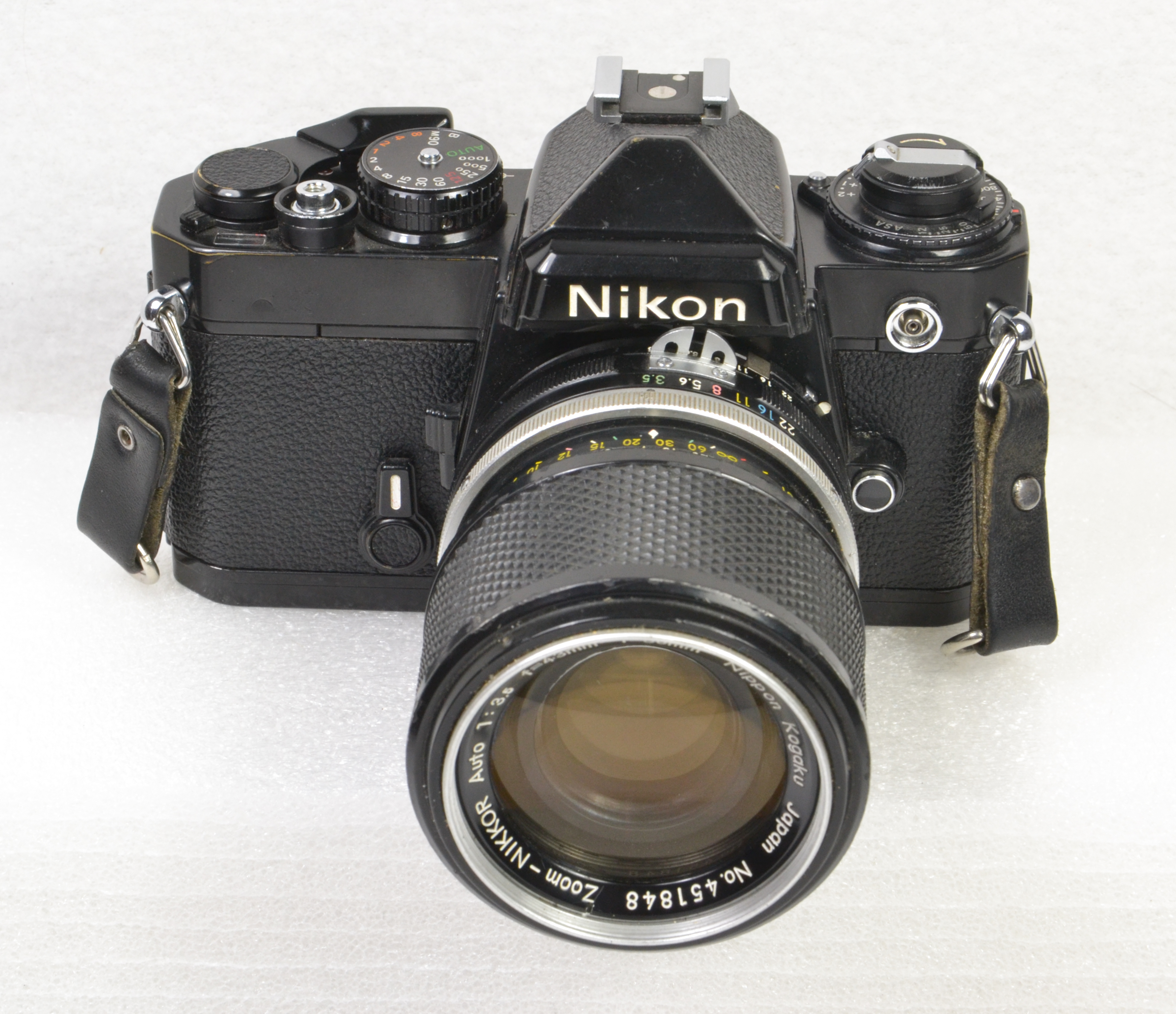
If you want the heavy metal experience without a hefty price, I recommend the Nikkormats.  The best choice would be the Nikkormat FT-3, but the FT2 and EL are also good choices, if you don’t mind doing the “Nikon twist” with Non-AI lenses.  Otherwise, the Nikon FG, FA, and FE sell at fairly low prices.  Stay away from the Nikon EM. They are prone to failure, and have very little to offer in the way of control. For autofocus bodies, the N8008, N90, N2002, N80, and N75 are inexpensive choices.  You don’t need a F100 or an F5 to take great photos!  If you are already using a Nikon DSLR, it's easy to use a Nikon AF film body.


The Nikon FE remains a popular entry in the Nikon world

 The FM10 works well.

The Nikon FG is remarkably small and full-featured


The FM2N is a lifetime camera. It ought to last.


The Nikkormat FTN is a heavy metal classic.


Canon 

I’ve shot a lot of Canon manual SLRs in my past, and the FTb QL was a favorite, because it was so reliable. They’ll be cheaper than the much-championed AE-1.  The Cosina-made Canon T60 is also a good choice.   It’s of modern design, has nice ergonomics, and is also quite similar to the Nikon FE-10 in operation. For EOS bodies, the Elan II, and many of the Rebel models will do the trick. If you already have a Canon EOS digital body, using the Rebel-series film bodies will be an easy switch. 


The Canon TL QL is a basic, but quite usable SLR


The Canon T60 is a joy to use.


Minolta (SR/MC/MD mount)

The classic mechanical Minolta SRT series offer good value, and the lenses are still relatively inexpensive.  A working SRT 101, 202, etc.,  are great cameras, and are quite plentiful. Going a bit later, the Minolta X-7A (also known as the X-370) is a good choice for an inexpensive aperture-priority SLR.  While the Minolta X-700 was a wonderful multi-mode SLR, it is prone to bad capacitors over time, so you never know when one might suffer from that malady.  However, the X7A was produced in the late 1980s, and as electronic Minolta SLRs go, it’s capable of great images with the range of Minolta glass that is available.  


The Minolta X-700 is a great SLR, so long as the capacitors last.


The SRT series are robust, with a great lens selection.

Ultimately, your choice of what is good enough may change the longer that you engage in photography.  One photographer’s choice of what is good enough might be a Holga, and another’s might be a Leica M6.  However you evaluate your needs,  you don’t need the top camera model to become a proficient photographer. But if you are just beginning film photography, there are a lot of choices of SLRs, and with some research and diligence, you ought to be able to get a reliable camera for less than $60. It might not be a Canon AE-1, a Pentax K1000, or a Nikon F3, but it will be more than good enough for learning photography. With a couple of lenses and a lot of film, you’ll be starting a great adventure.  


Friday, May 03, 2024

The Nikon N75 SLR

The N75/F75 SLR with a 35mm f/2 AF-D Nikkor


Cheap and good are rarely found together, but in the case of the Nikon N75 (F75 outside North America), they coexist.  Introduced in 2003, the N75 was Nikon’s last consumer-level AF 35mm SLR, and it replaced the N65.  It sold for around $300 with a kit lens when first introduced, and it apparently was also sold as a body without a lens for less than $200.  To put things in perspective, the Nikon D100 was introduced in 2002 and cost about $2000 for just the body.  Guess which one of these cameras can be used today to produce quality images with the least amount of fussing about?  The N75.  Just put in two CR-2 batteries, a roll of film, and you are ready to shoot with this lightweight SLR that has the most features of any camera in its class.  


The control layout is the typical one for Nikon SLRs

Uncluttered controls


The N75 is definitely more compact than the Nikon N80, but the major difference between the two is that the N75 only uses the DX code on the film cassette to set the ISO, whereas the N80’s ISO can be set manually.  If there is no ISO code on the cassette, the default ISO goes to 100.  That’s going to be a limitation if you are accustomed to using low-ISO films with no ISO codes, or using hand-rolled film. However, for many users, that’s not going to be a problem. The N75 replaced the N65 and N55, which are consumer-grade SLRs with similar control layouts and features.   The N75 is also the only Nikon SLR that automatically winds all the film out of the cassette at the beginning, and pulls the exposed frames back into the cassette as you shoot. This is commonly done in Canon’s AF SLR cameras,  but is a novelty with the N75.  I actually like the feature, since it cuts down on the rewind time.  The N75 was discontinued in 2006, making the Nikon F6 the last AF film SLR produced by Nikon.  There is an excellent review of the N75 by Thom Hogan, so go to his site to learn more.  


The N75 has most of the features found in the N80 and F100 (with the above exceptions). It’s small, inexpensive and light, yet it also takes most Nikon AF lenses.  Like the N80, and similar consumer-grade Nikon AF SLRs, the N75 does not meter with manual lenses.  You can use them, of course, but you will have to shoot in Manual mode, dialing in the shutter speed and aperture manually with no meter.  That’s always been the disappointing thing about Nikon’s dumbing down of non-pro AF bodies, both 35mm, and digital.


However, the N75 is a delight to use.  It has excellent 25-segment matrix metering, as well as center-weighted and spot metering.  I use mine primarily in Aperture-Priority, but it has all the PSAM modes as well as 6 special exposure modes.  When I pair the body with either the 50mm f/1.8 or 35mm f/2 AF-D lenses, it becomes a high quality "point and shoot." It’s only a tad over 13 ounces without a lens, and with the CR-2 batteries, it should be good for many rolls of film.  It definitely is noticeably lighter than my N80, and a LOT lighter than my F100, and has most of the features of those models.  Best of all, these cameras are plentiful and inexpensive.  I have a black-bodied F75, and to me, it looks a lot better than the silver-looking N75 that we typically see.  Paired with a good flash like the Nikon Speedlight 80DX, you can do flash photography and know that your exposures will be pretty much perfect.  


The SB-80DX flash on the camera


While the N75 does have a pop-up flash, which certainly works for fill flash, I recommend using a full-featured TTL flash that will give better results in a variety of situations.  In my case, I use a Nikon SB-80DX speedlight, which is as full-featured a film camera flash can be.  The only drawback with that flash is that it won’t work with your DSLR, as it only works with the 35mm SLR Nikons.  They sell for less than $40 used now, which is a pretty good deal for a modern TTL flash unit.


I often see a lot of love for the low-cost Canon Rebel series as entry to using film cameras, and of course, they are pretty decent low-cost AF SLRs.  I’ve used quite a few of them, and yes, they are inexpensive.  Some of the earlier Nikon AF SLRs that are now inexpensive are just a bit clunky, such as the N60, which is much larger than the N75 and N80, but loud and slow.  The N75 has just that right combination of controls where I want them, ease of use, and the ability to control your exposures to a very fine degree.  Online, I see prices for N75 bodies typically less than $40.  The nice thing is that these cameras are relatively young, are very mature in the control layout, and will accept most AF Nikon F-mount lenses.  It’s a great camera for travel, as it takes up less space and weight than even a DSLR. I highly recommend a lens like the 24-50mm AF-D for travel, but the 35mm f/2 AF-D is a great lens and doesn’t weigh you down.


I recommend the N75/F75 SLR to anyone that wants a lightweight, inexpensive 35mmm SLR.   Pair it with a prime lens, and you’ve got yourself a great little camera for street photography, travel, and hiking companion.    

Here are some examples from the N75.

SHD 100 film

SHD 100 film

SHD 100 film

Ilford FP4 film

Reflx Lab 200T film

Fujifilm Superia 200

Fujifilm Superia 200

Fujifilm Superia 200

Fujifilm Superia 200

Fujifilm Superia 200

Kentmere 100

Kentmere 400

Kentmere 400

Kentmere 400


Saturday, November 11, 2023

Appreciating a Classic Lens - Nikon’s 50mm f/2 Nikkor-H

My Nikon FE with a factory AI'd Nikkor-H

Over the years, I have had lenses come and go in my “toolkit” and some lenses become favorites for a time, to be replaced by another another focal length that fits my photographic practice.  Early on, it was always a 50mm lens of some sort on whatever camera body  you can imagine, and I have used an awful lot of different “normal” lenses.  In the Nikon ecosystem, there have been 50mm f/2, f/1.8, f/1.4 and f/1.2 lenses.  While I love the 50mm f/1.4 for a lot of things, the old, old, Nikkor-H 50mm f/2 has been around for the Nikon SLR since day 1, and it’s a lens that I know will always render a scene very well. Sure, it’s not the fastest of the bunch, but as a do-it-all 50, it’s at the top. Why?  


Above - the front and rear of an early non-AI 50mm Nikkor-H. This one lacks the 
rear of the lens held in place by 5 screws, meaning that it cannot be factory-
adapted to the more modern AI mount.

For one, it’s one of those lenses that has had many iterations as technology and camera bodies improved.  The original 5 cm Nikkor-S  came out in 1959, and it was a 7 element lens with 4 groups.   In 1964, the lens was changed to a 6 element lens with 4 groups, and renamed the 50mm Nikkor-H.  That lens became the sort of de-facto normal lens for many years, until 1974, when Nikon replaced the silver and black barrel with the 50mm f/2, an all-black barreled lens with a rubberized focus ring.  In 1977, the AI (auto-indexing) 50mm f/2 came out to be included with the Nikon FE, FM, Nikkormat EL2 and FT3, all of which were no longer required to use the old non-AI f/5.6 “double twist” to set the maximum aperture for the metering system.  The Nikon 50mm f/2 was dropped in 1979, and replaced in the lineup with the 50mm f/1.8, which has also had a number of iterations, but I won’t delve into them.


Above - The last iteration of the 50mm f/2 with an AI-mount.


Second, the 50mm f/2 has a very flat field with little distortion.  Perhaps that’s partly due to the f/2 maximum aperture, but in my experience, it’s sharp at all apertures, but especially so at f/5.6-f/16.  I’ve used it to copy documents on a copy stand, as a macro-lens with a bellows, and of course, general photography.  The lens was briefly given the H.C designation in 1972, to indicate improved coating surfaces.  For more information, see this account on the Nikon site

Real-world tests, not the sharpness of brick walls, indicate how a lens performs.  Lately, I have been using a 50mm Nikkor-H that was Nikon modified to be an AI-mount.  I don’t exactly remember when I started using it - probably last fall, but I have come to appreciate its performance with my Nikon FE, F3HP, and FM3A bodies.  In the past few months, I have been using the lens on my Nikon FE with various color films, and am really pleased with the results.  Is it any different than the last AI version of the 50mm f/2?  Probably not, but I love the classic look of the lens, and the knurled focus ring feels right.

Last and earlier versions of the 50mm f/2. The lens on the right was 
factory modified to be an AI lens.

Today, 50mm seems to be out in favor of expensive zooms, or, wide-aperture prime lenses.  I’ve certainly used  the 50mm f/1.2 Nikkor, and it has a special use for low-light or really shallow depth of field situations.  Overall though, as an all-purpose normal lens, the 50mm f/2 is one of the best lenses you can own.  The Leitz and Zeiss fanboys will probably disagree, but price-wise, you’ll not find a better 50mm lens.  It’s an SLR  lens that’s been around for over 60 years, and untold thousands have been used by photographers in all sorts of situations.  On a full-frame body such as my Nikon Df, or on a Nikon F or FM3a, the results will be excellent.  The AF equivalent would be the 50mm f/1.8 AF-D Nikkor, which is a pretty common lens and often overlooked in favor of the faster f/1.4.  However, with higher ISO settings on a DSLR, the f/1.8 aperture is not limiting.  

Old with the new 


The lenses one decides to use should be based on how they perform in the types of photography that you do.  Some times a prime lens or a set of them will be all one needs for a majority of his/her photography, and other times a zoom lens in a certain range fulfills one’s requirements.  While I have my share of zoom lenses in manual and auto-focus versions, I find myself using prime lenses most of the time.  There’s a lot to be said for using a single lens for many situations, and one photographer’s choice of say, a 24mm lens for many situations will result in quite different compositions than another photographer’s choice of 50mm, or 85mm.  You can “zoom” with your feet, if necessary, like many did when all you could afford was a single lens — the one that came with your camera, and it was most likely a 50mm prime lens.  

The Nikkormat FTN and 50mm f/2 Nikkor-H
A perfect match!

As I posted previously, I find that a 35mm lens is perfect for when I am on the street or traveling.  Often, I find myself packing one Nikon body with the 35mm f/2 and black and white film, and another Nikon body with color film and the 50mm f/2, and a 24mm and 85mm in the bag.  Those pretty much cover my needs for a lot of what I shoot, and that many decades old 50mm Nikkor-H f/2 has never disappointed me.

The more modern 50mm f/1.8 is a tad faster than the f/2, and is capable of slightly
closer focus. It's also an excellent normal lens.


My factory AI'd Nikkor-H has slotted screws on the back, vs the
Phillips screws on later versions. Those knurled sections are very
satisfying to the touch.


A few very recent results from that 50mm f/2 Nikkor-H with the Nikon FE and various color films.

Wassaic, NY. FPP Color 125

Amenia, NY FPP Color 125

Millbrook, NY Reflx Lab Pro 100

Amenia, NY Reflx Lab Pro 100

Kent, CT, Fuji Superia 400 at 200.