Wednesday, April 18, 2018

A REVIEW: HOLGA - Photographs by Michael Kenna.


I have long been a fan of Michael Kenna's photography. Many of  b&w photographs, often taken at dusk or dawn, possess dream-like qualities. Sometimes, the rich detail in the shadows invites us to linger over an image, so that we discern even more than we anticipated. With his array of landscapes, the often ethereal quality makes them timeless. His architecture-related images run counter to the notion that architecture photographs must be technically perfect. Instead, we are treated to a luscious world of tonality and keen observation of details.

When I first saw an announcement of Kenna's latest book, HOLGA, with the image of the white dove on the cover, I knew that I had to have it. After some delay, the book finally shipped in early March of 2018. I was not disappointed with the content. I know that Kenna has primarily used Hasselblads for his work, but to find out that he has also been carrying along a Holga on his trips was a surprise. It is not a surprise that his Holga images are wonderful. The very qualities that make a Holga an unpredictable camera - simple lens, limited aperture adjustment, and only two shutter modes - Instant and Bulb, are used masterfully by Kenna. I suspect that many of the images were done in B mode on a tripod. You don't have to be a fan of the Holga to appreciate the images in this book. Kenna wields the Holga as well as he does his 'Blad, and the luscious photographs are his forte. He uses the attributes of the Holga to produce images that  are enchanting, evocative, and soulful. The printing is excellent, and the 7x7 inch images are perfectly sized to view properly.

The old axiom, "It's not the camera, but the photographer that wields it" holds true here. Kenna's use of the Holga is indicative of his vision and his craft, and the book is a must-buy.

HOLGA - Photographs by Michael Kenna.  151 pp. Prestel Verlag, Munich, London, New York. 2017. ISBN 978-3-7913-8377-4  Price: USA $60.

Monday, April 09, 2018

On the Road Again

Tools and shot film, NC trip
I have been traveling a lot the past few months, and as a retiree, it's something that I had been looking forward to.  I was away in North Carolina the past week to check out Charlotte and Asheville, NC.  Aside from seeing the outer banks 24 years ago, I hadn't seen much of NC before, and I have to say Charlotte is a very nice city.  Charlotte has a great light rail system in place, and it really makes access quite easy.  I look forward to going back again. Asheville I like better, because it has a little grunginess, and as a photographer, I like to find interesting things to photograph.   I have turned into a flat-lander, having been in Michigan so long, but I really enjoy the mountains in NC.   I got back last night, so I won't have a chance to develop my film until after I get back from NJ next week. I leave for Fair Lawn, NJ on Wednesday to help out the Film Photography Project.

Hopefully, I'll have some material for some posts later this month, and I look forward to having some time to write and work on my photos.   The so-called spring weather has yet to take hold in Michigan, and I have to say it was a delight to be in a warmer climate last week.  Back at home in Ann Arbor, it is once again snowing (but not sticking), and spring weather would be welcome right now.


Thursday, March 29, 2018

ONE-ROLL REVIEW - Kosmo Foto Mono

One of the recent developments in the film world has been the sale of  "boutique" films, such as the JCH Pan.  Another brand, Kosmo Foto, has released a B&W film called Kosmo Foto Mono, an ISO 100 film.  I recently received a roll of this film, and had the opportunity to try it out.  First of all, you should know that only a few factories are actually producing film, and some of them have been very happy to repackage film for sale under a different name.  Lomography doesn't make their own film, but rebrands film made by Kodak, Fuji, etc.  In the case of Kosmo Foto, it's the Foma company in the Czech republic.  The film is Fomapan 100, and in the case of Kosmo Foto, it is the coolest film box I have seen. 

I shot the roll of film in my Nikon N2020 (see previous review of the camera) while on a trip in Michigan's Upper Peninsula in late March. I processed it at home in XTOL (straight) for 6 minutes. 

I don't recall previously shooting any Fomapan 100 (unless it was an Arista brand), but I am pleased with the results that I got. Nice tones, good shadow detail, and the highlights are good.  I was also pleased to see that the film lies PERFECTLY FLAT in the scanner holder. No curling or cupping.  Right away, I am a fan.

I will post a few photos below to show my results.  Crisp is how I would describe the images. All were scanned on my Epson V700 scanner.

At this point, you may wonder why I just didn't order Fomapan 100 and shoot it. I like the idea of these branded films -- whether it's Japan Camera Hunter Street Pan, Kosmo Foto Mono, or Lomography's Lady Grey, etc.  It gets people buying the film, and more film sales keep the plants churning out product.  More product, more choices, more film. Sure, you can just go buy the Fomapan 100 for less than $5/36 exp. roll from Freestyle and get the same results as buying the Kosmo Foto Mono.  However, by purchasing the Kosmo Foto film, you are helping out an enthusiast, too.  The point is, Stephen Dowling, the Kosmo Foto man himself, really likes the Fomapan 100 emulsion -- so much so, that is why he went to all the trouble to create the packaging and rebranding.  There will be lots of people that never would have tried the Fomapan 100, but are willing to buy into the buzz about the Kosmo Foto film.  It's all good. 


Other reviews of the Kosmo Foto Mono
Down the Road by Jim Grey
Emulsive Review
Classic Camera Revival


Tuesday, March 27, 2018

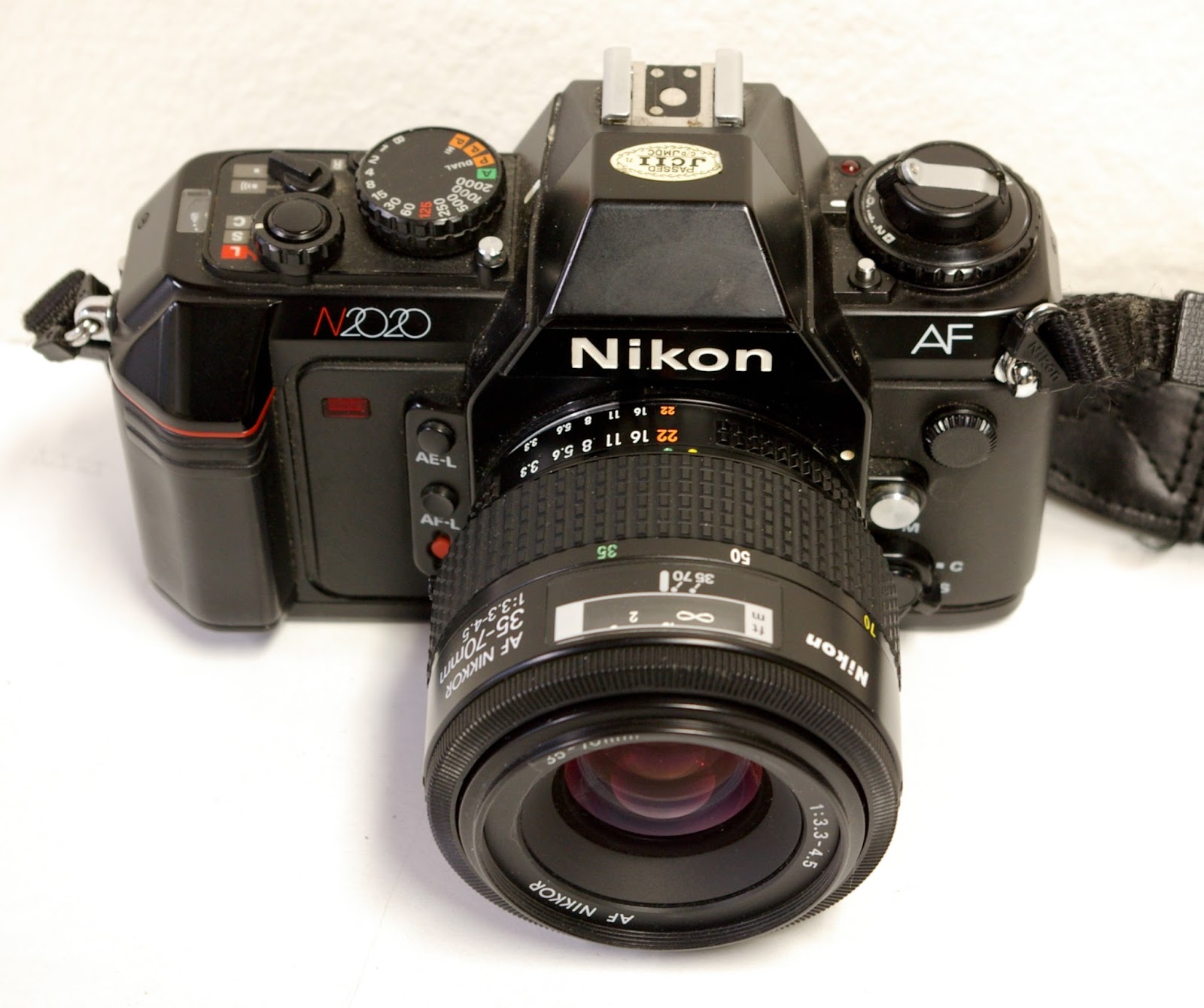
Nikon took AF Mainstream - the N2020 SLR

The 1980s was a decade of major change in the camera industry. Auto-focus was becoming a factor in the direction of new cameras, and while the Konica C35AF was the first AF point and shoot in 1977, SLR manufacturers were testing the AF waters with kludgy AF lenses attached to manual focus cameras. For those, we had the Nikon F3AF, The Canon T80, and the Pentax ME F with the SMC Pentax-AF 35-70/2.8 KF-mount lens.  In short, they were all dead-ends, because the focus motor was inside the lens, along with the batteries to power it.  It was not until 1985 that SLR manufacturers took AF seriously on advanced and pro-level SLR cameras when Minolta produced the Maxxum 7000 as a complete system camera with the focus motor inside the camera, along with the full control of the lenses on the body. Canon came out with the EOS system in 1987, Pentax brought out the SF-1 in 1987, and it was the first AF SLR with a built-in flash.  Nikon brought out the N2020 in 1986, which aside from the AF features, was nearly identical to the manual-focus N2000 that was released in 1985. While very similar to the popular N2000, the N2020 (F-501 in Europe) features the lens motor in the body, with the ability to use nearly all AI and AIS manual lenses, as well as AF and AF-D lenses.  This was accomplished without changing the lens-mount (as did Pentax), unlike Minolta and Canon, which created new mounts for their AF cameras that were not backwards-compatible with their manual predecessors.

While Nikon kept producing the manual-focus F3HP (until 2001) and the FM2N (until 1997) (followed by the FM3A 2001-2006), the switch to an AF pro-level body, the F4, did not take place until 1988.  In the meantime, Nikon produced a series of mostly forgettable AF cameras (N4004, N6006), until in 1988, the N8008 was also introduced. However, the N2020 stands out as a particular bit of genius because it looks like a manual-focus camera with the typical dials and controls one expects from an analog camera. Yet, the inclusion of the lens motor makes this first AF-SLR body from Nikon quite noteworthy.

I have previously owned a Nikon N2000 body, and found it to be a very capable SLR with great metering, easy-to-use controls, and with very good ergonomics.  The off-center tripod mount (rectified by attaching an AH-3 bottom plate adapter) was the only quirky bit, because of the AAA batteries in the bottom of the camera. The N2020 is exactly the same in that regard, but with the added AF-L, and M-C-S focus controls. The N2000/N2020 use an automatic film advance and a manual rewind knob, and were the first Nikon SLRs with polycarbonate bodies. 

What I find particularly nice about the N2020 is that it uses manual lenses without feeling awkward.  The green focus assist light works with manual lenses, and since there is no split-screen focus, that is useful. Because it was designed to use lenses with manual aperture control, it will not work with G-lenses (still not my favorite).  The camera does have three different P modes, but I confess that I have not used them.  I am basically an Aperture-Priority and Manual mode kind of guy.  The N2020 has a max shutter speed of 1/2000 sec, and ISO ranges of 12-3200.  Exposure compensation is available for +/- 2 stops in 1/3 stop increments.  DX-coded cassettes can be used (setting the ISO wheel at DX), or the ISO can be set manually.

The N2020's AF is a bit slow by today's standards, with only a central AF point.  In dim light, it may be faster to use manual focus.  However, I found that for most subjects, the AF is fast enough for my use.  It certainly is no slouch when using manual focus lenses, and in that regard, it's a perfect camera to learn with.  All of the controls are there for full manual operation, and the only auto-anything is the film advance.  If you want to use a remote release, you'll need to find an MC-12A release that attaches to the front left of the camera, as a standard threaded cable release is not included.  The viewfinder is not too bad, with 93% coverage.  You can use Nikon dedicated TTL flashes in full auto-mode with a shutter speed of 1/125 sec.  The perfect matching flash would be the SB-16 or SB-20.


The camera is now 32 years old, and certainly newer than the myriad of Nikon FMs and FEs in circulation.  I see it as a classic camera in a special category - Nikon's first AF SLR body. It has classic styling and is a robust camera. Whether you opt for the N2000 or the N2020, you will have the same controls, but the N2020 has the advantage of using both MF and AF lenses, and in that, I feel the N2020 is the superior camera. 

NIKON AF!


Wednesday, March 14, 2018

Agfa Isola I Review

Last fall I picked up an Agfa Isola I at a thrift shop for a few bucks.  I suspect the price was low because the staff didn't know that to make the shutter fire, you have to telescope the lens away from the body.  It was in a brown leatherette case, and while I had hopes for a more advanced 120 camera, the Isola I was a new one for me, so I picked it up. 

Agfa manufactured these cameras from the 1956 into the early-60s, and produced three Isola models - Isola, Isola I, and Isola II.  If you are  looking for any particular one, get the Isola II, which I'll explain a bit later on.  The original Isola and Isola II have the same features, that is, B, 1/30, and 1/100 shutter speeds. 

All Agfa Isola models feature a telescoping lens tube, which when fully extended from the body, click in place to allow the shutter to function. That's important, and otherwise the camera will seem inoperable.  Also, the shutter has double-exposure prevention, as the film takeup knob needs to wind on a bit for the shutter to re-engage. There is a tiny red window by the shutter button to show that it has been fired.

The Isola I has two shutter settings - I and B - instant is ca. 1/35 sec, and B is obviously however long you want to hold it open.  The 1/35 speed is the Achilles heel of this camera.  Knowing this, I loaded a roll of Ilford Pan-F (nominal ISO 50) to try it out.  The sunny and cloudy aperture settings are ca. f/11 for sunny, and f/6.5 for cloudy, and a third setting provides a yellow filter which would be fine for b&w film on a sunny day using ISO 100 film.   If you wish to use any faster films, you will need to tape a neutral-density gel over the lens. 

I took the camera to Chelsea, MI to try it out, and shot a roll in an hour or so, testing out the distance scale and the aperture settings.  I finally got around to developing the film this week, and I have to say that overall, I am pleased with the results.

Using the camera is fairly simple, and like most roll-film cameras, there is a red window on the back to see what frame you are on. It takes 120 film, so no 620 fuggery is necessary.  There is a PC cord socket to enable the use of a flash, should you want to.  I did not try using one.

For me, the most limiting factor of the Isola I is the 1/35 sec shutter speed.  Even the most basic box cameras have a shutter speed closer to 1/60 sec.  Other than that, it's a pretty straightforward budget box-type camera that will provide results that would be expected from a camera in its class. 

You can get a manual for the Isola over at Butkus, of course. There is also a nice online presentation of using the Isola II over at UK Camera.  I recommend using low-ISO film for outdoor shooting, so Ilford Pan-F would be my first choice.  For indoors, you could use ISO 400 with a flash. Since the camera has a thread for using a cable release and a tripod socket, it certainly could be used for long-exposures, which I will have to try sometime.  Right now, I have a roll of 1992-expired color Ektar 25 loaded to see what I get from it.