Showing posts with label FPP. Show all posts

Saturday, August 01, 2020

Slow Speed Serendipity

If you have been following Random Camera Blog over the years, you'll konw that I have been experimenting with low-iso films for quite a while.  If you haven't yet purchased a copy of Monochrome Mania Number 1, which is all about low-iso film, I still have some available for purchase and see the link in the sidebar.  
 
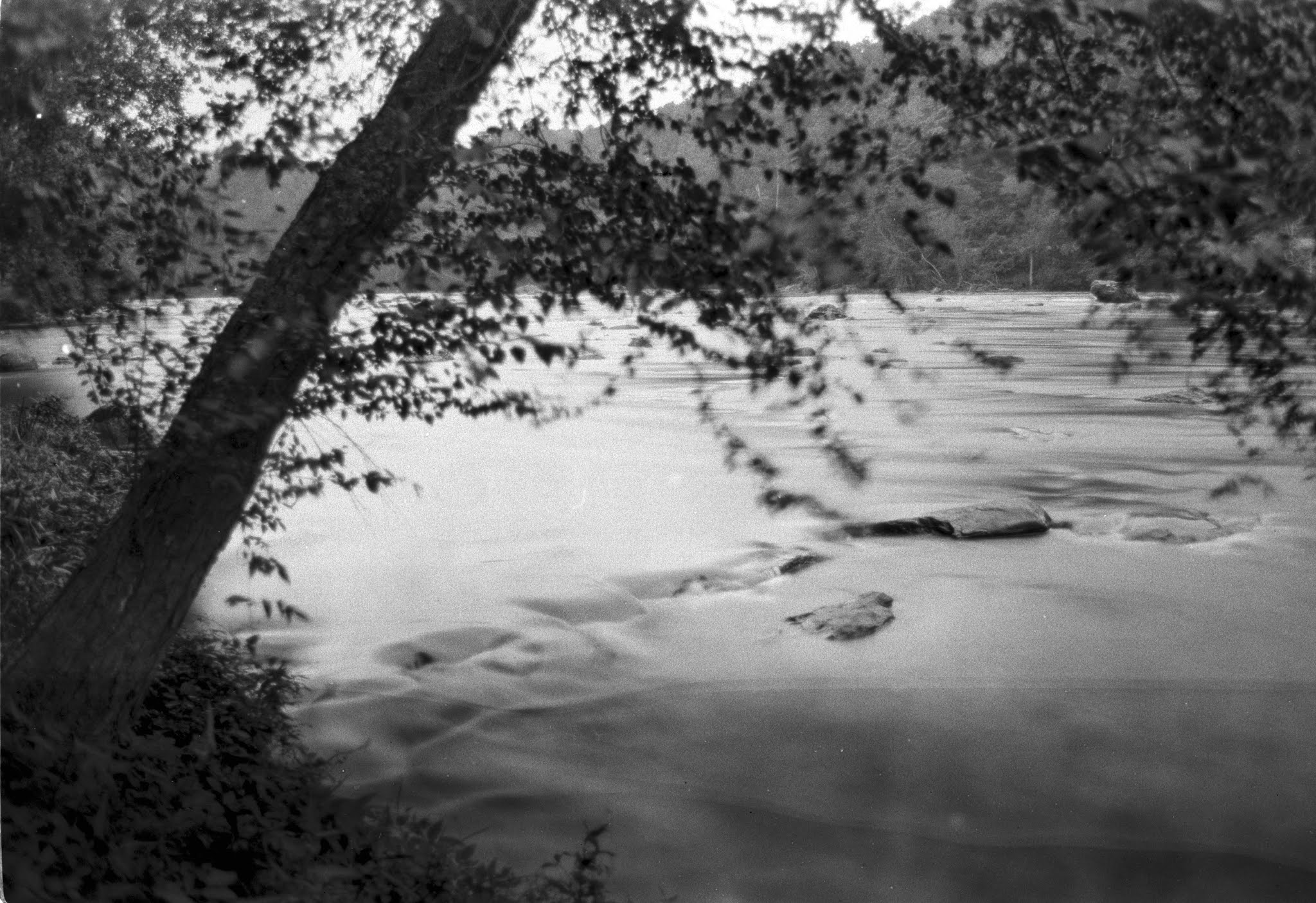
More than 4 years ago, Mike Raso gave me a short roll of what was then the Svema Blue-Sensitive Film at ISO 1.5.  It sat around in the open in a translucent container, in and out of camera bags, and one day in late July, I finally decided to use it while shooting along the French Broad River near Asheville, NC.  I knew that the slow film would enable me to get some nice long exposures of the swift current.With exposures running from 4 to 8 seconds, I hoped that they would have a real smooth appearance to them. Also of note, the film is Blue-sensitive (Orthochromatic) and doesn't see red, so the tonality of the image would be quite different than what you would get with a full-spectrum panchromatic film, such as Ilford Pan-F.

Sometimes I find that my results didn't meet my expectations, and instead of saying "ugh," I take a different tact and see what I can do with the negative.  The film was developed in POTA developer at 24°C for 13 minutes.  Turns out that this roll of Blue-Sensitive film is a victim of light-piping, as the PET film base transmits light like an optical fiber.  With no anti-halation layer, and a clear plastic storage canister, it only compounded the problem, as the film was fogged.  I didn't expect much from the scans. However, I realized that with the fog, imperfections, and long-exposure (ca. ISO 2), they looked like something from a wet-plate collodion negative. 


I'll try this stuff again, as I like the look of the film, but next time I'll get some fresh from the FPP! The newer version of the FPP Blue-Sensitive is at ISO 6, which will still give me the look that I am after.  

Compare the last image with this one, taken with my iPhone XR, to get an idea of how the Orthochromatic film captures the tones.


Thursday, January 31, 2019

Some Iced Coffee... my last rolls of Mr. Brown

A few years ago, I did a one-roll review of the Mr. Brown film from the Film Photography Project Store.  Over the past month, I have managed to shoot my last two rolls.  The first roll was shot at ISO 6, and developed in my caffenol recipe for 15 minutes at 20°C.  It was quickly apparent to me that the negatives were overdeveloped, as they were quite dense.  Well, one fix for that was to try the second, and last roll at a higher ISO and cut a smidge off the development time in caffenol.  Since Mr. Brown is now out of stock, you may wonder why I am publishing this now.  Well, I imagine that there are some users that have yet to shoot all that they purchased and have some rolls left.  Also, film photography is also about experimenting and sharing results, so here we go.

First of all, here is the Caffenol recipe that I use:

450 ml water
27 grams Sodium Carbonate
8 grams Ascorbic Acid
20 grams Instant coffee
5 grams Iodized salt

Mix in 30°C water and let cool to 20°C before using.  Development times can be from 10-15 minutes, depending on film, so experiment to see what works for you.

Roll 1: Mr. Brown at ISO 6, shot with Nikon N80, 15 min development time. The negatives were very dense, so I had to adjust the curves in the scans to get a normal-looking image: 


You can tell that the highlights are blown out.  So, after that, I decided that in Caffenol, Mr. Brown could be rated at ISO 12-25, perhaps even higher. 

Roll 2.  Shot in my Nikon F2S, 105mm Nikkor, I rated the film at ISO 25.  Quite different subject, with the high contrast ice and dark water, but I also figured that I would develop it for 1 minute less in the caffenol, for 14 minutes.  I still had to do some adjustments in the scans, but still very good for this type of subject, which is about as contrasty as I could get. These are all along Mill Creek in Dexter, MI.


Overall, very good.  So, this tells me that Mr. Brown is certainly a film worth trying in Caffenol, with the added benefit of being able to shoot at a higher ISO than 6!   Of course, you may want to also try this recipe with other low-ISO films to see what you get.  I'd be happy to hear about your results.

Thursday, March 08, 2018

Agfa Cinerex - Another Oddball Film

I purchased a couple of rolls of Agfa Cinerex IC1N film from Ultrafine last year, and finally finished up a roll in my Nikon FE a few weeks ago. I had forgotten to put a slip of paper in the film reminder slot on the back,so all I knew was that I was shooting an ISO 50 film.  I hate it when I do that, but in this case, my subject was a good test for the film.

First of all, what is Agfa Cinerex?  It's a fine-grained orthochromatic film (not red-sensitive) that was used in the medical industry as a cineradiography film.  There is no antihalation layer on the polyester base, so it's a good idea to load it in subdued light to avoid light-piping (which definitely shows on the sprocket area of the roll that I shot). It seems to have first become available online around 2012, as entries regarding the film appeared on Rangefinder Forum and APUG that year.  At that time, someone was selling 300 ft. rolls of it.

There is a dearth of information online from the manufacturer. I'll say one thing about Kodak -- they published technical data for their films and made the pdfs available online.  Thankfully, Ultrafine Online has some basic developing information available, and the links to the forums are helpful. 

When I loaded the film back in September, I did a few shots around town and forgot to indicate the film on the camera. I picked up the Nikon FE last month, and shot some beautiful fog shots to finsih the roll.  I shot more fog on a roll of Svema FN-64, and I will compare them sometime.

I developed the Cinerex film in XTOL 1:1 for 11 minutes at 20C, with my standard fixing time of 8 minutes.  The film dried quickly, and I scanned the negatives on my Epson V700.  There is a slight curl to the film, but it sat nicely in the 35mm filmstrip holders. 
See the light piping? Load in subdued light!

It's an odd film, of course, and probably not well-suited for low-contrast images such as the fog scenes.  However, with sunny conditions, and even low-light, it performed pretty well. Lots of good contrasty results in full sun.  The fog scenes are very grainy, and yet are very interesting.  That's probably pushing the film to accomplish what other films do better, so my next roll will be shot in strong light, and maybe even with LED lighting, just to see what I get.

Until recently, you could buy this unusual film in 36-exposure rolls from Ultrafine Online (also known as Photo Warehouse), but they are no longer selling it in 100-ft bulk rolls, and the individual rolls are listed as "out of Stock". That's too bad, because it's an interesting film. However, like I always say, "If you are late to the party, don't complain about not getting cake."


These all look pretty darn good 

As you might have guessed from many of my posts, I enjoy trying out strange films, especially if they are black and white.   While any film emulsion can be used for some sort of still photography, the challenge is often to see what a film is capable of doing well.  Sometimes the limiting factor is the low ISO of some cinema-specific films -- i.e., those used for making titles and special effects, or for copying to make positive masters.  With some films, it might be the spectral sensitivity that is a factor.  In some instances, we just have to wing it when it comes to the developing of the film.  With a large film user community, we end up having some good data on developing these films, and with sites like the Massive Development Chart, we have an easily-accessed knowledge base.  The gang at the Film Photography Project also have been providing us with some oddball films from Eastern Europe.  If you have been experimenting with any of these films, remember to share your successful results with the larger community.


After adjusting brightness and contrast post-scan 

Almost looks like a pen and ink image.


Monday, March 27, 2017

First Impressions - Lomography's New F2/400 film

When the new F²/400 film from Lomography was announced back in February, I eagerly pounced and bought 10 rolls.  I liked the images that I saw in their advertisements, and still, given the history of the film, I was prepared to be disappointed.  The thing about color films, is no matter what one gets, the resulting developing, scanning and modification can be quite different from person to person. That's because we tend to adjust the colors to what we find most pleasing. My red may not be the red you like, etc.

The history of the film -- from Lomography's site:

"In 2010, we bought the last ever Jumbo Roll of original 400 ASA film from some renowned Italian filmmakers. Then, ever the ones to experiment, we left the film to age like fine wine in oak casks in the Czech Republic. Thankfully, our crazy instincts were rewarded — seven years later, we went back to discover that this fantastic film still produces refined colors with a beautifully unique tone. It’s one-of-a-kind Color Negative with an X-Pro feel, and we’re so excited to share it with you! There’s a only a very limited amount of this film available, so make sure you don’t miss out.

Lomography Tipster: If you would like to experiment different ISO, the Lomography Color Negative F²/400 film gives exciting results also with ISO 200. "

Obviously, if it came from Italy, this is old Ferrania/Solaris film.  I don't recall any experience with that, but hey, I figured that I would still give it a go. The ad colors showed the film as having more of a pastel appearance, with some trending towards blue in the neutral colors.  I loaded two cameras with the film -- my Nikon FM2N, and my Minolta XG-M.  The film in the XG-M was finished first, and I developed it in a fresh Unicolor C-41 kit from the FPP store. About half the roll was shot in New Jersey while at the FPP HQ, and the rest was shot in Ann Arbor and a new state park in Jackson Co., MI.  I rated the film at ISO 400, used Aperture-priority mode, and did not do any exposure compensation for the shots. I used an Epson V700 scanner to scan the negatives.

The film base is a dark orange-red, and the frames looked uniformly overexposed to my eye.  As we know, scanning and post processing can do wonders,    The images did tend to have muted pastel colors, slightly bluish in the neutral colors, and a bit soft.  Not necessarily a bad thing, but I ended up tweaking every image to make them satisfactory to my taste, at least.  While the Lomo site says one can shoot it at 200 for exciting results, I think one should go the other way.  ISO 800 may be where this film really shines.  The roll in my Nikon is about half shot at 400, and I am going to do the rest at 800 and see what I get.  I'll post an uncorrected image from one frame first, and my corrected version after that. The remaining images all reflect my adjustments in Paint Shop Pro, reducing the exposure and in some cases, doing some auto local tone-mapping for a better effect.

unadjusted image - straight scan

adjusted to my liking

and here we go...


Judging by the indoor photos, this film could be easily rated at ISO 800.   I have used that XG-M many times, so I know it's not overexposing due to faulty metering.  My second roll will be additional data, for certain.  
Okay, what do I think so far?  I'm on the fence.  I sort of like it, and the indoor image of Mike Raso is quite good.  I think a little underexposure might be good.    I also need to shoot it with more people as subjects and see how it goes. Of course, if you want a washed-out Lomo look to your images, this film is perfect.  As of this evening, I see that Lomography Color Negative F²/400 is still sold out, so my remaining stock is all I will probably have on hand.  If you have shot some, let me know your opinion, as well!

Sunday, March 26, 2017

Point and Shoot Review - Olympus Trip XB40AF

front of the camera
There are so many cameras that turn up for a buck or two at the thrift shop, and while I ignore many of the point and shoots, I'll occasionally buy one.   Last year, I picked up an Olympus Trip XB40AF Quartz Date 35mm camera.  It takes 2 AA cells for power -- the exposure system (however minimal it may be) and the flash need the batteries, and the film advance is also automatic.  Don't let the "Trip" designation trip you up.  White the original Olympus Trip was and still is an amazing point and shoot, the cheap descendants are not really noteworthy.  However, it's my duty to at least give one a try and report on my impressions.

The camera switches on when you slide the lens cover away.  The wide-angle 27mm lens has a maximum aperture of f/6.3, which is hardly a benefit -- so it's pretty much similar to the simple Vivitar PN211 in that regard.  I am not sure how much automation is in the camera -- The flash operates in all conditions, and there is no way to turn it off in daylight.   The shutter speed is 1/100 sec. for everything.  The true-image viewfinder is large and certainly easy to see through. There is a tripod socket. The film chamber reads the film ISO 100-400.   Obviously, when indoors, it would pay to use ISO 400 film for a better flash coverage.  The film is automatically rewound when the end of the roll is reached. I think the camera was introduced in 2000, near the end of the 35mm film point and shoot era, when digitals started to replace that part of the market.
back of the camera.

So, I put in a roll of Svema 125 color C-41 film (my last, as it turns out).  Over the course of a year, I managed to finish the roll.  Mostly I used it while at Film Photography podcast recording sessions, since were are all close together, and the 27mm lens has a pretty wide field of view.

I finished the roll in March, and home-developed in the Unicolor C-41 kit.  The Svema films lies flatter in the scanner than a woodchuck on the expressway.  Here are a few examples from the camera.


So, how did the camera fare?  Considering that it's merely a cheap P&S without any sort of control, it did about as well as any wide-angle single-use camera.  The Trip on the name is a reminder that it's supposed to be used wherever you go.  However, it's not  that the camera is bad, it's just not worthy of the Trip branding.  It's certainly worth a buck, and will give adequate, but not super results - and better than say, a Diana 35mm.   Oh, and no I didn't activate the Quartz Date back.  That's just not needed.