
Showing posts with label caffenol. Show all posts

Sunday, June 16, 2024

Shooting Kudzu - developed from Kudzu

Kudzu, the weed that ate the South- 2023 image


One of the wonderful aspects of film photography is the ability to develop your film in the way you choose.  Maybe you are strictly a one-developer for all films kind of person, or maybe you use a variety of developers, and choose depending on the film being used.  Or, maybe, you are one of those renegades that think using a non-traditional developer such as instant coffee is the way into enlightenment.  Some photographers eschew traditional photo chemistry for different reasons, but the most common reason is the lower impact on the environment.  But another reason is just to see what works, and if it’s more environmentally friendly, all the better. That’s the charm of using film -- there is no single path, and you can choose whatever gives you the results you desire.  


I’ll admit that for many years, I stuck with traditional developers, as I wanted results that I could depend upon, and I mostly still do. That’s not a bad thing.  If you are accustomed to the results that you get from D-76, Rodinal, or XTOL, or whatever favorite developer, that’s backed by many years of use and predictable outcomes, that’s what you’ll use.  Developers made from coffee? Nah!  How about botanicals? Nah!  Who wants to trust their film to some sketchy home-brewed concoction?  Well, the avant-garde photographers and experimenters would like a word.  Don’t be tied into the clutches of Kodak, Ilford, or those chemistry peddlers!  Create your own developer from whatever the hell you want!
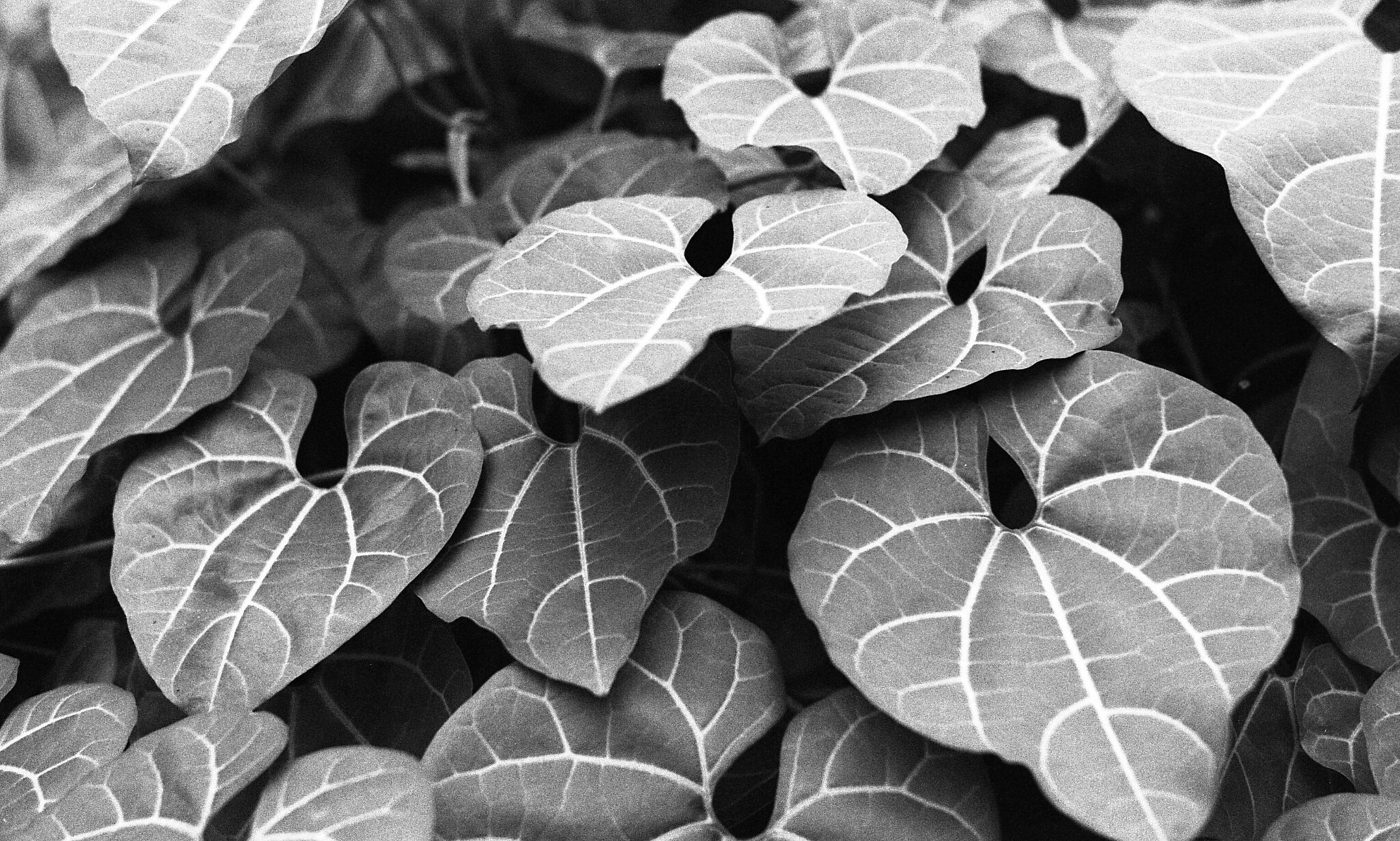

Orwo NP55, developed in Caffenol, 2019


Okay, the last sentence was a little much, but to create your own developer isn’t just throwing jelly at a wall to see what sticks.  You need to be able to transform that latent image into a negative, and to do that requires a few components.  I am not going to go into the complex photochemistry developers, but the main purpose of the developer is to turn the silver halides in the latent image into metallic silver, which will appear as a darker grain in the gelatin matrix of the film. When properly developed, areas that did not receive any light will be clear, and areas that received light will be in various shades of gray to black.  Typically, that action is done by by the developing agent, and traditionally, that agent is phenidone, hydroquinone, or metol.  The addition of an accelerator to provide a higher pH, such as borax, sodium carbonate, or sodium hydroxide keeps the developing environment basic to enable the developer to work without depletion before the halides are fully affected. However, Ascorbic Acid (Vitamin C) is also a developer,  but one that is not very strong, unless combined with another developing agent.  It’s also the least toxic developing agent.  A restraining agent is also used to avoid too aggressive development which results in fog.  That’s often Potassium bromide or Potassium iodide, but not all developers need them.


Are you confused yet?  To replace a commercial developer with a home-brew of less toxicity, you need a chemical that acts somewhat like phenidone, or that of a tanning or staining developer, such as Pyrogallol or Pyrocatechin.  Here is where things get interesting. Minute amounts of catechin are found in green tea.  If tea might work, what about coffee?  Its super power is caffeic acid.  Well, that works, but what about plants with green leaves?  So, you see where this is heading.  The problem is that we don’t know up front, what different plant chemistries are in relation to film developing.  But, given the penchant for experimentation, people have found materials that work as well as typical developers, but also with their unique characteristics.  Coffee, beer, wine, urine, tea, and various herbs have been used to make developers.  On their own, they can’t develop film, because the accelerator and ascorbic acid are needed.

So, on our mission to create a developer, we need:

  • Some extract from organic material that contains catechins,  caffeic acid, or polyphenols
  • Sodium carbonate for the accelerator
  • Vitamin C to work with the organic material as the developer.
  • maybe a restrainer - Iodized table salt 


You have probably heard of Caffenol as a developer, and there are numerous recipes for it. Caffenol works well, but has a few drawbacks, one being the expense of instant coffee, and the foul odor it has can be a real turnoff for some.  I have used caffenol a number of times and it is certainly a reliable developer that can be used for film and paper, but it does also stain the emulsion.  If you don't already have the ingredients, you can buy some pre-mixed from the Film Photography Project store. I have blogged about Caffenol several times, and it's a good developer if you want to try it out.  There are developer recipes that use green tea, and more recently, some photographers have gravitated to experimenting with locally-sourced herbs and leaves that can act as developing agents in concert with the above materials.  


In the past year, I have seen some very good results from Beatrice Thornton, a photographer based in California.  Her experiments with commonly available leafy plants to act as the basis for developers are quite impressive. (https://www.beatricevictoria.com/writingandreviews) Her work was in the back of my mind when I started working on a project with the invasive Kudzu vine.  My premise was to take photographs of Kudzu and use the Kudzu leaves to develop the film.  I had absolutely no idea if that would actually work, but I figured that I might at least get some thin negatives, if anything.


Riverside Drive, Aug. 2023, Leica M2, SHD 100 film


On June 14, I took a little drive along the French Broad River near Asheville, and found a spot with plenty of Kudzu growing along the roadside.  I took some photos of the Kudzu, and picked enough leaves to fill a plastic grocery sack.  I then went to some other places that I knew I would find plenty of photogenic Kudzu, and a few worked out, because I was also shooting with two cameras - my Nikon FM3A with Eastman 5231 (expired) for the film to be developed in the Kudzu. My Nikon F was loaded with Kodak HIE IR film (expired 2007), so I needed the leaves to be in strong sunlight.  


After I returned home, I put some of the Kudzu leaves into a 1 quart stainless pan and nearly filled it, making sure that I ripped the leaves into smaller pieces to facilitate the process of extracting whatever botanicals I might get.  I then poured enough boiling water to fill the pot and cover the leaves, and let it sit covered for about 5 hours.  


Making the  "Kudzol" developer


I poured the strained yellowish liquid into a plastic container and ended up with 1 liter of extract.  To make the developer, I did the following:

1000 ml of Kudzu extract

6 Tablespoons of Sodium Carbonate

2 Tablespoons of Vitamin C (crushed in a pestle from tablets)

1/4 teaspoon of Iodized Salt (restrainer) 


The temperature of the liquid at this point was 24°C, and because it was getting late, I decided to go ahead and use it at that temp.  With the addition of the other ingredients, the solution was a darker color.
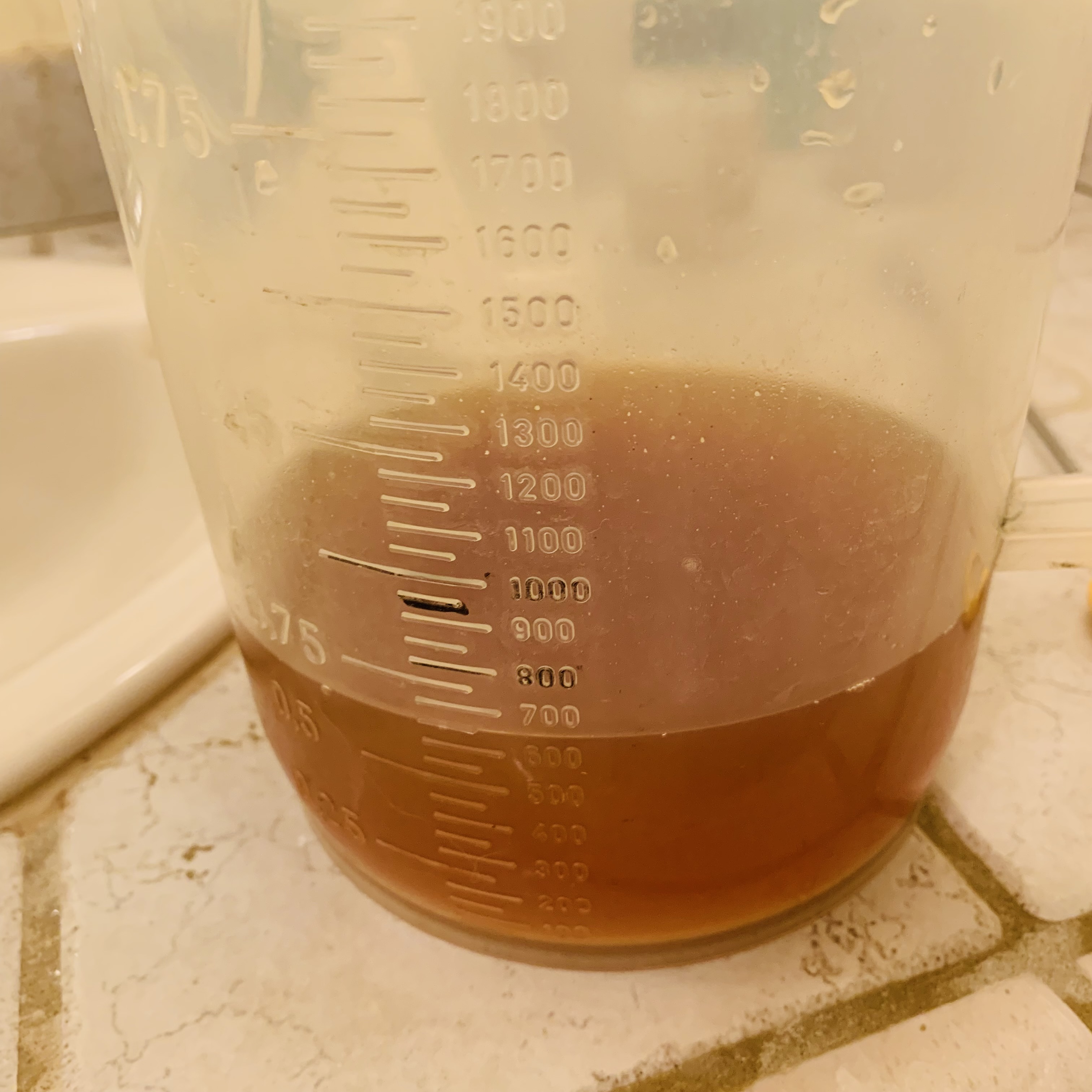


I put the Eastman 5231 in a 500 ml developing tank, and filled the tank with the developer. I decided on a time of 16 minutes, with 3 inversions every 30 seconds.  I really had no guide here, as I was just extrapolating from a caffenol recipe and the 24°C temperature.  I used a water stop as usual, and then 8 minutes in fixer, and the typical Ilford wash technique.


When I took the reel out of the tank, and unrolled the film, I was thrilled to see that I had negatives!  The emulsion was definitely stained by the developer, but what I could see looked quite good.  The next morning, I scanned the negatives on my Epson V700 scanner at 3200 dpi. The scans came out quite good with just some minimal tweaking afterwards.  


As you can see, these look like any other negative processed in typical chemistry, but with a yellowish tint to the emulsion.  Upon closer inspection, I think that if I had gone with 14 or 15 minutes, the negatives might be perfect, but as you can see from the following images, the results are very good.  If I were to do this at 20°C, I would estimate the time at 20 minutes.  For high-ISO films, you could add a teaspoon of iodized salt or even omit it, but I have not tested it for those films yet.  The Eastman 5231 is a silver-rich emulsion with an ISO of 80 (it’s expired film).


The beginning of the roll.  On US23 near Dillsboro, NC

The source of the Kudzu leaves

slowly enveloping

The same truck shown from 2023 just a few days ago


reach for the sky

young shoots

At the end of the roll in my yard. Hosta flowers


Final thoughts on Kudzu developer


What drove me to this was the “what if?” without worrying about failure.  While I had no preconceived idea of the result, I did know that others have used various botanical extracts to develop film.  So, I figured that I might get something.  I didn’t know what the quality of the results would be, so I am very pleased with what I got.  The experiment has taught me to trust my instincts, and to try out the unusual for a change.  It also shows that Kudzu can be used for something!  So, don’t be afraid to give this a try.  


I can't stress this enough...


WARNING - If you are unsure of what vining plant you are pulling leaves from, please take the time to know the difference between Poison Ivy and Kudzu!  That applies to any plant that you might harvest to make a concoction with.  Know your plants before you start picking anything.


I am not responsible for your mistakes.


Thursday, March 14, 2019

Agfa Copex Rapid 50 film - One Roll Review

I was going through some files today and realized that although I had shot this film in 2017, and noted it in my article of the pre-assembled Caffenol mix, I did not really review the film! So, here is my recollection of the Agfa Copex Rapid 35mm film.

I bought a roll of the 35mm Agfa Copex Rapid film from Freestyle to try it out. It sat in my fridge for many months before I decided to give it a try.  My delay was probably more about the development of the film than the shooting of it. At 50 ISO, it's not as slow as a lot of the strange films that I have tested, and it certainly is a stop faster than Kodak's TechPan film.  Since it's basically a microfilm, it will be inherently contrasty.  Not as much as something like Kodalith, but I assumed it was going to be more like a Technical pan type of film.

Here is Freestyle's online description of this film:

Agfa Copex Rapid 50 is a low-speed panchromatic black and white film with a nominal sensitivity of ISO 50/18°. Featuring excellent resolution, very fine grain and excellent acutance. The emulsion is coated on a transparent synthetic base providing excellent long-term and dimensional stability.

Features:

  • Traditional Black and White Film
  • 35mm x 36 exp.
  • 50 ISO
  • Manufactured to ISO specifications for archival use
  • For optimal results use: Spur Modular UR AB Developer

Note: Film has to be loaded and unloaded in subdued light and exposed film should be stored in a light tight film container.

When Copex is developed with Spur Modular UR developer, sharpness, fine-grain, exposure latitude, tonal values, speed utilization are all retained. The Parts 'A' and 'B' are needed for the absolutely streak-free development of the SPUR DSX/Agfa Copex Rapid roll film; Part 'C' is no longer needed as previously.

This film can also be processed using a black and white reversal process (SCALA) to make black and white slides (positives) with a neutral black tone, a middle graduation, very fine grain, a very high sharpness and detail resolution when processed as a black and white slide.

Black and White Reversal process expose to:
35mm: ISO 50-64
120 Medium Format: ISO 64-80
Development time: 4 minutes
-------------------------------------------------------------------

What deterred me from shooting it for so long was the specialty developer.  I like to use what I have, and I am assuming that the aforementioned developer tames the contrast.  Nevertheless, World-wide Pinhole Day was approaching, and I wanted to shoot the film in an SLR while also doing the pinhole stuff that day.  For some reason, I chose my Minolta X-370 SLR and took it along for the day.  I shot the film at 50 ISO, and used a tripod, as it was an overcast and chilly day. Some of my exposures were set at f/16, which meant shutter speeds long enough to blur motion.  As my link at top shows, I developed the film in the Labeauratoire Caffenol Concoction  for 15 minutes.  I figured, what the hell, just go for it and see what happens!

Developed in the Caffenol, the film looks a lot like some of the specialty microfilms that I have used -- though it was certainly faster.  I'll take ISO 50 over ISO 6 any day.

Here are some sample images.  Overall, I was pleasantly surprised at the results.  The film is on a PET base, so it does lie flat and scans easily. I had to do some tweaking in Corel Paint Shop Pro to get the look I wanted from the scans from the Epson V700.  I guess if I were to seriously try this film again, I would try the SPUR developer. However, the Caffenol did a pretty good job,and of course, I could also try Technidol to see how that works with the Copex rapid 50 film.


The beauty of shooting film is that there are so many different approaches you can take with any particular film.  In this case, I took a chance with a non-traditional developer and it worked pretty well.  Your results may vary when using the Copex Rapid 50, but it certainly is fine-grained and may be just the solution to what you are looking for in a film.  Missing TechPan?  Give this film a try.

Thursday, January 31, 2019

Some Iced Coffee... my last rolls of Mr. Brown

A few years ago, I did a one-roll review of the Mr. Brown film from the Film Photography Project Store.  Over the past month, I have managed to shoot my last two rolls.  The first roll was shot at ISO 6, and developed in my caffenol recipe for 15 minutes at 20°C.  It was quickly apparent to me that the negatives were overdeveloped, as they were quite dense.  Well, one fix for that was to try the second, and last roll at a higher ISO and cut a smidge off the development time in caffenol.  Since Mr. Brown is now out of stock, you may wonder why I am publishing this now.  Well, I imagine that there are some users that have yet to shoot all that they purchased and have some rolls left.  Also, film photography is also about experimenting and sharing results, so here we go.

First of all, here is the Caffenol recipe that I use:

450 ml water
27 grams Sodium Carbonate
8 grams Ascorbic Acid
20 grams Instant coffee
5 grams Iodized salt

Mix in 30°C water and let cool to 20°C before using.  Development times can be from 10-15 minutes, depending on film, so experiment to see what works for you.

Roll 1: Mr. Brown at ISO 6, shot with Nikon N80, 15 min development time. The negatives were very dense, so I had to adjust the curves in the scans to get a normal-looking image: 


You can tell that the highlights are blown out.  So, after that, I decided that in Caffenol, Mr. Brown could be rated at ISO 12-25, perhaps even higher. 

Roll 2.  Shot in my Nikon F2S, 105mm Nikkor, I rated the film at ISO 25.  Quite different subject, with the high contrast ice and dark water, but I also figured that I would develop it for 1 minute less in the caffenol, for 14 minutes.  I still had to do some adjustments in the scans, but still very good for this type of subject, which is about as contrasty as I could get. These are all along Mill Creek in Dexter, MI.


Overall, very good.  So, this tells me that Mr. Brown is certainly a film worth trying in Caffenol, with the added benefit of being able to shoot at a higher ISO than 6!   Of course, you may want to also try this recipe with other low-ISO films to see what you get.  I'd be happy to hear about your results.

Saturday, June 10, 2017

Caffenol, the Universal Developer?

One of the interesting aspects of film photography is that it is a chemical process.  Therefore, there are myriads of combinations of developers and films that give us differing results. The process encourages experimentation, and while there are varying opinions on what constitutes the ideal developer, ideal film, and so on, the results are a reflection of a photographer's eye and what he/she considers acceptable results.  In addition to that circle, there are people that look for the unusual and one of those is to find the household "chemicals" that allow us to develop a roll of traditional black and white film.  This is one of those aspects of developing film that I find quite interesting.  One popular "household" developer is Caffenol, which contains a strong mix of dissolved instant coffee. The cheaper the brand, the better.  There are various formulations of Caffenol, and the typical mixture contains instant coffee, Vitamin-C, and Sodium Carbonate (washing soda).  There is a really great resource for those wanting to know more about it at caffenol.org.   I have made my own Caffenol concoctions with decent results, but it's been a few years since I have used it.  However, a few months ago I received a packet from the FPP store of the pre-mixed Caffenol sold by Labeauratoire.  If you just want to try using Caffenol, this is a good way to sample it without buying all of the components and mixing it yourself, and you can decide if it is worth going that route if you like the results. Note -- you can also use Caffenol to develop prints - and "tone" them at the same time, but I have not tried it myself.

Mixing is easy -- just follow the instructions on the packet, and allow it to cool to 20C before developing your film.  The contents of the packet makes enough developer to do 4 rolls of 35mm film.  The beauty of Caffenol, absent of any other advice, is that you typically develop for 15 minutes for any film. Pretty simple, right?  Of course, the smell of the concoction is not the greatest, and if you were expecting the aroma of a fresh cup of coffee, you'll be disappointed. You are not supposed to drink the stuff, anyway.

I developed 2 rolls of 35mm and 1 roll of 120 film before I dumped the Caffenol down the drain.  One of the rolls was Agfa Copex Rapid film - a high contrast film that is similar to Kodak technical Pan film.  I have heard that people have gotten good results with TechPan in caffenol, so I was curious as to how the roll would come out.  The other 35mm roll was expired IIlford Pan-F, and a 120 roll of Agfa APX 100.  Standard Kodak fixer was used, and the stop bath was just a water bath, which also washed away the dark Caffenol from the film.

Results -- very good. In fact, far better than I expected. All the negatives looked good, and the Agfa Copex was contrasty, as I would have expected.  However, the cool thing is that I developed the Agfa and the Ilford 35mm films together in the tank.  That would not have happened with other developers.

Some samples

expired Pan-F at ISO 32, Olympus OM-2

expired Pan-F at ISO 32, Olympus OM-2

expired Pan-F at ISO 32, Olympus OM-2

Agfa Copex,  Minolta X370

Agfa Copex,  Minolta X370

Agfa Copex,  Minolta X370


I think you can see that this developer gives you really nice tonality. low-grain, and it's as easy as can be to use.  While the pre-made packet is about the same price as a bag of D-76, it has low toxicity, and can be assembled on your own quite a bit cheaper in quantity.  It's a lot of fun to experiment with developers, and take a look at the Caffenol information online. There is a very enthused community of users out there.