Showing posts with label low-iso film. Show all posts

Tuesday, October 17, 2023

Kodak 2238 and a Rollei 35 TE


I first reviewed Kodak 2238 in 2017, and shot it under winter conditions, where the contrast was already quite high.  Also known as Kodak Panchromatic Separation Film for use in the cine world, it’s a low ISO film that’s rated at 12-25 ISO, and does not require a special low-contrast developer to get a proper negative.  That’s what I like about it, since D-76 and D-96 are my favorite developers.  But the other thing I like about 2238 is it’s ultra-fine grain - nearly grainless, and the way it renders landscape scenes.  I loaded a roll into my Rollei 35 TE, which I’ve owned for well over 20 years.  The Tessar lens in that Rollei 35TE is sharp as can be, perfectly suited for a high-definition film like 2238.

Since 2238 is shot at ISO 25, I limited use to daylight photographs, as my Rollei 35 TE shutter no longer operates at speeds below 1/15 sec.  That’s due to the way these cameras are typically stored - with the shutter cocked and the lens retracted into the body.  Long-term storage like that causes the loss of the slow shutter speeds.  

I shot most of the roll of 2238 on a trip to Ludington State Park, Michigan, in mid-September.  It’s a great little camera to keep in my camera shoulder bag, as it takes up very little space, and I have always had great results from it.  While it does need a battery for the meter, I rarely use the meter, and just go with an external meter of sunny-16 estimates.    

Ludington State Park is on the Lake Michigan shoreline about half-way up the west coast of Michigan’s Lower Peninsula. There are lots of sand dunes, inter-dunal ponds and wetlands, as well as Big Sable Point light house at the northern end of the park.  So, it has great lakeshore access as well as a nice road/trail that runs N to the lighthouse.  I mostly shot that day with my Nikon F3HP, but the trusty little Rollei 35 came out towards the end of my day of shooting. 

The film was developed in FPP D-96 for 12 minutes, and the results were what I expected.  It turns out that the roll of 2238 had been loaded nearly a year prior, when I was in Lexington, VA.  That’s what happens when there’s a small camera in my bag — it sometimes can take a year to shoot with it.  Here are a few shots from that roll, all scanned on my Epson V700.


my favorite of the series


I encourage you to try some of these oddball films like Kodak 2238.  They are not what I’d call general-use films, since they are very slow.  But, for detail-rich landscapes, architecture, and a different take on portraiture, they can yield great results depending on the lens and the lighting.  Another good choice for slow films is Rollei RPX 25, which is readily available and can be easily developed.  

Wednesday, January 05, 2022

Review - FPP Blue Ultra Color Film

It seems that as film photography has roared back from the almost-dead, we are seeing some quite oddball emulsions popping up that we would never have seen pre-digital era.  However, while black and white film choices have expanded, color film choices from the big companies have shrunk, as Fujifilm has reduced the number of its color emulsions, and Kodak's color emulsions are much fewer than a dozen years ago.   Offsetting that of course, is Lomography and its stable of oddball films.  In addition, access to ECN-2 chemistry has brought some really wonderful color cine films from Kodak to the fore.  So, while the pre-digital era C-41 and E-6 films stressed color fidelity, we now see a number of unusual films such as Lomochrome Purple and Lomo Metropolis that do the opposite. In that vein, here is a color C-41 film from the Film Photography Project that is sure to be of interest.  

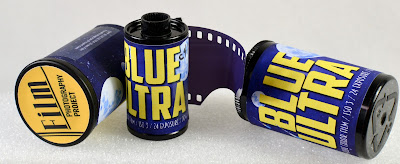
FPP Blue Ultra film

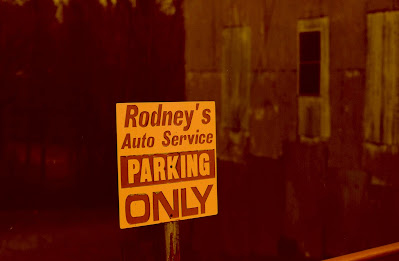
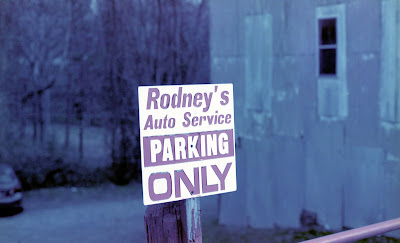
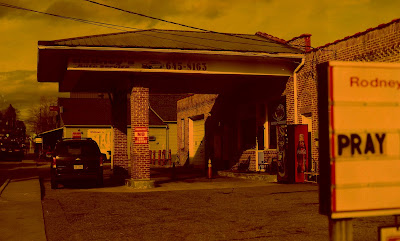
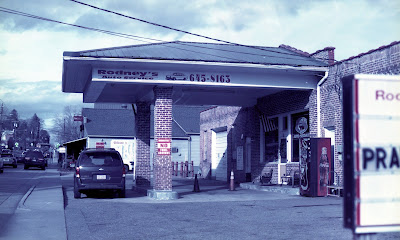
FPP Blue Ultra is a low-ISO (ISO 3) color film with a pronounced blue shift and muted colors that is unlike anything I have shot. It's much like a duotone with the blue -purple and popping reds. Since it is so slow, it's a challenge to shoot without a tripod, but believe me, you can.  On a sunny day you can shoot wide open at 1/30 sec, giving you an opportunity to exercise your creativity.  The film comes in 24 exposure rolls, and it's obvious just by looking at the unexposed film that blue is dominant.  The film appears to be on a polyester base.  The sprocket holes do not look like cine sprockets, but normal 35mm film. There is no antihalation layer or remjet. 

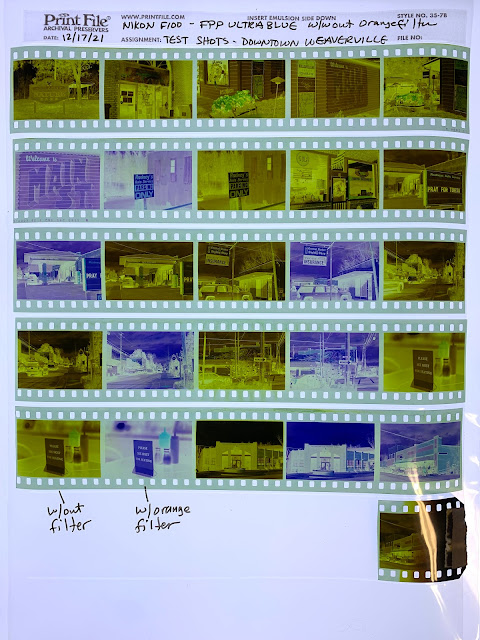
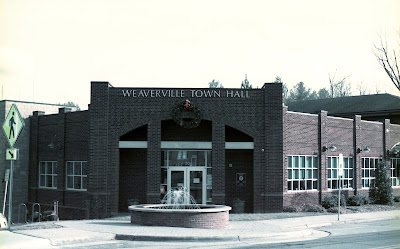
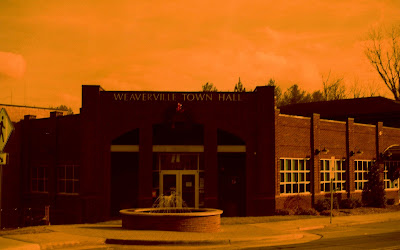
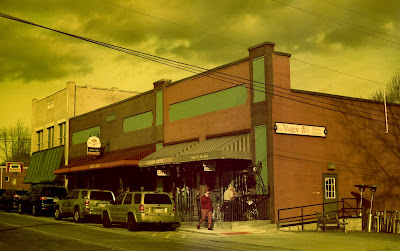
Mike Raso sent me some rolls of Blue Ultra to test, and I shot my first roll with my Nikon F100 and my 50mm f/1.4 AF-D Nikkor lens.  The FPP suggests trying an orange filter, which I did also use, but more on that later.  I set the ISO to 6 (as low as it goes on the F100) and set the exposure compensation dial to +1 to give me an ISO of 3.  I went for a stroll in downtown Weaverville to test the film on a partly cloudy December afternoon.   Shooting at apertures of f/1.4 - f/2.8 allowed me to shoot without a tripod, and of course, I tried to choose objects and scenes that were well-lit by the sun.  I also went for shooting colorful compositions to see what I'd get.  I typically shot a scene with and without the orange filter to see the difference. 

After I was done with the roll, I developed it in the FPP (Unicolor) C-41 developing kit.  I really did not know what to expect, and after seeing the negatives, I have to say that I really like this film.  It is extremely fine-grained, and after scanning the negatives with my Epson V700 scanner, I'm even more impressed.  You want a different look? This film has it.  On top of that, shooting wide-open changes a lot about a scene.  

contact sheet - non-filtered shots are yellow-ish


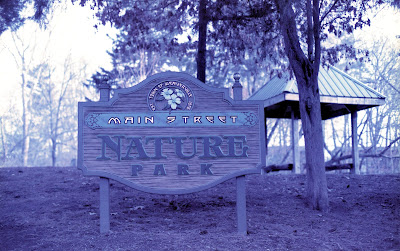
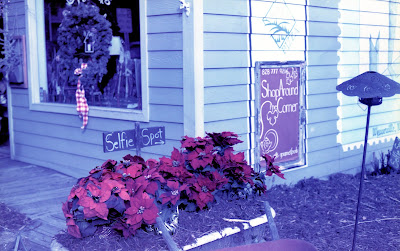
The film renders a scene bluish to purple, and reds are really nice.  Yellows are not seen. It sort of has a faded look to it, and using a photo editor to restore faded film won't work here, because part of the colors are actually lacking. When I used an orange filter, the colors are somewhat more punchy, but you also lose almost 2 stops of light when you need it most.  In addition, white areas look almost sepia, but more like a dark yellow, but not so much when in bright sun.   Another time I'll try a K-12 (yellow) filter to see what happens.  Saving the color images as grayscale to give you lovely black and white images isn't too bad a thing, either.  However, I really liked the results without any filtration the best.

Here is a selection of images from the first roll.  This film is certainly worth a try! I do advise use of a tripod if you are shooting at smaller apertures. 


no filtering

No filtering


orange filter

no filtering

orange filter

no filtering

no filtering - the yellow mustard container seems light blue

orange filter. Another stop of exposure would have helped.

without filter

orange filter

orange filter with strong sun. Definitely better with the sun at your back


Saturday, August 01, 2020

Slow Speed Serendipity

If you have been following Random Camera Blog over the years, you'll konw that I have been experimenting with low-iso films for quite a while.  If you haven't yet purchased a copy of Monochrome Mania Number 1, which is all about low-iso film, I still have some available for purchase and see the link in the sidebar.  
 
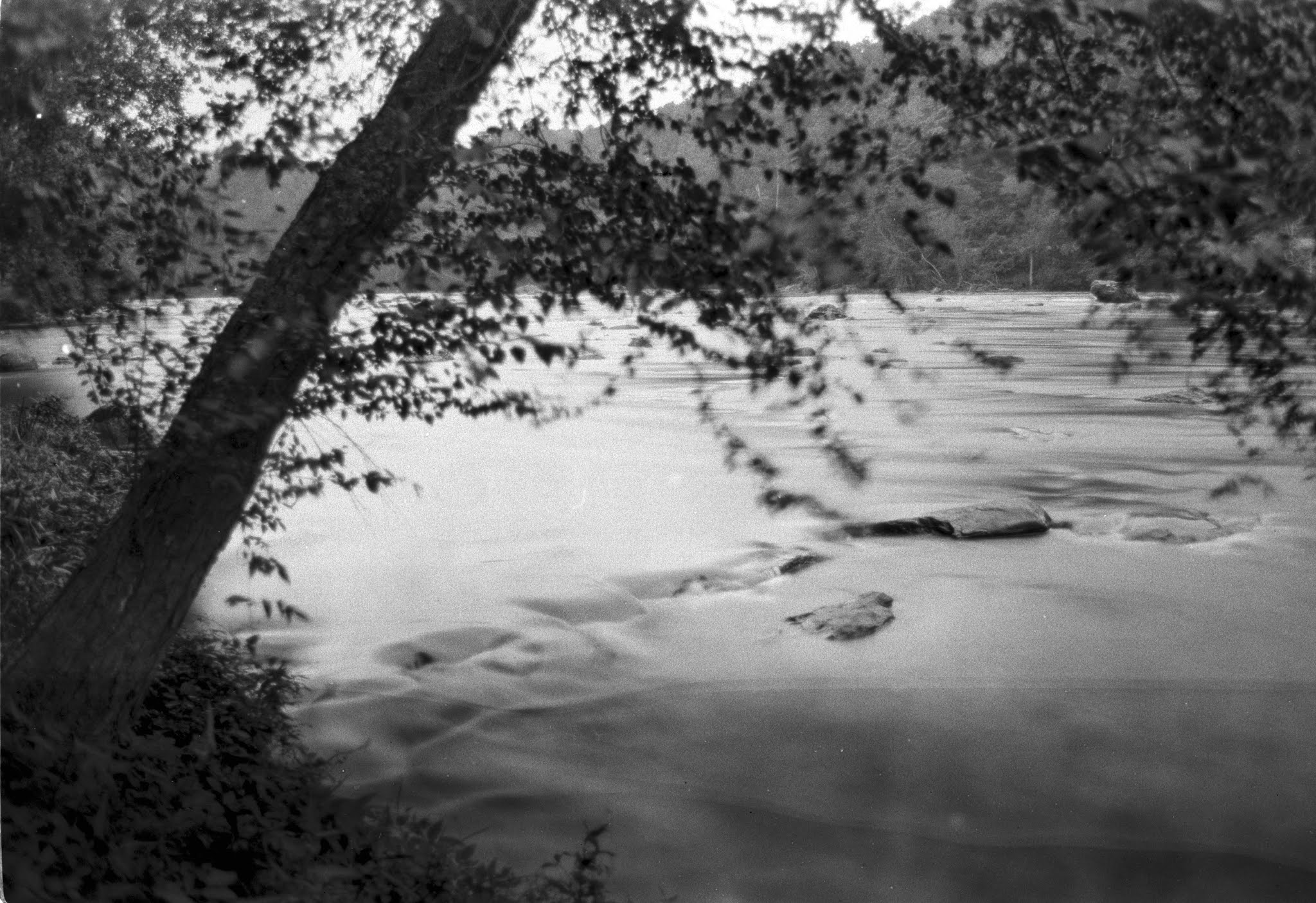
More than 4 years ago, Mike Raso gave me a short roll of what was then the Svema Blue-Sensitive Film at ISO 1.5.  It sat around in the open in a translucent container, in and out of camera bags, and one day in late July, I finally decided to use it while shooting along the French Broad River near Asheville, NC.  I knew that the slow film would enable me to get some nice long exposures of the swift current.With exposures running from 4 to 8 seconds, I hoped that they would have a real smooth appearance to them. Also of note, the film is Blue-sensitive (Orthochromatic) and doesn't see red, so the tonality of the image would be quite different than what you would get with a full-spectrum panchromatic film, such as Ilford Pan-F.

Sometimes I find that my results didn't meet my expectations, and instead of saying "ugh," I take a different tact and see what I can do with the negative.  The film was developed in POTA developer at 24°C for 13 minutes.  Turns out that this roll of Blue-Sensitive film is a victim of light-piping, as the PET film base transmits light like an optical fiber.  With no anti-halation layer, and a clear plastic storage canister, it only compounded the problem, as the film was fogged.  I didn't expect much from the scans. However, I realized that with the fog, imperfections, and long-exposure (ca. ISO 2), they looked like something from a wet-plate collodion negative. 


I'll try this stuff again, as I like the look of the film, but next time I'll get some fresh from the FPP! The newer version of the FPP Blue-Sensitive is at ISO 6, which will still give me the look that I am after.  

Compare the last image with this one, taken with my iPhone XR, to get an idea of how the Orthochromatic film captures the tones.


Tuesday, March 10, 2020

One Roll Review - Tasma Mikrat 200 - The Slow Meow


Back in February, I purchased three rolls of Tasma Mikrat 200 - an expired document copy film, from Eric (aka conspiracy.of.cartographers).  The film, cleverly named  by Eric as "The Slow Meow," is  nominally a 6-12 ISO film, on acetate stock, and without an anti-halation layer.   How do I know it does not have an anti-halation later?  Read on, dear reader!

First of all, by now you know that I love playing with slow films, and the Tasma Mikrat 200 is one that I had not had an opportunity to test out before now.  With any of the films from Tasma, it is likely that they are old stock, but given what I know about Russian and Ukraine film companies, it's safe to say that we don't ever really know what the actual story is.  I have tried many Svema films, as well as Tasma Mikrat Ortho and Tasma NKII film (sold by the FPP). However, The Tasma Mikrat 200 is one that stands out because I have seen very few examples of results from this film online.   When I saw that Eric was selling this film in 3-roll packs, I immediately placed an order.  It arrived very quickly, and the film cassetes were packed inside a black plastic ziploc bag.  I transferred them to black canisters, and made sure that I didn't leave them out in the light for too long.  Since I now know that the film is on an acetate base and not a polyester base, light-piping was not a problem.

I loaded the first roll into a Nikon FM2N, since the lowest ISO setting is 12.  I used it with a series E 35mm f/2.5 lens (just for the hell of it, I suppose).  I shot the first few frames on an overcast day, and used a tripod.  The photos of the sheep at the Biltmore Estate were about 1/8 sec exposures (March 4).  The rest of the roll I shot on a sunny afternoon of March 8  along Depot Street in the River Arts District of Asheville.  Those were all hand-held, and I shot at 1/30 sec, meaning most were shot at f/8.  There were 34 exposures on that roll.  Today, I developed the roll in Rodinal at 1:50 for 12 minutes, per samples that Eric had posted online.

After drying, the film has a very slight cupping, but nothing like Kodak Tri-X or old Agfa APX 400.  It scanned very well, and my initial reaction is that in a full sun situation, I could have shot the film at ISO 25.  For cloudy overcast conditions, I'd say that 12 was right on.    Due to the sunny conditions on the 8th, the film exhibited a "blooming effect" when bright reflections are in the frame, which I have seen with Lucky films, and with Polypan-F.   That indicates there the film has no anti-halation layer.  It would be far worse if the camera has a chrome or textured chrome film pressure plate.

Overall, I am very pleased with this film and developer combination.  A bit contrasty in full sun, which is fine, but also very fine-grained.  Kudos to Eric for taking the risk of buying a big-ass roll of this film to share with the film-shooting community.  I'm glad that I purchased three rolls!

RESULTS

At Biltmore Estate, overcast day

late in the day, setting sun. Lots of tonality here

Bright, but not direct sun

Direct sun, note the "blooming" at the bottom white structures


some motion at ISO 12.


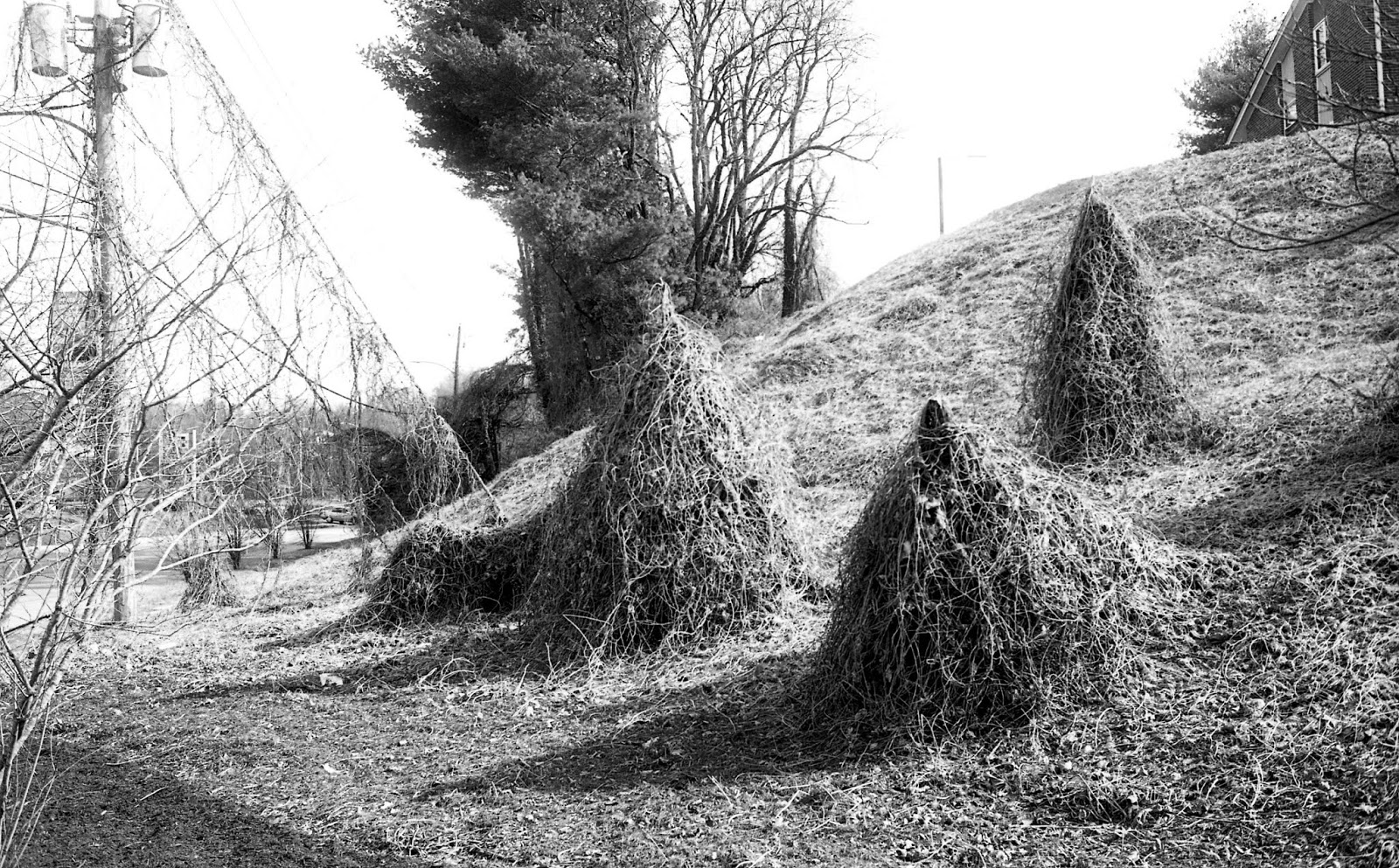
Kudzu Army