Showing posts with label low-ISO. Show all posts

Saturday, August 01, 2020

Slow Speed Serendipity

If you have been following Random Camera Blog over the years, you'll konw that I have been experimenting with low-iso films for quite a while.  If you haven't yet purchased a copy of Monochrome Mania Number 1, which is all about low-iso film, I still have some available for purchase and see the link in the sidebar.  
 
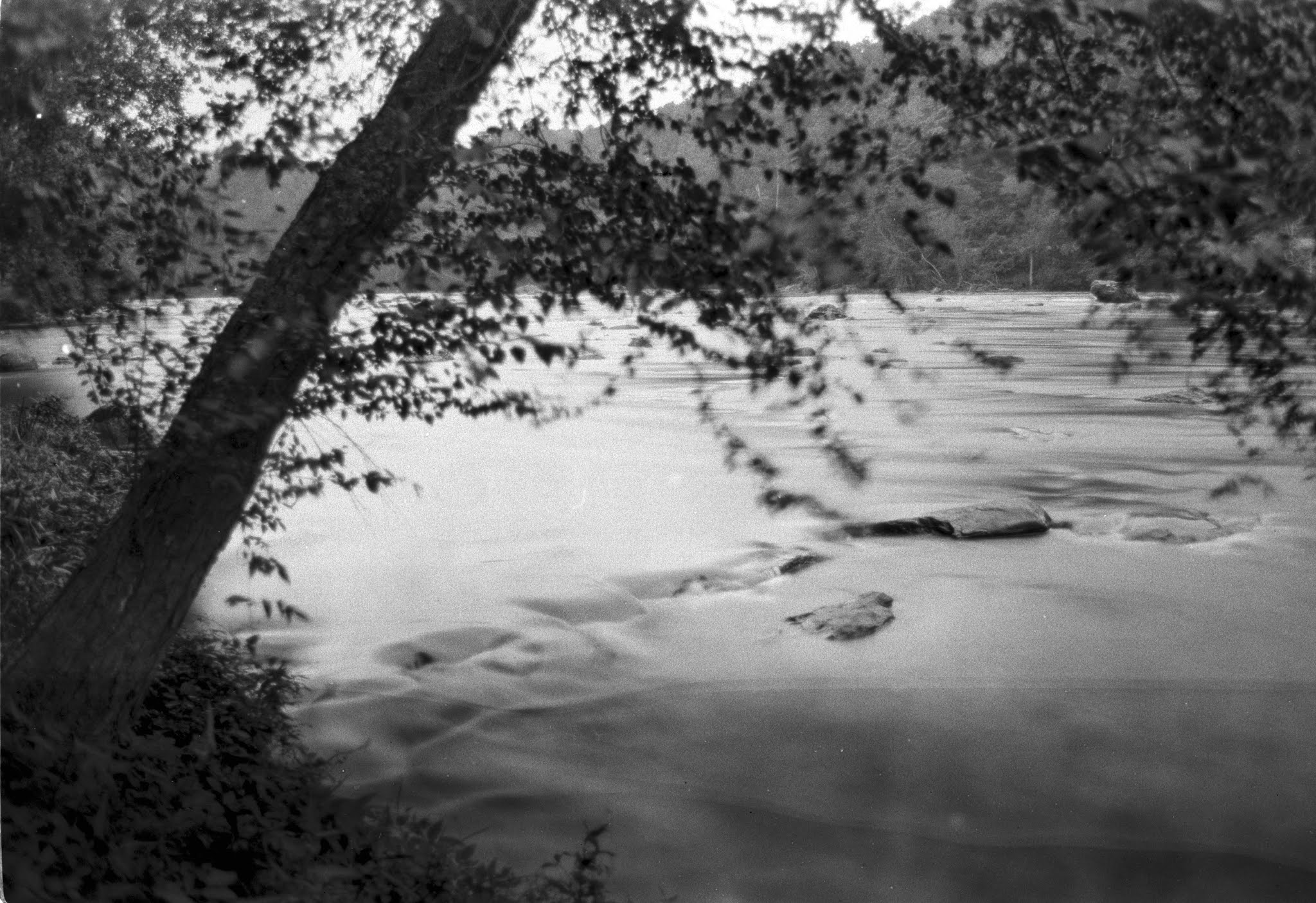
More than 4 years ago, Mike Raso gave me a short roll of what was then the Svema Blue-Sensitive Film at ISO 1.5.  It sat around in the open in a translucent container, in and out of camera bags, and one day in late July, I finally decided to use it while shooting along the French Broad River near Asheville, NC.  I knew that the slow film would enable me to get some nice long exposures of the swift current.With exposures running from 4 to 8 seconds, I hoped that they would have a real smooth appearance to them. Also of note, the film is Blue-sensitive (Orthochromatic) and doesn't see red, so the tonality of the image would be quite different than what you would get with a full-spectrum panchromatic film, such as Ilford Pan-F.

Sometimes I find that my results didn't meet my expectations, and instead of saying "ugh," I take a different tact and see what I can do with the negative.  The film was developed in POTA developer at 24°C for 13 minutes.  Turns out that this roll of Blue-Sensitive film is a victim of light-piping, as the PET film base transmits light like an optical fiber.  With no anti-halation layer, and a clear plastic storage canister, it only compounded the problem, as the film was fogged.  I didn't expect much from the scans. However, I realized that with the fog, imperfections, and long-exposure (ca. ISO 2), they looked like something from a wet-plate collodion negative. 


I'll try this stuff again, as I like the look of the film, but next time I'll get some fresh from the FPP! The newer version of the FPP Blue-Sensitive is at ISO 6, which will still give me the look that I am after.  

Compare the last image with this one, taken with my iPhone XR, to get an idea of how the Orthochromatic film captures the tones.


Saturday, February 15, 2020

One Roll Review - Rollei RPX 25

It seems that this is one of the few low-ISO films that I have not tried until now.  The film came on the market in 2014, so it's been available for quite a while. I placed a big order of Rollei and other films that I had yet to try, and B&H quickly shipped them to my door.  Among the films was Rollei RPX 25, which I assumed was a sort of replacement for the old Agfa APX 25, which I definitely liked when I shot with it over a decade ago.  After doing a bit of research, the RPX 25 is a different sort of film, which is made by someone, certainly not Rollei. While the packaging and the Rollei name are licensed by Maco, the film is quite different from the Rollei Ortho 25 Plus, and is not advertised as having extended red sensitivity like the Retro 80s film. 

From the RPX 25 Datasheet (translated by user ashfaque on Rangefinder forum 12/2015):

"Low-sensitivity, high-resolution, panchromatic black and white film, ISO 25/15°
Rollei RPX 25 is a panchromatic B&W film with a nominal sensitivity of ISO 25/15°, which is cast on a modern crystal clear, synthetic carrier.
    This film is characterized by its high resolution at fine grain and high edge sharpness. Rollei RPX 25 behaves perfectly in over- or under-exposure due to its optimum sensitivity reserve of up to 2 stops. Depending on the developer, the film compensates critical lightning situations. The 5µ film - silver-rich-panchromatic sensitized Rollei RPX 25 is poured into a crystal-clear polyester carrier of 100µ. "

Main Features in Brief

  • Low sensitive panchromatic film at ISO 25/15°
  • Resolution Contrast Ratio 1000: 1 = 260 lines / mm
  • RMS granularity (x1000) = 8
  • Exposure range (between 12 and 50 ISO)
  • Good pull-push characteristics
  • Good rendering of tones
  • Very good maximum blackness;
  • Transparent = optimal for scanning and as slide
  • Optimum flatness thanks to anti-curling layer


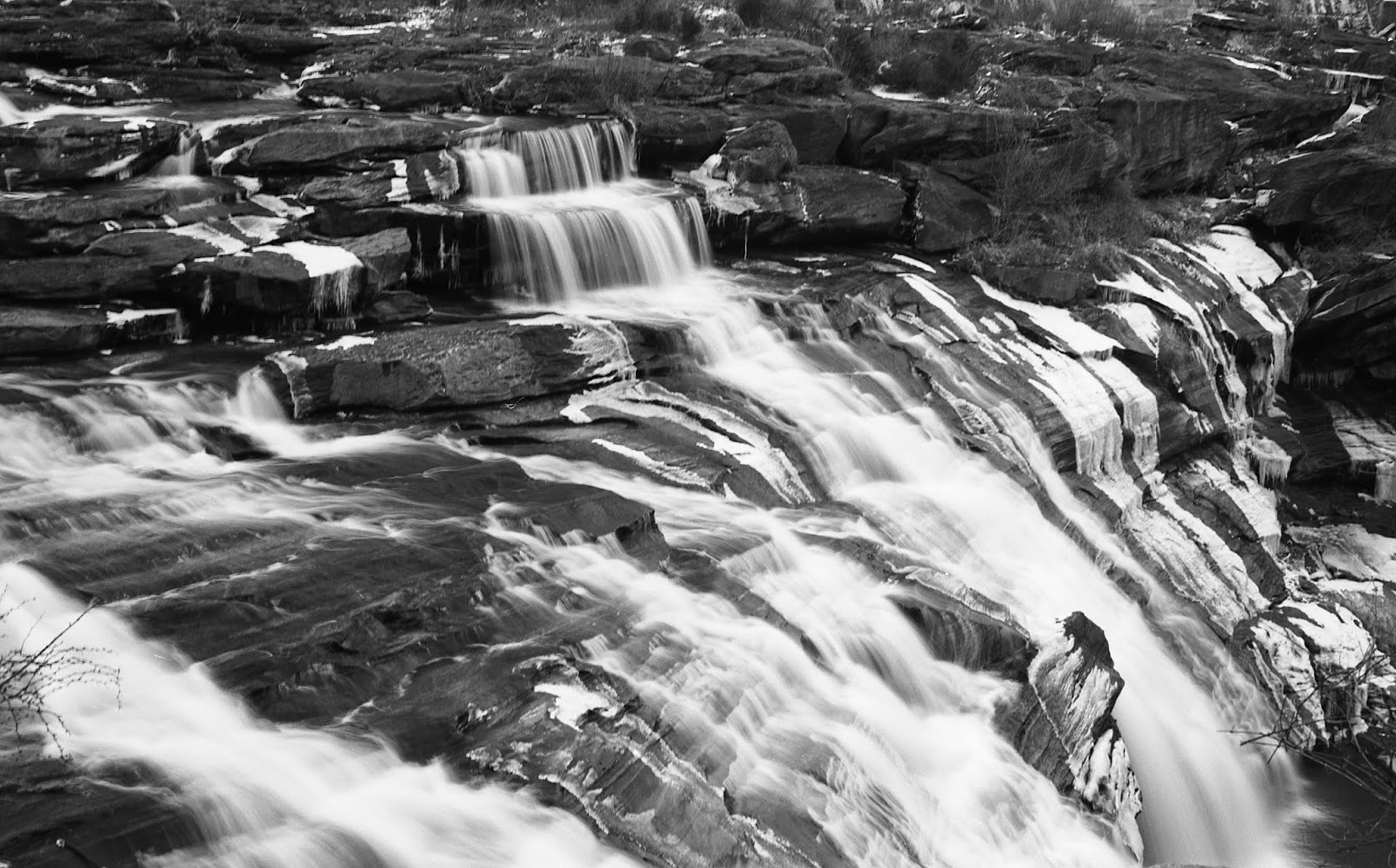
I shot my roll of RPX 25 while on a trip to Dutchess Co., NY in early February.  I also traveled around the nearby CT/MA/NY area, and when I found myself at Great Falls on the Housatonic River, I knew that a low-ISO film was perfect for what I was seeing.  I loaded my Nikon FM3a with the RPX 25 and had exposures of about 2 sec maximum.  I saw no problem with long vs normal exposure times.  I developed the film in Kodak D-76 1:1 for 8 minutes at 20°C.

some negatives on the light table

In my research about this film, I found that it could have been made by Agfa, and might have been the Agfa Aviphot 80 aerial film. Which apparently, is the same as the Rollei Retro 80s.  I have shot the Retro 80s, and I like it, and it does not appear to me to be the same film.  The Polyester base does lie very flat, which to me, is a plus in scanning.   I know that the Rollei films are all rebranded from other manufacturers, and of course, it's not old-stock Agfa APX 25. What exactly is it?  Does it really matter?  It's documented that the Rollei Retro 80s is the Aviphot 80 film.   I am not buying that RPX 25 is the same film.  I am glad that the RPX 25 is available and from what I have seen thus far, an excellent film for landscapes.  I'll leave the keyboard commandos to their theories about the film's origin.

One may argue that one roll isn't really testing this film.  I shot the film at the box speed, using a camera and a subject that I am familiar with in my shooting style.  Yes, I used a tripod and a cable release.  I feel that my results matched my expectations for a low-ISO panchromatic film.  Of course, I would shoot this film again.   

One bit of caution - since the film is on a PET base, light-piping can occur, so keep the film in the black canister, and load in dim light. 

All images shot with a Nikon 35-105 zoom Nikkor, unless otherwise specified.


on the way home, along I-26 N of Asheville, 50mm f/1.4 nikkor

on the way home, along I-26 N of Asheville, 50mm f/1.4 nikkor


Monday, November 25, 2019

Developing High-Contrast Films with POTA

old TechPan, POTA, Nikkormat EL
October 2019
Over the course of the past 20 years, I have been trying to become a better photographer.  When I started on this journey, my mentor, William Brudon (1921-2009) was instrumental in extolling the virtues of various films that he used.  One of the films that he absolutely loved was Kodak's Technical Pan film.  Not only was Bill a photographer, but he was also a well-known natural history and medical illustrator as well as a painter of some wonderful landscapes.   For him, Technical Pan was one of those wonder films that could be used for high-contrast black and white reproduction, as well as superb pictorial work and copy work that required a great tonal scale.  As a result, I too, realized what a wonderful film TechPan was for landscapes photography.  TechPan's drawback was that it was (a) a very slow film of ISO 25, and (b) it required the special Kodak Technidol developer to achieve that wonderful tonal scale.  Its advantage is that the film is virtually grainless, making 35mm negatives capable of producing very large prints.  It was also available in 120 and 4x5 sheet film.   As my supply of TechPan and Technidol developer diminished, I figured that it was the end of working with that film.

However, in the past 8 years, I acquired a supply of TechPan, both in 35mm and a small amount of 120.  I had ordered some TD-3 from Photographer's Formulary, and realized that it had a short shelf life, even if unopened.  Stand processing in 1/100 Rodinal just didn't do it for me, and I am not a fan of really thin negatives.   I had seen POTA listed as a developer to be used with high contrast films, but didn't know much about it.  POTA? What the hell is that?

my home-rolled TechPan

Earlier this year, I read up on POTA, and it seemed like a good candidate for developing TechPan as well as other high-contrast films.  I had to put that research away for a bit, as we moved from Ann Arbor, MI to just outside Asheville NC  in late July.    In the past 2 months, I have been developing several high-contrast films with POTA, and am realizing just how good a developer it is.

First of all, what is POTA? According to The Film Developing Cookbook (Anchell & Troop, 1998, Focal Press, 165 pp. ISBN-13: 978-0-240-80277-0), POTA  was developed by Martin Levy and the formula published in 1967.  The acronym POTA stands for Photo-Optics Technical Area at the Ft. Monmouth military installation where Levy was employed.  A weird thing to name a developer after a place, but oh, well.  The purpose of POTA was to use high-resolution document films such as Kodak Technical Pan, Agfa Ortho, and Macophot ORT25 as normal photographic films.  The why is quite obvious.  When properly processed, these ultra fine-grained films can rival large format results using 35mm film.

One thing to keep in mind is that these document films have a limited contrast range, and highlights may be blown out, so they tend to work better in low-contrast situations.  Some negatives with one film, Eastman 2378 bears this out. Developers such as Technidol and TD-3 can provide an increased contrast range (up to 12 stops, according to Anchell and Troop), but generally, document films will have impaired highlight rendition in typical daylight scenes.

So, what to do?  Anchell and Troop recommend the following developers with document films: XTOL 1:5, POTA, Kodak Technidol-LC, and Photographer's Formulary TD-3.   Technidol is no longer manufactured, and TD-3 is also a special developer that has to be ordered. XTOL 1:5 produces thin negatives (at least in my experience).  POTA, however, consists of only 2 compounds, and is easy to make yourself.  Anchell & Troop state that "POTA-type developers produce exceptionally even density growth over their useful range but have an abrupt shoulder after 8 zones. No further highlight detail is available above that point." 
expired TechPan, POTA, Oct. 2019

My original objective was to use POTA to test a bunch of bulk-loaded TechPan that I acquired  some time ago.  I had planned on hand-rolling it and selling the film after I tested it.  It turns out that someone had opened the bulk loader to see what was inside, and that was enough to fog the film through the overlapping sprocket holes, as well as the edges of the frame.  Plus, the film expiration date was 1990, so there is some small amount of base fog.  I can still use it, but no way that I could sell it like that.  Using POTA gave me the urge to test it with other document, high-contrast and ortho films to see how they would fare as traditional pictorial films. I seem to have an inexhaustible supply of Kodak's Kodalith, as well as some other oddball films that the Film Photography Project has made available.
TechPan, shot in 2008, developed in POTA, 2019. Mamiya 645


The formula for POTA does remind me of D-23 in the sense that it is a 2-compound developer.
The components to make 1 liter of POTA:

  • Sodium Sulfite Anhydrous - 30 g
  • Phenidone 1.5g
  • Dissolve the dry chemicals in 750 ml water at 35°C, then add water to make 1 liter.  Not all of the Phenidone will dissolve, but don't worry about it.

Use the POTA developer as soon as the temperature cools to 24°C.  The developer oxidizes quickly after mixing, and typically it's recommend that you use it within an hour.   I recommend that you read Anchell and Troop's book for more information on the chemistry of POTA, and how to modify the formula for longevity and less fogging.

I have plenty of Phenidone and many pounds of Sodium Suflite, so POTA seems to me to be a good alternative to TD-3 and XTOL.  I weigh out the dry ingredients for each 1 liter batch and put them in a ziplock bag so that I can mix them when I need them.  If you have to order the chemicals, ArtCraft Chemicals Inc. has them, as well as many other raw photo chemicals.  50 g of Phenidone is $12, and 1 lb of Sodium Sulfite is $6.50.  That's enough to make 33 liters of developer, which would develop up to 132 rolls of film, for a cost per roll of less than 15 cents.  That's pretty damn cheap!  Of course, you can use POTA for normal contrast films, but your results may not be optimal.

Anchell and Troop also provide another formula for a low-contrast developer called TDLC-103:

  • Metol - 1g
  • Sodium sulfite - 5g
  • Sodium Bicarbonate (baking soda) - 10g
  • dissolve to make 1 liter


This doesn't have the problems with Phenidone that POTA has, and I am going to give it a try soon. Anchell and Troop stated that TDLC-103 is more likely to give good results with document films, and as an extreme low contrast developer for normal contrast films. I think development times are 10-15 minutes with minimal agitation - 10 seconds every 3 minutes to suppress highlight development.  I am assuming that the development temp is 20° C.

My latest adventure with POTA was developing some long outdated Kodalith Otho Type 3 6556 film.  I shot the film in my Nikon F100, rated it at ISO 12, and developed in POTA for 11 minutes.  To say I was blown away with my results is an understatement.  I did not expect the rich tonal scale that I saw on the negatives.  I have never seen such good results with Kodalith before.   I am going to shoot some more later this with some different subject matter and see how it goes.

Kodalith Ortho, Nikon F100, POTA, Nov. 2019


POTA Development TIMES (all at 24°C)
Kodak Technical Pan - 12 minutes
Eastman 5363 - 12 minutes
Kodak 2378 - 11 minutes
Kodalith Ortho Type 3  – 11 minutes

Eastman 5363, POTA, Nikon FA, October 2019


.
Kodak 2378, POTA, Canon AE-1P, October, 2019

Kodalith Ortho, POTA, Nikon F100, November 2019

Kodalith Ortho, POTA, Nikon F100, November 2019


Kodalith Ortho, POTA, Nikon F100, November 2019


Monday, October 17, 2016

The Amazing Mr. Brown

Back in the summer, my Film Photography Project pals were involved in testing out some  odd films from the Svema factory (detailed on episode 152 of the FPP Podcast).   One of the films was uniquely brown, whereas the rest were yellow, lavender, blue, etc.  This unknown film became known as "Mr. Brown."  It has an ISO of 6, and while a bit punchy, is a film for "normal" photography. As if anything can be normal when using a camera with such slow film in it!  Those who have been following my blog know that I have been shooting slow films for quite a few years.  I bought a few rolls of Mr. Brown from the FPP store, and finally loaded up my Nikon N90s, set the ISO to 6, and went off to Fleming Creek yesterday.  I hoped to do some nice long exposures of the water while it was overcast.
 Using a 50 mm 1.8 AF-D Nikkor, and an 80-200 mm AF-D Nikkor on the N90s, I shot a roll of  Mr. Brown along Fleming Creek near Parker Mill. Exposures were at f/16 and f/11 in Aperture Priority mode, with the longest time at around 16 seconds, and many were in the 8-11 sec range.  The mushrooms were shot at f/8.

After I got home, I developed Mr. Brown in XTOL at 1:1 for 9 minutes at 20°C.  I just finished scanning in the negatives on my Epson V700 photo scanner.  To say I am impressed with the results would be an understatement!  The film is on a very strong and thin mylar base, and lies beautifully flat in the scanner. No curling, cupping, or other problems.  It scans beautifully.  Based upon my results, I may be tempted to try a roll at ISO 12 under similar situations.

Long exposures of water without using a ND filter is a plus, and this film warrants more experimentation.


Sunday, July 31, 2016

SLOOOOW Film Adventure

Another really slow film.
One of the more interesting aspects of using film is that we have the opportunity to experiment with emulsions that are not the every-day sort of film.  In the digital world, the ISOs keep getting insanely higher each year.  But, they never go LOWER.  Typically, ISO 100 is the lowest ISO available.  With film, there are emulsions with an ISO of 0.75.  Of course, most people would never dream of shooting with a low ISO film, and the standard low ISO in the film world is 25.  TechPan, that do-it-all film has an ISO of 25 in most applications.  Kodalith, designed to be a high-contrast graphic arts film has an ISO of 12.  Most of the available (mostly old-stock) low ISO films are designed for specific applications, not as general-purpose photographic films.  I still shoot a dwindling stock of Kodak Panatomic-X whose box speed is ISO 32, but I shoot it at 25 with great results.  Ilford's Pan-F has a box speed of ISO 50, but I shoot it at 32.   The now out-of-production Polypan-F has a stated speed of 50, but can be pushed higher.
an oldie low-ISO  in color, no less. 
To go back to my original thought -- why would you want to shoot a low ISO film?  For one, you can shoot wide-open on a sunny day for great shallow DOF results.   Stopping down, you can achieve a motion blur in the same situation.  So, let's get REALLY slow.  ISO 3.  
I had a project in mind, and that was to do a shoot at the annual Ann Arbor Art Fair, which happens every mid- July. Over the 4 days, there are up to a half million visitors.  What I wanted to do, was to try and get a ghost-like blur of people at the art fair. Of course, it's mid-summer, almost always bright and sunny. How do I do that?
1. Use a low ISO film.  I tried two. The FPP store had a Svema Micrat-Ortho which is a POSITIVE ISO 1 film (or maybe 0.75), as well as a Svema MZ-3, which is a higher-contrast repro film of ISO 3.  2. Use a Neutral Density Filter to allow even less light -- I used a 3-stop ND filter.
3. Use a camera that allows me to get as close to a low ISO setting as possible. My F100 ISO dial goes to ISO 6, and I can compensate +1, +2,  (and more)  full stops to achieve an ISO of 3 or less.
4. Shoot at f/22 if possible.  I used a Nikkor 24-120 AF zoom.
5. Of course, this means a tripod is absolutely necessary.  Remote release is also handy, as well.  

Results

Roll 1 -- The Svema Micrat Ortho was developed in D76 1:1 for 7 minutes.  Exposures ranged from 10-25 seconds.


Roll 2-- Svema MZ-3. Developed in Kodak Technidol LC for 15 minutes.  Exposures ranged from 3-10 seconds.


Both of these films are unusual films that are not being used as the films were intended.  If I were to shoot this way again, I would probably just use some of my Kodak Tech Pan with a 3 stop ND filter + a polarizer or red filter, and a cloudy day would surely help.  Maybe this fall, I will do it some more down town.  

If you want to see some fantastic work in this vein, look up Alexey Titarenko's photographs from Russia.  Really good work.