Back in December, I received a surprise package in the mail from the Film Photography Project. Three rolls of Eastman 5363 b&w to try out. Now, Mike Rasso must know that I have tried all kinds of crazy b&w films intended for copying, graphics, and other high-contrast applications. But 5363 was a new one for me. The data sheet states:
"EASTMAN High Contrast Positive Film II 5363 and 7363 is a medium-speed black and-white positive film that is suitable for making both positive and negative titles. It is also useful for production of printer effects, such as silhouette and traveling mattes. This blue-sensitive film is characterized by high contrast, excellent sharpness, and very high resolving power."
In other words, "This is not a film for general photography" -- or is it? Part of the problem with using these oddball films is that outside the cine world, we do not see them used much. If you have Tri-X, why use something like Eastman 5363? The answer is -- it's the challenge of seeing what happens. Unfortunately, the data sheet does not give one much hope for other uses, so others have been experimenting with developers and what the native ISO of the film really is. Seeing the term "medium speed" baffled me, - compared to what? Is it ISO 100? Based on reading what the FPP folks have been doing, I started with ISO 25. Roll 1 was shot with my Nikkormat EL -- perhaps not the best choice, but it worked. I compensated for the snow in some shots by shooting manually, in others, I left it in full Aperture Priority.
One interesting thing is that this is the first time that I have seen registration holes in addition to the perfs in a film. Development Notes -- I developed the 5363 in Kodak D76 at 1:1 dilution for 12 minutes, as provided by Mike Rasso's notes. It could obviously be a shorter development time, but like any of these oddball films, there is much room for experimentation. I think if one has Technidol LC or Photographer's Formulary TD-3, it would be worth trying out.
Based on the negatives from this first attempt, I'll try some less contrasty subjects, and a different developer...perhaps Technidol LC. Unlike a lot of high-contrast films such as Kodalith, TechPan, High-Contrast Copy film, which are for still cameras, these cine film stocks are always a challenge, because they do not see much use outside their industry. With the demise of analog titling and effects, they will probably pop up in the market more frequently. I don't know about 1000 ft rolls, though. That would be more than a lifetime supply for anyone.
Saturday, February 15, 2014
Saturday, February 01, 2014
Winter's Glory
Although we have been having one of the snowiest and coldest winters on record in Michigan, it seems silly to complain about it, even though we do. I think winter is one of those things that defines those of us that descended from Europeans. We survived the Ice Age. We will survive winter in the Great Lakes. Of course, our lives are far more complex than those of our ancestors huddled in caves and hide tents during the glacial period, but I suspect that any of them could cope with today's life better than we would if we were suddenly plunked down at the edge of the glaciers. However, they did get to share their back yards with cool megafauna...
So, winter offers us opportunities to explore a world that is quite different from what we see the rest of the year. One can go to the micro world, and explore an individual snowflake. Shown here is a photomicrograph of a snowflake by Wilson A. Bentley, a Vermont photographer who found that he could attach a camera to his microscope to obtain photos of his favorite subject.
"In 1885 he successfully photographed the flakes. This photomicrograph and more than five thousand others supported the belief that no two snowflakes are alike, leading scientists to study his work and publish it in numerous scientific articles and magazines. In 1903 Bentley sent prints of his snowflakes to the Smithsonian, hoping they might be of interest to Secretary Samuel P. Langley." (quoted from the Smithsonian archive record for Bentley's images).
So, in essence, Bentley not only embraced winter, it was the only time that he could do those images. Going back to the old saying "If life gives you lemons, make lemonade." So, while I may not enjoy the limitations that winter weather gives me - as in bad driving conditions, salt and crud from the streets and roads, and that my heating bill this winter will be a doozy, the snow and ice afford me an opportunity (many, it seems) to do different things than the rest of the year. I could stay inside, and hang out in my cave, doing studio shots, and still-lifes, or I can go out onto the glacier and see what I can find.
Although winter photography is often challenging because of the cold... and cameras and fingers do not always work so well cold, imagine how much harder it was back in the day when people were using view cameras, glass plates, and did not have Gore-tex, Thinsulate, and other modern fabrics to keep warm.
While I enjoy shooting black and white in the winter, largely because it is such a monochromatic landscape, color allows for the nuances on the snow that don't show up in monochrome. I will admit that shooting digital is often easier in cold weather than shooting film, so long as your batteries hold out. The Li-on batteries in today's DSLRs do quite well in the cold, and keeping a few extras in a warm pocket make shooting pretty easy. However, if using a film camera, I go for simplicity and easy control - which means the Nikon F2 and FM2N.
Winter is also a good time to experiment with high contrast black and white films such as Kodalith, Techpan, and all the other oddball films that are still out there designed for high contrast work. I know I have posted here previously on using such films, so take a look through my archives. About the only thing I have not tried in winter is shooting models in the snow. That seems like a way to torture someone. I know I would not get naked in the snow, so why should I expect someone else to? However, take a look at Craig Blacklock's "Lake Superior Nudes" - some people are just tougher, I guess. His and her ancestors must have been from the edge of the glacier.
So, winter offers us opportunities to explore a world that is quite different from what we see the rest of the year. One can go to the micro world, and explore an individual snowflake. Shown here is a photomicrograph of a snowflake by Wilson A. Bentley, a Vermont photographer who found that he could attach a camera to his microscope to obtain photos of his favorite subject.
![]() |
| 1885 Snowflake photo from the Smithsonian Archives. |
So, in essence, Bentley not only embraced winter, it was the only time that he could do those images. Going back to the old saying "If life gives you lemons, make lemonade." So, while I may not enjoy the limitations that winter weather gives me - as in bad driving conditions, salt and crud from the streets and roads, and that my heating bill this winter will be a doozy, the snow and ice afford me an opportunity (many, it seems) to do different things than the rest of the year. I could stay inside, and hang out in my cave, doing studio shots, and still-lifes, or I can go out onto the glacier and see what I can find.
![]() |
| Ice Cave in Big Four Glacier, Washington, ca. 1920. Courtesy of Univ. of Washington |
While I enjoy shooting black and white in the winter, largely because it is such a monochromatic landscape, color allows for the nuances on the snow that don't show up in monochrome. I will admit that shooting digital is often easier in cold weather than shooting film, so long as your batteries hold out. The Li-on batteries in today's DSLRs do quite well in the cold, and keeping a few extras in a warm pocket make shooting pretty easy. However, if using a film camera, I go for simplicity and easy control - which means the Nikon F2 and FM2N. Winter is also a good time to experiment with high contrast black and white films such as Kodalith, Techpan, and all the other oddball films that are still out there designed for high contrast work. I know I have posted here previously on using such films, so take a look through my archives. About the only thing I have not tried in winter is shooting models in the snow. That seems like a way to torture someone. I know I would not get naked in the snow, so why should I expect someone else to? However, take a look at Craig Blacklock's "Lake Superior Nudes" - some people are just tougher, I guess. His and her ancestors must have been from the edge of the glacier.
Monday, January 27, 2014
Results from the Autoreflex T
![]() |
| I cheated here -- this is not a flipped mirror shot, it was taken with my Nikon 1J1. |
One of the problem with many of these older cameras is that they required 1.35V Mercury cells for the meters. Fortunately, I can use Zinc-Air cells in this model without any adapter, and their voltage is plenty close enough. On top of that, some meters lose sensitivity at low EV levels, so while they may function well in daylight, the metering goes to hell in a room. Or, the meter may be non-functional due to corrosion, old solder joints, aged components, etc. Picking up a camera made in the 1960s and expecting it to work like new seems to be a quality found only with photographers. Even purely mechanical cameras can have problems caused by old seized lubricants, bad materials used in manufacturing, and things do age. I know I don't work quite as well as I did 40 years ago. This particular Autoreflex T seems to work fine, but I still think the metering is a bit suspect indoors. However, since the shutter speeds are not electronic, I can always shoot in manually, instead of in shutter priority mode. It certainly has a gratifying solid-sounding shutter and is built very well.
I shot some photos while out in the cold winter temperatures that we have been enduring for the past few weeks in Michigan. Black and white film is great for winter, especially for subjects that have great contrast, such as snow and anything not snow.
![]() |
| The icy Huron River, just W of Zeeb Road. |
It was only about 15°F, but for some reason I cold chilled more quickly than usual, and Cheryl's Nikon FM2N decided it didn't like the cold either. I had also brought along my Nikkormat EL, and it too, decided to stop working in the cold!
![]() |
| Cheryl borrowed my tripod to shoot some scenes with her Nikon FM2N. |
Is the Autoreflex series a good buy? Back in the 1960s -1985 or so, there were a lot of different SLR brands. Some makers, such as Nikon , Minolta, Canon, and Pentax were able to retain their following and incrementally improve their SLR bodies and features. Konica, Yashica, Olympus, Topcon and Miranda all had some outstanding cameras with great glass. None of them survived as top SLR makers after 1990. Well, Yashica did, only because of the Contax contract. Konica's last SLR was made by Chinon, though the Hexanon lenses were probably made by Konica. Because the AR-mount lenses are so good, they often command a higher premium with people using them on mirrorless cameras. If you find a good used Autoreflex T or T3, or even a TC, go for it. You should be able to pick one up in the $30 and less range.
![]() |
| US 23 was closed due to another accident, so the truckers came through town. |
![]() |
| My walk home is a lot more fun photographically with the sun up longer. |
![]() |
| Youthful dedication. |
![]() |
| My office at work. The exposure looks dead-on. |
Sunday, January 19, 2014
Another try with a Konica
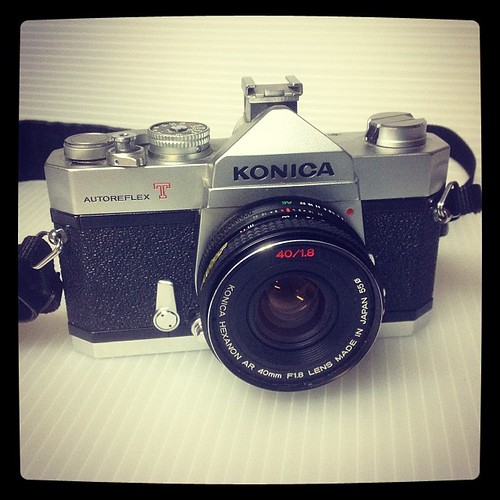
Last fall, my mother-in-law gave me her old Konica Autoreflex TC with a 40mm 1.8 lens. I had previously owned one a few years ago, but sold off my small assemblage of Konica stuff (which is something I do when I realize I have too damn many cameras). I liked the TC, as it was a fairly compact camera, and the 40mm lens is outstanding. So, after I got the camera home, no amount of fiddling could get the shutter working. That seems to be a problem with that model, and rather than spend more time on it, I bought an Autoreflex T with 2 lenses and a flash on eBay for $30. It arrived last week, and it is in pretty darn good condition. I put the 40mm lens on it, and loaded it with B&W film. I should finish the roll sometime this week, and look forward to seeing the results. The Konica Autoreflex T, like most of the Konica SLRs, is a shutter-priority and manual exposure camera. I usually shoot in Aperture Priority with my other cameras, so this is a little backwards, but still I ca get used to it.

The camera is a hefty all-metal-bodied SLR with a cold flash shoe, but there is a PC flash socket. It originally took two Mercury cells for the meter, but I used 2 Zinc-air batteries, and they should do just fine. Stay tuned for images...

The camera is a hefty all-metal-bodied SLR with a cold flash shoe, but there is a PC flash socket. It originally took two Mercury cells for the meter, but I used 2 Zinc-air batteries, and they should do just fine. Stay tuned for images...
Thursday, January 09, 2014
Polypan-F on the Ice.
Last Saturday, I did some shooting on Fleming Creek with my Nikon F2S and my Nikon 1J1. The F2S was loaded with Polypan-F, an ISO 50 b&w film from Germany that I purchased in 2012. Conditions were amazing, as there were some really incredible ice forms and some streams running above the ice. I have shot at this spot repeatedly, and like many photographers, I revisit familiar spots because things do change, and there is always the desire to get something better than the last attempt. Rivers and lake shores are places worth revisiting, as they can change dramatically when weather conditions are in play. Fleming Creek has been photographed quite a few times, and this creek always has something to offer. One just has to look.
Winter photography has its own challenges, and my favorite film camera for this kind of work is my Nikon F2S. The controls are easy to work with gloves, making cold weather shooting much easier. You kmow what though, the Nikon 1J1 is also easy to use with gloves, which was kind of surprising. You can see in this photo that the water has frozen in large sheets, and some of it is flowing on top of the ice, rather than under it. I shot the 1J1 in monochrome mode, because to me, winter IS monochrome.
I used a Tamron 35-135 zoom (in the old Adaptall2 mount), which is an excellent lens. The Polypan-F was developed in Rodinal 1:25 for 6.5 minutes. Some of my shots were bracketed, and all looked pretty good.


As you can see, I like zooming in on the details, which obscures the scale of the features. I had a show up on this topic at Matthaei Botanical Gardens in 2012, and I should do another one with the same theme in the near future.
One last photo, taken again with the IJ1, which I have to admit does a pretty decent job. This is Fleming Creek on the N side of Geddes Road near Parker Mill. There was a lot of texture to the ice on the creek.

That's it for now. We have had some serious cold the past week, with temps at -15F on Tuesday. I hope to get over there early Saturday before it warms up and gets slushy.
| Taken with the Nikon 1J1 with a polarizer, ISO 100. |
I used a Tamron 35-135 zoom (in the old Adaptall2 mount), which is an excellent lens. The Polypan-F was developed in Rodinal 1:25 for 6.5 minutes. Some of my shots were bracketed, and all looked pretty good.
As you can see, I like zooming in on the details, which obscures the scale of the features. I had a show up on this topic at Matthaei Botanical Gardens in 2012, and I should do another one with the same theme in the near future.
One last photo, taken again with the IJ1, which I have to admit does a pretty decent job. This is Fleming Creek on the N side of Geddes Road near Parker Mill. There was a lot of texture to the ice on the creek.
That's it for now. We have had some serious cold the past week, with temps at -15F on Tuesday. I hope to get over there early Saturday before it warms up and gets slushy.
Subscribe to:
Posts (Atom)