Showing posts with label film photography. Show all posts

Tuesday, December 30, 2025

Some "best shots" from 2025 on film

 I have one more post after this one, but since I am in scanning mode today, I thought that I would look back at 2025 and post examples from each month. Not necessarily the best image for each month, but jeebus, I shot well over 100 rolls of film this year.


January

Amenia, NY. Pentax Spotmatic, FPP Derevpan 100

February

Floyd County, Va. Nikon FM2N, Fuji Acros 100

March

River Arts District debris. Pentax SV, Fomapan 200


April

Wapakoneta, Ohio.  Nikon F3HP, EZ 400 film


May

Mt. Airy, NC. Pentax 17, FPP  Jiangshi 400

June

Bailey Mountain Preserve, Mars Hill, NC. Spotmatic F, Fuji Acros 100

July

Maggie Valley, NC. Nikon F75, Harman Phoenix II film

August

Harrisville, NY. Nikon F3HP, Kentmere 400

September

River Arts District, Kodak Signet 50, Rollei Retro 80S

October

Bisbee, Arizona - Pentax 6x7, Kodak Gold 200

November

Maumee River, Grand Rapids, Ohio. Leica M2, Fomapan 400


December

Mountain to Sea Trail, nr Weaverville, NC.  Pentax Spotmatic F, Helios 44M lens, Svema 100 film


It's been quite a year, photography-wise.  Thousands and thousands of images, and a lot of projects to result from them - I hope.  

Sunday, May 01, 2022

May 1 Musings

Taken today, May 1.

Well, here we are on the first day of May, and I am getting ready for a week away from home.  I'll be visiting the Film Photography Project HQ for a few days to record some sessions, and to also help with unboxing/checking of gear that has been donated to the FPP School donation program.  Then it's off to Amenia, NY, where I'll be for a few more days to visit family.  The drive from home this time will include a stop at the Camera Heritage Museum in Staunton, VA, which I saw last year, but it was closed by the time we stopped in Staunton.  I'll be giving a review of it here and on the podcast.

I love the month of May because of all of the rich variations in the color green, and as I drive up the Shenandoah Valley along Rt 81, I look forward to enjoying the scenery.  Of course, the various green shades don't look as good in b&w film, but there are so many interesting textures of unfurling leaves and patterns that to see them in monochrome is a different experience than in color.  

Rhubarb Leaf

Japanese maple

Speaking of color, people are still having a difficult time finding C-41 color film in stock.  I know that there is some excitement about Kodak Gold 200 being available in 120, and it's good to have that choice.  However, I remember when it was exciting to actually see a NEW film stock from Kodak.  It's anyone's guess about what's going on with Kodak and Fuji, and whether it really is supply-chain problems, worker shortages, or accumulating inflation effects, the prices of film have really shot up.  I'm glad that I jumped in and bought a 50 roll case of Fuji Superia 200 in 2018, when I paid $2/roll.  Last fall, as I was getting ready for a trip to the SW, I bought a bunch of Kodak Profoto 100, so I am pretty much set for any color film shooting.  I buy most of my black and white film in 100 ft rolls, and whether it's Arista 100, Kentmere 400, Fomapan 100, or Kentmere 100, I pay far less than I would for Kodak Tri-X (which I really don't like), or Ilford HP-5 (which I prefer).  The Kentmere and Foma films give me good, consistent results that I can trust.   However, the oddball films like some of the low-ISO films from the Film Photography Project (such as the Yeti and the Blue-Sensitive) and the films from Rollei always have a place in my camera bag(s).  

I am working on the next issue of Monochrome Mania - "Strictly Botanical" - which of course will be back to images and not gear, and I hope to have it ready by mid-summer.  I really appreciate the good comments that I get from readers of the latest issue - 35mm Toy Cameras, Issue No. 7, and copies of that are still available, though my Etsy store is closed until after I return on May 9.  

Here in the mountains of Western NC, spring seems to last for months, and if I drive 20 minutes, I can go back in time a week or two, and see flowers in bloom at 5200 ft. that have come and gone here at 2200 feet.   I feel fortunate to be living here.  I still have a lot to explore in NC, and hopefully, some short road trips are in order in late May/early June.

I hope that this month goes well for all of you!

Wednesday, December 22, 2021

What’s old is new again

Unless you have been in a cabin in the woods without internet access, you have no doubt seen all of the hoopla about simple-use  and single-use cameras.  Several podcasts (All Through a Lens and the FPP) have had dips into the world of disposable cameras. 

Kodak's latest

Isn’t it funny that here in the year 2021, soon to be 2022, there is this amazing dichotomy: a huge emphasis in the digital world on mirrorless cameras with ever-pricier lenses that seem to be getting larger all the time, and the film community with announcements about cheap plastic simple cameras, and the Kodak price hikes.  Of course, it’s not quite that simple a divergence, but my point is that at what point does the  path to doing meaningful photography become a choice in spending $10,000 or more to feel that you have have the lens/camera that will FINALLY  allow you to capture great images?  That’s not including the high-end computer  necessary to process the thousands of frames you shot at the park yesterday, and never-mind the fact that you only post them somewhere in the digital realm for others to see.   Meanwhile, some person mucking around with their Holga got a magazine cover.  That’s so unfair.  

Konica B&W from early 2000s

Yes, I am being satirical here, but the truth is that how much the equipment costs does not equal great photographs or meaningful images. You can have a 20 x 30 inch colorful photograph that was shot with the latest and greatest technology, and it can be soulless wall art.  Or not. Great images depend on the person holding the camera making that exposure.  It doesn’t matter if the camera is a one-time use Kodak with Tri-X film, a Leica MP, a Rolleiflex, a Canon A-1, Olympus XA, Nikon F4, a battered Pentax Spotmatic that you bought for $10, or a $2500 mirrorless outfit.  The photo is made between the ears.  


Why is it that young people are wanting to shoot film?  It definitely isn’t perfect. Things don’t always come out the way that you thought they would.  It takes chemicals to process the film, and it’s expensive to send rolls to a lab.  Yet, they persist, because film has captured their imagination.  It’s okay to have serendipity, to have a mistake turn into a successful image.  Using a camera that is always ready because it has no batteries to charge, no start-up delay, and requires only that you, the person using it, has some creative impulse to satisfy.  Even a lowly one-time use camera can be used, within its limitations, to take interesting and meaningful images.  

From an Agfa LeBox dispo camera.


There is something about using a Nikon F with just its plain prism that I am sure the digital folks just won’t get.  That is, the ability to always choose exactly what I want to shoot at. There is no mini-computer telling me what the histogram should be, asking what digital effect would I like, whether or not the person is smiling in face detection, etc. Photography should not have to be about those things.  What do you feel?  What do you see?  How does the scene before you affect you?   How will you commit it to a piece of acetate with a coating of silver salts and dyes?  


As we approach the end of 2021, and I look back on over two decades of committing myself to becoming a photographer, I see how I have changed in my approach and my expectations, and choice of subjects.  In the beginning, I wanted to be able to take really good macro shots of insects, because that was the realm within which I worked.  Along the way, I learned a lot by reading, and shooting hundreds of transparencies, because that’s what the nature pros did.  Slide film.  Just when I got pretty good at it, digital SLRs started to appear, and they became a tool that I used in my work, and made my museum work all the better because of the immediacy and how the images are used. 

Magicicada septendecim, May, 2004

But that work world was different from the creative world that I embraced with film cameras.  In that world, lay the myriad paths one could take, depending on types of film, type of camera, format, type of lens, or not lens (pinhole), genre, type of darkroom process, etc.  In other words, film photography is a rich environment that never stops being capable of teaching us things. You don’t need to spend much to get into the club, and in the film world, everyone has a seat at the table.  From one-time use cameras to wet-plate, from pinhole to Leitz Summicrons, from Kodak Gold 100 to Ilford Ortho 80.    In short, the film world offers creative possibilities that will often lead one to paths that they never knew existed.

Bill Schwab, 2008 and his wet plates

So, this season, buy a kid a Kodak, Lomo, or Harman simple-use camera and see what happens.  Be ready to have an old Pentax or Canon or Nikon to loan or give away once the thrill kicks in.


(Note: Do not take this post as a rant against digital photography.  It's not.)

Monday, April 06, 2020

Something new -- Photo Notes

I talk about the Kodak Pony in this video


I have been thinking about this for a while, and today I finally shot a little video to share on YouTube.  It doesn't replace blogging, but I hope to do a few more of these short Photo Notes videos (less than 10 minutes) to share my experience with the photo community.   Let me know what you think.  I know I have to do a better job with the framing, but it was all done on the quick, using a Canon G10 camera, my iPad, and iCloud, and iMovie - first time ever, but I'll get better.  So, Photo Notes will be that - short videos to inform and maybe amuse.

The link is  -

Have a good day!


Tuesday, January 01, 2019

Happy New Year!


I am sitting here at my computer writing this with a cat on my lap. Johan, my furry buddy, seems to think that is the best place to be. It makes typing a bit awkward, but he's not been feeling well the past few days, so I'll put up with it. Eventually, he moves around behind me on the seat, which probably helps my sitting posture.

Last year seems like only yesterday, and it was quite a year. My first year of retirement was filled with lots of travel, lots of photography, and personally, was quite good. I still think about my friend Marc, and wish I could share some of my adventures with him. I think my film photography was extremely prolific, with at least 120 rolls shot. Between testing new films, old cameras, and travel, I was also doing a lot of film developing. Of course, I scan my negatives, and while I have my darkroom and enlarger, I rarely print just for the sake of printing. I only make prints if I have a project in mind. Film photography is gaining more press and more traction, and I think most of would agree that the variety of film stocks (especially in b&w) keeps increasing. I hope that 2019 sees some great new products on the market.

Speaking of darkrooms… my most important acquisition has been the sous vide heater for doing C-41, ECN-2, and E-6 developing. It's been an incredible water and time saver, not to mention, giving me great uniformity in my developing process. While I bought mine on Amazon for about $70, The FPP is selling one for about $50. Of course, if you are doing stand development in regular b&w chemistry, the unit is even more desirable, especially if your workspace is chilly.

This year will see some big changes in my life, as we are preparing to sell our home and move to the Asheville, NC area. As we look at houses, it will be important for me to have darkroom and studio space. Analog photography processes will be an important aspect of my life, and I will continue to be advocating for traditional processes. We will have lived in Michigan for 38 years this May, and while we have greatly enjoyed Michigan, Adrienne and I are looking forward to new adventures elsewhere. She retired from her job yesterday, and now both of us are “pensioners.” We both grew up in New York State, and miss the terrain, but not the long winters, so the Appalachians are calling to us, and Asheville is a good fit. We probably won't be moving until mid-year, and in the interim, I have lots to do. 

Due to the impending move I'll probably be selling some of my camera gear on eBay that I am not using. Just look for argusmaniac on eBay, and you can see my auctions. Moving a household is filled with making decisions on what to move. In addition, we are having some home renovations done, which of course means moving things around within the house. That's a great motivator to reduce the “clutter.” No, I am NOT selling my big Seal dry-mount press!

I have plenty of camera reviews lined up for 2019, and hopefully, more travelogues and photos to accompany them.

Here's to a good year! 


Thursday, November 22, 2018

A Visit to Blue Moon Camera in Portland, Oregon


Jim Hair at the counter with customers
In late May, I was in Oregon for a week, and before I left, I set up an appointment to meet and interview the folks at Blue Moon Camera and Machine in Portland.  You may have heard of Blue Moon Camera (BMC) as a place to send in your film for development. That is one of the services that they offer, but the store is so much more than that.  Started in 2001, which of course, is about the time that digital started making inroads into general photography, Blue Moon Camera and Machine is a place that caters to lovers of analog processes.  Yes, they sell refurbished typewriters in the store, but their main business is film-based photography.  I spoke with Jake Shivery, the co-founder of BMC, and he is proud of their film-processing and production of optical prints for their customers.  The printing is so good, that professionals have chosen them to produce prints for gallery shows.  Of course, BMC does black and white, C-41 color, E-6 transparency film, and now, ECN-2 development for the Kodak Vision films. The Vision films (sold by the FPP store) are beautiful color 35mm cine films that have a remjet layer that must be removed during the development process.  Few commercial labs do this for the simple reason that the carbon in the remjet will contaminate the chemistry.  Cinestill has already removed the remjet layer before they sell it to you, but you pay more for their version of the Vision films because of that.  Blue Moon Camera is now one of the few labs that will process the Vision films in ECN-2 chemistry.

Jim Hair of BMC (now retired) told me how much the store and employees are involved in promoting analog processes and serving as a conduit for film photographers and the involvement in the local arts community.  It's no wonder that people in the Portland area come into the store for more than just film processing.  Jim likes to use a 4x5 rotating back Graflex SLR, and took my photo outside the store.  He's an extremely knowledgeable and likable fellow, and an excellent photographer.

BMC sells used and new film cameras and accessories, film, paper, and chemicals. No digital, period.  While I was there, I had to make sure that I didn't drool on the counter.  This is the kind of photo store that I remember from before digital became the driving force in camera sales.  One display case contained a number of well-crafted pinhole cameras from several companies. That may be the first time I have seen that in a camera store of any kind.  The used gear is usually sold on consignment, but it does some with a guarantee. Lots of different films for sale, including Polaroid. There was even short-dated film on sale, which I took advantage of, and I bought a bunch of Fomapan 100, Agfa APX 100, and some other oddball rolls of 35mm.

David Paulin
In talking with David Paulin, I found out that BMC is the sole place for your Minox film and developing.  If you are a subminiature shooter, you probably already know this.  They carry color and b&w emulsions loaded into Minox cassettes.  I should point out that all of the sales people dress professionally. The men had white shirts and ties.  In the photo here, BMC looks timeless as David Paulin stands at the counter, backed by shelves of film cameras.

While there, I also interviewed Bill Lee, a hobbyist photographer from Vancouver WA, which is just across the river from Portland.  Bill likes to use 120 film with older cameras, especially in 6x9 format.  We shared our experience with older cameras, and why we like to use them.  Bill especially likes to shoot city architecture, and the special look that the older cameras give the images is what makes them nostalgic as well as contemporary. Of course, he uses BMC to process his film.
Jim Hair with his 4x5 Graflex SLR!

Everyone that works at BMC is a photographer, and I have to say that I am quite envious that Portland has such a store.  When I stepped in, I felt that I was "with my people."  Furthermore, I like the way that they support and nurture film photography.  Sure, it is a niche business.  However, the way that film photography has been ascending in popularity is a sign that BMC will have continued success in what they are doing.

I greatly enjoyed my visit, and you can listen to the interviews on the Film Photography Podcast on Episode Number 206.  I thank Zeb Andrews for setting me up for the visit, and sorry that I missed him, as it was his day off.  Jake, Jim, and David were so very accommodating, and I thank them for their time and for the bag of BMC swag!  The Film Photography Podcast also received 3 gift certificates for developing and printing, which were given away at the August FPP Meetup in Findlay, OH.

Blue Moon Camera and Machine address: Blue Moon Camera, 8417 N. Lombard Street, Portland, OR 97203


Wednesday, August 01, 2018

Kodak Master Photoguide - Filmtastic Resource!

When I got my first SLR, an Exa Ia, in 1973, I was eager to learn as much as I could about photography.  I don't recall what books I may have looked at in high school, but I did buy a current (at the time) Kodak Master Photoguide.  That little black pocket-sized ringbound book served me well for years, and I still have it tucked away somewhere.  For the longest time, it was my only photographic resource. When I think about it,  never had a light meter, and the Exa IIa had a very limited range of shutter speeds.  The Master Photoguide was my source for exposures, flash photography, and Kodak film information. 

My most recent example of the Master Photoguide dates from 1981, and I don't know how much later they were produced, but I would assume that they stopped making them by the late 1990s.  Back in the day, it was (and still is) a good thing to have in your camera bag.  If you are new to manual film cameras, the Master Photoguide is an easy way to have a lot of information at hand. 

There were subtle changes in the Master Photoguide over the years, as camera and film technology changed.  I like the older ones that actually had the filter gels in the page.  That makes them useful for seeing how a filter changes how the image looks to your eye.  The guide also has the "filter factor" chart to adjust your exposure for a given filter.  If you have a meterless camera such as a Nikon F with a plain prism, a Kodak Retina IIa, or a Yashica A TLR, the guide is quite handy. 

To me, the genius of the guide is that all of the subjects are located by the tabs at the edge of the page.  A quick looks takes you right to the appropriate topic.  Secondly, the guide has the essential information that a photographer needs without the fluff that may be found in a much larger book.

1966 version with color gels
 While a lot of old Kodak publications can be found online as  PDF files, the Master Photoguides have wheels inside that you move to get the appropriate exposure, as in the daylight exposure dial.  That makes the real thing all the more desirable.The durable covers and binding will give you years of service, and my old beat-up guide is 45 years old!

I did a brief look online, and the Master Photoguides now sell for more than they did when new.  They are often most encountered in old camera bags and thrift shops, so keep your eyes open for the various editions.  The most recent one has a silvery cover, and is easily identified. 
the tabs are very handy.
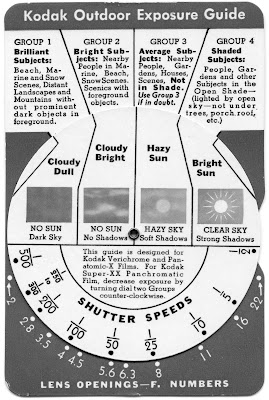
The daylight exposure guide looks suspiciously like it is based on Sunny-16.  Yes, it is!

Thursday, July 05, 2018

The Last Exposure - Celebrating the life of Marc Akemann

 This is probably the hardest post for me to write. On Tuesday (07/03/2018), I lost my best friend, Marcelino (Marc) Akemann (born 10/27/1956).  Marc had been battling non-small-cell lung cancer for over a year, and the latest treatments had him feeling quite positive and feeling good.  He drove over to the house for a visit on Saturday, and we laughed and had a good time. He also got see to my daughter Jorie, who was down for a few days from Marquette.  I took a photo of the two of them in front of Hound, the Jeep Cherokee that Marc bought from her a few years ago.  I gave him a big hug, and he drove home.  On Monday afternoon, he suffered a massive brain hemorrhage, and died peacefully Tuesday afternoon in the ER surrounded by family (and Adrienne and I, who arrived just moments earlier).  It was a surreal scene for me, to see a man that had just a few days ago, been talking about the future, lying still, and never again being part of this world.

Marc and I met for the first time in late 2007, when he showed up at my house for a Crappy Camera Club Meeting. We had actually talked earlier that year when he visited the A3C3 "Cheap Shots" exhibit in Nickles Arcade, and of course, in true Marc fashion, he remembered our conversation, while I did not.  Someone had told him that he should meet me, as we had some things in common.  I know that we quickly became friends, and by 2008, we both went to our first Photostock and traveled around together.  In the ensuing decade, we became the Marc (with a C) and Mark (with a K) show, and made many photo trips together all over Michigan.   In Facebook posts while we were travelling in 2013, it seemed that we were eating our way across the Upper Peninsula. In fact, restaurants were the only place we had good wi-fi!
At the Two-Hearted River in 2013

Marc was the most honest and conscientious person I have known.  He was a gentle soul that made sure those who needed help were okay, and always had time to help out if you needed him.  He was a master of constructive criticism, and rarely had bad things to say about anyone.  Both of us had common ground in many things, and we both abhorred hypocrisy. Marc served in the Air Force during the post-Vietnam era, mostly in Germany.  He was a "fuelie" - working with AV fuel and other ground support.  In hindsight, I have to wonder if that was the cause of his cancer. He never smoked. In the Air Force, he was able to travel a lot in Europe, and that gave him a better insight than most US citizens about other countries.  His father (Dutch) and mother (Indonesian) emigrated with Marc from the Hague to the US in the late 1950s.  His younger brothers Max, Victor, and Dimitry, and sister Nicole were born in Wisconsin.  His dad worked in the auto-industry, and Marc had tales about when his dad worked for American Motors, and they had some of those amazing cars that came out in the 1970s.

Marc and I used to meet up for coffee in Dexter, where we might have first dropped off some film at Huron Camera, had a leisurely chat at Joe and Rosie's coffee shop next door, and then went back to Huron Camera to get our processed film.  In its heyday, Huron Camera was an amazing place that had just about everything, and there were always the "treasure bins" at the back where we found the occasional bargain.   It closed in 2014, and our subsequent Dexter meetups were less frequent.
At Roos Roast, Ann Arbor, April 2017.

We had so much fun traveling around together. We both had the same sense of humor, and I recall a couple of times that we saw things and had to double back and take a photo.  Marc used to have a rusting Jeep Wrangler that he drove everywhere.  It of course had a short turn radius, and he was never hesitant about making a quick U-turn to get back to the scene.  Somewhere in the thumb region of Michigan we saw a hilarious sign and we knew that if we didn't shoot, we would never get over a missed opportunity.  I included the photo in an exhibit I had at the Common Cup in Ann Arbor, and I was asked to remove it from the show.  It's here for your enjoyment, though.

Travelling across the back roads of the Upper Peninsula we saw a strip club.  In the middle of nowhere (to us, at least). It seemed so out of place in the UP.

Later that day, we made it to the Delta Peninsula and spent several hours at  the ghost town of Fayette, now a state historical park.  Marc and I had different approaches to our photography.  He was very deliberate, and he often used a Mamiya RB-67 and a damned heavy Gitzo tripod.  Me, I was scampering around with my much lighter Bogen tripod and usually a 35mm Nikon.  We both had a preference for Nikon cameras, and he always had a very nice black Nikon FA that he used regularly. So much so, that I regretted selling mine years earlier.  His other daily shooter was a Nikon F100 with a 50mm 1.4 (which his brother Vic had found at a garage sale for $25), and he almost always had his compact Olympus XA with him.   Of course, Marc was no stranger to GAS, and we often brought our latest acquisitions to a coffee meet-up.  He was especially fond of his nice Contaflex system, and shot with it regularly.   He had acquired some interesting gear over the years, and always took great care of it.  He had planned on getting his darkroom set up at his new place in Whitmore Lake, and then he fell ill with the cancer.

One November about 6 years ago, Marc and I were on a little photo trip to the Adrian, MI area.  At some point we saw something odd in the road, so we stopped. It turned out to be an expensive shotgun in a case.  We loaded our find into my Escape, and went searching for the proper authorities to turn it in.  As it was Veteran's Day, we had a hard time locating the police, and since it was not an emergency, we had to go find the station.  It wasn't in their jurisdiction, so the Sheriff Dept. had to deal with it. When we finally found the right place, we turned in the shotgun, and Marc filled out a form.  Two days later he got a call from the owner.  Turns out the guy had taken out the case to load something else into his truck for a hunting trip, and put the gun  on top of the cap.  He drove off, not realizing that it had dropped to the ground about 500 feet from his house.  He was so grateful that he sent Marc $50, which bought the two of us lunch at Seva.  That was so typical of many of our trips -- we also ended up with a story.
12/31/2012, on our River Raisin drive

Marc was a regular exhibitor at our Crappy Camera Club shows, and a regular attendee at meetings.  Even if he didn't have photos to show, he was always there to help put up a show or take it down.  For him, it was a way to connect with other film shooters in a group that was not about egos or agendas.  I will say it again that Marc was a dedicated film shooter, even in his professional mode as a photographer.  Only recently did he use digital cameras, and then only for very specific jobs.  He had come to really love flying his DJI Phantom drone, and this past May, he took it out when we went on our last photo/lunch/thriftshop day trip.  We went out May 5, which was one of those bright sunny days with no clouds.  We visited a bunch of places, and finally in the afternoon, visited a thrift shop in Chelsea, where he bought a LOMO LC-A camera for less than $5!
Drone Pilot, May 2018

Marc's drone at Pickerel Lake

Marc, atypical pose. May 5, 2018.


We both looked forward to attending Photostock, which is a yearly event held in late June by Bill Schwab, near Harbor Springs, MI.  We didn't always attend, but we made many of them over the past decade.  It's a great gathering of photographers - mostly film and alt-process users, but nobody is a stranger to digital, either.  People leave their egos at the door, and we talk a lot, show our work, and do some photography.  Oh, yes, and we party at night, too. We both met some fantastic people at Photostock.

Marc at Photostock 2008

Marc and I traveled together a lot at Photostock.  I think 2013 was my favorite year, because we also did a UP photo trip afterwards.  We saw a lot together, and always came away with some good images and memories.  
At a later Photostock 
Another trip to the UP was in late October 2012.  We drove Jorie's Jeep up to Marquette after I had some work done on it in Arbor. We switched out with my Ford Escape, and then drove it to some spots in Alger County that were definitely worth the trip.  Marc used to tell me that I drove like an old man. That's because I didn't have his lead foot on the gas. We did some great photography on that trip and saw the places mosquito-free, especially at Mosquito Falls.
Marc and his Contaflex, Deerton, MI

At Mosquito Falls area

At Tannery Falls, near Munising.

We definitely loaded up the SUV with our respective camera gear. However, Marc's Gitzo tripod and RB-67 bag ALWAYS took up the most space.  He had a separate bag for his Nikon gear and his Contaflex outfit.  I don't know that I saw many of those images from the Contaflex.  We went on a trip to the Ghost Forest at Sleeping Bear Dunes one year, and he carried that monster tripod and backpack across the sand and up the hills.  He was always in better physical shape than me.  We always had fun, though, and I don't think he and I ever had a cross word with one another in all those years.

It's not every day that you meet a person that you immediately like. Marc was one of those people. He had a way of making one at ease, and could start a conversation with anyone.  In his various jobs, I will bet that his demeanor and honesty was a great asset to him.  He had been a freelance photographer for some time, and one of his biggest accounts was doing photography at Domino's Farms, and was still intending to finish up some work. 

He was what I call a once-in-a lifetime best friend.  I wish we had both been able to live out to a decent old age, and I will miss his graciousness, his sense of humor, and wry smile.   I know that he made me a better photographer and a more outgoing person.   
November, 2017

street shooting in Holly, MI, 2011

At Photostock 2008

2008 Crappy camera meeting

2008-2009

Marc will be missed by so many people. I know his wife Coleen and daughter Camille will miss him most of all. He was a proud father, good husband, and wonderful brother to his siblings.  I know that he made me a better person, and I will always be thinking of him when I venture out on a photo trip. Marc, you may not be with us now, but your spirit lives on in how you touched our lives, and so our lives must go on. I'll be thinking of you when I see the night sky and the water over the falls. Rest in peace, my friend.

08/06/2018 --PLEASE NOTE: A Celebration of Life event will be held on Sunday, August 26, at 11:00 a.m. – 3:30 p.m., at Domino's Farms Office Park, EBA Café, Lobby H, Level 1, 24 Frank Lloyd Wright Dr., Ann Arbor, MI 48105. There will be an Open House at 11:00 a.m., a Remembrance Service starting at 11:30 a.m., with a luncheon to follow, and plenty of desserts.

Memorial donations in memory of Marc may be made to the Huron River Watershed Council. https://www.hrwc.org/donate/someonespecial/