Thursday, March 11, 2021

Monochrome Mania #4 Available!


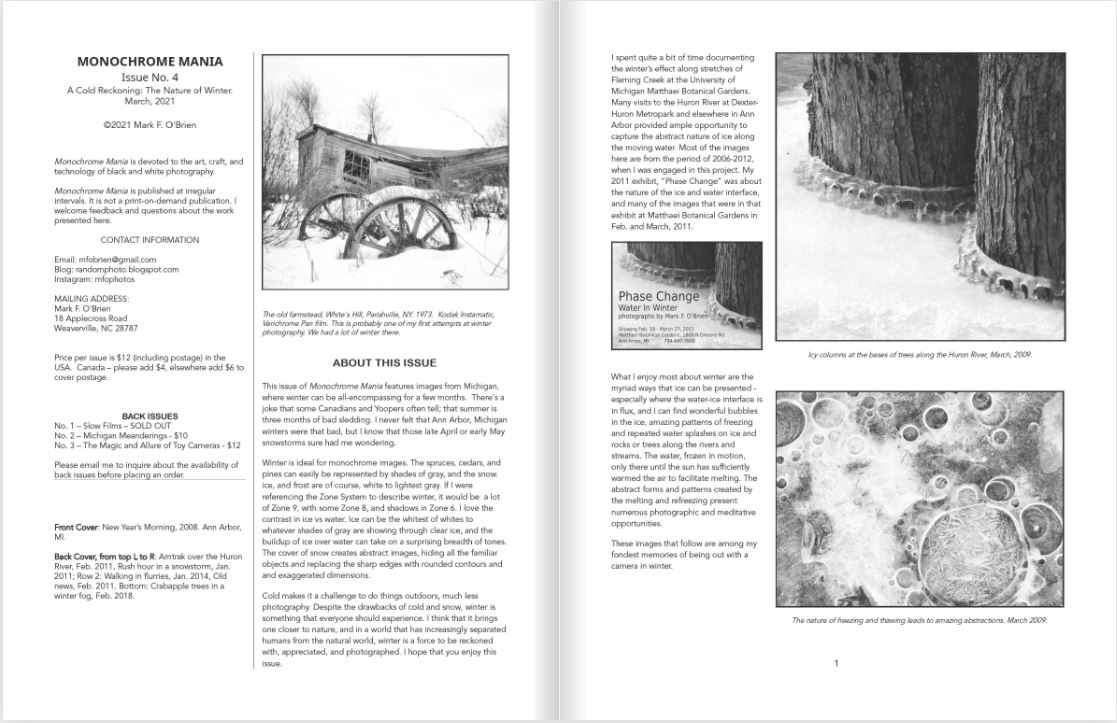
While Spring is making itself quite apparent here in North Carolina, the latest issue of Monochrome Mania is fresh from the printers, and it's about...Winter.  Yes, you read that right. The title is A Cold Reckoning - The Nature of Winter.  This issue explores the abstract images found in ice, winter weather, and the forms that result from repeated freezing and thawing, along with some tips about cold weather photography.  The origins for this issue go back a decade, when I had a photo exhibit at Matthaei Botanical gardens in Ann Arbor, MI. It was titled "Phase Change" and the images were of various facets of the phases of water from liquid to solid and back again along Fleming Creek and the Huron River.  Many of those images appear in the zine, along with others taken after that show.  This issue departs from what I had previously done in the sense that I don't tell you about the cameras and films that I used, because I want the reader to enjoy the images for what they are.  Included are some quotes and poetry as well as information at the end about photographing in cold weather.  My friend Susan Patrice suggested some better fonts, and they have made a difference in the presentation.  Everyone that's seen the pre-press copy has really liked this issue, and I hope that you'll be tempted to purchase it and enjoy it, too.

Monochrome Mania # 4 is once again  36 pages plus covers, and priced at $12 within the USA.  For readers in Canada, It's $15, and overseas, $18. All prices include shipping. 

You can purchase it at this link: https://bityl.co/5uis


You can also link to the store via this QR code:


Friday, March 05, 2021

One Roll Review - Adox HR-50

I purchased a bunch of  "new to me" film stocks last year, and I am slowly shooting these low-iso films.  I aim to update the first Monochrome Mania with an additional review of films that are currently available, after I have tested them all. These one-roll reviews are sort of a preliminary report of what I hope to be more thorough testing.


Adox HR-50 is certainly a film that should be of interest to black and white enthusiasts.  According to the Adox literature, the film is "based on an emulsion commonly available for technical purposes, featuring an ultrafine grain and superpanchromatical sensitization."  I like that term "superpanchromatical"  I am going to have to use it sometimes and say, "Wow! Superpanchromatical, Dude!"

HR-50 Spectral Response


In addition,  Adox  states "ADOX HR-50 is especially suitable for street and landscape photography. In Portrait photography we recomend our dedicated HR-50 developer.ADOX modifies this film from the master roll and finishes it to 35mm, 120 and sheets (4×5). The film´s speed is enhanced to 50 ASA using ADOX´s new SPEED BOOST- technology. The gamma is reduced so it becomes perfectly usable for pictorial photography in regular developers. ADOX HR-50 can be used as an Infrared film and responds extremely well to any sort of filtration (yellow, orange, red, blue, green)."


Fact sheet - https://www.fotoimpex.com/shop/images/products/media/63360_5_PDF-Datasheet.pdf

Film facts:

  • Emulsion: Superpanchromatical
  • Resolution: Up to 280 lp/mm at an image contrast of 1000:1
  • ISO: 50/17°
  • Base: 0.1mm PET
  • Anti Halation: Combined AHU with NC/AH on backside* ( AHU=Anti-Halation Underlayer, NC=No Curling, AH=Anti-Halation)

I purchased two rolls of the HR-50 and a bottle of its special developer from B&H. Usually, I try to stick to developers that I commonly use, but in this instance, it seems that the HR Developer gives the best results. In developing a roll of the HR-50 in a single reel tank, I needed only 6 ml of developer and 294 of water.  

I shot the first roll in November of 2020 and Feb. 2021 in my Pentax Spotmatic F. No filters were used. I plan on using roll 2 during the summer with a 25A red filter to see what I get with green vegetation on a sunny day.

This film reminds me a great deal of Kodak's Technical Pan Film. The clear PET base makes scanning really easy, and the spectral response is similar to TechPan, which is sensitive into the near-IR end of the spectrum. The HR developer reminds me a bit of the Kodak Technidol liquid, but I have no idea what the HR-formula contains. I sense that the HR-50 film would be a high-contrast film if developed with anything other than the HR Developer, much like Tech Pan.  

This film is really sharp and virtually grainless, and I found that in shaded conditions, there is a really smooth tonality.  In stark sunlit conditions, the highlights appear somewhat overexposed, and shadows dark. That could be due to my processing or my metering, but I do like the look of this film. Midtones, do look pretty good, though.  

I think that if you are looking for a pictorial replacement for Tech Pan, the Adox HR-50 should be a great candidate.  The preliminary results from it certainly encourage me to do more testing. It's a faster film than Tech Pan, for sure.  I may also try developing some in POTA, just to see how it compares, and likewise, I will try developing some Tech Pan (I still have a lot of it) in the HR Developer and see what I get from that.

As of this writing (3-5-2021),  it appears that HR-50 is no longer offered through US retailers, though I see it for sale in the EU. Drat!  Now I wish that I had bought more of this nice film.

Some Examples:


From the Blue Ridge Parkway, November 2020

dying elephant-ear leaves

These are all from a visit to Dillsboro, NC in late February, 2021.

Dillsboro, NC RR crossing. 

Restful place on the other side of the tracks

We sell masks

All others pay cash

mirror view

Rails, roads, and mountains


Tuesday, March 02, 2021

Spotmatic II - SP II Joy

 Out and About With A Spotmatic II


The SP II


I have always loved Pentax Spotmatic SLRs.  I was able to borrow one in college (late 1970s) which I used on a research trip to the SW in 1980, and before that, used it with extension tubes to shoot macro of the wasps that I was working with for my thesis.  My own SLR at the time was an Exakta Exa 1a which lacked so many features that the Spotmatic had.  By the time I was working and needed to buy a new SLR, I bought a Pentax MG, which is pretty much the same camera as the Pentax ME.  Had I thought about it, I should have purchased a used Spotmatic F or Spotmatic II, which although they were M-42 mount bodies, were superior to the MG in build and had match-needle metering.


This Spotmatic II (SP II) came to me recently to sell, and it is in wonderful condition.  So good, I should have bought it for myself, but I already have the better camera in the Spotmatic F.  The Spotmatic F features open-aperture metering with SMC-Takumar lenses, whereas the SP II still uses stop-down metering.  Not really a big deal, but I do like the open-aperture metering.  I decided to test the camera out and shot a roll of the FPP 200 BW film - now known as FPP LOVE BW.  


First of all, the SP II was produced from 1971-1977, and based on the serial number of this one (5407261), it was probably made between 1971-73.  So, it's about 50 years old.It is in excellent condition. I have seen very few Spotmatics that look as minty as this one, which is probably because it was kept in a never-ready case. The SP II is as elegant and as simple in operation as metal-bodied SLR can get Everything about it seems precise and ergonomically correct. The shutter is fairly quiet, and advancing the film is easily done.  The camera came with the typical 55mm f/1.8 Super Multi-Coated Takumar (SMC Tak), which is a great lens, and one of the best in the M-42 mount.

A thing of beauty

I took the camera around the River Arts District in Asheville, and also on a short trip into Pisgah national Forest near Barnardsville, NC. I also had my Spotmatic F along loaded with color film.  

I processed the FPP 200 in D-96 for 8 minutes.  The results were pretty much as I expected. The meter works well, and for a 50-year old SLR, it works as good as it did on the sday it was made. Not too big of a surprise, really, but the camera confirmed why I like Spotmatics.  They are great to work with, and while some people don't like the screw-mount lens system, I don't feel it ever hindered me.

Of course, there are other places on the web with far more information on Spotmatics than I am going to give here, Casual Photophile's blog is a good place to start, and the Camera Wiki has more information.  I just don't understand how the Pentax K1000 gets all the attention, while the more refined Spotmatic F is a far better body. Pricewise, you can pick up the SP II for less than $50, and M-42 lenses are similarly inexpensive.  


A few images:


Thursday, February 18, 2021

Widening Your Horizon

Vance Birthplace, Reems Creek, NC 2019. Sprocket Rocket, Fuji Superia 400

One of the important aspects of photography is determining how much of a scene will appear in your image. Not only that, but the aspect ratio in which the scene was recorded (whether film or digital), is also an important decision.  We often see different aspect ratios available on digital cameras - 1:1 (square) 3:2, 4:3, 16:9, etc.  With film, the original aspect ratio of the medium is square 1:1 (24x24 mm for 35 mm, or 6x6 cm in 120), 2x3 (24 x 36mm for 35mm) 3x4 (18 x 24 mm in 35mm half-frame), and in medium format, 6x4.5, 6x7, 6x8, 6x9, and 6 x 17. Large format of course, is 4x5, 5x7, 8x10, etc., but not a part of this discussion.  I only mention digital here because you can choose a wider aspect ratio in-camera, but at the cost of pixels. Panoramic format is generally considered to be about twice as wide as high, so an aspect ratio of 16:9 is pretty close in the digital world. 

I'm going to discuss 35mm film formats, since that's the most-often used film, and the panoramic options are more affordable.  To get more of a landscape in your image, one can go the wide-angle route, using lenses with short focal lengths such as 28mm down to 16mm.  My favorite wide focal length is 24mm, because it's not so wide that there is going to be major distortion in perspective, compared to 19mm or 20mm.  However, the problem with just using a wide-angle lens is that all of the scene, from sky to foreground is there, unless you crop it out.  The better solution to a wide-scape is to use a wider frame of film for the scene.

While a standard 35mm still negative image area is 24 x 36 mm, there are other formats that will affect the area of the scene captured.  You may often hear about panoramic format images from 35mm and the typical, easy way to do that is simply to mask a 35mm frame so that it ends up with the negative area that is about 15mm high x 36mm wide.  There are many 35mm point and shoots and a few SLRs that do this trick by using a horizontal mask at the top and bottom of the frame. It works quite well, but the downside is that you have also lost some resolution, as you are cropping the 35mm frame to a much smaller area.  Making enlargements will often be grainier and less sharp. However, with a wide-angle lens and a good exposure on fine-grained film, the result can be quite acceptable.   

Lake Michigan Dunes, 2007. Ansco Pix Panorama, Delta 400 film

The better way to present a wider-aspect ratio image is to increase the frame size. To do this, the camera needs to have a wider film gate, and a lens that will work with the wider image circle. There are several options for this, and most of them are expensive. The one camera that's probably most coveted for wide shots is the Hasselblad X-Pan (made by Fujifilm, and also known as the Fujifilm TX-1). The negative area for that camera is 24 x 65mm, almost double the frame width of a typical 35mm.  The price of such a camera now is beyond the means for most of us. So, what other choices are there?  Well, fear not.  My list that follows are low-cost solutions to the panoramic problem.

Ansco Pix Panorama 

The low-fi way to do it.

The removeable panoramic mask in the camera

This is the low-fi, low-cost way to shoot a cropped frame panoramic. Amazingly enough, the images are better than one might expect. They have the toy camera aesthetic, and with the 27mm lens, one gets a true wide-angle for the best result with the cropped 13x36mm negative.  The shutter speed is about 1/125 sec, with an F/11 aperture.  The panorama mask is removeable so that you can also get standard 24x36mm negatives.   Ebay prices are quite low, ranging from $5 to $20.  Ansco Pix Panorama  cameras are quite common (not made by Ansco, but by Haking in China), so don't overpay for one.  Due their easily pocketable size, they provide a fun and easy way to get a panoramic look.  On sunny days, ISO 100 films should be just fine, otherwise ISO 200 or 400 films.  Kodak's Tmax 100 for b&w would be a good choice for sunny conditions. There are many other 35mm cameras with a panorama mask and wide-angle lens, such as the Ricoh R1, Minolta Freedom Vista, Olympus Trip Panorama, Yashica Microtek Zoom 70,  Nikon Lite Touch AF 600, Vivitar IC101, Vivitar T200, Vivitar PN 2011, Pentax UC-1, etc. 

Lower harbor, Marquette, MI. 2014. Yashica Microtek Zoom 70.
Konica VX 400 film.


Curvilinear, 2013. Nikon F-50D with the pano mask, Tmax 100 film


Lomography Sprocket Rocket


Lomography's Sprocket Rocket is a great plastic fantastic panoramic camera, which I discussed in 2017.   The Sprocket Rocket's real frame size is actually wider than the X-Pan, at 24 x 72mm, or two full 35mm frames.   With its 30mm f/11 and f/16 lens and only Instant (1/100) and B shutter speeds, it's limited in the ways that an X-Pan is not.  However, it does have a tripod socket, so lengthy exposures are possible.  Best of all, it's an easy to carry-around camera that takes pretty darn good images. There's some vignetting, some blurred edges, and a bit of distortion, but I love the images that I get from this camera.  I do not care about showing the sprockets, and they are cropped in my scanner frame, anyway.  With a 36 exposure roll of film, you will get about 16 shots.   I have found that using 200-400 ISO film works great in most conditions.  My favorite film to use with this camera is Eastman 5222 (Double-X).  

Cloudgate, Chicago, 2017. Sprocket Rocket, Eastman 5222


Holga 135 Pan


The Holga 135 Pan looks much like an elongated  Holga 120N.  It has a removable 55mm f/8 lens plus an f/236 pinhole lens.  The frame size is 24 x 72 mm - again, a tad wider than the X-Pan. It's zone focus, and has two shutter speeds - ca. 1/100 sec and Bulb.  It also has a tripod socket and a hot shoe for flash.  I have used mine as a pinhole camera and also with the regular lens, and I prefer the 55mm lens. I reviewed the camera back in 2012.  I don't think the images are as sharp as the Sprocket Rocket, which is due to the Holga lens. However, if you want to shoot wide with a toy camera, it's one to consider, and it's definitely given me some memorable images.

Great Lakes Freighter, 2012. Holga 135 Pan, Superia 200

Angell Hall, 2012. Holga 135 pan, Vista 100 film


Holga 120N 35mm Adapter

I reviewed this solution in 2010, and the resulting frame size is 24 x 55 mm, because you are using the 35mm film in a 120 film body.  The biggest drawback in my opinion is the frame counting is tedious, and you can't rewind the film without taking the camera into a dark bag and unloading it.  You can also put 35mm in film other medium format cameras, and only a 6x9 format makes this desirable.  There are many hacks for doing this, but in most of the instances, you can't rewind the film in camera, which does make this method cumbersome.  In addition, the medium-format lenses are typicall "normal" and not wide, so the effect won't be quite the same as a panoramic camera.


Result from the Holga 35mm adapter, 2010.


Other Medium Format Camera Adapters -

Using a 35mm adapter in a Pentax 6x7 ought to give nice results if you use it with a wide-angle lens such as the 45 or 55 mm lens. There are 3D printed adapters available online.  One photographer has blogged about his impressive results.  A Mamiya RB67  can also be modified to work with 35mm, and as with the Pentax 67, there are some online sources for a DIY or finished product.  Again, all of these adapters require you to rewind the film back into the cassette by using a dark bag or darkroom. If you already have a Pentax 6x7, then the adapter is a low-cost entry into 35mm panoramas. I plan on trying one out this year.

Horizon Panoramic Camera

Horizont (Horizon) 35mm swing-lens panoramic camera

The other option is to use a swing-lens panoramic camera that does not distort the images the way toy cameras are prone to do. The Horizont cameras, manufactured by Krasnogorsky Mechanicheskiy Zavod (KMZ) in the Former Soviet Union (FSU), debuted in 1966, and use 35mm film with a 24 x 58 mm framze size.  KMZ is also known for its line of Zenit 35mm cameras.  The Horizont features an 28mm f/2.8 Industar lens and four shutter speeds, ranging from 1/30 to 1/250 sec. It was replaced by the Horizon 202 in 1989, and then by the Horizon S3Pro in 2003.  Lomography now sells the Horizon Perfekt, which has an ABS plastic body, easier controls, more streamlined shape, and is made in the Zenit factory.  Another model from Lomography is the Horizon Kompakt which has only 1 shutter speed and an f/8 aperture. A new Horizon Perfekt will set you back about $350, with the older models going for less.  The Horizont will give you sharp images, and is a heck of a lot cheaper than the Widelux or Noblex swing-lens panoramic cameras.    My Horizont arrived the other day from an eBay seller, and I am just testing it out now.

To sum it all up, shooting a scene on a wider negative provides a much different view than a standard 35mm frame, even if a wide-angle lens is used.  You can of course, crop any image to get a wider aspect ratio, but cropping is at the loss of image area, whether film or pixels. A wider negative in panoramic format presents the viewer with a more dynamic depiction of a scene.

Of course, you do not have to shoot panoramas horizontally.  Vertical shots are really fun, and provide a definite vertically dominant image.

A triptych from 3 vertical Ansco Pix Panorama shots, 2007.

About Medium Format Panoramas

If you want to really go with film real estate, you can choose among medium-format cameras, with 6x12 and 6x18 cm being very amazing, and also very expensive.  However, there are a number of people that have produced 6x12 cameras using 3D printing.  The Kraken 6x12 from Graham Young is a good example. This makes shooting wide in medium format much more accessible. Lomography's Belair also does 6x12 at a reasonable price, but my sample of the camera never seemed to focus accurately, and I really never warmed to to it.  Of course, there are Widelux and Noblex cameras that use 120, and are pricey.  The cheapest 6x12 would be the Holga 120 Pan that has a 90mm lens and the typical Holga construction.  However, it's probably no longer in production. On the higher end of the scale, Linhoff and Fujifilm have the extreme wide panoramic cameras with prices and image quality to match. 


  More Images!


The wide-angle image from the Ansco Pix without the
panorama mask in place. 2008. 


April 2017 Festifools. Sprocket Rocket, Kodak Gold 200.


Smithfield Cemetery, 2020. Sprocket Rocket, expired
Ektachrome Elite 200


Parker Mill, 2010. Holga 35mm adapter.


Pergola, Biltmore, 2021.  Sprocket Rocket on Ultrafine 400

Landscape, Biltmore, 2021.  Sprocket Rocket on Ultrafine 400


Skeleton, 2015. Holga 135 Pan, Tmax 100


Perspective, 2006. Ansco Pix Panorama. Ilford HP-5


Black Rocks, Marquette 2006. Ansco Pix Panorama, Delta 400 


Tuesday, February 02, 2021

It's About Time

The Phochron XA shutter tester and a Kodak Duex

In issue 3 of Monochrome Mania, I provided estimated shutter speeds for most of the cameras that I listed. At the time, I had not tested the speeds with my shutter tester - The Phochron  XA. I probably should have done so before publication, but it just didn't happen.  One of my readers asked me if I had checked the speeds or used the ones given in the literature. The ones provided in the various sources are what I used, because they are the benchmark numbers that provide a basis from which to work from.  I don't expect any of these cameras to have the same shutter speed across all examples.

Today, I went and tested a number of my toy cameras. I repeated each shutter activation 6-10 times, and got an average speed.  The numbers listed below don't mean that every example of a camera will have the same speeds, but you can compare what I found with the published speeds and go from there. All shutter speeds from my test are given as the average.


120 Cameras (Listed in the same order as in MM#3)


The Diana

DIANA

First up is the mighty Diana, and the shutter speeds of the original versus the Lomography Diana + are definitely different. The original Diana shutter speed was given at about 1/60, and the Diana + at 1/100 sec.  Here's what I found.

  • Original Diana - 1/130 sec 
  • Banier - Diana clone - 1/140 sec
  • Diana + No. 1 - 1/72 sec 
  • Diana + No. 2 - 1/190 sec


HOLGA

I realize that I didn't provide a shutter speed for the Holga, but it's considered to be about 1/100 sec.

  • Holga 120N - 1/170 sec 
  • Holga 120S No. 1 - 1/171 sec
  • Holga 120S No. 2 - 1/155 sec


DEBONAIR 

The number typically given is 1/60 sec.  My example has an average speed of 1/36 sec.


Agfa Isola I


AGFA ISOLA I

The literature says the shutter speed is 1/30 sec.  Mine has a speed of 1/32 sec., which is certainly within the tolerances!

ANSCO SHUR SHOT 

The typical speed provided is about 1/35 sec.  My example has a shutter speed of 1/50 sec.


SPARTUS FULL-VUE

The shutter speed given is about 1/60 sec.  My example's shutter speed is 1/53 sec.


620 Cameras


ANSCO PANDA

The shutter speed given was 1/30 - 1/50 sec., and my example has a shutter speed of 1/35 sec.


KODAK BROWNIE BULL'S EYE

The instant shutter speed is supposed to be around 1/50 sec, and my example has a shutter speed of 1/38 sec.


KODAK DUAFLEX III

My Duaflex III witha Kodar lens has a shutter speed of 1/48 sec


KODAK DUEX 

The Duex shutter speed is supposed to be "about 1/30 sec," and my example's shutter speed was 1/66 sec.


Beacon 225


BEACON 225

My example of the Beacon 225 has a shutter speed of 1/60 sec.


IMPERIAL MARK XII

Posted shutter speeds are in the 1/30-1/60 sec range. My example has a shutter speed of 1/63 sec.


IMPERIAL SIX TWENTY

My example's shutter speed was 1/50 sec.


IMPERIAL REFLEX

I guess my example's shutter must be a bit fast, as the shutter speed was 1/106 sec.

Photak USC Reflex III


USC REFLEX III

My example of this camera has a shutter speed of exactly 1/60 sec.  

I did not test all of the cameras that are in Monochrome Mania, as some have film in them, and the construction of some makes it difficult to do a speed test.  Your examples my be different from what I found for my cameras, or they may be the same.  However, I think that even if they were fresh from the factory, there would still be variance in the shutter speeds. These are not precision cameras, so do not expect precise shutter speeds.  My biggest surprise was with the Diana and Holga cameras. I did not expect the Holga speeds to be over 1/150 sec, nor did I think that the Diana+ examples would be so different.  However, as I have said before, the variance in performance of those cameras makes them ideal candidates for owning several, as they seem to have individual character.