
Showing posts with label waterfalls. Show all posts

Saturday, February 15, 2020

One Roll Review - Rollei RPX 25

It seems that this is one of the few low-ISO films that I have not tried until now.  The film came on the market in 2014, so it's been available for quite a while. I placed a big order of Rollei and other films that I had yet to try, and B&H quickly shipped them to my door.  Among the films was Rollei RPX 25, which I assumed was a sort of replacement for the old Agfa APX 25, which I definitely liked when I shot with it over a decade ago.  After doing a bit of research, the RPX 25 is a different sort of film, which is made by someone, certainly not Rollei. While the packaging and the Rollei name are licensed by Maco, the film is quite different from the Rollei Ortho 25 Plus, and is not advertised as having extended red sensitivity like the Retro 80s film. 

From the RPX 25 Datasheet (translated by user ashfaque on Rangefinder forum 12/2015):

"Low-sensitivity, high-resolution, panchromatic black and white film, ISO 25/15°
Rollei RPX 25 is a panchromatic B&W film with a nominal sensitivity of ISO 25/15°, which is cast on a modern crystal clear, synthetic carrier.
    This film is characterized by its high resolution at fine grain and high edge sharpness. Rollei RPX 25 behaves perfectly in over- or under-exposure due to its optimum sensitivity reserve of up to 2 stops. Depending on the developer, the film compensates critical lightning situations. The 5µ film - silver-rich-panchromatic sensitized Rollei RPX 25 is poured into a crystal-clear polyester carrier of 100µ. "

Main Features in Brief

  • Low sensitive panchromatic film at ISO 25/15°
  • Resolution Contrast Ratio 1000: 1 = 260 lines / mm
  • RMS granularity (x1000) = 8
  • Exposure range (between 12 and 50 ISO)
  • Good pull-push characteristics
  • Good rendering of tones
  • Very good maximum blackness;
  • Transparent = optimal for scanning and as slide
  • Optimum flatness thanks to anti-curling layer


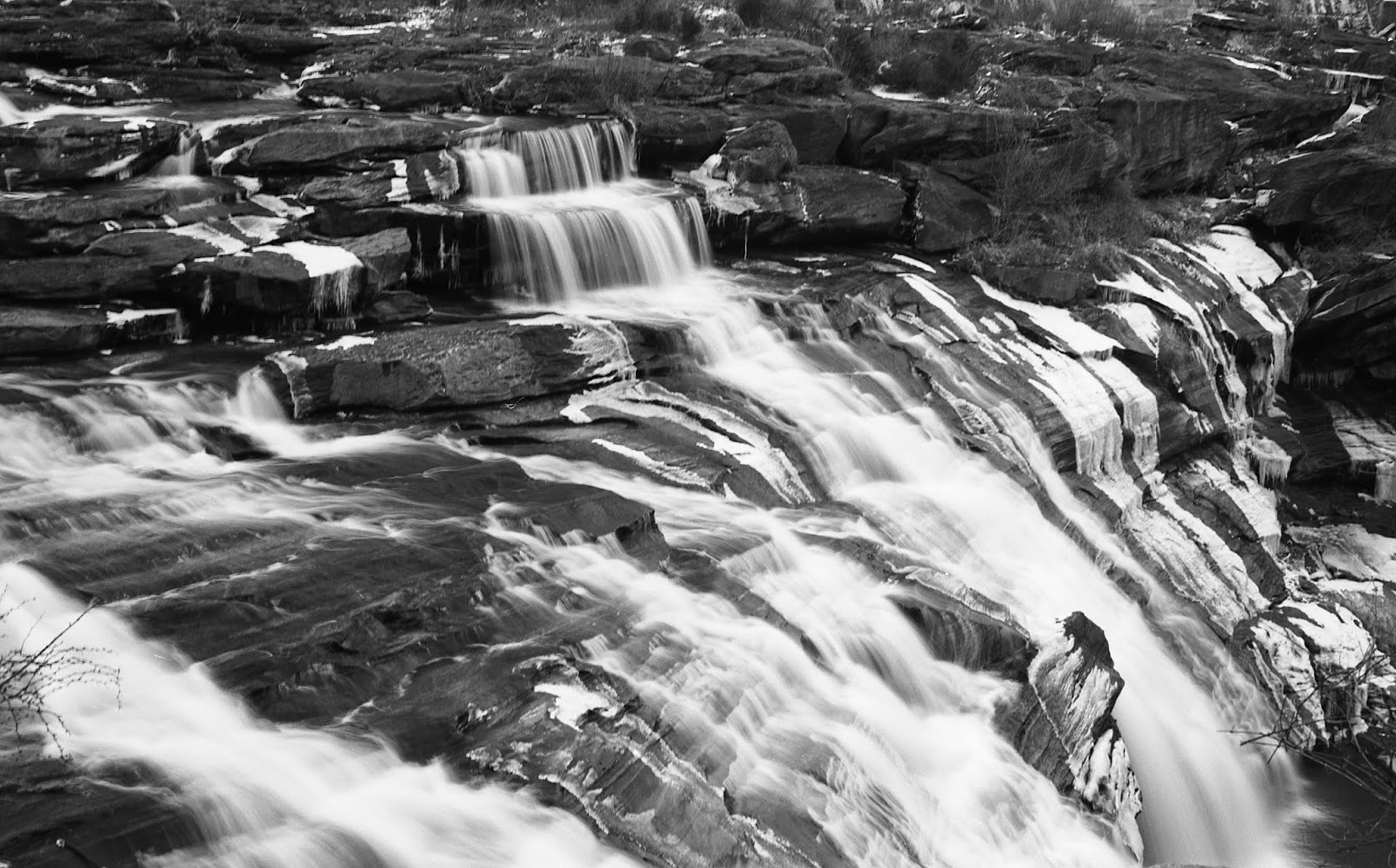
I shot my roll of RPX 25 while on a trip to Dutchess Co., NY in early February.  I also traveled around the nearby CT/MA/NY area, and when I found myself at Great Falls on the Housatonic River, I knew that a low-ISO film was perfect for what I was seeing.  I loaded my Nikon FM3a with the RPX 25 and had exposures of about 2 sec maximum.  I saw no problem with long vs normal exposure times.  I developed the film in Kodak D-76 1:1 for 8 minutes at 20°C.

some negatives on the light table

In my research about this film, I found that it could have been made by Agfa, and might have been the Agfa Aviphot 80 aerial film. Which apparently, is the same as the Rollei Retro 80s.  I have shot the Retro 80s, and I like it, and it does not appear to me to be the same film.  The Polyester base does lie very flat, which to me, is a plus in scanning.   I know that the Rollei films are all rebranded from other manufacturers, and of course, it's not old-stock Agfa APX 25. What exactly is it?  Does it really matter?  It's documented that the Rollei Retro 80s is the Aviphot 80 film.   I am not buying that RPX 25 is the same film.  I am glad that the RPX 25 is available and from what I have seen thus far, an excellent film for landscapes.  I'll leave the keyboard commandos to their theories about the film's origin.

One may argue that one roll isn't really testing this film.  I shot the film at the box speed, using a camera and a subject that I am familiar with in my shooting style.  Yes, I used a tripod and a cable release.  I feel that my results matched my expectations for a low-ISO panchromatic film.  Of course, I would shoot this film again.   

One bit of caution - since the film is on a PET base, light-piping can occur, so keep the film in the black canister, and load in dim light. 

All images shot with a Nikon 35-105 zoom Nikkor, unless otherwise specified.


on the way home, along I-26 N of Asheville, 50mm f/1.4 nikkor

on the way home, along I-26 N of Asheville, 50mm f/1.4 nikkor


Sunday, August 28, 2016

A week along the AuTrain

6-8 foot waves in AuTrain Bay
Reany Creek after the rains.
I am back from a week-long stay in AuTrain, MI.  If you are unaware of where that is, it's sort of in the middle of the Upper Peninsula, about 30 miles E of Marquette.  The AuTrain River empties into Lake Superior in AuTrain Bay, and I have photographed that particular spot numerous times over the years.  Changing lake levels keep the channel into Lake Superior in an unpredictable state.  When we arrived on the 20th, fierce storms had produced huge waves all along the coast, and by the evening of the 22, the lake had calmed.  We visited my daughter and daughter-in-law in Marquette, and were treated to some awesome scenes along Reany Creek, which empties into the dead River.  I shot lots of waterfalls through the week, and did a little macro work, and some street shooting in Marquette.  It was a great break from work, and quite relaxing to stay in a small cabin, being able to make meals, etc., and not in a motel.  Adrienne and I had a nice dinner in the Brownstone Inn along M-28, just a couple of miles from AuTrain.  Now that we are back, I have some film to develop. My most used film was Kentmere 100, but as you can see, I had quite a bit of variety.
I also shot quite a bit of digital with my trusty Nikon D200 and a bag of lenses. The camera phone  of course, was a good way to document our travel, if only to put a few things up on Instagram.
One of the things in the Upper Peninsula is that cell phone service isn't always good.   Keeping a charger cable in the car is a good idea to keep your phone from running down if it is searching for a signal much of the day.

One of my favorite places to shoot under various types of weather is Black Rocks on Presque Isle.  This time, it was an overcast day with some light rain, which really made for some good photography this time around.


Black Rocks
lots of sky along Lake Superior!

a much calmer lake a few days after the storm

Great Lakes beaches are hard to beat.

I did a little macro, too.  A male Polistes dominulus. The 60mm micro-Nikkor is a gem of a lens.

I have only been home a little over 24 hours and I miss the UP already.  I love the skies, the weather changes, the shoreline, the rocks, the people, and the smell of the woods.  I have been going there for over 30 years, and each time I come back, I have new memories and an anticipation of another trip. When I process my many rolls of film, I'll show some new work from AuTrain Bay.


Tuesday, August 11, 2009

Bond Falls

Not your average fishing hole
Aug. 5, 2009. Nikon F3HP, 28-80mm AIS Nikkor lens, 4x ND filter, Ilford Pan-F.

Bond Falls, located in the west-central Upper Peninsula is one of those places that many photographers have visited, and a few photographers have made iconic. The step-like nature of the falls and the easy access (due to a series of steps and pathways all around one side and at the base of the falls), really make it a pleasure to photograph. I can set my tripod and camera up for great angles, and whether it is a close-up of a small cascade or the full view from the base, as seen above, it's hard to get tired shooting there.

This was my second visit there, and I have much better technique and tools available to me since my first visit. The weather was largely the same -- bright sun. I can't control the weather nor could I choose a later time of day. However, with a 4x Neutral-density filter and a red filter, I was able to get shutter speeds as slow as 8 seconds, using Ilford Pan-F rated at ISO 32. The only problem I had was people. There is easy access to the water, and all kinds of kids were frolicking in the water near the base of the falls. I was patient, and got the shots I wanted when they moved on. I had to laugh though. This couple in the photo at the top was fly-fishing in the same area where the kids had been splashing around. Dressed like they stepped out of an Orvis catalog. Fishing there? I think they made for a great shot though, and I hope they had better success elsewhere.

However, fishing -- like photography, is similar in some respects. Success is often determined by the time of day, your patience, and your technique. Sometimes the tools don't matter, but using the tools at hand to their fullest will often make success more probable. Luck plays a part sometimes, but I'd like to think that it's the prepared that are lucky. In this instance I think I had more luck than the couple fishing.

Friday, August 07, 2009

Porcupine Mountains Trip 2009

Overlooked falls
Overlooked Falls, Finepix S2


I have lived in Michigan for a few months more than 28 years. I have made numerous lengthy trips to the Upper Peninsula, and have been all over it -- except for one area, the Porcupine Mountains. Finally, this past week I made a brief visit to the Porkies with my wife Adrienne, my daughter Marjorie, and her GF, Stephanie. We stayed at the Superior Shores Resort, in a nice cottage right on the shoreline of Lake Superior. It was a nice base to have, to able to make our meals there, have the waves crashing not 70 feet from our bedroom window, and be just a short drive from the Porcupine Mountains State Park. It was nice having Steph and Jorie prepare the meals, too.

Two peas
Jorie and Stephanie, shot on Ektar 100.

We went on several forays to view various waterfalls, hike some trails, and enjoy nature. The weather was excellent, never really hot, and although we didn't hit every spot, I think we came away wanting to see more next time, which is a good thing. Photographically, I kept my equipment fairly simple for this trip -- a recently acquired Fuji Finepix S2 Pro (which I found on ebay for $220), 18-50mm, 50mm 1.8, 70-200 Nikkor, lensbaby, and various ND and polarizing filters; Nikon F3HP, 50mm 1.4, 24mm 2.8, 90mm Tamron macro, and 80-200 f4. Also brought my "new" Great Wall medium format SLR that I bought on ebay from a seller in China. Oh, and a Bogen tripod w/ball head -- it is my lighter of two Bogen/Manfrotto tripods, and in retrospect, wish that I had brought the heavier one.

I really enjoyed shooting with the Fuji Finepix S2 -- ergonomically better than my D70, with sensible controls and the ability to also shoot b&w. I still need to do more work on some dirt removal from the sensor. Makes me think that my next "new" DSLR might be a FinePix if they come out with a full-frame version. However, that's a way down the road.

I shot three rolls of Kodachrome 64 -- the last of it that I will ever shoot, so doing it on a vacation is a very fitting end of such a unique film. I'll send those off to Dwayne's photo for processing next week. Look for images sometime in September.

The waterfalls are varied, ranging from small intimate falls on Union Creek and the Carp River that are very photogenic, to quite large falls on the Presque Isle River. Outside the park, we found Bonanza falls on the Big Iron River, which were a favorite. Farther west, we briefly visited Conglomerate and Potawatomi falls on the Black River. However, you can't really get close to those falls, as the viewing platforms are high above the river. Probably a good thing at high water. So, our favorites were smaller waterfalls that we could explore from every angle.
Bonanza Falls 2
one aspect of Bonanza Falls

If you want to capture the water over a long exposure, use at least one ND4 filter and your lowest ISO setting. I suggest using a polarizer and an ND4 filter for best results unless you are shooting very late in the day.

Greenstone Falls
Greenstone Falls

Overall, it was an excellent, if short trip. I think if I lived in the UP, I would be out shooting almost every day.