Sunday, December 17, 2017

Out and about with my Zorki 2C.


 Back in March, I purchased a Zorki 2C from a Ukraine eBay seller.  I had seen my buddy Marc's Leica IIIf when we met for coffee, so I decided to find a cheap LTM (Leica Thread Mount) Soviet camera online.  I had previously owned a Fed 5, and sold it to a friend when she was looking for an affordable and reliable manual rangefinder camera.  However, the Fed 5 did not look at all like a Leica II or III.   I found a Zorki 2C and it came with an Industar 61 52mm f/2.8 lens for $28 + $18 shipping.  It arrived within a few weeks in excellent condition.  On closer inspection, there were microscratches on the lens, which would definitely cause some loss of contrast.  I eventually found an Industar 50 lens on ebay for $10 + free shipping.  That lens has a maximum aperture of f/3.5 and I have the same lens in an M42 mount.  It's definitely a good, but not a fast lens. 

The Zorki 2C has strap lugs, which earlier Zorki models do not.  For me, that was a necessity as I hate never-ready cases.  The Zorki 2C, like most of the cameras from the Soviet era, is built pretty robustly, and has a limited selection of shutter speeds.  B, 1/25, 1/50, 1/100, 1/250, 1/500 sec.  Which, when you think about it, actually cover most situations with a handheld camera.  It has a separate window for the rangefinder, and both viewfinders are eye-glass scratchers.  Certainly not as good as my Leica M2, but better than an Argus C3!

For me, it was a question that I needed to answer - "How good is a Soviet copy of a Leica II in operation.?"  The Zorki 2C certainly is a compact, manual 35 mm camera that looks very "old school" and requires no battery for anything.  You can use an external light meter or sunny-16 for setting your exposure.  On my outings with the camera, I used sunny-16, and did pretty well. One other caveat that users of any LTM camera that loads from the bottom (as opposed to a hinged back) is that you need to cut your film leader just like the Leicas required them to be.  Otherwise, your film might hang up and you will have problems. 

Other than the film leader issue, remember to cock the shutter before you change the shutter speed.  These cameras are easy to use, all-metal, and easy to find online.  I really like taking it out to shoot with, and overall, I am quite happy with my Zorki 2C.  I may look for a collapsible Elmar-like Soviet (collapsible Industar 50) lens in the future, but for now I am set with what I have. The collapsible lens really makes this a coat pocket camera.

These images were taken earlier this year on Polypan-F film, which has no anti-halation layer, and an ISO of 50.


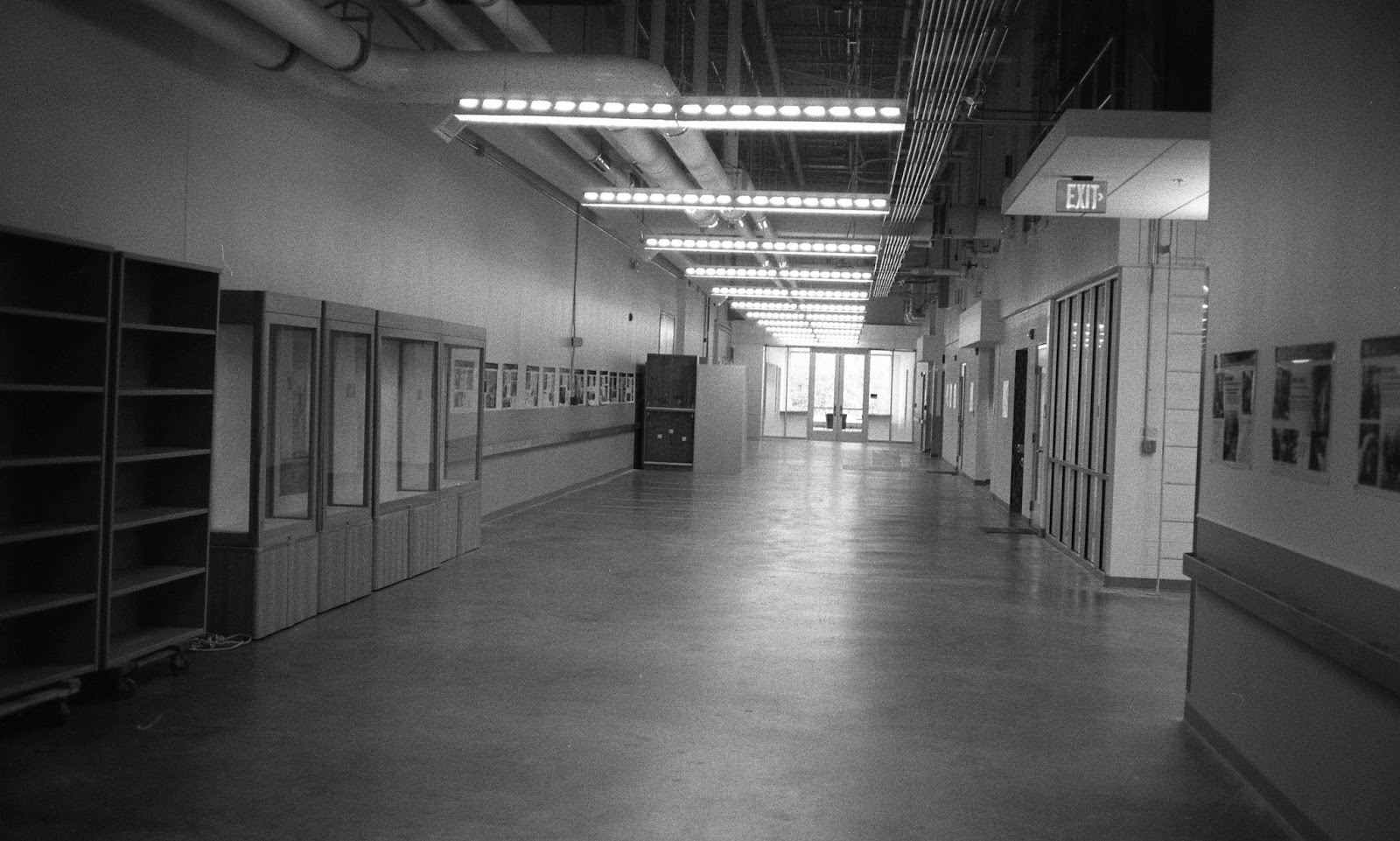
These photos were taken on hand-spooled Ilford HP-5+ just a few weeks ago.


So, there you go.  The Zorki 2C is an affordable LTM camera that deserves a try.


Tuesday, December 05, 2017

The Agfa Silette-L: It's 1962 all over again


Clean and simple design
 The nineteen-sixties saw a lot of innovation in cameras, and as photography became ever more accessible and affordable, we saw the simplicity of the Kodak Instamatic with its Kodapak 126 cartridge, and an ever-increasing level of automation in the 35mm camera world.  However, in 1962, cameras with Selenium meters were quite common, as consumers wanted more features that helped them take better photos.  While a coupled meter is ideal, uncoupled meters still give you enough information to set your camera to the desired exposure. This Silette L, while being fairly simple, is still capable of good images.

Top Deck of camera
Agfa sold a number of 35mm cameras with the Silette name. The series was first introduced in 1953 and the line ended around 1975, when cameras with more automation (Optima Sensor series) were becoming more desirable.  In its heyday, several million Silettes sold within the first few years, with a long series of models with designations that reappeared at various dates.  The first Silette L appeared in 1956, with an uncoupled Selenium meter and a Color Apotar 45mm f/2.8 lens.  This model, is the 1962 version with a Color Agnar 45mm f/2.8 lens and a Prontor 125 shutter.  The shutter speeds are B, 1/30, 1/60, and 1/125 sec.  Not exactly a big range to choose from, but certainly workable.  The minimum aperture is f/22. The Selenium meter is read from the top deck of the camera, and adjusting the dial to the left of the match needle to center the needle gives you the shutter speed/aperture combination to set the exposure to.  Or, you can ignore it and use mostly the Sunny-16 rules for your exposure.

In practice, I found the meter to be accurate outdoors, and the ISO setting dial has an amazing range of 10 to 3200!  Of course, with a shutter a max shutter speed of 1/125 sec, I can't imagine trying to use high-ISO film.
film counter placement

Other than the limited shutter speeds, this camera was fun to use, and I am impressed with the non-coupled Selenium meter.  No batteries ever required.  I suspect the meter was in such good shape because the camera had been kept in a never-ready case for many years.

I loaded a roll of Ilford FP-4+ b&w film and shot the 36 exposures over the course of a few weeks.  I generally went by the metering suggested, though in bright sun, I just used f/16 at 1/125 sec.  I developed the film in Rodinal at 1:25 dilution for 9 minutes.  The frames were very evenly spaced, and the negatives had slightly rounded corners.  All of the exposures looked great.  I didn't tax the camera too much, as I did not try it with a flash or dimly-lit situations. Although the camera has "guess" or zone focus, most of my shots were spot on because they were 25 feet away. The lens focuses from 1 meter to infinity. The Agnar lens is a triplet, and most of my shots were with the lens stopped down to f/11 or smaller. Everything looked quite sharp.
Pittsfield Twp. erection

Inside playground equipment

Dexter, MI

Dexter, MI

Dexter, MI

Matthaei Botanical Gardens

Matthaei Botanical Gardens

Matthaei Botanical Gardens


In a nutshell, I found the Silette-L easy to use, and it worked very well.  Any film from ISO 25 to 200 should be usable, given the range of shutter speeds.  Price? Mine was free, but expect to pay between $10 and $40 for one on ebay.  There are many different Silette models, some of which are simpler than this one, so look carefully before you buy.

Friday, December 01, 2017

I sure do love Chromes, and you should, too!

Many of us baby boomers were subject to slide shows
For most of my years, there was just one way to share your photos to a bunch of people at once -- a slide projector.  To do that, you needed to use reversal film, also known as slides, chromes, or transparencies. Reversal film is called that because the normal photo image is a negative, which is printed to make a positive.  With reversal film, you get a positive after developing.  Of course, since the idea is to project the image, and view it as a positive, there is no orange mask, and the base is clear, hence, they are transparent.    They became the defacto medium for most pro photographers, unless they were shooting black and white.  If you were a nature photographer, it was a given that you shot slide film.  It allowed editors to quickly pick the best images out on a light table; the individual slides were easily packaged and labelled, and passed along to the composition dept., etc.  Magazines like National Geographic bought cases of film (especially Kodachrome) for the photographers, so that a single batch all had the same color characteristics.
In the amateur photography sector, countless vacations and moments were shot on slide film so that they could be projected and "enjoyed."   The process was so simple -- shoot your rolls, send them off to Kodak, and get back beautiful color slides in mounts so that they could be loaded into the projector.   
Then came the digital onslaught and almost overnight, slides became an anachronism, as computer LCD projectors replaced the beautiful slide presentations.  The medium and large formats were also affected by the digital tide, though they comprised a smaller pie of the transparency film sales.  At this point, two processes produced transparencies -- K-14 -- Kodachrome (limited to 35mm at the end) and E-6 -- Kodak's Ektachrome line, Fuji's Velvia, Sensia, and Provia lines, and and a few lesser-known emulsions  from Europe and Japan.  In the year 2000, there were  about 40 different color slide films available, from Kodachrome 25 to Ektachrome P1600 Professional.  Some films were made for shooting in tungsten lighting, such as Fujichrome 64T and Kodachrome 64T.  Often, those were used for studio work to photograph artwork and still-lifes.  The prices, in year 2000 prices for 36-exposure rolls ranged from cheap Imation Chrome 100 (Ferrania) at $6.80/roll to $18/roll for Fujichrome Provia 1600.   During the period from 1981-2005, I shot a lot of slide film; some of it was Kodachrome, but a lot was Fuji Sensia and Velvia, as well as various flavors of Ektachrome.
Kodak's Kodachrome was king of the chromes, until
Velvia came along.


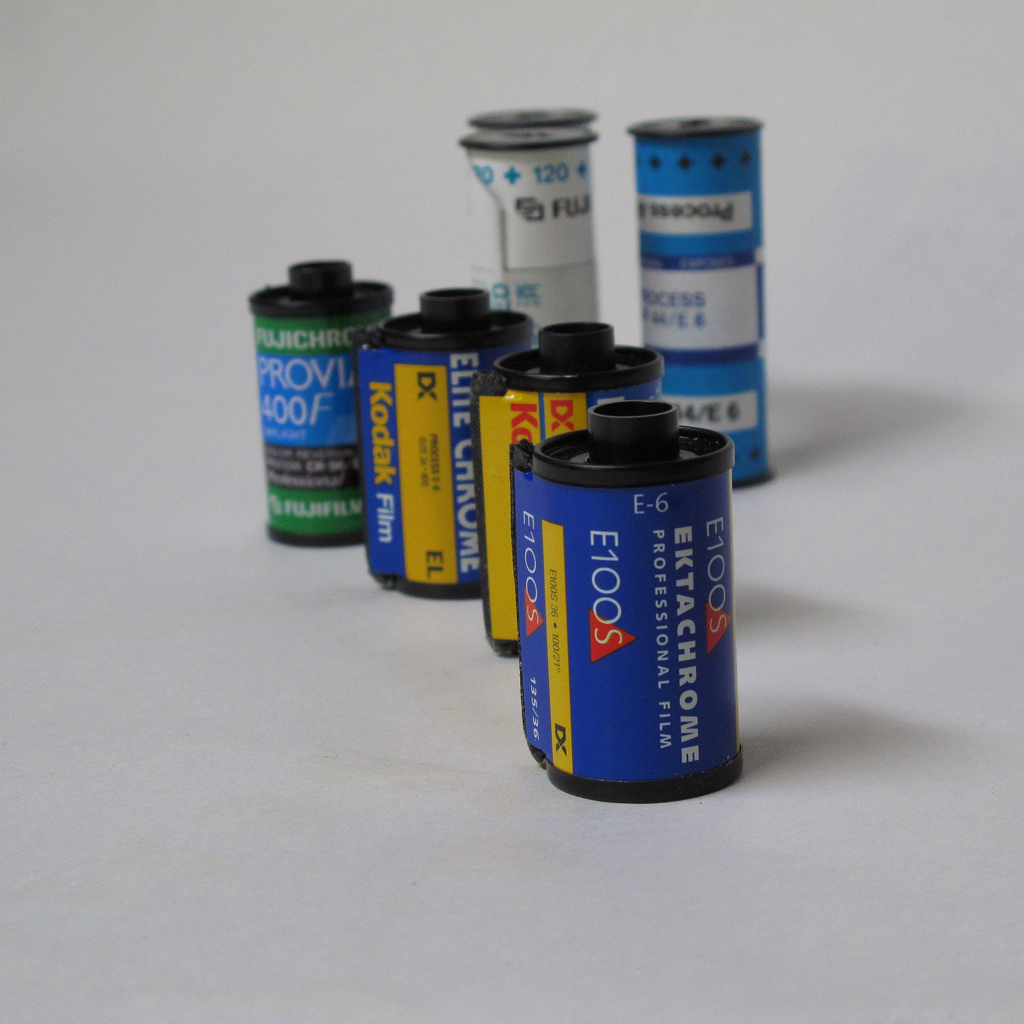
Some juicy 120 chrome film from my fridge

There used to be more choices

The other effect that digital had on slide films was the loss of local E-6 labs.  When pros were using E-6, local labs got a lot of work, and they dwindled as digital became the norm for most professional work.  Kodachrome was last processed in 2010, and aside from some experimental forays by a few people, the old expired boxes of Kodachrome are best left on the shelf. It's too bad that people forget how many jobs were lost due to the digital avalanche.  Now, there are few local film labs of any sort, and the mail-order labs have dwindled to a few major ones that are now seeing their business grow as film becomes more popular (such as The Darkroom).  However, if you want to shoot E-6 films, you can process the film yourself at home.  Unicolor has a kit that is sold under several brand names, but the Film Photography Project Store certainly has the best deal.

So, that brings us to the present-day.  As far as fresh slide film, Fuji is the only current manufacturer, though Kodak should start putting its new Ektachrome on the shelves in the coming months.  That's a big deal, since Kodak was out of the slide film business about 5 years ago.  While Film Ferrania has had a struggle getting their slide film into production, it's largely been because of matters that are not directly related to the film itself.  I hope that they are successful in the end.  That brings me to other sources for slide or chrome films, and that would be the Film Photography Project.  They sell a line called Retrochrome, and there are two films available - Retrochrome 160 and Retrochrome  320 - both are "expired" but certainly quite usable and the FPP has a large quantity of these films.  I have shot both, and of the two, I like the 320 film much more.  I feel my initial tries with it at 320 seemed overexposed, so I have been shooting it at 400.  The color palette is warm, and the film has grain, giving a definite "retro" look.   I would also check  Ultrafine Online's catalog as they offer fresh Fuji slide film and some expired but usable chrome films, too.  Freestyle Photo is another good source for fresh slide film.
A hanging file sheet with slides

Retrochrome 320

120 transparencies, shot with a Mamiya C330

I really love seeing color transparencies, especially on 120 film.  Spreading out a bunch of color slides on a light table is quite enjoyable, too. Each image is bordered by a frame, and become separate photos.  While I rarely show slides these days, I still have lots of 2x2 slides in archival sheets.  My recently shot images are just scanned like any film strip, and kept in negative preservers.  But if I wanted to, I could easily put them into individual slide mounts. My 120 chromes are also kept in clear archival holders.  I have a bunch of frozen 120 Velvia and Provia that should last me for a while.

So, you may wonder why should you even bother to use chrome films?  You can cross process them in C-41 chemistry for a different look, as Lomography folks have been doing for years.  However, standard E-6 chemistry gives you a more accurate color rendition.   Use can also use the narrower latitude to your advantage if you want a more high-key washed out look, which is what slight overexposure will give you. Chrome films have to be exposed correctly, as there is less latitude than a C-41 color film. However, when you see your transparencies that are properly exposed, you will appreciate the magic that the chrome films can produce.

Retrochrome 320 at 400 

Mackinac Bridge on expired Fujichrome 64T

Color IR on FPP Infrachrome film

Lake George area on Retrochrome 320

Wassiac, NY on Wittnerchrome

Potsdam, NY on Retrochrome 160

Presque Isle sunset on Velvia 50 @40


Fall reflections on Velvia 50 @40


Monday, November 20, 2017

The Minolta Hi-Matic G (Gee, it worked!)

I have a love-hate relationship with those 1970’s 35mm rangefinder and compact zone-focus cameras. Far too many of them to keep track of, and far too many that took Mercury cells or some odd-ball battery that I can’t find, and far too many of them that now, don’t work.  On the plus side, they are usually sturdy little metal boxes, attractive, and easy to use. Over the years, I have had Minolta  RFs land in my lap, and a few, such as a Minolta 7s worked quite well, but I didn’t fall in love with it.  I had a Hi-matic G in 2005, but it had exposure issues.   The worst aspect of the Hi-Matic series (with one exception) is the auto-exposure with no manual capability.  In regards to the Hi-Matic G, it’s not an especially singular camera, and is a middle of the road auto-exposure compact RF camera with a zone/scale focus, with the following features:

  • Rokkor 38mm f/1:2.8 lens with 46mm filter thread, f/2.8-f/14 aperture 
  • Zone & Scale focus with symbols and numbers 
  • CdS meter in lens bezel, so you can use filters and expose correctly 
  • ISO range : 25-400 
  • Shutter: 1/30-1/650 
  • Battery : PX675 (I used a standard S76 cell, and with negative films, it should be just fine). 
  • Viewfinder shows shutter speed/aperture on right side. 
  • Hotshoe and PC connector for flash 
  • standard 1/4-20 tripod thread
The ISO range is a limiting feature, but given the time when these cameras were made, entirely proper for the audience they were being sold to.   Not having a B setting is also limiting.   There is not really much to distinguish it from a slew of other compact 35mm cameras of its time.  The Konica C-35 has similar specs, but has a real rangefinder, not scale focus.  The Sears 35RF is similar. As much as I want to like the Hi-Matic G, the Hi-Matic 7SII (quite different from the 7S!) is the camera of the Hi-Matic series that should be on your list (and eBay prices are high).   The Ricoh 500G is another compact, yet robust RF camera, with reasonable prices on the used market. It too, is fully adjustable in manual mode. The Canonet QL-17 is not much larger, and certainly a better camera than the Hi-Matic G.


I tested the camera with such a S76 cell, and a roll of Svema 100 b&w - my cheap go-to film for testing.  Overall, I feel the camera works well, and it passed the test to be a pocket companion.