Showing posts with label Verichrome Pan. Show all posts

Friday, June 16, 2023

Unfolding a wonder - The Kodak Vigilant SIX-20


Over the years, I have had opportunities to photograph with many different folding cameras, ranging from the simple and inexpensive Ansco Speedex, to various flavors of Zeiss Ikon Ikontas, and many in between.  The Kodak Tourist was a widely used 6x9 folder, and are relatively inexpensive on today’s market.  However, the one thing hampering many of the Kodak models is the creation of 620 film - really, just 120 film on a smaller diameter spool.  That one quirk has a lot of people not wanting to shoot with some of the nicer 620 cameras bearing the Kodak label.  Instead, they look to European Agfas, Voigtlanders, Baldas, and Zeiss Ikontas to load with 120 film, and I can’t blame them.  However, the Kodak Vigilant SIX-20 - the best one with the Kodak Anastigmat Special 101mm f/4.5 lens, is a wonderful folding camera, produced from 1939-1948.  It features the Kodak Supermatic shutter with B, T, 1-1/400 sec shutter speeds, and an aperture range of f/4.5-32, and scale focus from 3 feet to infinity.  One of these camera recently came my way - and upon inspection, I realized that it had a roll of film inside, at frame 1.  I inadvertently fired the shutter after I extended the bellows, so then I had 6 exposures left, as you get 8 on a roll of 6x9 cm negs.  


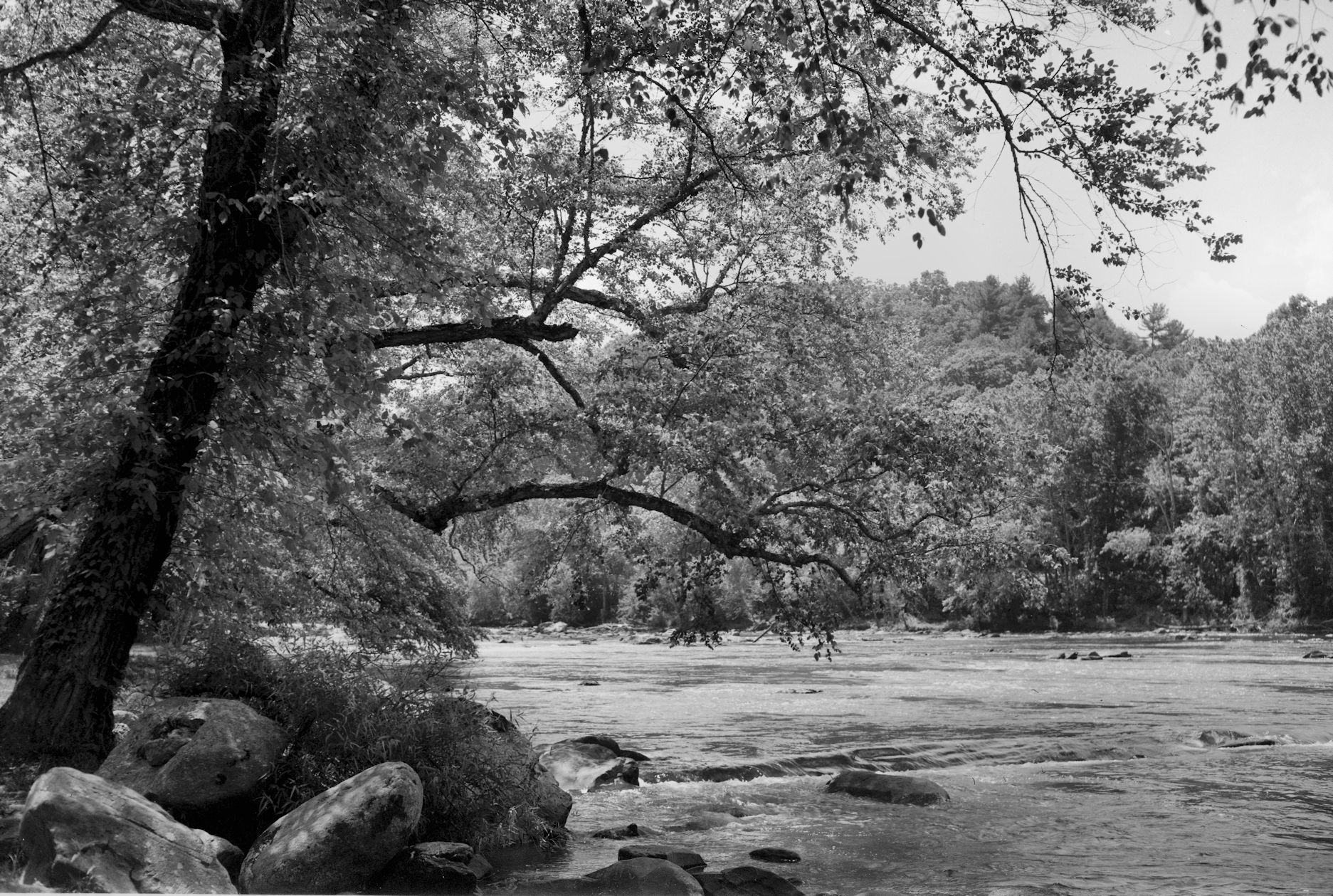
I decided to shoot the rest of the roll on some good subjects, so I took the camera down to the Ledges Whitewater Park on the French Broad River, just outside of Asheville.  I decided to rate the film as ISO 50, as I had no idea how old the film was, but I assumed it was at least 50 years old.  I have had a lot of experience with old Verichrome Pan, and knew that I ought to get SOMETHING out of it.  So, in the conditions that I had, I ended up shooting at either 1/50  or 1/100 sec, at an appropriate aperture for the conditions - often at F/8.

After I got home, I loaded the film into a Paterson tank, and developed it with  the FPP D-96 for 8 min at 20°C, followed by a water rinse and fixing, and then final rinses.  When I hung up the film to dry, I was really impressed that this film and camera came through with excellent results.  I did not see any problems with pinholes in the bellows, either, but I will do a check on that later.

perfectly developed with D-96

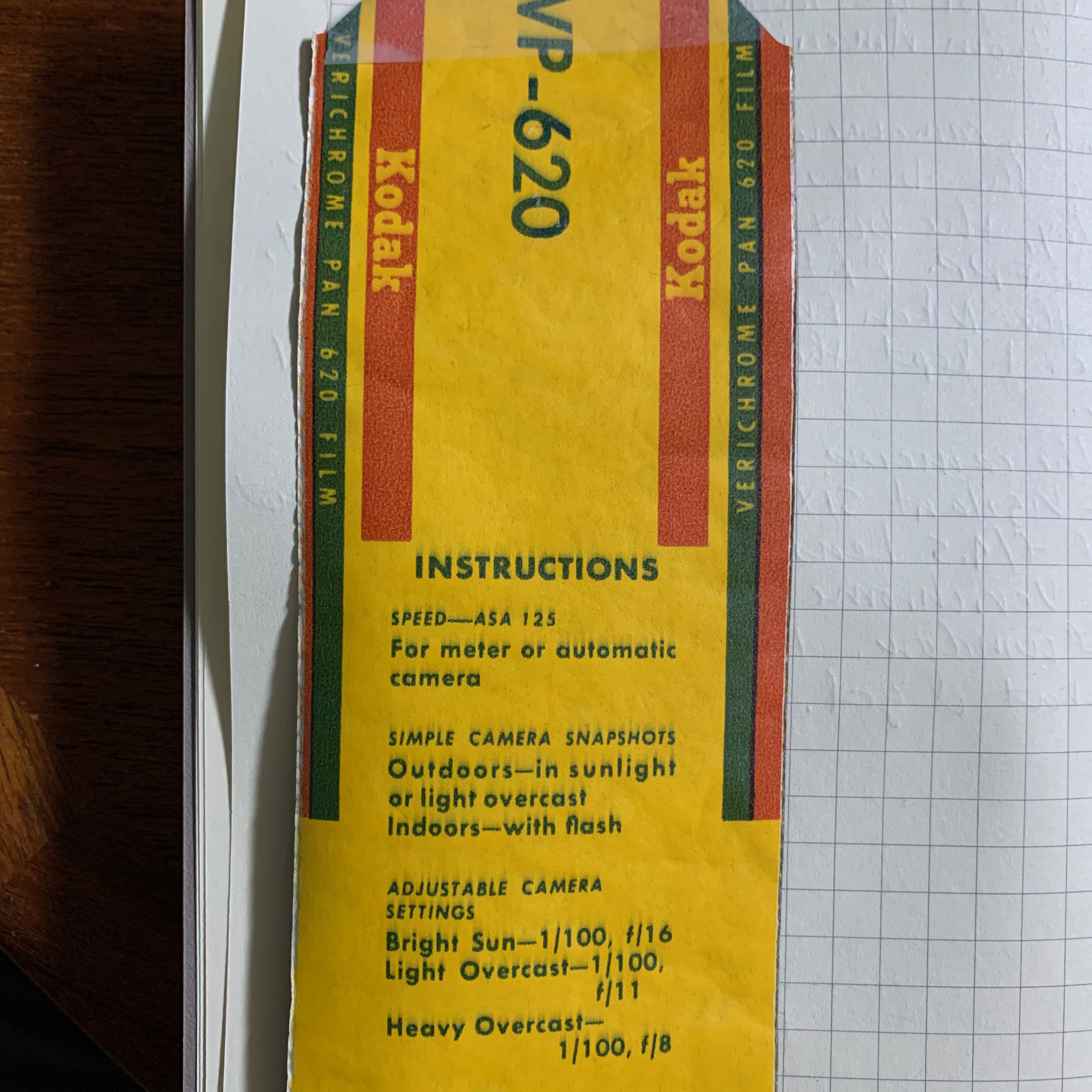
I love seeing the film info on the leader


Aside from wanting to test simple cameras like I did for the medium-format toy camera issue no. 3 for Monochrome Mania (out of print now), I didn’t really want to have to re-spool 120 to 620 spools.  For most of the Kodaks, it’s just not worth it, but with a few exceptions, and this Vigilant SIX-20 is definitely an exception.  I’ll have to re-spool some Kentmere 400 onto 620 so that I can test this camera further.  

That nice lens and shutter combo

the viewfinder with parallax adjustment


The design of this camera is quite nice — and a feature that I have not mentioned is the reverse Galilean viewfinder on the top deck. It has a small adjustment for parallax correction, and there is also one of those small reflex viewers at the front of  the bellows, which I hate.  Anyhow, I want to shoot with this camera some more. For one, it’s probably the lightest 6x9 camera that anyone can carry in their bag, and it also easily fits into a coat pocket. Unfolded, it’s still fairly compact, and also easy to use. The only thing that might be a problem is figuring out the distance to the subject, as there is no rangefinder, so one of those old accessory rangefinders might be a good idea to carry with me.  


There are other versions of this camera, but none of the others have all the bells and whistles of this one.  That f/4.5 maximum aperture is far better than the others with a maximum aperture of f/6.3 or f/8.8.  The Vigilant isn’t the only camera in this class that can take excellent 6x9 cm images, though.  You could look for a Kodak Monitor SIX-20, and all 4 variants of that camera have a lens with a maximum aperture of f/4.5.  There’s also the Kodak Special SIX-20 and the Kodak Senior SIX-20 - all take 6x9 cm negatives on 620 film, if you haven’t already figured out the SIX-20.   

However, if you are looking for a camera that takes 120 film and makes 6x9 cm negatives, I’d look for a Zeiss Ikonta or a Voigtlander Bessa. A folding camera makes a lot of sense for travel, and these folders will give you nice big negatives.  I found that a 3200 dpi scan of one 6x9 negative can produce a 2x3 ft print at 300 DPI.  Not too shabby.  So, be prepared to re-spool the 120 film onto 620 spools if you want to go the Kodak route. If your camera has a sound bellows, clean lens, and accurate shutter, it will be worth the effort for these big negatives.   


Saturday, February 25, 2017

The Magic Square... The Bronica SQ-B

There is something about shooting in square format - whether it's 35mm or medium format.  While one can crop an image to be square, it's the composition in camera that makes the difference.  For one, you don't have to worry about an image being in portrait or landscape mode -- it's all the same. I think the first camera that I owned that shot square format may have been an Ansco folder. Then, I acquired a Rolleiflex for $75 back in 2002.  There are a lot of fun little square-format cameras out there, too. Some use 127 film. Getting used to the advantages as well as limitations of a TLR was quite educational and opened up a new way of seeing for me.  In 2004 I bought a Mamiya 645E that was new at Adray Camera in Ann Arbor, and while I owned it for 6 years, I never was comfortable with it -- the boxy body was cumbersome for vertical shots. I also owned a Kiev 60 for a while, and that SLR was quirky, as the frame spacing wasn't predictable.  However, i did take some decent images with it. I bought a nice  Kowa Six, and that lovely camera was nice, but a bit fiddly. Later, I acquired a Hasselblad 500C, back when they were selling used for really cheap, and people were ditching their film cameras for the latest DSLR.  I sold the Mamiya 645, of course. I enjoyed using the 'blad and had a number of lenses for it, and for some reason, sold it all after I acquired a like-new Mamiya C330 Pro with 80mm and 135mm lenses in March 2014.  The Mamiya is a bit of a beast, but I do enjoy shooting with it, as it close-focuses, which is something the Rolleiflex could not do without a special diopter , etc.   Having full control of my exposure and focus is important, but then, a camera like the Great Wall SLR from China is pretty much the opposite -- I owned one for a few years, and while I got some images from it that were somewhere between a Holga and an Argoflex, I found that it sat on the shelf a lot, so I sold it for a bit more than what I paid for it. While I sometimes regret selling my Rollei, the Yashica A that I have had for quite a while takes satisfactory images, and I paid $30 for it. The Mamiya C330 is a great system camera, and I use it regularly. How many TLRs does one need? (Don't answer that!).
At this point, you are wondering "When is this guy going to get to the topic in the title?" I'm getting to that. Really.  What this all leads up to is over time, I realized that I sometimes have a camera crush, and what I really want is to be able to use a certain camera for a bit, not necessarily own it.  I have had a sort of revolving door when it comes to square-format cameras. Last fall, I realized that the one camera system that I had NOT tried was a Bronica SQ (I have no interest in shooting any more 6x4.5).  I didn't really want to go and buy one, only to find that it wasn't for me, or it was okay but quirky.  I mentioned that I would just like to borrow one for a while on the Film Photography Podcast, and certainly never thought that anyone would take me seriously.  After all, the FPP gives cameras away, right?

A few months ago, I received an email from an FPP listener, and he offered to loan me a Bronica SQ-B.  It had belonged to his sister, and he needed to have some work done on it, and after that he would send it to me to use for a while.  It arrived on February 18, and after unboxing it and checking it over, I looked online and found a manual. I had a 6V battery for it, and after getting used to the controls and layout, I loaded a long-expired roll of film and shot it at various settings, just to acquaint myself to the camera.  I tossed the exposed roll in the garbage, and loaded a roll of Verichrome Pan which I shot last weekend, along with a roll of Tri-X.  Those were developed the next night, and I am quite pleased with the results.
First of all, the SQ uses an electronic shutter, so unlike the Hasselblad 500C that I once owned, you need a battery for the camera to work (so does my Pentax 6x7).  There is no metering with the SQ-B, just like the 'blad 500C. The SQ-B that I now have is fitted with a waist-level finder, which I do like, and of course, one can add a prism finder, just as with the 'blad.  The controls on the SQ-B remind me of the Mamiya 645E, which is fine.  I wasn't a fan of setting the shutter speed on the lens with the 'blad.  The SQ-B goes from 8 seconds to 1/500, and no B or T.  That works fine for me.  It fits easily into my canvas messenger bag with a compartment insert.   The film loading is familiar, and the use of the dark slide is also familiar, though sometimes results in a  "doh!" moment when I forget to remove it.   Using the camera with an external meter or just using sunny-16 (or the Black Cat Exposure Guide) is fine.  If I were shooting something complex, I might use my Pentax Spotmeter.  In any case, this is a fun camera to use, and I look forward to doing a lot of photography with it over the next few months.  Thank you for the loaner, David Lyon!

A few images from my Sunday afternoon outing last week. All shot in Ann Arbor, MI.


Sunday, March 27, 2016

Quickie Review - The Beacon 225

Last September, I purchased a lovely Beacon 225 in the lether case for the sum of $5 at the PTO Thrift shop in Ann arbor.  It was a banner day, because that is when I also bought the Olympus Trip 35 that I have enjoyed using.  The Beacon sat on the shelf over the winter, until I decided to re-spool some 120 film onto 620 spools a few weeks ago.  I loaded some 1997-expired Verichrome Pan - a perfect film for simple cameras such as the Beacon 225.

The Beacon 225 was made by Whitehouse Products in Brooklyn, NY, between 1950 -1958.  Whitehouse Products is another of those post-WWII camera companies that lasted about a decade. The Beacon II is very similar, but it's smaller and takes 127 film.  The Beacon 225, like the Beacon II, has a collapsible lens box that snaps into place when pulled away from the body. Then, the shutter will fire.  The Beacon 225 takes 12  6x6 cm images on 620 roll film.  The shutter speeds are Instant and Bulb, with aperture settings for sunny ("brite") (f/16?) and cloudy ("dull") (f/8?).  The lens is a 70 mm coated doublet.  There is a tripod thread on the bottom of the camera.  The red window in the back is set in a rectangular frame. The camera is mostly black plastic of some sort, and is actually rather attractive.  It collapses to a respectable size that would fit into a coat pocket.

On March 20, I shot the roll of Verichrome Pan, mostly along the beach in Muskegon, MI.  The wind was really gusty, and sand was blowing all over the place.  What better conditions to use a cheap camera?

I developed the Verichrome Pan in D-76 1:1 for 9 minutes.  Overall,  I am quite pleased with the results, and the subject matter was perfectly suited to this camera.


Tuesday, December 27, 2011

The Kodak Brownie Reflex

I have divested myself of most of my 127 film cameras, but the Kodak Brownie Reflex I have recently shot with is one that sat on a shelf for a number of years before I finally put some film in it. I had a roll of 40+ year old Kodak Verichrome Pan in 127 size,(the best film ever for box cameras), so I figured that I may as well finally try out the Brownie. While it looks much like a TLR, it's really just a box camera with a reflex (mirror) viewfinder. My camera is a bit grungy on the viewfinder part, but the taking lens (a simple meniscus lens) is clear. Note that the camera has I and B settings - for "Instant" and "Bulb". The frames are square 4x4 cm, with 12 exposures on a roll. The model I have is the "synchro" version, made from 1941-1952, meaning that it accepts a clip-on flash unit. The body is mostly made of black bakelite, and it really is a stylish box camera, complete with neck strap. I started the roll of VP127 back in June, when my daughter Jorie and I went on a photo safari to Indiana, and finally finished the roll yesterday by taking some shots in Ann Arbor. I developed the film in Kodak DK-50 1:1 for 6 minutes. That particular developer seems to work really well with old Verichrome Pan. I like the square format, and considering the age of the film AND the age of the camera, the results are pretty decent.

The theater in Angola, Indiana. June 2011.

Decatur, IN., June 2011.

The railroad trestle near Argo dam, Ann Arbor. 12/26/2011. Note that this, the last image on the roll, is quite free from the markings found on the beginning of the roll.

I might shoot 127 more often if it were not for the fact that the only b&w film is Efke, and that 127 film is a pain to scan, as there are no film holders for it. However, I certainly have enough 120 and 35mm cameras to use, and 127 remains a rarely-used format. At one time, it was quite popular, and pretty much died out as a consumer film once Kodak brought out the Instamatic cartridge in 1963. There are still some beautifully-made 127 cameras that are worth trying -- the Sawyers 127 TLR, the mini Rollei, and the Ricoh Super-44. Such compact TLR cameras are fun to use, and produce excellent results.