Showing posts with label Kodak Vigilant SIX-20. Show all posts

Wednesday, July 08, 2026

Last Roll From my Kodak Vigilant Six-20


A few years ago, I acquired a Kodak Vigilant Six-20.  I respooled 120 onto 620 spools, and over the course of 3 years shot 3 rolls with it.  The results were always quite good. The Vigilant Six-20 is a 6x9 format camera that came in many versions.  The one I used had the best features with the Kodak No. 1 Supermatic Shutter, with speeds from B, T, and 1-1/400 sec, and apertures from f/4.5- f/32.   The Kodak Anastigmat Special is a very good lens, too. An excellent lens/shutter combination that allowed 400 ISO film and reasonable shutter speeds.   

Another version of the camera, and priced lower, features a Kodak No. 1 Diomatic shutter, with B, T, 1/25, 1/50, and 1/100 sec shutter speeds and a Kodak Anastigmat f/6.3 lens.  Definitely not as fast as my camera, and certainly usable with 100-400 ISO film. It’s probably the more common version of the camera, since it was more affordable.


Unfortunately, I’d left the roll of Fomapan 100 in my camera for at least 2 years, with a couple of exposures still to be had.  The film had somehow become stuck and would not advance.  I ended up having to use pliers to wind the film.  I ended up with a “fat roll” which I promptly put into a black container.  I think moisture had caused the film to stick and that’s why I could not roll it along by hand.  

Now that I have a 4x5 camera, I decided to see if the lens and shutter assembly could be used on my Intrepid 4x5.  Now that I know that it covers 4x5, the 101mm lens has become my wide-angle, leaving the shell of the Vigilant lensless.  

Here are some shots from that last roll.  You can see where the film stuck and acquired some rust in one of the images.  I started that roll in the summer 0f 2024, on a photo meetup with the AVL Camera Club.  We visited several small breweries next to the Swannanoa River, all of which were destroyed a month later by Hurricane Helene and the flood.  The very last photo was taken early this year in the River Arts District, which I guess is fitting. 


The light leaks at the top are from the "fat roll"


You can see the spots on the right side where the film was sticking

These 6x9 cameras from Kodak are capable of some very good results, and if you don’t mind respooling the 120 film to 620 spools, they represent an inexpensive option for 2 1/4 x 3 1/4 inch negatives.  You’ll get 8 shots on a roll.  The cameras easily fit into a large pocket and do not weigh much.  However, you’ll have to make sure the bellows is free from pinholes - and the black fabric used for the bellows is going to need some liquid rubber or black fabric paint to fix. If the lens is free of haze, and the shutter works, you are good to go.  

These cameras were manufactured from 1939-1949, with 10 variants in lens and shutter combinations. The prices at the time ranged from $15 to $49. Today, you should be able to pick up a fully operational example for less than $25, and I certainly would not pay much more.


Another version that I owned in 2011

Friday, June 16, 2023

Unfolding a wonder - The Kodak Vigilant SIX-20


Over the years, I have had opportunities to photograph with many different folding cameras, ranging from the simple and inexpensive Ansco Speedex, to various flavors of Zeiss Ikon Ikontas, and many in between.  The Kodak Tourist was a widely used 6x9 folder, and are relatively inexpensive on today’s market.  However, the one thing hampering many of the Kodak models is the creation of 620 film - really, just 120 film on a smaller diameter spool.  That one quirk has a lot of people not wanting to shoot with some of the nicer 620 cameras bearing the Kodak label.  Instead, they look to European Agfas, Voigtlanders, Baldas, and Zeiss Ikontas to load with 120 film, and I can’t blame them.  However, the Kodak Vigilant SIX-20 - the best one with the Kodak Anastigmat Special 101mm f/4.5 lens, is a wonderful folding camera, produced from 1939-1948.  It features the Kodak Supermatic shutter with B, T, 1-1/400 sec shutter speeds, and an aperture range of f/4.5-32, and scale focus from 3 feet to infinity.  One of these camera recently came my way - and upon inspection, I realized that it had a roll of film inside, at frame 1.  I inadvertently fired the shutter after I extended the bellows, so then I had 6 exposures left, as you get 8 on a roll of 6x9 cm negs.  


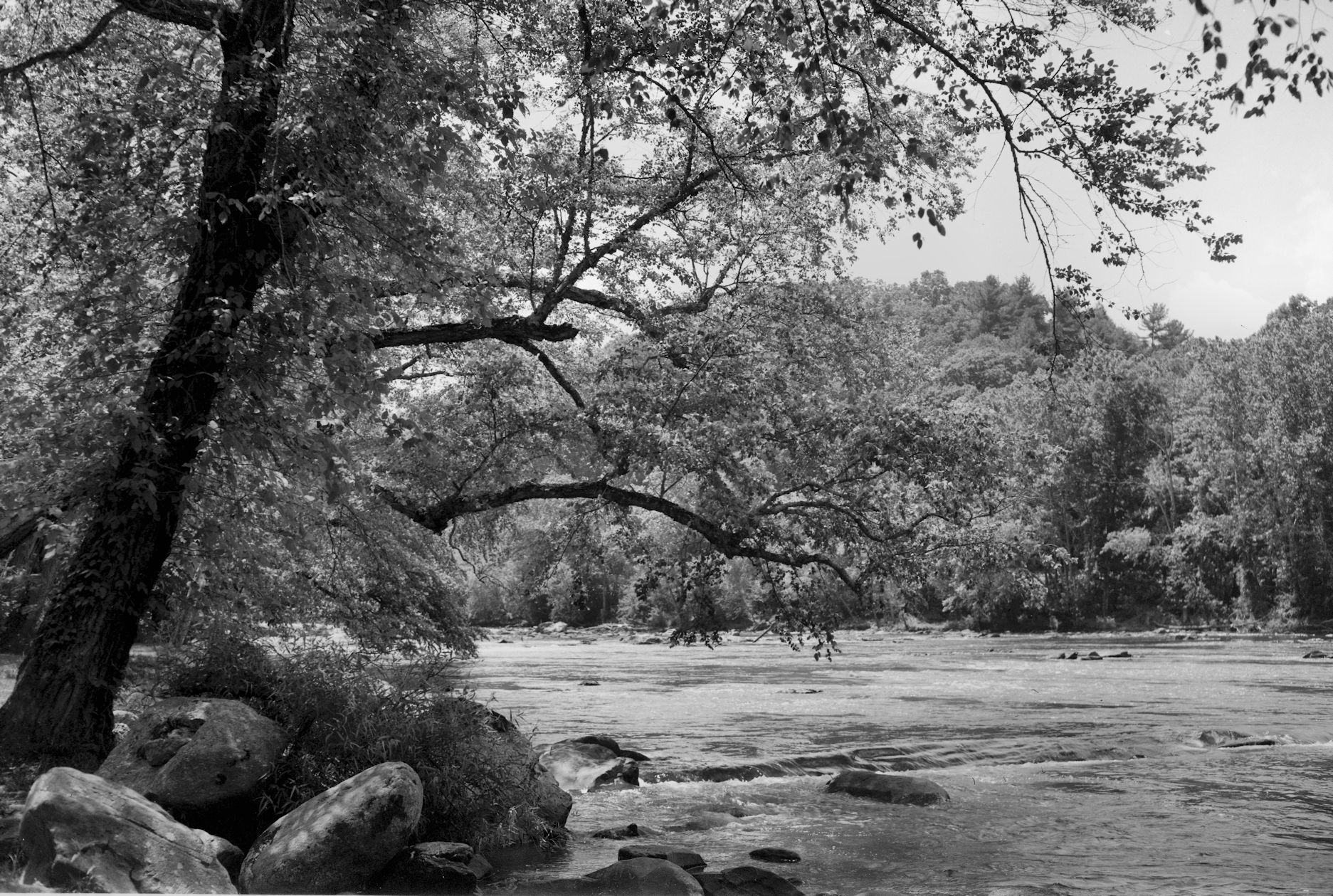
I decided to shoot the rest of the roll on some good subjects, so I took the camera down to the Ledges Whitewater Park on the French Broad River, just outside of Asheville.  I decided to rate the film as ISO 50, as I had no idea how old the film was, but I assumed it was at least 50 years old.  I have had a lot of experience with old Verichrome Pan, and knew that I ought to get SOMETHING out of it.  So, in the conditions that I had, I ended up shooting at either 1/50  or 1/100 sec, at an appropriate aperture for the conditions - often at F/8.

After I got home, I loaded the film into a Paterson tank, and developed it with  the FPP D-96 for 8 min at 20°C, followed by a water rinse and fixing, and then final rinses.  When I hung up the film to dry, I was really impressed that this film and camera came through with excellent results.  I did not see any problems with pinholes in the bellows, either, but I will do a check on that later.

perfectly developed with D-96

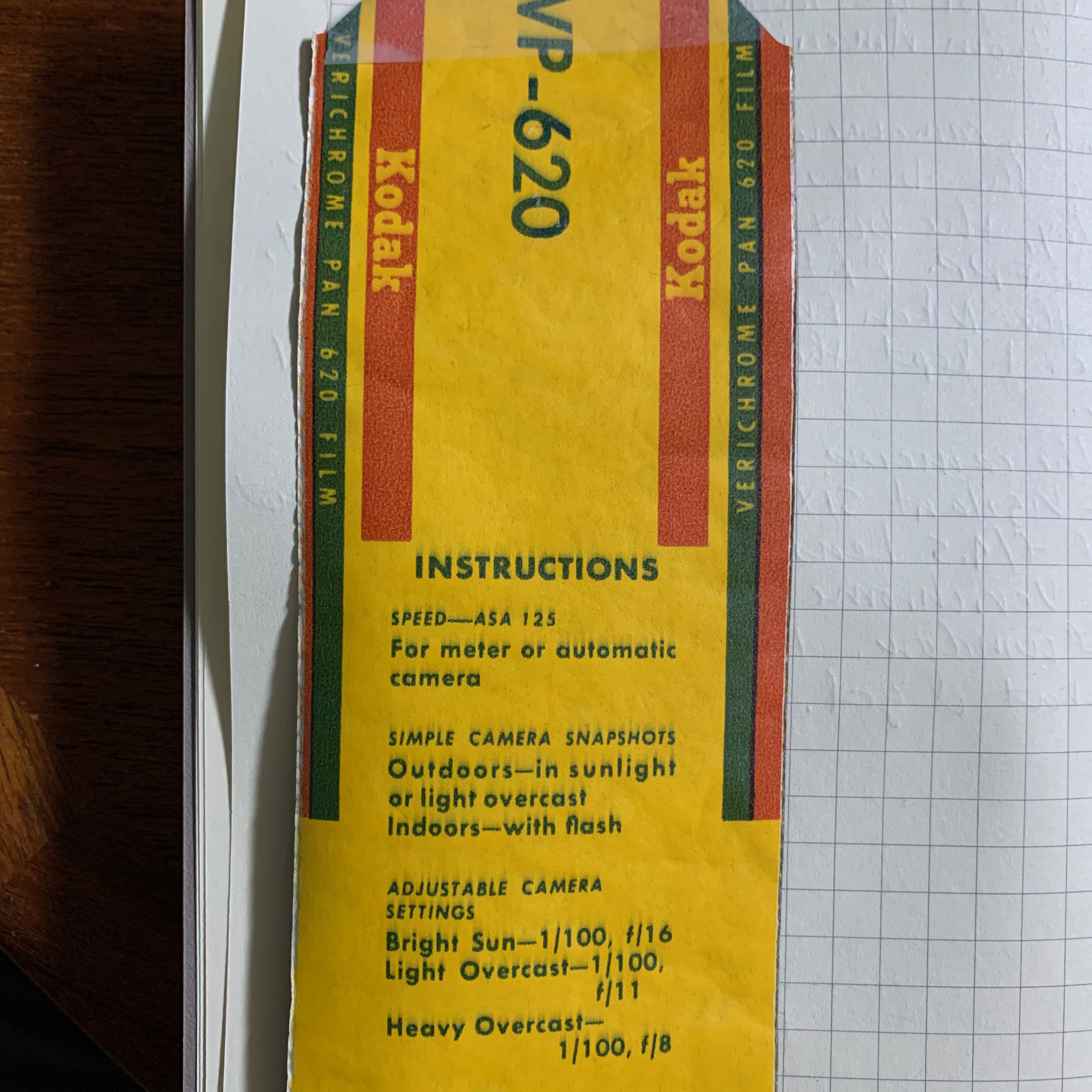
I love seeing the film info on the leader


Aside from wanting to test simple cameras like I did for the medium-format toy camera issue no. 3 for Monochrome Mania (out of print now), I didn’t really want to have to re-spool 120 to 620 spools.  For most of the Kodaks, it’s just not worth it, but with a few exceptions, and this Vigilant SIX-20 is definitely an exception.  I’ll have to re-spool some Kentmere 400 onto 620 so that I can test this camera further.  

That nice lens and shutter combo

the viewfinder with parallax adjustment


The design of this camera is quite nice — and a feature that I have not mentioned is the reverse Galilean viewfinder on the top deck. It has a small adjustment for parallax correction, and there is also one of those small reflex viewers at the front of  the bellows, which I hate.  Anyhow, I want to shoot with this camera some more. For one, it’s probably the lightest 6x9 camera that anyone can carry in their bag, and it also easily fits into a coat pocket. Unfolded, it’s still fairly compact, and also easy to use. The only thing that might be a problem is figuring out the distance to the subject, as there is no rangefinder, so one of those old accessory rangefinders might be a good idea to carry with me.  


There are other versions of this camera, but none of the others have all the bells and whistles of this one.  That f/4.5 maximum aperture is far better than the others with a maximum aperture of f/6.3 or f/8.8.  The Vigilant isn’t the only camera in this class that can take excellent 6x9 cm images, though.  You could look for a Kodak Monitor SIX-20, and all 4 variants of that camera have a lens with a maximum aperture of f/4.5.  There’s also the Kodak Special SIX-20 and the Kodak Senior SIX-20 - all take 6x9 cm negatives on 620 film, if you haven’t already figured out the SIX-20.   

However, if you are looking for a camera that takes 120 film and makes 6x9 cm negatives, I’d look for a Zeiss Ikonta or a Voigtlander Bessa. A folding camera makes a lot of sense for travel, and these folders will give you nice big negatives.  I found that a 3200 dpi scan of one 6x9 negative can produce a 2x3 ft print at 300 DPI.  Not too shabby.  So, be prepared to re-spool the 120 film onto 620 spools if you want to go the Kodak route. If your camera has a sound bellows, clean lens, and accurate shutter, it will be worth the effort for these big negatives.