Showing posts with label Matthaei Botanical Gardens. Show all posts

Saturday, December 30, 2017

Some winter scenery on Kodak 2238 film.

a roll of 2238 from the
Ultrafine Online site.
If you have been following this blog for awhile, you'll know that I am always eager to try out some odd b&w films.  A few months ago, I purchased some Kodak 2238 Panchromatic Separation Film from Ultrafine Online.  It has been touted as a "poor man's TechPan!" and after seeing results from my first roll of this film, I am inclined to agree.  The typical use of this film is to make archival black and white positive separations from color movie film negatives. It can also be used to make special effects, panchromatic masters from b&w negatives, and other movie-industry applications. It's on a polyester ESTAR base like Techpan, and has a blue-antihalation dye that comes out in developing.

I loaded up a Nikon F2 with a plain prism, and headed out into the 10 degree F weather at Matthaei Botanical Gardens.  The film is rated from ISO 6 to 50, depending on the use, I suppose, and I followed Ultrafine's suggestion of ISO 25.  Unlike TechPan, this film can be developed as a panchromatic pictorial film in D-76 (1:1 for 10 minutes), which greatly facilitates its use, and not having to use my dwindling supply of Technidol. Photographer's Formulary sells the TD-3 low contrast developer for films like Techpan that would otherwise result in high-contrast negatives using typical developers.   

Winter warrior.
Shooting in winter in northern climates has its share of obstacles - cold temperatures mean low battery life when outside, and I picked the meterless plain prism F2 because it works flawlessly without a battery, and the ergonomics with gloves on make it easy to use. I had an external meter, but generally went sunny-16 for most of my shots.  In full sun, that would be f/16 and 1/30 sec, or f/11 at 1/60, or f/8 at 1/125.  F8 at 1/125 seemed to work pretty well when it was sunny.

I developed the film as I described above, in D76.  Some of the frames were underexposed, and I think that was when I forgot to adjust my aperture when the sun went behind the clouds. For the images that I estimated properly, the negatives looked good.   At ISO 25, I would recommend a tripod for most subjects, but my results were pretty good.
Okay, so if this film is like TechPan, how does the grain stack up?  It is extremely fine-grained, and almost as good as TechPan. I would say that the negatives do remind me of that film, and I will have to experiment with it some more to get an idea of how versatile it is.  Some portraits are in order, as well as some non-snowy scenes.  The film comes in 100 foot rolls as well as 36 exp. cassettes, so for $50, one could do quite a bit of testing with the bulk roll.  It may be advisable to bracket to see how the film performs for your particular use. The nice thing is that it is also easy and economical to develop!

Here are a few images from that roll that I shot earlier this week. 


One of the fun aspects of film shooting is the appreciation for different films and the qualities that each film stock has.  Shooting something new (to me) means that the results may not always be what I expected.  In the case of the Kodak 2238, I think the shots where I exposed correctly have good range and bode well for further testing.  The film is a tad curly drying, but flattened out fine in the scanner film holder. 

I suggest that you give this interesting film a try. There are plenty of examples of it on Flickr. 


Tuesday, April 11, 2017

Some Aged Scotch

Several weeks ago I received some 35mm film to test.  My contact at Ultrafine Online sent me a couple of rolls of Scotch ATG 400 C-41 film.  I was of course, intrigued, and there was some speculation that it may be the same film stock as the recently released Lomography F2/400.    From Ultrafine's web site is the description of the Scotch ATG 400 film:

"This is a rare film and this series was unique from back in the day as Scotch was trying to set themselves apart from the field and did some R & D, which mainly resulted in this ATG Series of films, which were originally meant to assist with underexposure and exposure compensation. This has resulted as the film has aged to a nice tone, which has been a favorite among Lomophiles, Holga shooters, and dedicated film shooters, who love have fun, shoot film, and experiment with different types of emulsions."

The ATG 400 film was tested by Popular Photography back in 1993, and came in behind 400-speed films from Kodak, Fuji, Konica and Agfa beating it out.  However, the review by Michael McNamara "400 Revolution" [Pop.Photo. September 1993, pp. 28-37] tested a number of attributes of these films, at a time when 400 ISO C-41 films offered users many choices.  Interestingly, almost all of the results looked best at ISO 200, but in most cases, acceptable results were obtained between ISO 50 and 800. The Scotch film was the lowest-priced emulsion, and was designed to have better rendition in the shadows.
From 9/1993 Popular Photography

Okay, this film has been in Ultrafine's freezers for a while, so I knew that I wasn't going to shoot it at ISO 400. I figured it was worth a try to shoot it at 200 and hope for the best.  I loaded up my Pentax K1000 with the 55mm f/2 lens, and shot the roll on an overcast dreary day inside Matthaei Botanical Gardens. I figured it would offer me plenty of color and I could photograph things I am very familiar with.

I processed the film last night using the Unicolor C-41 kit.  It was fresh, and I had only put 2 rolls through the 1-liter kit since I mixed it up.  Processed as normal.  When I took the film off the reel I thought perhaps it had not even developed as the emulsion side looked brown.  However, after drying, the film has a noticeable blue base, and the emulsion side looked "normal."

Results?  I am thrilled with the results from this film.  It has a soft grainy look that is pleasant.  It makes me wish the weather was warmer and I had a model outdoors.  It would really be interesting to see how it would do for portraits and figures.  I chose well picking ISO 200. 100 may be even better, so I'll try that next time for part of the roll.  Reds looked red, the shadows were not too bad, and while I think the greens are muted, tending a bit blue, it could also be the muted light that day. Full sun would be the next challenge.

Here are some scans from the negatives. Minimal post-processing has been done, and there may be dust spots that I have not cleaned up.


So, I am impressed with the results from this forgotten film. Maybe like whiskey, aging does it good. At $3.95/roll it's cheaper than vintage Scotch. You may want to give this film a try.  I don't think it's the same as the  Lomo F squared/400 film.  The Scotch film is probably close to 20 years old.

Sunday, February 07, 2016

The Argoflex E and 120 film

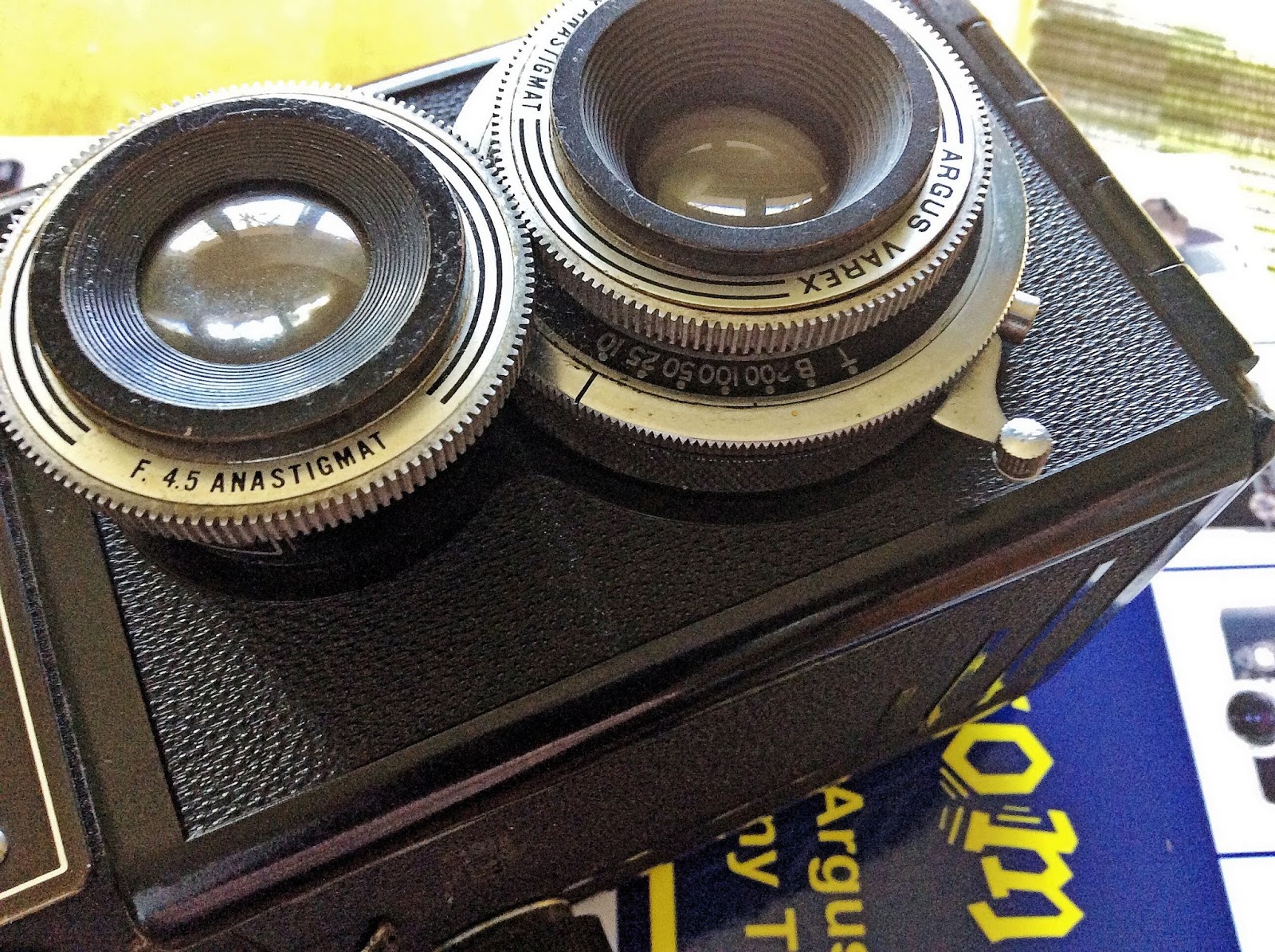
Argus (located right here in Ann Arbor, MI) started producing a twins lens reflex camera before WWII, and the first model was the Argoflex E (1940-42).   It is a Bakelite-bodied camera with gear-coupled taking and viewing lenses, and actually very similar to  the Voigtlander Focusing Brilliant TLR.  The Argoflex E can use 620 and 120 film in the pre-war model, which can be easily distinguished from the post-war version by the presence of a small spindle knob on the upper left side of the earlier camera.  The post-war  version merely has a circular piece of trim in the same spot.   Film is wound with the advance knob on the right side, and you look through the red window (which has a turnable shield) to watch the film advance.


The Argoflex E has a 75mm f/4.5 Varex Anastigmat lens (uncoated in pre-war version).  The shutter speeds are 1/10 – 1/200, sec, plus B and T.  Apertures range from f/4.5-f/18.  There is a place to screw in a remote release on the rim of the shutter housing.    The viewing lens features a depth of field scale that you can view from above.

The post-war Argoflex E (1946-1948) can also use 120 film, contrary to Henry Gambino's assertion in Argomania. Of course, with Argus always tweaking things, it's possible that some cameras made later in the cycle do not accept 120 in the supply side of the camera.  The post-war Argoflex E also has a coated lens, which should help with flare.

The Argoflex E does not have double-exposure prevention, so it can be used to make multiple exposures.  For some, that may make it a very ideal TLR.


What about other Argoflex models?
After Argus shelved  the Argoflex II and replaced it with the Argoflex EM (1948) and EF (1948-1951), these metal-bodied cameras took only 620 film, and 120 film spools cannot be used in them.

The later Argoflexes do not have coupled taking and viewing lenses, and except for the Argus Super 75 and the Argus 40, do not have adjustments except for “Instant” and “Time.”  None of these models can use 120 film rolls.

So, the Argoflex E is certainly still a usable camera, and since it readily accepts 120 film, it's worth a try.  Some things to look for and to be aware of, though.  Number one is the reflex mirror, which is now  over 70 years old, and may be de-silvering or corroded, or just very dusty, depending on where the camera was kept all this time.  In other words, the image in the viewfinder will not be as bright as that of a Rollei or a Yashicamat.   The shutters appear to be fairly dependable, but remember that these are old cameras, so they could be sluggish.  The lenses may also need cleaning if they are hazy.  In addition, the lack of coated lenses will probably give you less-contrast in the image. One remedy would be to find a UV filter that can slip in place over the taking lens (there is no threaded filter ring). The Argoflex E is certainly as better camera than the Kodak reflex cameras, all of which require 620 film.

Should you buy one?  I would say it depends on the condition of the camera and of course, the price.  While not as complex or as well engineered as cameras from the 50s - 70s, it can  produce sharp images when stopped down.  Depending on the lens condition, wide-open quality will vary.  The reflex mirror's age will also produce a dimmer image in the viewfinder, but using the pop-up magnifier may help with focus.  I would not pay more than $40 for one.

On  February 6, the A3C3 met up at Matthaei Botanical gardens.  I shot a roll of Ilford Delta 100 in the Argoflex E, and developed it in D76, 1:1.   Overall, my light-meter estimation worked pretty well, and the images came out better than expected. Here are a few.


Sunday, March 22, 2009

Fairyland At Matthaei Botanical Gardens

The Nasturtium Fairy

Yesterday, I visited the Conservatory at Matthaei Botanical Gardens to photograph the garden fairies that my wife, Adrienne had been telling me about. She's one of the horticulturists at MBG, and has worked there since 1983. So, you might think that I go there all the time to take photographs, but in fact, I don't go there enough. For those that rarely go there, or haven't been there yet, the conservatory is a good dose of what one needs as we emerge from the lingering grip of winter. Yes, spring is technically here, but until the last vestiges of those piles of snow that remind me of decaying whale carcasses disappear, we are fortunate to have Matthaei's conservatory to buoy us.

The Sweetpea Fairy

Matthaei's "Enchanted Spring Display" is very charming, with small fairies placed in the plantings amongst the spring flowers that are now blooming the conservatory. The fairies look like they are right out of the Art Nouveau period, and are obviously a big hit with children of the age that can still imagine fairies as something that might exist. In addition, there are placards with fairies for different plants, such as the "Lobsterclaw Fairy" for the Heliconia flowers. I like the idea of garden fairies... and there is that part of our psyche that seems to want to believe in the supernatural. Fairies are certainly some of the less horrific things that one could believe in, and if you want to create your own fairy garden, one source that seems to have it all is the aptly-named Garden Fairy.com.

I spent over an hour in the conservatory, photographing the diminutive fairies and the flowers with my Nikon F3 with my Lensbaby lens, as well as a lot of shots taken with my Fuji Finepix S700 with some different filters on the front to achieve the look I wanted. The S700 was great for reaching in over the plants to get close-up shots, and of course, to get the immediate results that you see here. I'll be interested in seeing how the F3 shots came out, as I was using Kodak's Ektar 100 color film. Despite being an adult, I was having fun trying to find the various fairies amongst the flowers, and I saw small children there that were having even more fun than I was. The display will be up until March 31, so give yourself a respite from the weather, and see the flowering bulbs and the fairies at UM's Matthaei Botanical Gardens on Dixboro Road.

The Crocus Fairy

Sunday, January 18, 2009

Winter Photography With A Hammer


Well, perhaps not really a hammer, but there is no doubt that the Nikon F2 could be used for one if necessary. Like a hammer, it is a basic tool - what you create with it depends on the wielder. My F2 pictured above, has a plain (non-metered DE-1) prism, making for a very solid and attractive SLR. Winter photography (and by that, I mean with snow being present) is challenging enough -- too cold and your batteries in the fancy SLR or DSLR fail, leaving you with a plastic rock, never mind the fact that your hands get cold adjusting all those tiny buttons. No, I think winter photography works really well for simple cameras with no batteries, or if any -- just the ones needed for the meter. The Nikon F2 with a plain prism obviously has no metering, so you can use a hand-held meter, or learn to trust your instincts and go with the "sunny-16" rules. I like b&w film for snowy landscapes -- I find that unless there is a compelling color element, b&w and shades of gray are the predominant colors, anyway. So, I tend to shoot b&w film, and in the photos that follow, it was a roll of expired Kodak Plus-X Pan. Kodak's T-Max 100 or Tri-X are also good choices.

A lens hood is a good idea, as there are reflections coming off snow in the winter landscape that can cause havoc with lens flare and reducing contrast. If you shoot using sunny-16, you won't have to account for the meter being wrong, as the snow will reflect enough light that your meter will indicate overexposure. If your camera has exposure compensation, set it at +1 to +2, depending on conditions to get an accurate exposure. Bracket, if necessary. Black and white film has plenty of latitude, and some overexposure is better than underexposure with most b&w emulsions.

The Nikon F2 was the last hand-assembled camera made by Nikon, and was produced from 1970-1980. Certainly one could not ask for a nicer all-mechanical body. Without the big metering prism (typically a DP-1), it's fairly compact. With winter shooting, I just go by sunny-16, and set the shutter speed and f-stops accordingly. No tiny buttons or thumbwheels to adjust. Manual focus, of course. I also use a tripod in the snow, with a quick-release bracket. That makes landscape photography much easier, keeps the camera steady, and another tip - it's easier to change lenses, since the camera is sitting on the sturdy tripod, and cold hands are less likely to be dropping things.

One of my favorite places to shoot locally is at Matthaei Botanical Gardens -- the trails that follow Fleming Creek offer access to some nice winter scenes that are usually pretty undisturbed.

Snow-covered
The bridge over the pond that leads to the trails. Tamron 90mm lens.

The eye in the ice
The eye in the ice.

little worlds
I love the contrast of snow and water and the various states of ice formation.

Try some winter photography -- go all-manual with a twin-lens reflex, a 35mm SLR or even a Holga. Leave the DSLR at home.