Showing posts with label used cameras. Show all posts

Tuesday, March 17, 2026

TESTING…TESTING


I recently acquired a pretty nice example of a Pentax K2, a member of the first generation of Pentax’s K-mount SLRs. I paid about $80 including shipping for it, and it’s the black paint version, which looks really nice.  The price was below what most of these go for online, and I was assured by the seller that the meter worked.  Well, after it arrived I found that it was good electronically, but the ASA ring was not turning. After doing a little research, I put a few drops of light oil around the base of the lens mount/ASA ring, and it then moved like it was supposed to.  The K2 is an aperture-priority and manual exposure camera, so I still needed to test it with film before I used it seriously.  


I loaded a 24 exposure roll of the FPP’s She-Wolf 100 black and white film (it’s Fomapan 100) and spent a few days shooting with the camera.  After I developed the film, I scanned it with my Epson V700, and I’m very pleased with the results. The metering is very accurate, and I know that I can trust the camera to expose properly.  Here are a few unedited images from the roll so that you can see.


This brings me back to the title.  A used film camera today is likely to be at least 20 years old, and more often than not, over 40 years.  The K2 came out in 1975, which makes it 51 years old.  Now, for me, 1975 was the year I graduated high school and started college.  It’s not ancient history to me, because I lived it. However, to a lot of young adopters of film cameras, it IS ancient history.  All too often I see people on Reddit asking if a certain camera is okay to use, or “what is the best camera?” or “is this any good?”  Some cameras have aged better than others, and so much depends upon the brand, the way it was used and stored, and whether the new owner knows what they are doing.  Old cameras that have been well-kept and stored properly are great. Old cameras that have sat in damp basements, storage units, or dusty hot attics may have a whole slew of problems, or they may not. You won't know for sure until you have the camera in your hands.  

To test a camera:

Find out if it requires a battery to operate the shutter.  Cameras like the Canon AE-1, Pentax ME, Nikon FE, Minolta X series, all require a battery to operate the shutter and the light meter.  If a camera’s shutter is independent of the light meter, all the better.  However, that’s not so much an endorsement of those camera as it is a basic step that you should know before using any camera.  

The Spotmatic only needs a battery for the TTL meter. 


Don’t have a manual?  Go to www.butkus.org and you should be able to download a manual.  Want to know more about the camera? Go to camera-wiki.org

The Minolta X7A requires a battery to operate at all.

If the shutter works without a battery, then dry-fire the shutter at the various speeds and listen to the sound at each speed.  If the shutter is working properly, you’ll discern the different shutter speeds as you change them.  If you can open the back of the camera and look through it, you’ll see the shutter curtain (if it’s an SLR) open and close for each setting, which ought to be obviously different at low and high speeds.


Find the proper battery to test your camera, and see if the light meter works. Depending on the camera, you’ll see a +/- display, differently colored LEDs, or a small pointer at different shutter speeds.  This is why it is important to have the manual, so you will know if things are working properly.  If the meter is not working, check the battery contacts in the camera and clean them with a pencil eraser.  If you see corrosion, then, you'll need to clean that off.  Make sure that you have inserted the battery with the + side facing the proper direction.

I keep an old roll of film that’s been exposed many, many times as a test roll to see if the film transport works properly as well as the rewind.

Does the self-timer work (if it has one)?  I know people get caught up in the “Pentax K1000” for a basic camera, but the K1000 does not even have a self-timer!  There are better all-manual SLRs out there at a lower price, such as the Vivitar V2000 or V3800, both of which use K-mount lenses.

Are the lenses clear? Is there dirt in the viewfinder? Older SLRs are prone to having a bunch of dust on the ground glass of the focus screen from the decomposing foam of the mirror bumper.  Lenses may have a haze inside, dust, or fungus. You may need to remove the lens and hold it up to the light to see that.

Once you are sure that the camera works, shoot a 24 exposure roll of film with it, and it can be on as mundane subjects as you want. This is to test the camera.  Once you are satisfied that it works properly, you can take it on that trip that you planned to use it on.  Never bring an untested camera on a trip!  

Sometimes you only spot that something’s wrong until after you shoot a roll of film, so thtat’s why the test roll is important. If you are buying from a dealer, they should have tested the camera before they sold it.  If you bought it from someone on eBay, then you have to assume that no testing has been done unless it was explicitly stated in the description of the item.  Since way too many sellers now use eBay’s AI option to list, every camera is a tool to produce wonderful contemporary images that will delight you.  Buyer beware.


All-electronic point and shoots are always a gamble.

A well-maintained camera that is not fully electronic should last a long time.  Even now, the first DSLRs are over 20 years old, and by some standards they are e-waste.  Some people covet them because of the CCD imaging system.  The same rules apply to them - if they were well-cared for they should still work fine, but then you have the to find the batteries and in some cases, small enough capacity CF or SD cards that will work with them.  Unless your plan is to make prints larger than 8x12 inches, a 6 MP DSLR is certainly a capable camera.  In the case of any digital camera - you can only test them with a battery and a storage card, and again, buyer beware.




Wednesday, April 19, 2017

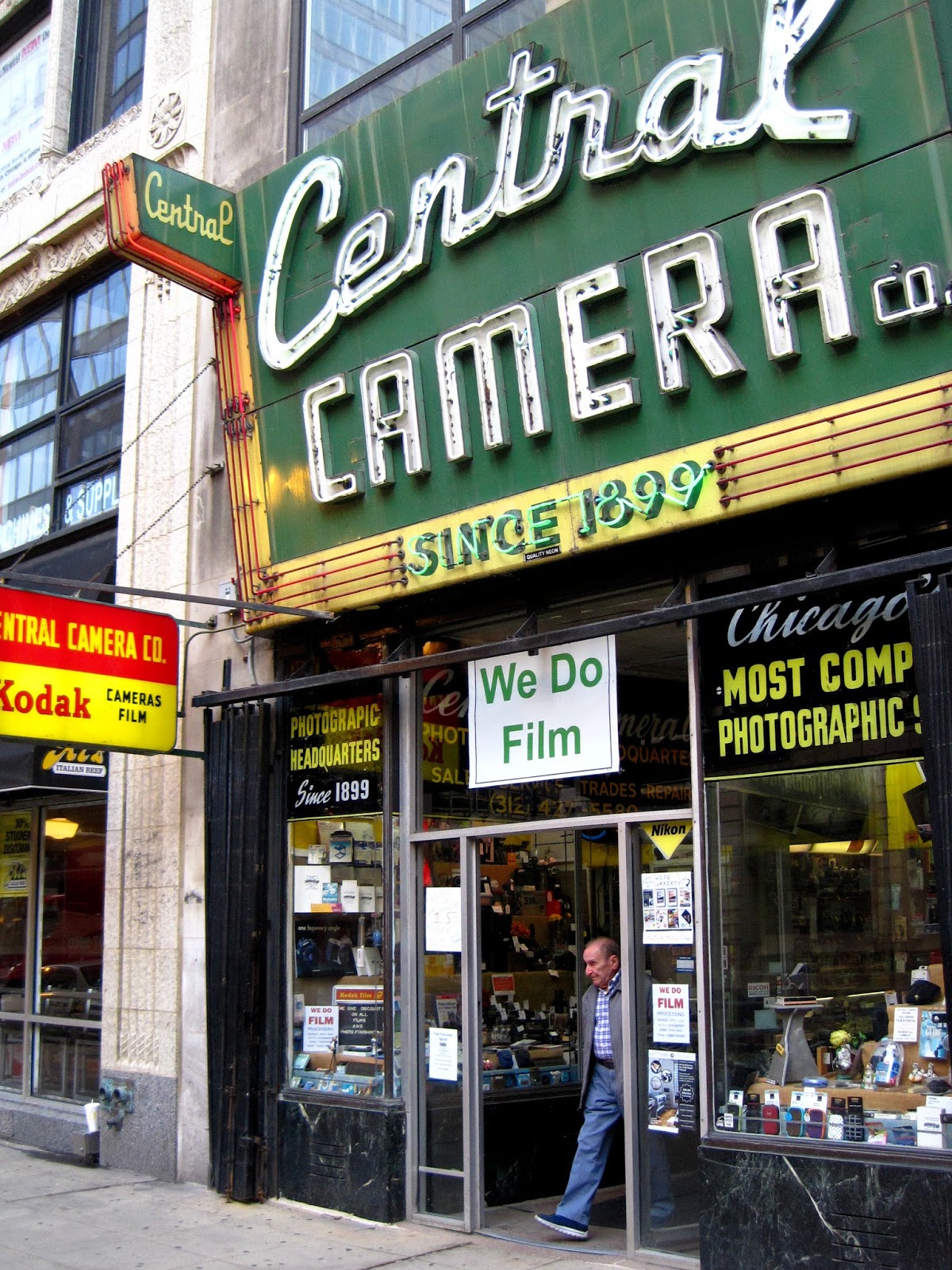
Chicago's Central Camera - They Do Film Right

Last weekend, my wife and I visited Chicago together for the first time in many years.  We stayed at the Palmer House Hilton, a most fantastic classy hotel that has been in operation longer than any other hotel in the USA.  While I didn't plan the trip, it just so happened that Central Camera is a block away on Wabash.  Central Camera is equally as qualified for a longevity award as Palmer House.  I last shopped there in 2002, and bought a Tamrac backpack, which I still have.  Since then, I have been able to photograph the front of the store during quick Chicago visits, but it was always on Sundays, so it was closed.  This time, I stopped by on a Friday afternoon and a Saturday morning.  They open at 8:30, which is when I stopped by after breakfast Saturday. The nice thing about getting there early - is to be able chat with the folks behind the counters.
First of all, Central Camera is the photo store that is so archetypical of  the genre. Old-school, with glass cases filled with used gear (and new) that will induce a severe case of GAS.  All kinds of delectable cameras and accessories.  Of course, they have digital gear, too. If they don't have it, you can have them order it.  They have film. Lots of film. I haven't seen that much film in a store -- ever.  They also process film.  Vivian Maier used to buy her film there, too.   I am sure she didn't chat up the folks at the counter, though.
I bought s bunch of Kentmere 400 b&w, and some C-41 film while I was there. I don't NEED any more cameras, and it's a good thing I don't live in Chicago, or they would be getting a lot more of my money.
Speaking of film -- Yes they DO film.
Katherine Greenleaf and Charles Ezaki at the film counter.
I had a good time talking with the folks there, and told them about the Film Photography Podcast.  I hope they listen in.  Stores like Central Camera are few and far between these days, and to walk into the store is to feel like it's a place that is welcoming and also a bit like a piece of history.  Yes, you can buy the latest digi item, but I'll bet that they have a lens hood that will fit that vintage Contaflex in your bag, too.   I know that if I were doing photowalks in Chicago, Central Camera would have to be a stopping point -- or maybe a starting point.   Anyhow, it was fun to shop there and talk photography.  It was just a year ago that I visited another iconic place -- Looking Glass Photo in Berkeley, CA.  Definitely a difference between the two locales, but no difference in their love of film photography.  You have to be passionate and knowledgeable about what you sell, and they have the right folks there.
So, if you are in Chicago, check out Central Camera. It's a destination, and a shrine to all things photographic.


Sunday, November 27, 2016

Konica Autoreflex TC...again.

You would think that by now I would be able to see a lonely orphaned camera in a thrift shop without bringing it home.  I guess I am not there yet, if the price is right.  Yesterday I was at the Ann Arbor Recycle/Reuse Center (where I also purchased a like-new pair of Realistic Solo-1 speakers), and saw this dirty, yet working Konica Autoreflex TC for $10.  It had the wonderful 40mm 1.8 Hexanon AR lens.  I opened it up, and the inside was clean, the shutter speeds worked, so I figured I would buy it. Over the years, I have acquired a few of these cameras, and have donated them to the Film Photography Project. A few years ago, I had a bag full of Konica SLRs, and have since divested myself of all of them.  Yet, once again, a lonely, unloved Konica TC turns up.

before cleaning

Today, I cleaned the camera up.  It was filthy on the outside, but the glass on the lens is excellent, and the insides are clean.  My cleanup kit consists of a used soft toothbrush, industrial cotton swabs (the ones on a stick), an old t-shirt, lens tissue, and a bottle of isopropyl alcohol.  That usually handles just about everything, but sometimes a bit of Windex or Naptha is needed for stubborn dirt or sticky residue.  I removed the old camera strap, which was a custom one with the name of the former owner embroidered on it.  Although the Autoreflex TC originally required 2 PX-13 1.35V mercury cells, two 625A 1.5 cells will work fine, and you may not need to compensate via the ISO wheel.   I put in the 625As, and checked the metering against my Nikon N6006, and the reading in the TC was the same at ISO 400. Note -- you do not need batteries for the TC to function, except for the auto-exposure and metering.  If the batteries fail, you can use an external meter or sunny-16, and you adjust aperture and shutter speed manually. Otherwise, just set the lens to AE and set the shutter speed, and the camera will choose the aperture.  In other words, it is a Shutter-Priority and Manual camera.

One of the things I find when rehabilitating old cameras is that the light seals and mirror-bumper  usually need replacing. In the Autoreflex TC, I cannot see the mirror bumper, as there is a thin plastic or metal shield at the top behind the lens.  The light seals on the back seemed to be good enough to at least shoot a test roll.
after cleanup!

Using the Autoreflex TC
I look at the TC as being a compact Autoreflex T, hence the TC.  It's definitely lighter than a Autoreflex T, T2, etc., and is smaller than a Pentax K1000.  Plastic components obviously keep the weight down.  While the TC has a limited range of shutter speeds from B, 1/8- 1/1000 sec., it's a good street camera.    The camera has a standard hot shoe and PC socket for flashes, with a 1/125 sec sync speed.  In other words, while it's not everything you might need in a small SLR, it has what you will need in most situations.  In fact, it's a pretty decent "student camera."  One other tip on using the camera -- do not try to pull up on the film rewind to insert a new roll of film. The bottom is cut out a bit so a roll just fits right in. The rewind knob only rotates to rewind the film, and there is no vertical movement. The meter turns on when you move the wind lever away from the body. A button below it sets the lever back against the body, locks the shutter release, and turns off the meter.  Of course, if you need a manual, our friend Butkus has one. Be sure to donate some $ to his site to keep those manuals available.