Showing posts with label landscape photography. Show all posts

Sunday, March 06, 2022

A Tale of Three Films

I typically have a variety of film types in my camera bags, so that when I pick one up, it's ready to go.  The types of films I include in the bag usually reflects the cameras inside and the type of photography that I use them for.  For example, my small bag with the Leica M2 has b&w ISO 100 & 400 film, whereas my canvas shoulder bag often has the camera of the week that I am using, along with the right lenses, as well as a couple of toy cameras, etc.  Therefore, it has a variety of film types from color to low-ISO b&w.  

On Feb. 25, we had friends visiting and I thought we might to go the NC Aboretum, so I grabbed the canvas shoulder bag.  I had to make a stop at the local post office first, and when I got back into the car I decided that we would go N instead, to Rocky Fork State Park in Tennessee.  It turned out to be the right choice, as everyone really enjoyed Rocky Fork, and the volume of water roaring through the creek was quite amazing.  

My canvas messenger bag 

Unfortunately, the Nikon FM2N SLR that I had in the bag was loaded with Fomapan 400.   It was also a sunny day, which is not ideal for photographing waterfalls. Oh well, I had to make do, so I put on a 2X Neutral Density filter and a polarizer, so that I could take longer exposures in the semi-sunny conditions along  Rocky Fork.  Once I finished the Fomapan 400, I decided to use a slow film, so I pulled out a roll of Adox CMS 20 II, and loaded it. That was a mistake, in hindsight, as you'll see from the images.  After that roll was done, I used a roll of Eastman 5231 - an expired cine film that's a lot like Plus-X.  It's rated at ISO 80, so with a polarizer, I was still getting some good 1/2 second exposures.  Of course, I wouldn't know any of this until after I developed the film, and that's one of the things that I like about film - be prepared to fail, or succeed spectacularly.

Rocky Fork State Park is a stream with a pretty exciting course through rocky terrain, and having been there a number of times, I know what sections are the most photogenic later in the year. But after some recent rains, just about any part of this stream with cascades of plunge pools, and white water is going to be photogenic. My trusty 22-year old Bogen/Manfrotto tripod has certainly been to its share of riparian scenes, and yes, if you want to shoot water scenes with long exposures, hand-held is not gonna do it, no matter what camera system you are using.  I started with the 24mm Nikkor on the FM2N, and then went to the 50mm. While I used the ND filter and the polarizer with the Fomapan 400, I just used the Polarizer with the Adox and Eastman films.

The Fomapan 400 was developed in HC-110 B for 7 min, the Adox CMS20 II was developed in D76 1:3, for 10.5 minutes, and the Eastman 5231 was developed in D96 for 6.5 minutes.  The Fomapan 400 looks like it always does - grainy, but otherwise, okay.  The Adox CMS 20 was NOT the right film for this, though, and probably the D76 1:3, while one of the suggested developers  in the Massive Development Chart, it would probably have been better going with a Technidol-style developer, as the Adox film is very contrasty, and did not have much latitude. The clear polyester base really shows the lack of grain, but also the high contrast. I'll try this film again, but in a situation where the lighting is even, and also rate it at ISO 12 instead of 20.  The real champion that day was the Eastman 5231 film.  I have a large supply, thanks to my friend Bill Pivetta, and I look forward to shooting more of it in the future.  At Rocky Fork, it was the perfect film with great latitude, low grain, and in the mixed lighting (sun and shadows), it showed how great it really is.  

This is not just a tale of three different films, it's a microcosm of the film world. Yes, I could have just shot Rocky Fork with my Nikon Df and not have to worry about film, and making adjustments as I worked the creek.  But you know what? By using film, I was learning something new, and creating a body of work that I can derive great satisfaction from.  It's not that the Adox film was a failure, it was just the wrong film for the conditions, and I learned from that.  The Fomapan was grainy, yet, I liked the effects that I got from it.  The Eastman 5231 is butter,  Smooth, creamy, and it really did well in the shadows and highlights. I don't want it to sound like I am knocking digital, but I could churn out a 100 digital images of Rocky Fork without even breaking a sweat and would have learned nothing new. Sometimes the journey IS the reward. 

Herewith are samples from the three films.

Fomapan 400-


Adox CMS 20 II-


Eastman 5231--


As you can see from the above, I did get some nice images from all three films.  However, the Eastman 5231 really performed the best when considering the overall exposure.  The shadow detail in the Adox is pretty bad, and the Fomapan 400 certainly did fine with the shadows, but one may not like the grain.  It's all a matter of taste and expectations.  


Wednesday, July 22, 2020

One Year


It's been a year since we moved to Weaverville, NC from Ann Arbor, MI.  We feel very comfortable here, and are very happy in our new home. If you had  asked me three years ago, where I might be living in 2020, I don't think that NC would have been on my radar at the time.  Life is funny, in how things can quickly change in ways that one does not foresee.  But, at the age of 62, one does not often make big changes, and moving here was certainly a big change.  To be honest, I was getting in a rut in Ann Arbor, and while I did like our old home, the neighborhood, and my friends, nothing much had changed, except that I was retired.  The ugly politics at work hastened my retirement, and I had no reason for emotional ties to the place I worked for almost 37 years.    It was time to reinvent myself, and in a way, I did.  I'm no longer a retired entomologist. I'm a retired man that is passionate about photography, loves living in the mountains, and having a relatively stress-free life. 

Vance Birthplace, State Historic Site. Nikon F2S, FPP Infrapan.


I have fallen in love with Western North Carolina - the mountains, the rivers and creeks, nature's abundance, and  the people here are genuinely welcoming and friendly.  I grew up at the NW edge of the Adirondacks in New York State, and love being in the mountains once again.  We are very close to the Blue Ridge Parkway, and getting into the higher elevations is a really quick trip.  There are so many streams and waterfalls that are within 30 miles, it seems almost too good to be true to be living here.   We had plans for some trips to the coast, but then COVID-19 happened, and of course, those were put aside for the time being.  Despite that, I have been doing a lot of day trips in the area, and it's helped familiarize me with the best routes and natural features. 

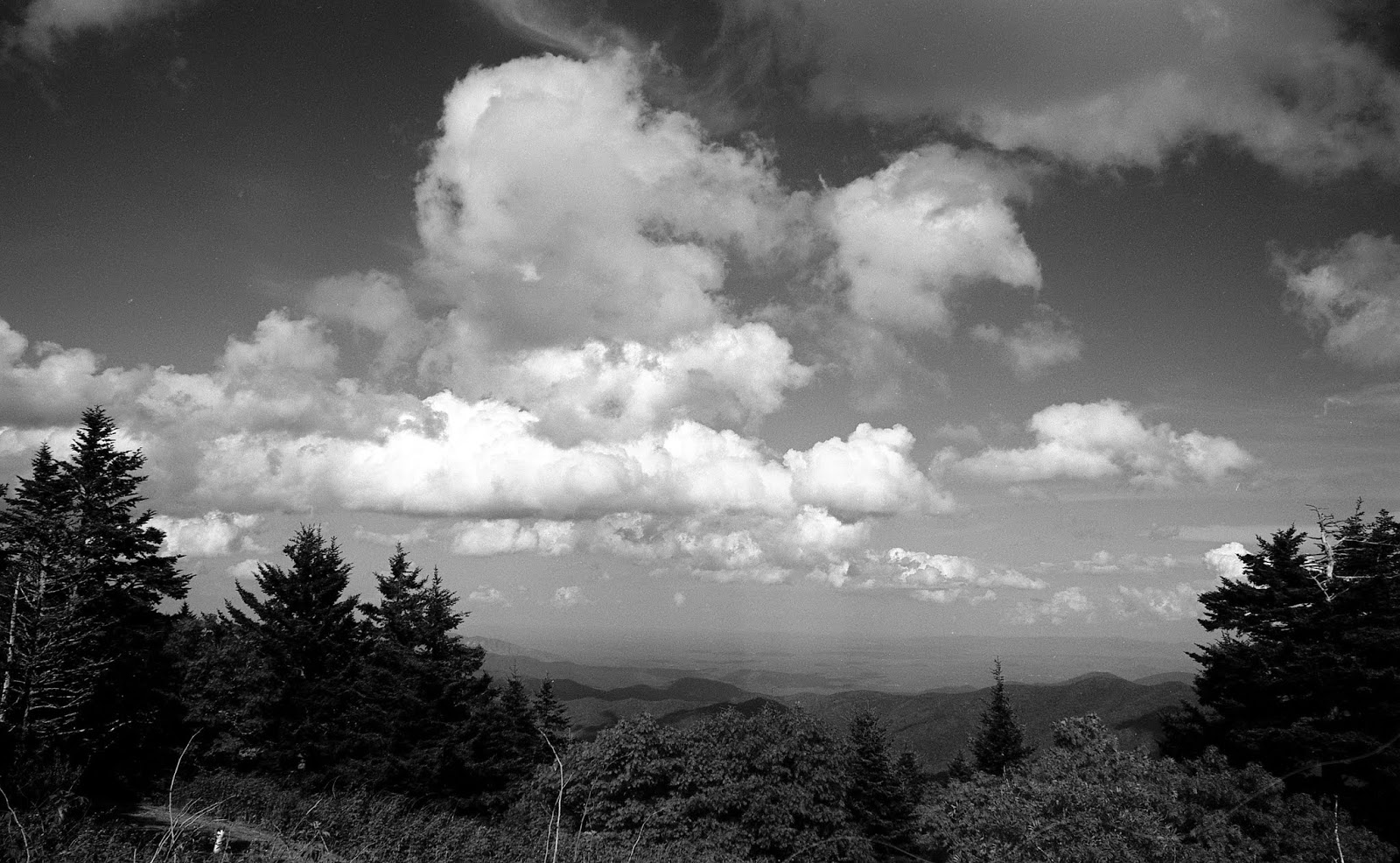
View from Mt. Mitchell.  Nikon FM3a, Rollei Retro 80s

I still have not gotten my darkroom put in, and the new space will be smaller than my old one, but will be adequate for what I do.  For now, the downstairs bathroom is where I develop film, and it's worked out pretty well.  Unfortunately, with the current situation, there have been no photography meetups or gatherings.  I'd really like to do a Western NC film-shooters' meetup, but that will have to wait.
Biltmore Estate, Tasma Mikrat 200, Nikon FM2N

One other thing that is new for me is that I am trying to learn to paint with Acrylics.  The landscapes here are inspiring, and maybe I will find my style and see where I go with it.  It's definitely a challenge.

Walker falls, Nikon FM3a, Ilford Pan-F

Of course, if you have been following this blog, then you already know the things that I  have been doing over the past 12 months.  I am currently testing a bunch of other films, and hope to have some reviews ready  in August.

Stay healthy, my friends.

Thursday, May 28, 2020

The Agfa Clack - a 6x9 gem

 I guess it is time for a little box camera love.  It's been a while since I have used a camera like the Agfa Clack, which is a 1950s camera that takes 8 6x9 cm negatives on a roll of 120 film.   The Clack is by no means a cheap plastic camera, as it has a stamped metal body with metal and plastic parts, and a glass meniscus lens. 

The Agfa Clack was manufactured in Germany from the mid-1950s  to mid-1960s, and apparently the later iterations featured a plastic body.  On first look, the camera has a vaguely oval shape, due to the curved back to reduce aberration in the images.  The features are pretty simple:

Meniscus lens with two apertures - ca. f/13 and f/10
Shutter about 1/30 plus B
Built-in yellow filter  on some models
Close-up lens for 1-3m distance
otherwise, focus is at  3m -infinity
tripod socket centered on bottom
simple viewfinder
red window with movable cover for frame number
cable-release socket


Back in the days of big box cameras, it was routine to get contact prints back from your local drugstore when you dropped off your film, as 2.25 x 3.25" (6x9 cm) prints are decent-sized, and the best shots could be sent out for reprints at a larger size.  If you understood the limitations of your camera and exposed properly, the Clack and many other box camera were adequate snap shot cameras. Today, such cameras are put into the "Toy Camera" category, but they really aren't toy cameras.  They were designed and produced at a higher price point than what would later become cheap plastic cameras with light leaks and lens aberrations. 

My goal with this particular Agfa Clack is to see how well it would work as a camera to take on local photo trips to see how it renders a scene.  The large negative is an obvious plus, as is the ergonomics of the camera. It handles much better than say, a Kodak Brownie 120 box camera.  For my use, I knew that the tripod socket, B mode, and cable release connector were just the things I needed to use the camera for landscapes in the NC mountains. 


My first roll was expired Kodak TMax 400, which I shot walking around Marshall, NC on May 1.  Hand holding the camera works pretty well, and the negatives (developed in D-96) looked pretty good.  The vertical shots were a bit blurred due to camera shake, but the landscape orientation was just fine. 

That encouraged me to take the Clack to Rocky Fork State Park in Tennessee 2 weeks later.  To photograph the creek, I rated the expired Tmax 400 at ISO 100, and the f/13 setting in the shady conditions gave me an exposure time of 1/2 sec or so.  That meant using the tripod and a cable release to shoot in Bulb mode. I estimated the exposure time and hoped for the best.  I developed the film in D-96, and am thrilled with the results.  From this, I know I can also put even slower films in it, such as Ilford Pan-F and Rollei Retro 80s.  The trick is to figure out the exposure with a light meter, and try and approximate it in B mode.  If it is sunny, I could tape a piece of ND gel over the lens for the longer exposure time.

Marshall, NC

Marshall, NC, Madison County seat

Rocky Fork State Park, TN.

Rocky Fork State Park, TN.

Rocky Fork State Park, TN.

If anything, this exercise shows very well that one can overcome a camera's limitations with a little bit of care and planning.  I love the larger negative and look forward to shooting more riparian scenes with the Agfa Clack.  I have an Agfa Isola which makes 6x6 negatives and has features similar to the Clack.  I'll take it along, and see how it does in the same situations.  

Maybe you have a 120 box camera in your collection. Don't be afraid to shoot with it!  Use ISO 100 film, as the cameras were made when Verichrome Pan (ISO 125) was THE film for box cameras.  Or, if you use a ISO 400 film, shoot on overcast conditions.