Showing posts with label remjet. Show all posts

Monday, September 15, 2025

RETO’s Amber T800


If you might recall, back in 2023 there was a lot of online drama because Cinestill registered their 800T as a trademark (which is crazy, because Kodak had an earlier version of Eastman Vision II 800T). The fallout from that was that other companies that were reselling remjet-removed 500T simply renamed their films as T800. So there, Cinestill!  My opinion is that Cinestill was most likely angling to protect what they felt was their process, and in fact, nobody else was a challenge until China-based companies started their own remjet-removal and marketed their lines of Eastman Vision III cine films as C-41 compatible and challenged Cinestill’s monopoly.  

I picked up two rolls of RETO Amber T800 back in mid-April from Amazon because I had some Amazon Prime rewards points to spend.  I loaded one roll into my Minolta X7A, and finally finished the roll at the end of August.  I developed the roll in my ECN-2 kit from Ultrafine Online.


Amber T800 is the same film as the Cinestill 800T, that is Eastman Vision III 500T with the remjet removed. It’s been argued that by removing the remjet, the film “gains” more sensitivity, and should be shot at ISO 800.  It could just be that 500T has good latitude, so 2/3 of a stop increase is not a big deal.  In any case, I set my ISO to 800.  The one thing about the RETO film is that it is sold in a 27-exposure roll.  That makes it slightly less expensive than the Cinestill film, but it’s also fewer exposures.  I prefer 36 exposure rolls most of the time.  Also remember that because of the remjet removal, the film has problems with halation, and point light sources will be red-tinged.  Another caveat - this is a Tungsten-balanced film, made for artificial lighting.  If you shoot it in daylight, you ought to use an 85B color correction filter to avoid the bluish overcast of the images.  However, you can shoot it without a filter and fix the scans in post-processing.


I shot the T800 in a variety of situations, and overall, it performed as I expected. As you can see from the images that follow, there are instances of halation.  I did not encounter any remaining remjet on the film, so that was a plus.  All of the negatives were scanned on my Epson V700.


The photograph of the Nikon D80 in sunlight really shows how crazy that reddish-hued halation can be, as well as the interior shot at Highland Brewery and the white lights on the ceiling.  That's not really a look that I appreciate, which I is why I am not a Cinestill fan, or of the cine films without the remjet. I can develop my remjet-backed film in ECN-2 process just fine. Of course, not everyone can do that, so you'll have to decide if you like the look or not.

Now that Kodak has reformulated their cine stocks to be sold without any remjet, I look forward to seeing what will be available in the coming year. I still have 200 feet of Vision III 250D to use, and that is a gorgeous color film, processed in ECN-2.  


Sunday, January 14, 2024

One Roll Review - Reflx Lab 200T


I was recently contacted by Reflx Lab to see if I’d like to try out their 200T 35mm film, and of course, I said yes.  There are so many new rebranded films turning up now, that it’s getting hard to keep track of them.  In 2022, I reviewed their 400D ECN-2 film which was Eastman Vision 3 250D with the remjet layer already removed, so that it could be processed in any lab offering C-41 service.  That was “early days” for Reflx Lab, and I pointed out a few minor defects in the emulsion on the rolls, as well as light piping at the beginning.  Otherwise, I still liked what I saw.  


Unless you have been in a cave or the middle of the Amazon forest for the past few years, you know that the Cinestill brand has been selling Kodak ECN-2 films with the remjet removed, and in their branding, advertised every ECN-2 film with a raised ISO, supposedly because the remjet removal raised the sensitivity.  I think that’s just marketing bullshit, but it created a unique niche that until recently, had been occupied only by them.  So, in late 2023, when other resellers started selling the same exact films with the remjet removed, Cinestill took aggressive action because they’d been granted a trademark status on 800T.  While it was certainly wrong for them to claim 800T as a trademark, it opened a whole lot of ill will towards Cinestill, and much of it was deserved.  So, in the aftermath, other brands have come up with unique ways to advertise their remjet-removed Vision 3 films.  That’s where Reflx Lab comes in with their 200T film in this review.


The Reflx Lab  200T box uses a stylized T that looks like a lamp bulb.  Ingenious!  The  other thing about this film is that it really is a 200 ISO Tungsten-balanced film.  It’s Kodak Vision 3 200T, but with the remjet layer already removed so that it can be safely developed at your local lab.


A couple of things about the remjet layer that you should know by now.  First, it acts as an antihalation layer, and second, it acts as an antistatic layer and third, it sort of lubricates and avoids scratches as the the film travels through the movie camera.  That’s significant, because cine film moves far faster through a movie camera than a 35mm still camera.  Without the remjet in a still camera, the only real problem will be from the removal of the antihalation properties.  That means you’ll be more likely to see “blooming” from point light sources or backlit scenes.  In a color film, it’s going to result in reddish tints from the halation.  Some photographers love the effect, especially in shooting night scenes.  I’m most familiar with the halation in b&w films, and it can be a good thing in the right circumstances.  So, it’s just something that you should be aware of, if you choose to shoot any ECN-2 film that’s had the remjet pre-removed.


I put a roll of the 200T in my Nikon N75, and shot the roll within a couple of days in early January.  After I shot the first few frames, I remembered to attach an 85 filter to compensate for shooting in daylight with the Tungsten-balanced film.  The film cassette is DX-coded, so if you are using a camera that requires a DX code (such as the N75), you will be just fine using the Reflex Lab film.  I only had a few shots indoors, and I took off the 85 filter for those.  After I finished the roll, it was processed by my local lab in Asheville- Ball Photo.


The Reflx Lab 200T film scanned easily in my Epson V700, and the results are very good overall. However, as you will see below, backlighting and point light sources cause halation with reddish blooming.  


a little blue-ish, no #85 filter


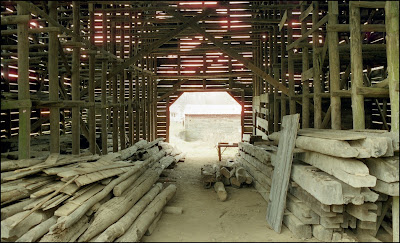
that light poking between the boards, and it was not sunny


great color rendition


You can really see the halation with the light peeping
between those boards!

a very well-rendered scene


those spotlights...


Comparing this film with my experience from 2022, shows a very improved process from Reflx Lab.  There was no light piping at the beginning/end of the roll, no strange artifacts, and no residual remjet.  In fact, the film is as good as any C-41 film that I have used - however, as I stated earlier, halation needs to be taken into consideration when planning your shots.  I’ve only shot one roll so far, and I’ll shoot another roll in the evening sometime to see how well the Tungsten-balanced film looks indoors with good lighting, and also with neon signs.


There are many choices now that other companies have figured out how to remove the remjet layer from ECN-2 films before packaging them for the consumer. You can send your money to Cinestill,  Reflx Lab, or to Reto, and try these films for yourself.  Personally, I like the Reflx Lab films, and they are now found on the shelves in brick and mortar photo stores.  That’s good news for the consumer, and there are more choices than ever.  However, if you like the DIY approach, there’s no shame in buying regular ECN-2 films and doing the remjet removal as part of your developing process.  You’ll certainly avoid the halation problem, and also save a bit of money as well.  


Overall, yes, I like the Reflx Lab 200T, and I am looking forward to shooting more of it.  Maybe I’ll even try some “800T,” but without the Cinestill branding.


Monday, February 13, 2023

Eastman 5243 Internegative Film

Sometimes it's fun to just try things and see what happens...


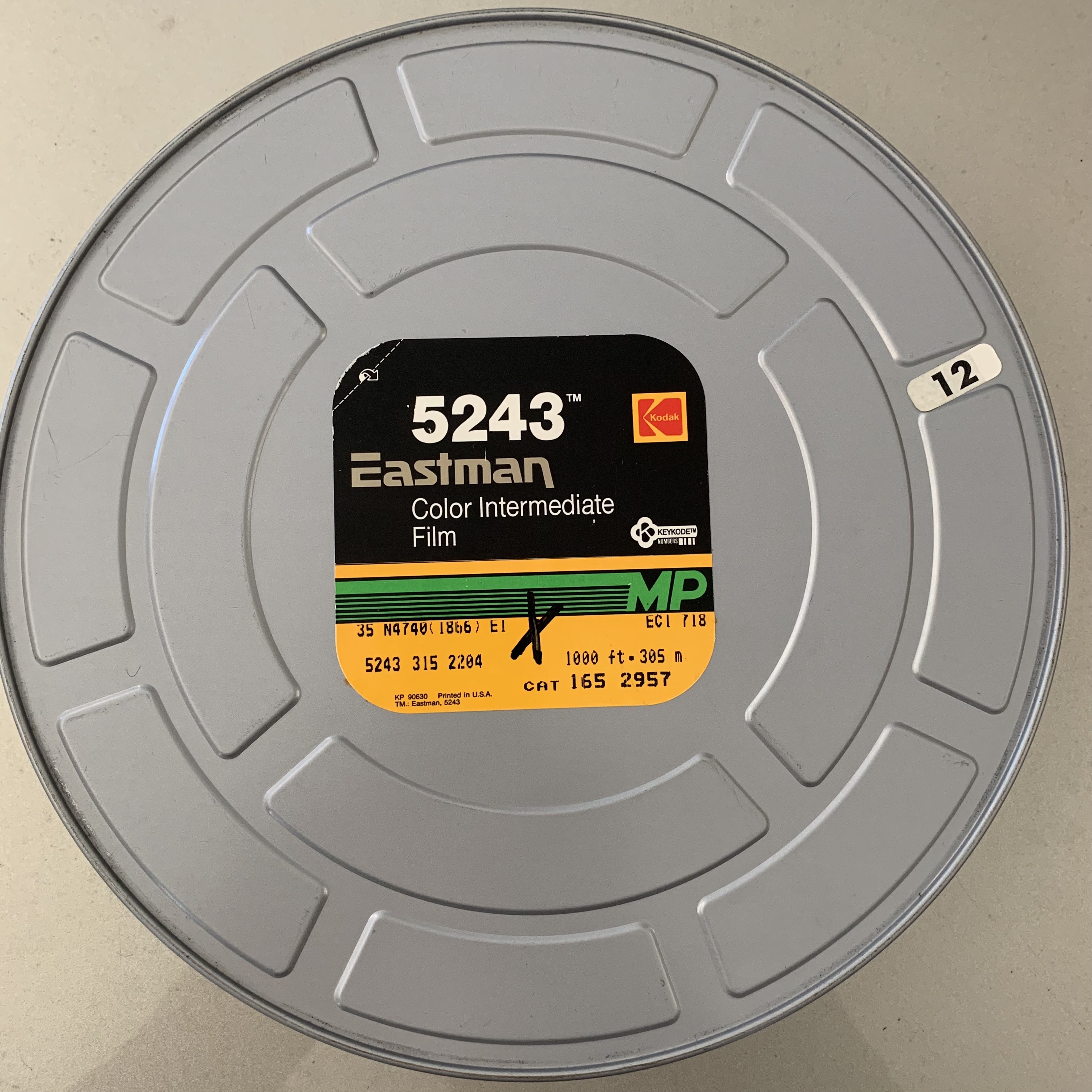
My buddy Bill Pivetta gave me an unopened 1000 ft reel of 35mm motion picture stock last summer, and until recently, it sat in the fridge.  I finally got around to spooling up some of that 1000 ft reel into a 35mm bulk loader, and from that, I loaded up a couple of 35mm cassettes.  The “mystery film” is Eastman 5243 color internegative film.  It’s been really difficult to find much information about it, except that it was used in Star Wars (1977) to produce the final negative for the positive copies for distribution.  The database of film stocks indicates that this film was discontinued in the late 1950s, but that is not the case.  These big reels of film appear to be relatively “recent” - perhaps from the 1980s.  In any case, I was intrigued to see what I might get from this film.  Knowing that similar special-purpose cine films have a low ISO, I decided on an ISO of 1.5, which is 2 stops more exposure than my F4’s lowest ISO setting. So, I just set the exposure compensation dial to +2, giving me an ISO of 1.5 for in-camera metering purposes.  While shooting, I bracketed from +2 to +1 and 0, for an estimated ISO of 1.5, 3.0, and 6.   On a full sunny day, sunny-16 for this film would be about 1 second at f/16, or about 1/15 sec at f/4.  


I shot the roll in the River Arts District, and developed the film in C-41 chemistry along with a roll of Kodak Vision 3 500T.  Before developing, I gave the two rolls a good soak in an alkaline solution of Sodium bicarbonate and Sodium carbonate, and then shook the tank like a cocktail shaker for 4 rinses to get as much remjet off the films as possible - about 99%. I then proceeded to do a typical developer and blix, followed by a series of washes.


before  scanning

The resulting negative has a greenish base, and while the base was rather dense, I could see the negatives, and my eye says the ISO 1.5 was pretty close.  Scanning gave me some interesting results.  For one, it’s obvious that the film has lost some color sensitivity, and I don’t know if the blue-green base color is merely the result of age - which it certainly could be, or a factor of age and storage conditions.  I don’t think the film was refrigerated.  The color matrix in the first image shows how the film now records colors.   The grain is fine, as I would expect from an internegative film.  There is some odd coloration in some frames - and perhaps that’s from age, as this was the beginning of the large roll.  With some post processing in my favorite image editor (Corel Paint Shop Pro), I did some fade correction and exposure correction.  The resulting colors are muted, and some people might find them very appealing.  


5243 color chart after some tweaking


color chart as it's supposed to look (iphone)

I don’t think there would be all that much difference had I developed the film in ECN-2 chemistry.  After all, this is a special purpose, slow cine film that’s probably at least 40 years old.  I may try another roll soon and see how it goes.  However, that’s the beauty of testing a strange film --strange results.   I don’t know if there would be enough interest for me to sell any reloaded 35mm cassettes with the 5243 film at ISO 1.5.  Obviously there’s no guarantee on the results, but if you are interested in acquiring a few rolls of 5243 at a low price, let me know (USA only), as I have almost 1000 feet of it... 


before any corrections


For  comparison, here is a frame from Vision 500T developed in the same tank:

Vision 500T, Nikon FE10.