 |
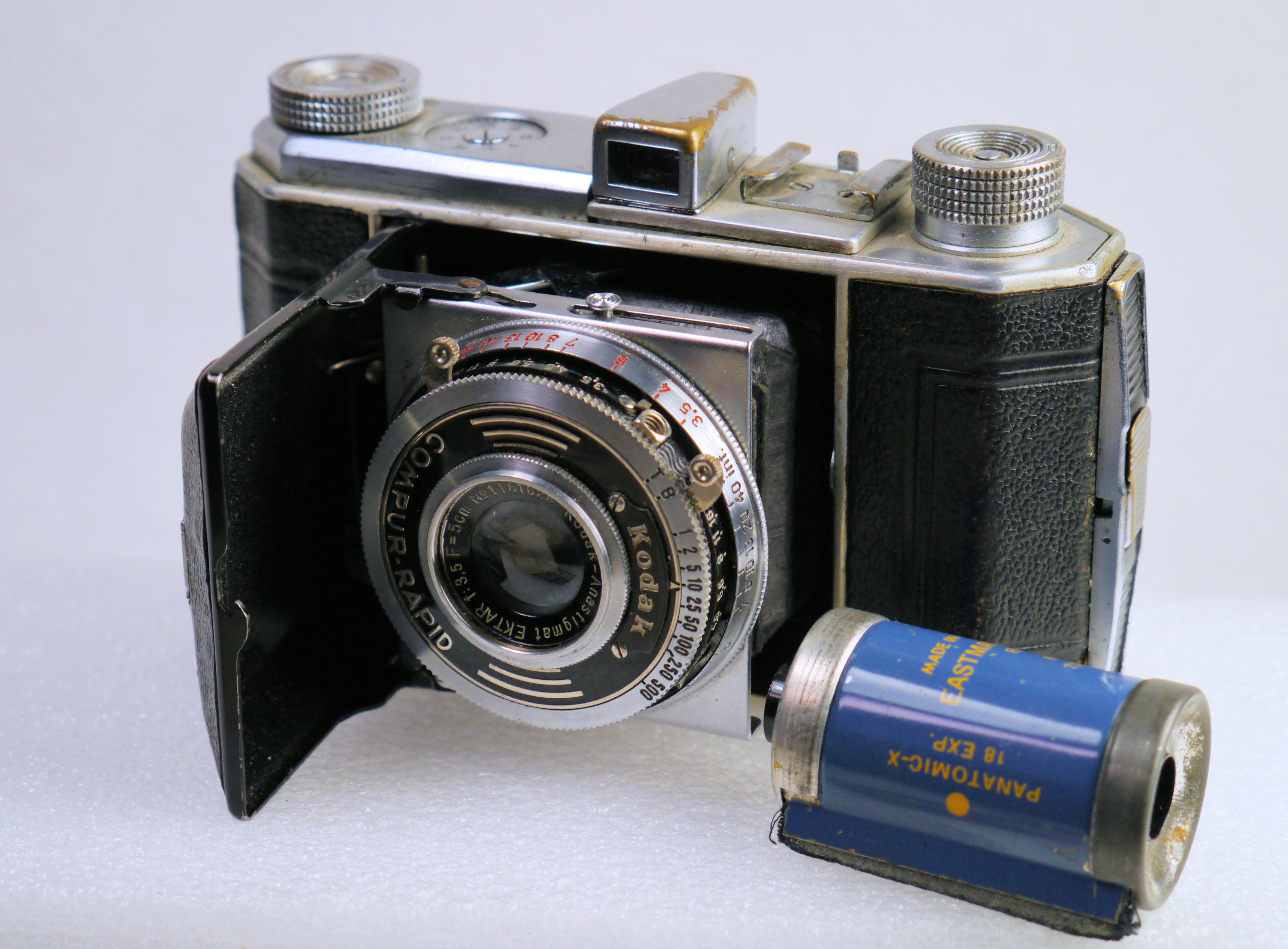
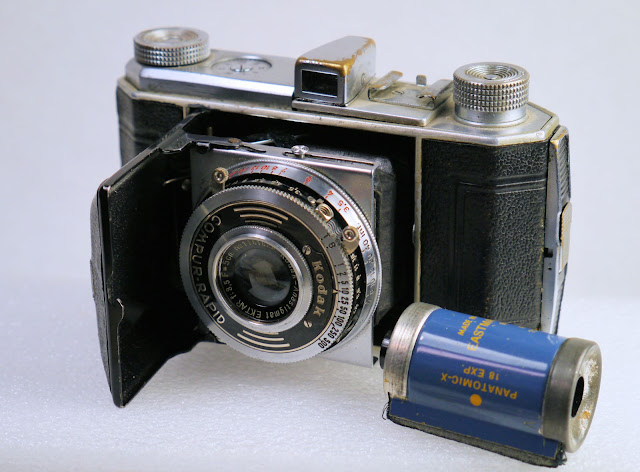
| Kodak Retina I, type 126, with vintage Kodak 35mm film cassette |
In the early days of 35mm cameras, the Barnack Leica was considered to be the epitome of a quality compact 35mm camera. However, what are often overlooked are the Retina series of cameras, made by Kodak's German factory, Nagel Werke in Stuttgart, which became Kodak A.G. Retina cameras were manufactured there from 1934 - 1969, and included the renowned Instamatic 500. Kodak acquired Nagel-Werke in 1932, and the Vollenda, shown below, looks a lot like a Retina camera, but it uses 127 roll film.
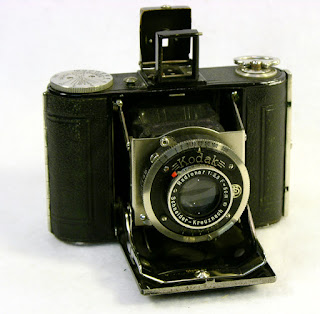 |
| 1933 Kodak Vollenda - a very compact folding 127 film camera |
The Retina cameras are a somewhat bewildering adventure, as different models, such as the Retina I has many different versions, called types, that were produced in different years, with different finishes, lenses, and so forth. To dig deep, there are several books on Kodak Retina cameras, but the McKeown's Guide is a great starting point. The first Retinas arrived in the US in 1934, and were priced around $50 – a substantial sum for the time, and the US was still in the grips of the Great Depression. Nevertheless, these optically superb, mechanically precise, and easily carried cameras gained a following.

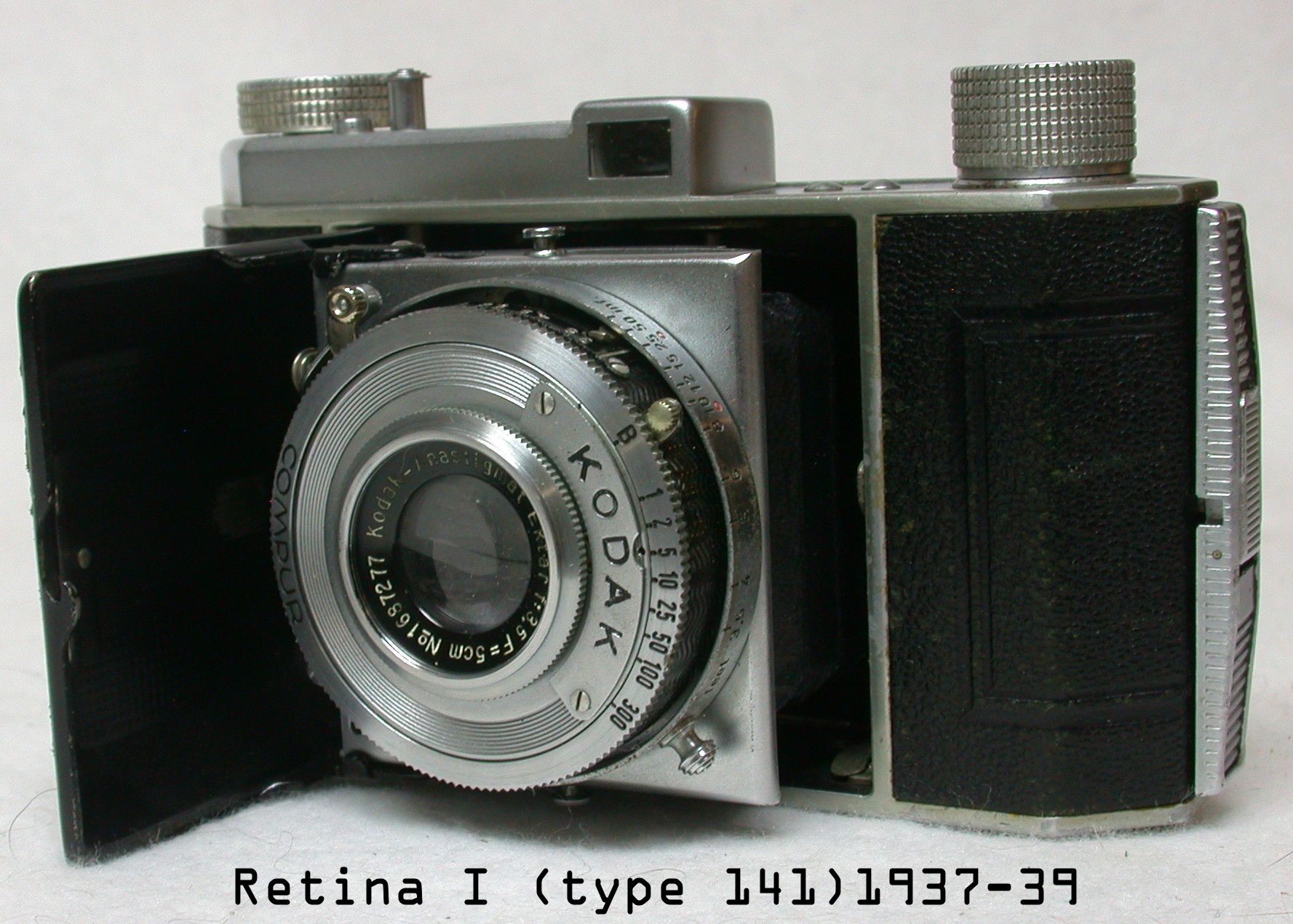
What makes the Retinas special is that starting with the original Retina to the Retina IIIC, the cameras featured a folding bed, with the lens on a very short bellows, which makes them easy to carry with no protruding lenses. The front pops open which releases the lens to be able to shoot. All of the folding Retinas feature Compur leaf shutters with the lens helical, shutter speeds, and apertures around the lens all on a front panel. The Retina I cameras were guess -focus, unless you had an accessory rangefinder that fit into the accessory shoe on the top deck. Rangefinder focus didn't start until the Retina II was introduced.


All models had fixed lenses, until the IIc appeared, and removable front lens elements allowed different focal length lenses from 35-80mm to be used. Due to the small throat diameter of the lens mount, fast lenses were not available, with 50mm f/2 being about as good as one could get. Of course, you could not retract the 80mm lens into the camera, so it had to be open all the time if it was attached.
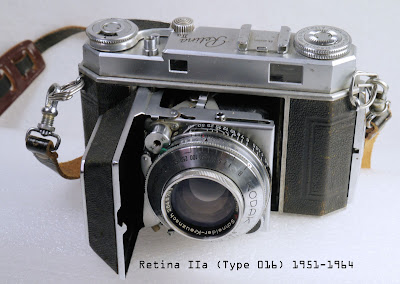
The folding Retinas feature shutter speeds from B, and 1-1/500 sec (early Retina I models had a max 1/300), and typically have Schneider Xenon lenses, which are as good as anything from the Leitz factory. Later iterations, such as the IIIc, incorporated built-in uncoupled exposure meters. My personal favorite is the Retina IIa, which was manufactured from 1939-1954, and has a Retina Xenon 50mm f/2 lens. It exemplifies the sturdy mechanics and straightforward control of manual cameras. The closed camera can easily fit into a jacket pocket. Depending on the model and type, the film advance is a wind-knob on top (Retina I), an advance lever on top (Retina IIa Type 016), or an advance lever on the bottom (Retina Ib, IIc, IIC, IIIc, and IIIC).
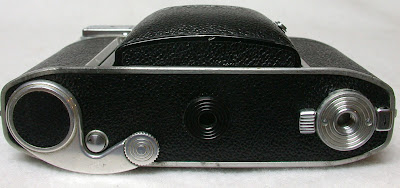 |
| Film advance lever on the bottom |
Later Retina versions, such as the IIc feature Exposure Value (EV) with linkage of apertures to shutter speeds. For example, if your EV was 11, then any combination of aperture and shutter speed corresponding to that EV would be linked. Changing the aperture also changed the shutter speed. You can find the same system on Hasselblad lenses. A simple form of automation that works quite well. The non-coupled Selenium meters were accurate at the time, but today, finding one that works accurately is improbable.
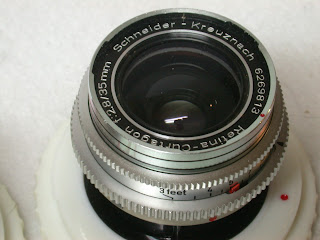 |
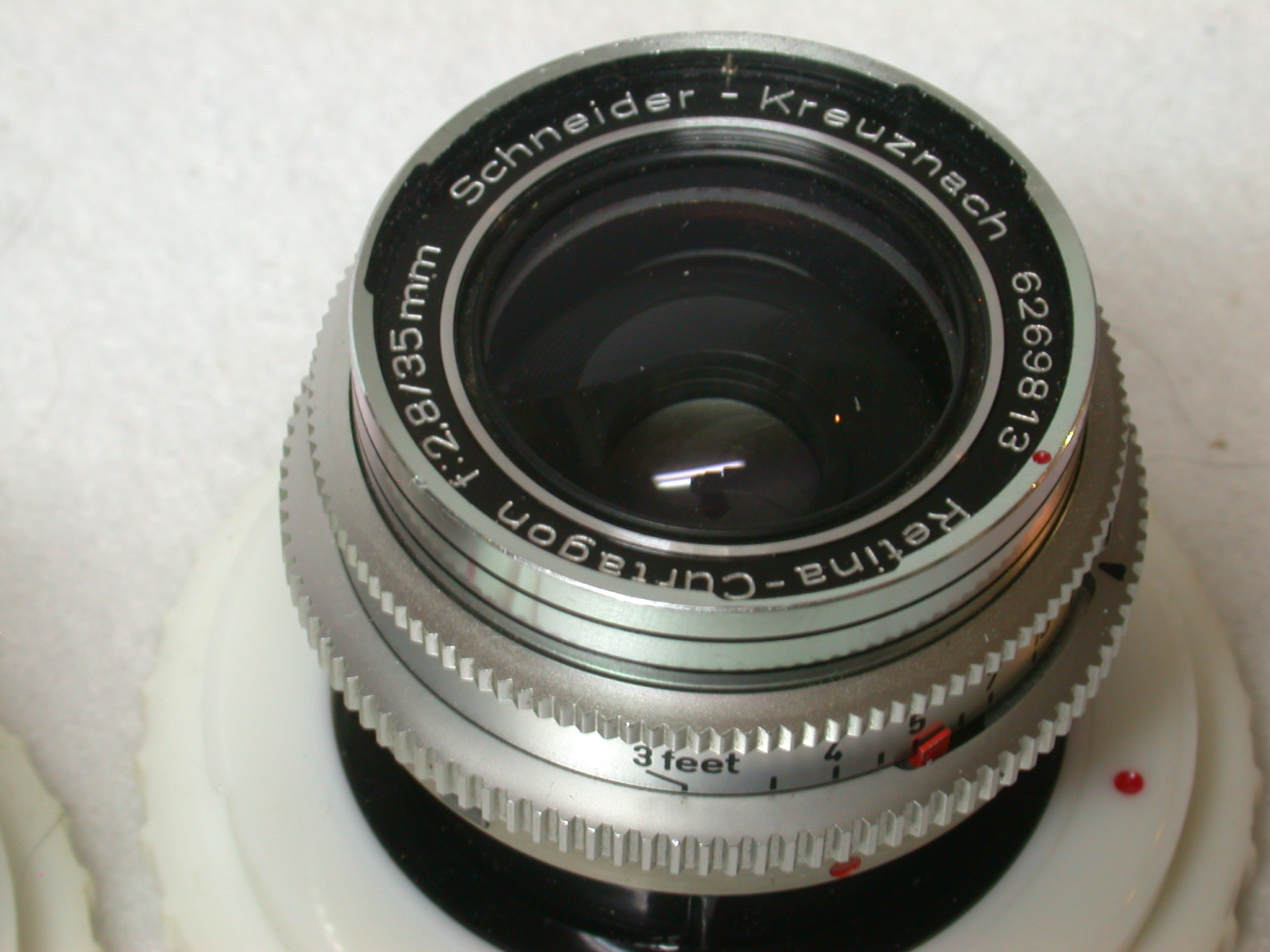
| If you have a Retina IIIc, THIS lens, the 35mm is the one to find. |
The rigid-bodied Retinas started appearing in 1959, with the end of the line folding Retina IIIC being made until 1960. There were also Retina Reflex SLRs that incorporated a similar removable front-element lens. I posted here about one of the solid-bodied Retinas a while back.
The Retinette line of cameras were designed to be cheaper folding cameras with Kodak Anastigmat f/6.3 lenses and no meters or rangefinders. They were made from 1939-1954, and other Retinettes were solid-bodied.
Folding Retinas: Within the designations are many types, pre-WWII and post-war models with the same name, but a different “type” and you’ll need to see a reference on the variants in a book like McKeown’s Cameras 12th edition.
• Kodak Retina (1934-36)
• Kodak Retina I (1936-50)
• Kodak Retina Ia (1951-54)
• Kodak Retina Ib (1954-60)
• Kodak Retina II (1936-50)
• Kodak Retina IIa (1939-54)
• Kodak Retina IIc (1954-57)
• Kodak Retina IIC – (1957-58)
• Kodak Retina IIIc (1954-57)
• Kodak Retina IIIC (1957-60)
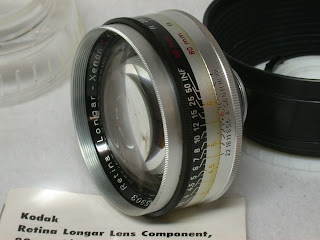 |
| Kodak 80mm Longar for the Retina IIIc |
Agfa/Ansco
But, hey, imitation is the best form of flattery, right? The Agfa corporation came out with the Karat series of 35mm cameras. Originally designed to use the Agfa Rapid Cassettes, these cameras featured a short bellows that held the lens and shutter (Compur-Rapid). They did not have a cover over the lens like the Retinas, but the design is quite similar. The cheaper models had Agfa Solinar or Igestar lenses, but the more expensive models have Schneider Xenon or Heligon f/2 50mm lenses. The Karat 36 used standard 35mm cassettes, so that's the one I recommend if you are looking for one. Under the Ansco name, it is called the Karomat.
Zeiss Ikon
The Zeiss Ikon Contessa 35 (1950-55) and Contina I (1951-55) and Contina II (1952-53) are also 35mm folding cameras. The Contessa 35 features a rangefinder, uncoupled exposure meter, along with a 45mm f/2.8 Tessar lens. It’s a fantastic little folder, and certainly in the same league as the the better Retinas.
Certo
Certo, in Dresden, produced a lot of roll-film folder, but only a few 35mm models – Dollina (1930s), the Durata (1949) and Durata II (1951).
Balda
Balda, in Dresden, Germany, produced a folding 35mm camera in 1950 named the Baldalette, which looks a lot like the folding 127 roll film cameras that were produced pre-war. One that stands out is the Jubilette (1938) – a very non-Balda name, which came about for the 30th anniversary of Balda-Werk. Later 35mm folders were called the Baldini, Baldinette, Super Baldina, and Super Baldinette. I can only speculate that the Balda did not sell well in English-speaking counties, because damn, those stupid names! Of course, I have a follicularly-challenged friend that enjoys his Balda folder.
Beier
Beier, also from Dresden, produced the Bierette in 1939, and the sleek design is much different than all the other 35mm folders listed here. I should note that most of the Dresden-based companies became part of VEB Pentacon in the 1950s.
Welta
Welta, another German company, produced 35mm folding cameras that are similar to the Retina I from Kodak – named the Welti, which first appeared in 1935, featured several different iterations with 50mm lenses, Compur-Rapid shutters, and either an f/2.9 Cassar, an f/2.8 Tessar, an f/3.5 Xenar, or an f/2.4 Xenon lens. Other Welti models followed, and were made into the early 1950s. The Weltini and Weltix are also folding 35mm bodies. The folding 35mm cameras from Balda and Welta are not common on this side of the Atlantic, and certainly are not well-known. Again, Welta doesn’t look like a great name in the English language. Weltini sounds like the name of a circus performer. "The great Weltini will amaze you with his Compur-Rapid shutter. "
Voigtlander
Voigtlander, which made a dizzying array of camera models, released the Vitessa in 1950, and those cameras have a “barn-door” opening, and feature a big plunger to advance the film and cock the shutter. The Vitessa models are interesting, but like many (but NOT all) 1950-60s Voigtlander cameras, they are prone to be mechanically problematic. You will find them with either Color Skopar f/2.8 50mm or Ultron f/2.0 50mm lenses in Synchro-Compur shutters. An earlier 35mm camera known as the Vito lacked a rangefinder, but is more similar to a Retina I. The Vito III is a beautiful rangefinder camera that commands pretty good prices to match.
Buying your 35mm folderThe beauty of these folding 35mm cameras is their compactness when the lens is retracted, and in the case of the any camera NOT Agfa/Ansco, a front door protects everything behind it. If you are looking for a classic manual rangefinder camera that does not start with the letter L, many of these folding 35mm cameras are excellent alternatives. One of the modern shoe-mount digital light meters makes the perfect accessory.
The prices for most of the Retinas on eBay are pretty low, especially compared to something from Leitz. A nice Retina IIa typically sells in the $50 range, which is a steal for such a wonderful camera. Other models such as a IIIC can sell for a bit more, but generally, they are undervalued in today’s market. A model such as the Welta Weltini II can sell for about $100, but they are uncommon, which adds to the price. Cameras from Balda and Welta are more common in European markets.
I should add here that I once owned a Retina IIa that was previously owned by Harold Edgerton of MIT, who developed the Xenon flash for cameras. Hence, that's why it is called "X" sync. I picked it up at estate auction of a Detroit area engineer who must have purchased it from Edgerton. I wrote about it in 2011, when I used it with of course, a flash unit.
My choice for anyone wanting to find a Retina, is to look for a IIa, as it does not have a light meter, and it's very compact with a wonderful lens that will produce excellent images. For about $50, you'll have a wonderfully compact 35mm rangefinder camera.
Retina Resources
I consider my post to be an introduction to the genre of 35mm folding cameras. Aside from printed resources, check out these links for more Retina and folding 35mm information: