Showing posts with label vintage cameras. Show all posts

Thursday, March 12, 2020

The Wirgin Edinex - so many Wirgins!

Germany produced many different camera manufacturers and it's just amazing that so many interesting cameras were designed and manufactured there before and after WWII.   Apart from popular names like Leitz and Zeiss, there were many manufacturers that produced quite good photographic equipment.  Many of the companies started in the 1920s, and had mixed success after the end of WWII.  With the creation of East and West Germany,  things became even more complicated with naming and branding. With VEB Pentacon in Dresden and Zeiss moving to Stuttgart, there became two major productions of Zeiss-named cameras.  However, the Zeiss in Jena became Pentacon to avoid trademark infringements in the West.  Zeiss Ikon became the West German manufacturer.  On top of all that Zeiss Ikon incorporated a bunch of other companies in the late 1920s, such as Ernemann, Goerz and Ica.  It's a confusing mess without some sort of guide.  However, it bears repeating that if you want to delve into collecting German cameras, restricting yourself to Leitz is pretty boring, if not expensive.
Wirgin Edinex (0)

Some German companies, such as Agfa, produced films as well as cameras.  Some, such as Voigtlander go back to the early days of photography (i.e., the Petzval lens was designed in 1840), and the names have outlived the German factories that made the photographic equipment.  The myriad of cameras that were produced in Germany in the 20th century is astounding, and if you look through a tome such as McKeown's Cameras (at over 1200 pages), you could spend a long time just looking at German-made cameras.  You'll see Adox, Agfa, Balda, Beier, Bentzin, Bilora, Braun, Bulter, Certo, Contessa, Dacora, Diax, Eho-Altissa, Erka-Kamerewerk, Ernemann, Finneta-Werk, Foitzik, Foth, Foto-Quelle, Franka-Werk, Futura Kamerawerk, Genos, Gerlach, Glunz, Goerz, Goldammer, Huttig, ICA, Ihagee, Iloca, Kamera Werkstatten, Kenngott, Kochmann, Krauss, Krugener, Kunik, K.W., Leidolf, Leitz, Linhof, Lippische, Mentor, Merkel, Mimosa, Minox, Montanus, Nagel, Neithold, Nettel, Orionwerk, Pentacon, Plaubel, Porst, Regula, Rietschel, Robot, Rodenstock, Rollei, Ruberg & Renner, Steinheil, Voigtlander, Vredeborch, Welta, Wirgin, Wunsche, Zeh, Zeiss,  and Zeiss-Ikon.  Some of them you have undoubtedly heard of, but others are  relatively obscure names outside of Europe.    The manufacturers Balda, Ihagee, Pentacon, Voigtlander, Welta, Wirgin, and Zeiss-Ikon produced a dizzying array of different cameras.
 
Wirgin began in Wiesbaden, Germany  in the 1920s and started producing cameras in the 1930s.  To escape the Nazi persecution of Jews, the Wirgin brothers fled Germany to the US  around 1938.  The factory was largely destroyed during the war, and camera production restarted in 1948, after Henry Wirgin returned to Germany and restarted the company.  The company went bankrupt in 1968.  Wirgin made about 150 different camera models, with a confusing number of similarly-named 35mm rangefinders and SLRs.  The company also made 16 mm subminiature cameras, 120 folding cameras, plate cameras, stereo cameras, as well as a number of zone-focus 35 mm cameras, such as the Edinex, which I am reviewing here. 

The Wirgin Edinex (0)

McKeown's lists the early basic Edinex models as type 0, as there are typically no distinguishing names on the models until the Edinex 1 was produced in 1951.  The Edinex cameras are surprisingly small due to the telescoping lens tube, rim-set leaf shutters, and compact metal body that opens from the bottom for film loading.   They lacked a built-in rangefinder until the Edinex III appeared.  There is a tubular post on the top deck of the camera that accepts an accessory rangefinder.   My Edinex probably dates from about 1948-1950, as it has a 5 cm Schneider Radionar f/2.9 lens set in a Compur-Rapid rim-set shutter with T, B, 1 - 1/500 sec.   Focus is made by turning the front lens cell, which focuses from 3.5 feet to infinity.  The viewfinder is tiny, and not ideal for anyone wearing glasses.


Using the camera

First, to load film in the camera, you rotate the release on the bottom plate, which comes all the way off. There is not much space between the pressure plate and the film transport, so you have to carefully load the film.  I had to tape the film leader into the metal removable -take-up spool and carefully guide it all into place.  To advance the film you must turn a small rotating disk to the left edge of the film winding knob. The arrow shows the proper direction, and once the film starts winding, release the small advance wheel, and the film will wind properly.  I found that the frame spacing is very generous, and varies from 4-6 mm vs. about 2 mm for typical 35 mm cameras.  The frame counter on the top is manually set. 

Since there is no rangefinder in the viewfinder, I just estimated the distance and set the focus on the lens.  I could have brought a rangefinder, but I didn't.  I used sunny-16 for my exposure guide.  To shoot, you must pull out the lens away from the body, and the two very obvious metal knobs on each side of the front assembly are grasped for this.  Pull it out until it stops and rotate just a bit clock-wise.  Cock the shutter by moving the cocking lever (upper arm) until it catches.  The shutter release is the lower arm on the edge of the front assembly.  There is also a cable-release port.    It really wasn't that hard to operate, and is certainly much better than using an Argus A camera.    The full range of shutter speeds makes the camera far more usable with modern films.    I loaded the camera with a roll of Ilford Pan-F, rated at ISO 50.   To rewind the film, turn the small rotating wheel in the direction indicated  (R, clockwise) and turn the rewind knob.  There is no double-exposure prevention, so yes, the camera could be used for multiple exposures.

negative sheet - note the wide frame spacing

I  developed the Pan-F, and I am actually quite pleased with the results.  Despite being a bit awkward to use, the camera's shutter was accurate, and my focus was never off.  I shot it at the Biltmore Estate, and I think this 70-year old camera performed as good as new.   Perhaps there really is something to be said for simplicity.  No doubt that this camera is compact, and while it isn't going to win the award for elegance, it handles pretty well.  To me, the biggest deal-breaker is the bottom loading and the cumbersome film advance sequence.    However, the camera obviously beats the US-made Argus A series which use a similar lens arrangement and focus scheme.   It's remarkably smaller and lighter  than the Kodak Retina-1, which is of similar vintage.  The lens and shutter assembly of my Edinex and a Retina -1 are very similar. The Retina-1 likewise lacks a rangefinder, but does also have an accessory shoe for one.  Note that the Retina-1 was built by Nagel Kamerwek, so is also a German camera. 

I think if you really want a rabbit hole to chase down, take a look at Wirgin Edixa SLR models.  So many different models, so many Wirgins!!

RESULTING IMAGES


Friday, March 06, 2020

Cameras I Have Known

I was going through some of my older photos last night, and realized that I had enough material for a new post. The title, "Cameras I have known" is a lot better than "cameras I have owned" because some cameras have only been in my hands for a short while as they were parts of estates that I was selling.  Those estate sale cameras were interesting, varied, and it was a lot of fun to have met their acquaintance. Parting with some cameras brings backs memories of how I acquired them, and in some cases, the stories about how they came my way are more interesting than the camera.

RARITIES

The Argoflex II

Back in the early 2000s, I visited a camera collector that was selling off a lot of cameras that he was no longer interested in.  I think I bought about a half-dozen cameras, and paid somewhere around $70.  It was early in my infatuation with Argus cameras, and one of the cameras I bought was an Argoflex TLR.  At the time, I did not realize what a rare thing I had purchased.  Upon some research and incredulous moments, I found that that I had one of a handful of examples of the Argoflex II twin-lens reflex.  In addition, it was different from other known Argoflex II models. First of all, you may wonder what was so darn special about the Argoflex II?
My Argoflex II

The only known examples of the Argoflex II

The Argoflex II was supposed to be introduced in 1947, and it was meant to be an upgraded version of the Argoflex, with a metal body, and most notably, an automatic film wind that stopped at the proper space for each frame, just like a Rolleiflex would, even though the red window remained on the back of the camera.  According to Henry J. Gambino, author of "Argomania," only about 300 cameras were produced, and the film wind did not work properly, so they were recalled and destroyed. It turns out that a handful survived, and of that handful, the one I owned had a different script logo on the front - perhaps it was the protoype.  The camera was designed by Harley Earl, and it's certainly possible that the camera came from someplace in Detroit, perhaps Earl's studio?  In any case, I had a unique model, which I soon had people offereing to purchase it from me.  In 2011, I was trying to get enough cash for a down-payment on a house for my daughter, and serendipitously received an offer to purchase the Argoflex II for a sum that was over $1000.  The timing was perfect, and I carefully packed that unique camera and it was on its way to a new home.  I don't regret selling it, as I had it for as long as I really wanted, and who know if the value would have gone down later on?


The Black Argus C-4

My Argus C-4

This is another rare Argus camera, which has only a handful of known examples.  The body has a black anodized finish instead of the typical chrome. Chrome Argus C-4s are relatively plentiful, and of the few known black examples, it was rumored that they may have been made to attract a military contract (they were made from 1951-57, so maybe for the Korean War?), or perhaps they made some all-black models to make the camera look more appealing and stand out. For whatever reason, only a few were made, and of course, they are extremely collectible.  How I got mine was just dumb luck of the most amazing sort.  A woman had dropped off a box of cameras for the Ann Arbor Crappy Camera Club, and Mike Myers, the club president brought the box to our meeting.  It was a matter of anytone reaching in and taking a camera.  I reached in and saw a black camera, and took it, and then... could not believe that what I was holding was one of the most sought-after American-made cameras.  A black Argus C-4.  I was dumbstruck.  While the camera could have used a CLA to make it operable, it was too rare to take out and about, anyways.  Again, in 2011 I sold it to the same collector that bought the Argoflex II, and received a very nice price for it.  How odd it was for me to have such amazing Argus luck -- twice!


Now, the rest of the cameras that follow, are not necessarily rare, but they remain wonderful cameras, and some fall into "why did I sell it?" category. Others are ones that I had a brief fling with before they went on the market - also called testing before selling, as they were part of camera estates that I have sold over the past 15 years.

The Kodak Medalist II

My Kodak Medalist II came from the George O'Neal estate.  His family asked me to sell off his extensive camera collection after his death, and among the cameras that George owned was this Medalist II with all of the extra backs and accessories. George did collect a lot of Kodaks, and some Argus cameras.  Among his rarities was one of the earliest roll-film Kodak box cameras, the No. 2 Kodak Camera from the late 1890s, as well as a Number 1 Panoram Kodak camera (1900-1901).
My Kodak Medalist II

The Medalist II was produced post-WWII, and what is immediately obvious is the large helicoid tube on the front for focusing.  The camera is a rangefinder, and takes 620 film (more about that later).  The lens is a 5-element 100mm f/3.5 Ektar lens with a Kodak Supermatic shutter.  Parallax-correction and double-exposure prevention were additional features.  While there was only the one lens, one could use the camera for close-up work with the close-up extension backs that were sold separately. That was definitely an odd way to accomplish close-ups, but they allowed one to use 2.25 x 3.25" sheet film, so I suspect that it was mostly for studio work.

Matthaei Botanical gardens, Medalist II

Using the Medalist II meant that I had to re-roll 120 onto 620 spools because the metal body was precisely machined for Kodak's 620 film spools.  Since I wear glasses, the tiny rangefinder focus window was really a pain to use, though the helical was easy to focus.  The camera is a wonderful piece of machinery, though as I realized, we were never meant to last in our relationship.  The large negative size was great, but the camera's ergonomics and peculiarities just meant that I rarely used it.  I briefly considered sending it off to get the camera modified to take 120 spools, but the money was better spent on a camera that replaced it... a Hasselblad 500c.  So, I sold the Medalist and its accessories.  It falls in the "sorta regretted" column, because it is a such a notable camera from Kodak.


Rolleiflex Automat

My Rolleiflex Automat 3.5

In 2002, I was at a camera swap in SE Michigan, and saw one vendor hauling in boxes of cameras. He had not priced anything yet, and I saw this Rolleiflex among the many cameras he had just loaded onto the table.  I picked up the camera, which looked a bit beat-up on the outside. On close inspection, the glass was clear, the shutter speeds worked, and the interior was very clean. He said it hadn't been tested yet, but I could have it for $75.  SOLD!  I loved that camera, and I still don't know WHY I sold it in 2014.  At the time, I had just acquired a Mamiya C330 and lenses, I already had a Yashica A TLR, and a Hasselblad.  I probably should have sold the Yashica A (which I still use!).  If you have ever used a Rolleiflex, you know how smooth they are to operate.  I took quite a few rolls of film through that camera, and I now have a YashicaMat 124 that works pretty similarly to the Rollei Automat, except that it has a meter, which I find to be useful.  So, the moral of the story is...keep the Rolleiflex.


The Hasselblad 500c

My Hasselblad 500c and the basic kit

I suppose this is the camera that many, many photographers think of when you say "medium format."  I really did enjoy shooting with the 500c, and I had several lenses for it, including the 50mm Distagon. I purchased it all when film camera prices were at the nadir because of the DSLR onslaught. People were trading them into camera dealers to buy the latest DSLRs that were popular in the mid-2000s.  Now, of course, those prices have risen a great deal due to more interest in shooting film.  My biggest problem with the Hasselblad was that it was a pain in the ass to use in cold weather.  Every control is around the lens, meaning gloves made it harder to use, etc.   Now that I live in NC, I wish I still had it at times.  I sold it all after I bought the Mamiya C330, and figured that I had too many square-format cameras.  The Mamiya C330 TLR certainly is a different camera than the 'blad, but the lenses sure are cheaper, too.  The loaned Bronica SQ-B that I used a few years ago, was possibly the perfect 'blad replacement. Alas, I have not yet purchased a Bronica.


The Contax G1


My mentor, Bill Brudon, gifted me a used Contax G1 with the 45mm lens in 2002. The only thing wrong with the camera was a slight bleed in the LCD panel on the top.  At the time, I was really not a rangefinder fan, as I was more into SLRs and doing close-up and macro-photography.  On top of that, the Contax G1 was a pretty posh camera, and extra lenses were beyond my means.  I took some pretty nice photos with it, and the only flaw, really, was the slow AF of the camera.  I know that I sold it sometime in the late 2000s.  I now realize that it was a foolish thing to sell it, but oh, well.


Hasselblad SWC


A handful of beauty

Understandably, you may wonder why I didn't keep this absolute gem of a camera.  Alas, it was part of a large camera estate that I sold in 2014.  I shot it enough to test it and make sure everything worked as it should.  I know that it sold for a pretty hefty price, like it should have.  It's one of those cameras that you have to hold in your hand to appreciate the beauty and the genius of the camera.  The 35mm Zeiss Biogon has a 90°angle of view, and because the lens is so close to the film plane, there is no mirror box on the camera.  Very simple to operate with superb results.  However, it's a niche camera, but if that's your niche, this is the camera.


Plaubel Makina 67 and 67W


I used both of these cameras to test them out for an estate that I was selling in 2014.  Made in Japan, these rangefinder cameras have Nikkor lenses, and are the most compact and lightest 6x7cm cameras that I know of.  The lenses are on a short bellows and sliding tongs lock the lens into place. The 67 has an 80mm lens, and the 67W has a 55mm Nikkor lens.  While not a common camera, they seemed to be well-built, and certainly easier to travel with than a Pentax 6x7 or a Mamiya RB 67.  Had I not set my eyes on a Leica M2 in the estate, the Plaubel Makina 67W might have been my next choice.  I am pretty sure, though, that the M2 is getting more use by me than one of these interesting 6x7 camera would be getting.


Great Wall DF-2


simply cheesy

Great results, though!
This Chinese-made camera, based upon the KW Pilot 6 medium-format SLR, is not even in the same class as any of the cameras listed above. However, its quirky design and less than stellar optics certainly make the camera memorable.  I also found that I made some remarkably beautiful images with it. I had it for just a few years, and stupidly sold it in 2013.  I have no idea why I did that. I'd buy another if the price was right, I suppose.

Zeiss Magnar Kamera


Of all the cameras that I have sold over the years for various estates, this ranks right up there with the very rare and very odd.  Made by Zeiss, it's called the Magnar Kamera, and has an 800mm lens on a sliding brass tube.  Very few were made.  The front lens bezel is 105mm across.  Max aperture is f/10. Focal plane shutter.  I am trying to imagine shooting with this beast, and I just can't.  It was certainly fun playing with it, and I doubt many people have ever seen one in person. It was made in 1906, and like so many European cameras, it took a 9x12 cm plate.


Envoy Wide Angle


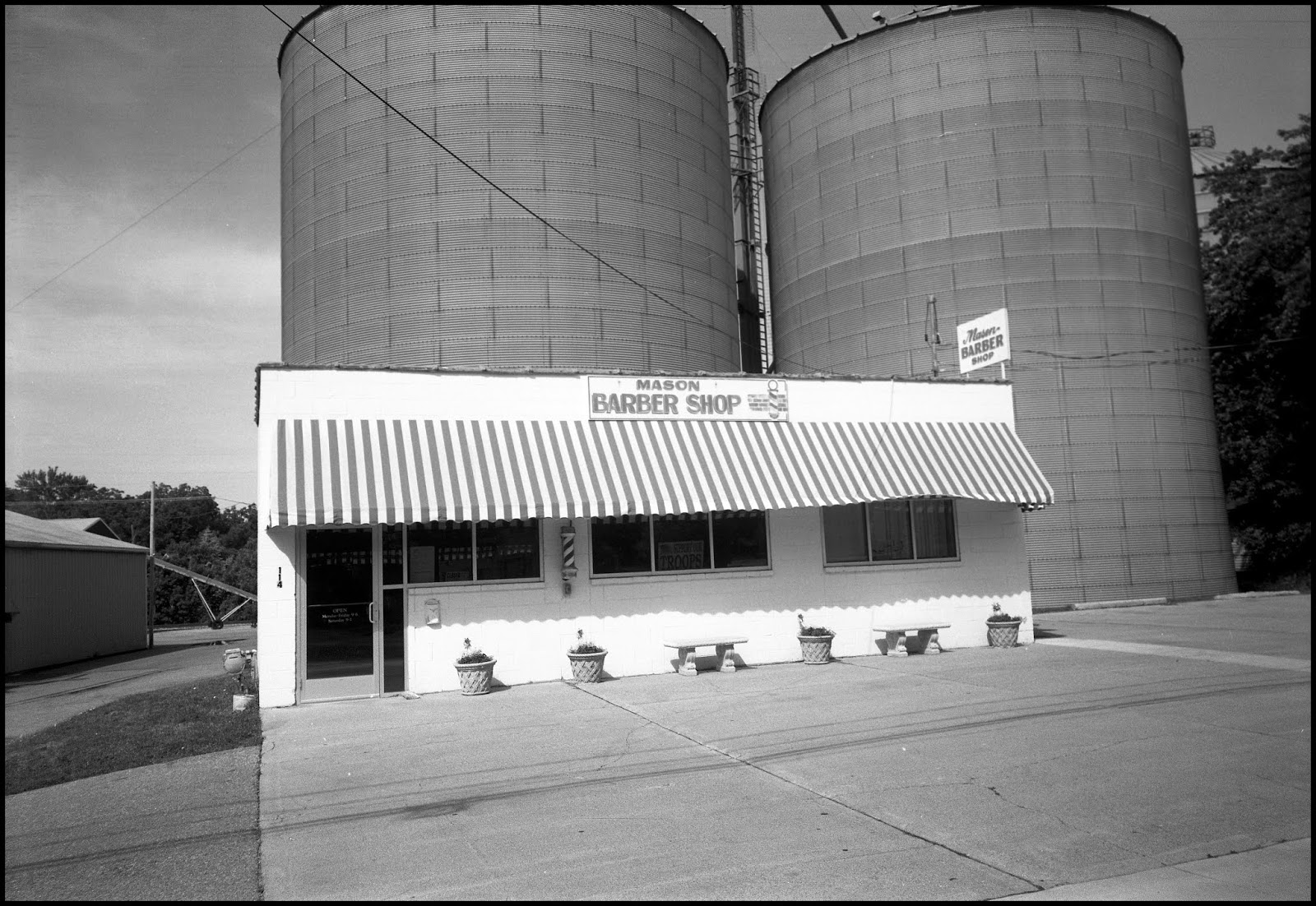
Mason, MI, Envoy Wide Angle


Another estate sale camera, I am not sure why I didn't keep this one from getting away.  It's basically an English 6x9 box camera with a flip-up sports finder, designed for wide-angle photographs. It came with Taylor-Hobson 64mm f/6.5 fixed-focus lens with rim-set shutter from B, T, 1/25-1/125s. I was testing it out, and the images were great.  Wide-angle, and so easy to use, I don't understand why I didn't snap it up!

I know that I have many more examples I could post here, but I think the above cameras are enough for now.  After handling many hundreds of cameras over the past 20 years, I think I have seen so many different cameras that there are not many I have yet to want to try out. There are certainly some "dogs" that I can tell you to avoid, but that's for a future post.  As far as cameras that I'd like to try out, the only ones that immediately come to mind are the Horizon, Widelux, Mamiya 7, and Fujifilm GL690 and GW690.

Johan, taking up the photo shoot space!


Well, what cameras do you regret selling?  What camera have you always wanted, but haven't been able to find or afford?  What cameras do you regret purchasing?  Do you have a "holy grail" camera?


Don't end up like this guy.... sell the stuff you are not using while you are alive!


Saturday, April 20, 2019

Using Vintage Cameras. Some Tips to Follow.

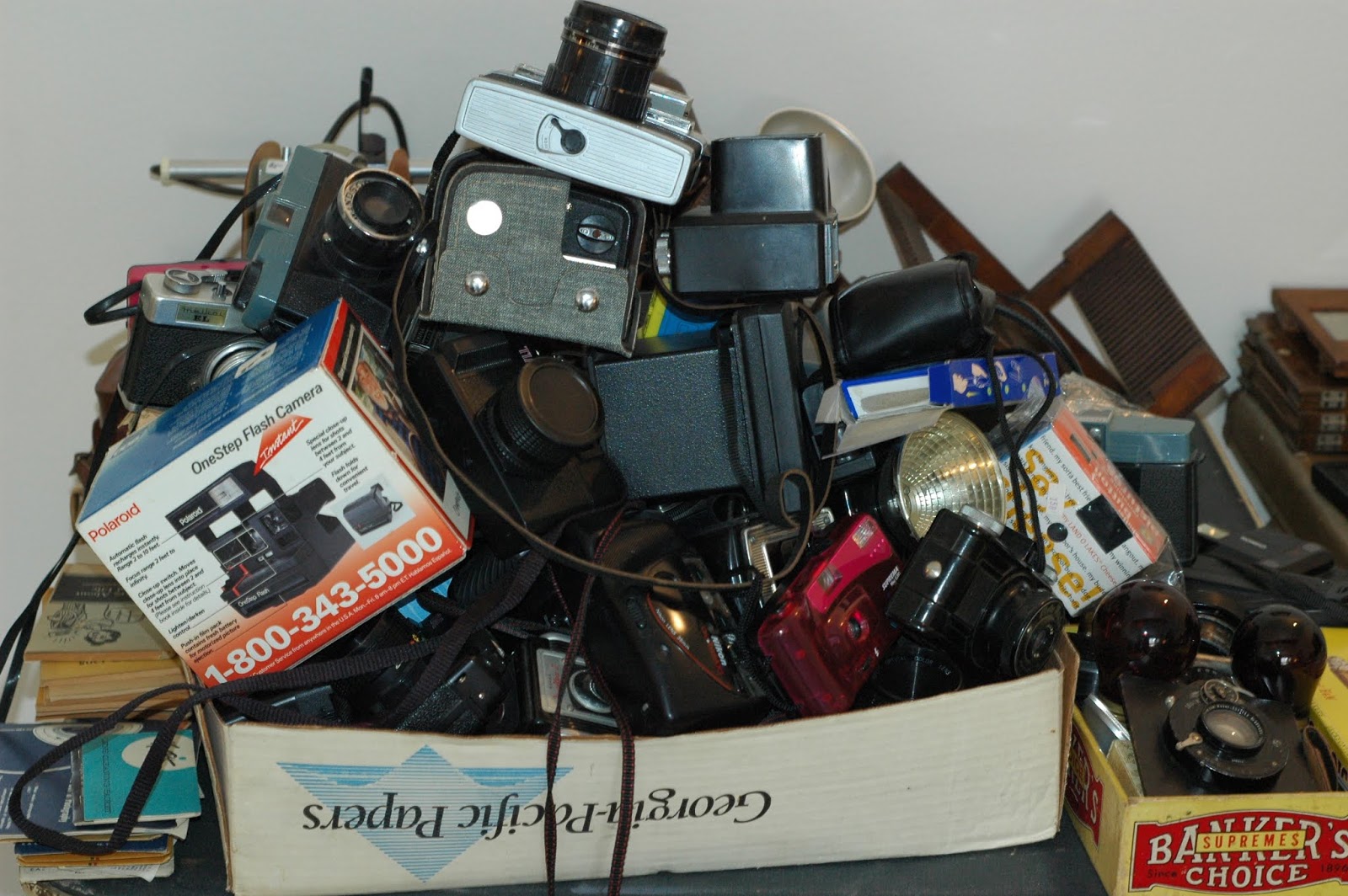
So, you have acquired a bunch of old film cameras from an estate, an attic, or some basement.  Perhaps you know their history of ownership, or perhaps you are totally clueless when and where they came from and how they were stored, and for how long.   You are curious about using them again.  Before you start, five  main factors have to be addressed when using older cameras that might have been sitting unused for a lengthy period of time.


  1. Shutters
  2. Light-tightness
  3. Batteries (if needed)
  4. Film
  5. Overall condition

The old Kodak ball-bearing shutters seem to
last forever!

1Shutters.  Shutters might be as simple as a sector shutter found on a box camera, or as complex as a focal-plane shutter on a single lens reflex camera.  Any camera that hasn't been used in a long while, especially those with between the lens leaf shutters, may need some TLC to get them working acceptably.  Sometimes all that is needed is to repeatedly fire the shutter at a moderate setting, and work the slower shutter speeds in gradually until the shutter appears to be working appropriately.  On  medium-format folding cameras, you can usually unscrew a front lens element to reach the aperture blades  and the shutter,  and a drop of lighter fluid (Ronsonol) or white naphtha will help get things moving. Remember that old rule -- DON'T FORCE ANYTHING!   Brute force will often render a camera useless.  Look for repair examples online, as many people have encountered the same problems, and there may be a step-by-step repair guide available.  Cameras that have sat unused for many years can't be expected to suddenly be fired up without some hesitation.

 SLRs with focal plane shutters are usually very reliable, but some models that have rubberized silk curtains in the shutter may have problems as they are now getting upwards of 60 years old. I have seen Exaktas with the rubberized curtains in tatters.  In contrast, the focal-plane shutters of 100-year old Graflex large-format SLRs are often just fine.  It all depends on the storage conditions and usage history of the camera. The 35mm SLRs with copal-square shutters are typically less prone to problems over time.  However, if a camera requires batteries for the shutter to function, that provides another avenue of failure. See Number 3.
Cloth focal plane shutter, Asahiflex

This is a lovely Nikon SP rangefinder...

with a hole in the shutter! Caused by leaving it in the sun with
the f/16 aperture allowing the sun to burn hole through it.


Bellows need to be checked on all folding cameras.

2. Light-tightness.  Light-tightness is important, or you'll have light leaks on your film.  Bellows cameras should be examined for pinholes.   Shine an LED light into the bellows area in a dark room and see if you can detect any pinholes. Black electrical tape can cover holes in bellows, but it's only a temporary fix. You can dab some black liquid rubber (sold for coating tool handles) or black fabric paint into the bellows material to fix small pinholes.  While I have never done a bellows replacement, there are people that make replacement bellows for old folding cameras and large format view cameras.  If you like origami, you might try to tackle it yourself, as there are online resources for DIY bellows.

Cameras with foam in the seals should be checked and the foam replaced if it has hardened or turned into a gummy mess! You can buy adhesive-backed felt or black foam at craft stores, and the thinner the material the better.  Black electrical tape can cover gaps in the back of a camera, but avoid it if possible. Black gaffer's tape is preferable, as it does not leave a sticky residue.  Light seal material for the backs of cameras can easily be made from adhesive backed black felt or thin black foam from the craft store.  Some old cameras merely need a strip of black yarn in a groove. Remove old gummy foam with lighter fluid on the end of a cotton swab and a toothpick, scraping the material away.   Make sure you cover the shutter or lens with a small piece of cardboard taped over the film gate while the back of the camera is open. You don't want residue or tools in there.


3. Batteries. Batteries are often the culprit in preventing the use of some older cameras.  Many cameras from the 60s and 70s used mercury cells, which are no longer sold.  The PX-625, for example, was used in many 35mm cameras and light meters,  and supplied a constant 1.35v.   The modern replacement is a PX-625A or LR-9.  Using modern-day cells provide 1.5 volts, which in many cameras, will give inaccurate meter readings.  PX-27 cells delivered 5.6 V, and the modern replacement is a PX-27A or 4LR43, which delivers 6v. With color print or b&w film, you can usually be “close enough” in your exposure that the voltage difference is not significant. You can use the zinc-air hearing aid batteries to use the camera meters, or, better yet, if the camera is going to be used a lot, C.R.I.S. (online) sells an adapter that allows the use of silver batteries.  Their MR-9 adapter might seem pricey, but if you buy one, you can really extend the life of these older, fine cameras.  It also pays to buy the LR-44 1.5v cells online in bulk.  There are other oddball battery types from the past that have no current alkaline or lithium equivalent.   You may have to clean battery contacts that have become oxidized or corroded.  A pencil eraser may not be enough to clean the contacts.  A swab dipped in vinegar and rubbed on the contacts will loosen the crud.  Wipe off the vinegar with another swab and clean with isopropyl alcohol.
With the X-700 and related models, a dead capacitor will incapacitate
the camera, even with new batteries.


A film haul from 2007. I wish I had saved the Minolta 16 film!

4. Film.  35mm film isn't a problem, but many old cameras use sizes no longer being manufactured - 828, 116, 620, 616, 126 etc.  You can sometimes use 120 in 620 roll-film cameras, as the films are the same size, only the spools are slightly different.  How you do it depends on the camera.  Most people re-spool 120 onto 620 spools, and some cameras allow 120 spools in the supply chamber, but 620 for the take-up spool.   120 film is easily purchased at a real camera store or online, and 620 (respooled) can be found at the Film Photography Project online store.  The FPP Store also sells the Camerahack adapters for roll-film cameras, allowing you to use 120 in a 122 film camera,  35mm in a 126 cartridge, etc.  There are no manufacturers currently making 126 film, 127 film, APS film, or Kodak Disc film.  Lomography and the FPP Store are currently selling 110 film, so there is a mini-resurgence in 110 shooting.  If you are relegated to shooting old, outdated film in your camera, remember that most films lose a stop of effective sensitivity every decade.  So, that roll of 400 ISO Kodak Max from 2009 is now rated at ISO 200. Black and white slow to moderate speed films age far better.  I have shot 40 year old Verichrome Pan in box cameras with good results.  Panatomic-X that expired in the 1980s works great now at ISO 25. However,  high-speed color films do not fare as well.

Typical Graflex RB - it may work fine, but look for one that
takes currently available film sizes!

Polaroid Cameras - at this point I will suggest to only obtain Polaroid 600-series and Time-Zero series (as in the SX-70) cameras.  Any old pre-packfilm cameras are going to be doorstops, and now that Fuji is no longer making the pack film, cameras such as the Polaroid Land 100 and up are not going to be usable. Kodak Instant cameras (not Instamatic) have been filmless for over 20 years. Polaroid Swingers are objects of curiosity, and not usable.  Cameras such as the Polaroid 80A are not usable.

5. Overall condition
. I have had hundreds of old cameras pass through my hands over the years. It's always unfortunate to see an example of some rare camera beset with grime and crud, mold, cigarette smoke, or rust.  Sometimes it may just need a good exterior cleaning.  However, a camera with lots of dents, mold, and oxidation may indicate that it not worth your time.  It might have been rescued from a lake, a flooded basement, or maybe it was carried off by a tornado.


Other potential problems are fungus growing on lenses, corroded battery contacts, mildew on the camera leather, and of course, user unfamiliarity with a camera.  Sometimes not knowing how something works will leave you feeling like it's broken, but in reality, you may just need to know more about the camera.  Mike Butkus has manuals available online and they can be a great help!  Google is also your friend when it comes to these things.  Don't be afraid to search for help that way -- you'll be surprised at how many sources of information are out there.

This Ermanox was a rare find and cleaned up well

Exterior cleaning -- I use a soft rag with isopropyl alcohol to clean the exterior.  Large cotton-tipped swabs are also useful for hard to reach spots, such as around knobs and dials.  Tape residue or other gooey substances can be removed with "Goof-Off".  An old soft toothbrush is useful for "scrubbing" the leatherette.  For mold on the camera body or on the lens, vinegar or windex can be used to clean the surface.  Old dirty Bakelite can be scrubbed with a paste of baking soda and a soft toothbrush, and rinsed off with water. For old cameras with real leather on the body or with leather cases, you can use Lexol, a leather cleaning solution easily found in the hardware store.  Rub it in with a soft cloth in an inconspicuous spot first to see how it affects the item you are cleaning.


Lastly -- sometimes a camera is just plain broken and not worth fixing, or perhaps it's no longer usable because the film isn't available.  Many old metal-bodied Polaroid cameras fall into the latter category. The classic and even not-so-classic cameras are sometimes art objects on their own, and can be used to decorate, or to create something useful from them.  I have seen Kodak Brownies with their flash units turned into night lights.  The distinctive appearance of old film cameras are something that today's look-alike digital models just don't have.