Showing posts with label Kodak Tri-X. Show all posts

Sunday, March 13, 2022

KODAK'S TRI-X SINGLE-USE CAMERA


Last year, Kodak introduced their single-use camera loaded with a roll of Tri-X film.  I was initially skeptical, but finally ordered one from the Film Photography Project Store.  Seeing that I have been working on an issue of Monochrome Mania dedicated to 35mm toy cameras, I really had to try out this camera (the issue will be available in late March from my Etsy shop).  For starters, the phrase "Kodak Professional" on the front of this little plastic camera seems laughable, but just go with it.  The camera is pre-loaded with a 27 exposure roll of Tri-X, which is a 400 ISO black and white film. There is a built-in flash, so other than the film, the camera is similar to Kodak's Fun Saver series of cameras. I mostly shot outdoors, and only used the flash as a fill-flash and not as the sole light source, so I did not evaluate the performance in a dark indoor setting.  I suppose like any of these cameras, the small flash will be good for up to 10 feet.  The angle of view is wide, as the lens is a 30mm f/10, 2-element acrylic lens.  The focus distance is 1 meter to infinity. 
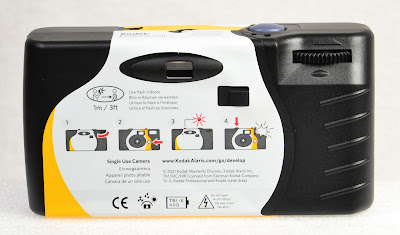


 I shot with the camera over the course of over a month, and its compactness allows it to easily fit into a shirt pocket, as well as any space in a camera bag. I should note that I taped a yellow gel over the lens when shooting on sunny days, so that I would not overexpose the image, and to achieve better tonality.  After I was finished with the roll, I opened the camera body and removed the film cassette, which other than the serrated top of the spool, looks like any other roll of Tri-X, and with the chrome cap ends. 


I developed the film in the FPP D-96 developer for 8 minutes, and did the standard fix and wash that I do for all my black and white films.  Overall, I have to say that I am pleased with the results.  Tri-X fell out of favor with me because the film base always cupped when dried.  That's a real pain in the ass when I am trying to load it into the Epson scanner  film holders, and films that lie perfectly flat are my preference.  Perhaps Kodak's made some changes, because this time, the film was almost perfectly flat.  The other factor is that the cameras are assembled in China, and maybe the film is made there, as well.  That could be a reason for the difference.

If you are new to film photography, and want to experience shooting B&W, this is a good way to try it out.  I have seen prices in the $11-$14 range, so the camera is pretty cheap.  On the other hand, Ilford has a single-use B&W camera loaded with Ilford HP5+.  I've not tried the camera, but HP5+ is the film that I prefer over Kodak Tri-X.  The price for the Ilford alternative is in the same price range.   In addition, Harman sells a single-use camera loaded with Ilford XP-2, a C-41 film (that can also be developed in b&w chemistry).  Lomography also sells a simple-use camera loaded with 400 ISO Lady Grey film. If you just want a simple camera loaded with B&W film, you could get a Harman 35 reloadable which comes with 2 rolls of Kentmere 400 for about $30.  

Three other choices for a simple to use camera with B&W film: Ilford B&W, Harman B&W, and Lomography Monochrome

The Harman camera w/2 rolls of Kentmere 400 is a good value.

You CAN reload the Kodak camera with another roll of film, and if if you are careful opening the camera body, you'll quickly see how that would work.  It would probably be best to use a 24-exposure roll as the counter starts at 27.  I'll give it a try later on and see if it works with a normal cassette, or if I have to use the one with a serrated end to the film spool (like the one that was in the camera).  The wider view of the Kodak camera certainly is a plus, and I felt that the lens was plenty sharp enough. 

Of course, if you don't develop film yourself, The Darkroom Lab can develop it and you can get scans and prints from that roll of Tri-X.  

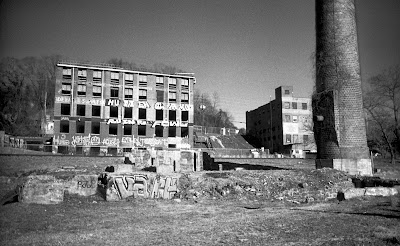
Here are some examples from the roll of Tri-X, and I am quite happy with them.


Friday, August 24, 2018

A Quick Review of the Olympus 35 LC Camera

If you ask film users about Olympus 35mm rangefinder cameras, there is no doubt that you'll hear about the popular Olympus 35 RC, the Olympus XA, and probably the Olympus 35 SP. It's unlikely that you'll hear a peep about the Olympus 35 LC.  While the 35 LC was produced from 1967 to perhaps 1970, it just does not seem to be as commonly seen as the subsequent Olympus rangefinder cameras.
Last year, I happened to come across an Olympus rangefinder camera that I had never seen before.  The Olympus 35 LC is an interesting 35mm rangefinder with a CdS light meter.  It's not auto-anything, and is somewhat on the large size, compared to the later Olympus 35 RC.  The 35 LC features a 42mm f/1.7 Zuiko lens, shutter speeds from 1 sec to 1/500 sec + B, an ISO range of 10 to 800, and an easily focused lens with a lever on the lens barrel.  This is a nice all-metal camera, with a very quiet shutter.  There is both a PC socket and a hot shoe for the flash.  The meter needle shows both in the viewfinder and in a window on the top deck of the camera.  The meter requires a mercury cell for 1.3 V, but I used a 1.5V silver-oxide cell, as that will be close-enough for b&w and C-41 films.    The bright-frame viewfinder is large and has parallax correction.  The RF focus patch is easy to see, making the camera a joy to focus.  No squinting into a tiny window with this camera.    Since the CdS meter window is inside the lens ring, you can use filters and the camera will meter through them for proper exposures.

The Olympus 35 LC stands out as being larger than the compact 35 RC.  Released in 1967, it predates the smaller SP and RC rangefinders by 2-3 years.  The 35LC dimensions are  138 mm W x 81 mm H x 70 mm D. Compare that to the 35 RC, which is 110 mm W x 70mm H x 50mm D.  While it's a larger camera, it feels right in the hands, much like a Konica Auto S2. 


The Olympus 35 LC features:


  • Lens: G.Zuiko 42mm f1.7, 7 elements in 5 groups, 55mm filter ring
  • Apertures: f/1.7 - f/16
  • Shutter: Copal-X, speeds B, 1-1/500 sec.
  • Meter: CdS cell, inside the filter thread
  • Viewfinder: Bright frame viewfinder with parallax correction.
  • Film speed: ASA 10 to 800.
  • Self timer: on lens barrel
  • Tripod socket centered 
  • Flash- PC  socket on left side, standard hot shoe, x-sync only
  • Power: 1.3v mercury for meter - I used a 1.5 V cell with good results.
  • Weight: 660 grams.


The meter is actuated by a button on the top right of the rear of the camera body. You can use the top-mounted display to see where your settings are centering the needle (or not), or you can use the display that appears in the viewfinder.  There is no auto setting. 

The camera has a fast 42mm f/1.7 lens.  The 42mm focal length makes it just slightly wider than the standard 50mm that we consider "normal."  By comparison, the Olympus 35 RC has a maximum aperture of f/2.8 with its 42mm lens, which makes it more compact, but definitely not as capable.  The shutter speed range on the 35 LC is B, and 1- 1/500 sec, with all of the standard intervals.  You can use any 55mm screw-on filter, and the CdS cell will give you an accurate reading through the filter. Of course, with a polarizer, you won't be able to see the maximum effect like you would in an SLR.

I find the camera to be pleasant to use. The focus ring has a lever to grip, and the focus range is just under 3 feet to infinity.  The outer ring on the lens barrel comtrols shutter speed, and the inner ring controls aperture. Each has a different feel, making the operation easier without looking.  The shutter is very quiet, and the film advance is a single stroke.  It's not as light as my Olympus Trip 35, but then again, this is a far more capable camera, not a point and shoot.  I love the logo on the front -- rather old-school, and it looks like a quality camera.   I see the 35 LC on eBay for around $100 for good examples.  As a quality camera, this is a steal.

As always, the proof is in the results. 

Marquette, MI, Tri-X

Ann Arbor, MI. Tri-X

Collingwood, Ontario, Polypan-F

Collingwood, Ontario, Polypan-F

Collingwood, Ontario, Polypan-F

Ann Arbor, MI, Polypan-F

Collingwood, Ontario, Polypan-F