
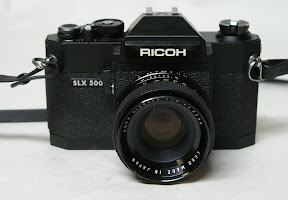
The M-42 mount gives one the opportunity to use a slew of various old lenses from Pentax, Cosina, Ricoh, Fuji, Meyer-Optik, Carl-Zeiss Jena, and others. The shutter speed choices are limited to B, 1/30, 1/60, 1/125, 1/250, 1/500 sec. , which isn't bad, as compared to something like an Argus C-4. From what I could find out, the original cost in 1976 was about $250 with the standard lens.
The SLX-500 doesn't seem to have had the production run of cameras like the Singlex and Singlex II -both of which I owned at one time, nor does it have as meany features. It appeared at about the time the M-42 mount was being phased out in favor of the K-mount, and within a few years, a plethora of 35mm SLRs at competitive prices would be flooding the market. However, it IS a basic SLR, and despite the limited range of shutter speeds, it should be adequate for a lot of photography. I loaded mine with the old standby - Kodak Gold 100, and sunny-16 for exposure guide. For most of the shots I used the Rikenon 50mm 2.0 lens.


Like a lot of cameras from the 1970s, it's well-built, can be used as a weapon, and a battery is needed only for the meter.


4 comments:
Nice. It has a no-nonsense industrial look about it. It almost says, "I don't care if you don't like it that I'm taking your picture."
Nice camera.. Could you post more photos? Im using digital camera but maybe I'll change my stuff.
i have got one this week, the mirror blocked high position.i just banged it on a chair to deblock it.
works perfect now.
I found one of these cameras in the back of a cupboard in my art classroom. I couldn't believe no one had even known about it until I shown it to them.
Post a Comment