Showing posts with label Nikon F4. Show all posts

Thursday, March 10, 2022

YETI ANOTHER ADVENTURE IN FILM


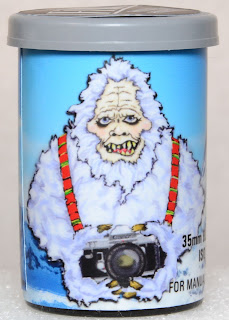
Now available in the Film Photography Project Store, YETI  is the latest in their "monster" film series. What is the story behind the YETI?  I really don't know, but I think because the film is a glacially slow ISO 6, the YETI is the perfect "monster" to be the face on the film container.  It could also be based on Mike Raso's expression as he sits in the FPP HQ during the cold winter months.  However YETI arose, it's an interesting SLOW black and white film that is blue-sensitive (orthochromatic). The intended use for this film stock is in the cine world, where it was used for contact copying of titles and mats in motion pictures.  It has a very fine grain, and nice tonality, and since it's blue-sensitive, it makes for an interesting film for portraiture.   It should be shot in daylight for best results.

YETI comes in 24-exposure rolls, which is probably best for these unusual films. It has a PET  (Estar) plastic base, so it light-pipes like crazy.  Store it in black plastic film cans and load in subdued light.  My experience with it has shown me that loading in direct sunlight is a real no-no.  So, load the film into your camera indoors, if possible.  Since it has an ISO of 6, you can only use this film in an SLR or a rangefinder camera where you can manually set the shutter speed/aperture/ISO.  Automatic cameras, such as point and shoots cannot be used with these low-ISO films.  If your camera can't go down to ISO 6, there are several ways to determine the correct exposure.  If your camera's ISO dial only goes to 25, and you have an exposure compensation dial, set it to +2 stops.  If there is no compensation dial, you'll have to manually compensate in the exposure.  You can use a light-meter app on your phone to determine the exposure if you want to go full manual.  You can also try sunny-16 if you wish, as follows:

full sun at f/16, ISO 6 = 1/6 sec , therefore f/11= 1/12 sec (1/15); f/8= 1/25, f/5.6= 1/50, f/4= 1/100 sec f/2.8= 1/200 sec., f/1.4 = 1/500 sec.

That's for full sun.  Make the appropriate changes for cloudy conditions, etc. So, on a sunny or cloudy-bright day, you can shoot this film hand-held at wide apertures.  On any other conditions, a tripod is recommended.  

My favorite camera with these slow films is my F100 or my F4, since ISO 6 is available as a setting. That's because I'm lazy and don't like to extrapolate in my head with cameras that can't go that low, and since I like aperture-priority, it all works smoothly with  my chosen cameras.   I used my Nikon F3HP for the first roll, and as the ISO setting only goes to 12, I used +1 to +1.5 for the shots (compensating more when the subject was bright water). An external light-meter that can go to ISO 6 is not that common, but my iPhone light meter app goes to ISO 1.  Shooting films like YETI wide open on a sunny day gives you some creative possibilities that you just won't get with normal films.

Orthochromatic films are also a different experience to shoot with, vs panchromatic films.  A blue-sensitive film means that reds will register as dark tones, so skin will be darker, and blue skies very light.  Again, slow and orthochromatic will be somewhat like shooting film in the late 1800s. A definite creative opportunity!

YETI is one of the films that you really ought to try out. It develops easily in common developers, and unlike some high-contrast slow films, it has a normal tonality that does not require the use of special developers to achieve proper contrast.  

I shot YETI film in situations that I might normally encounter, and I'm pretty happy with how they turned out.  I definitely will be shooting some urban scenes with it soon, now that spring has arrived and I'm exploring more in my area.

I developed my YETI in D76 1:1 for 11 minutes for the first roll (images 1-3 below) and the second roll in D-96 for 7.5 minutes at 20°C for the last three images.

Some examples from the two rolls that I shot.


Saturday, May 22, 2021

The Nikon F4 - Still An Amazing SLR

Nikon F4 with a lovely 50mm f/1.4 manual lens


I recently came into possession of a Nikon F4 that is in excellent condition.  I really hadn't thought about all the features that it has, since the last time I shot with one was well over 15 years ago.  The local Ann Arbor camera store, Big Georges (which stopped selling photographic stuff in 2008) had a used one for sale that I purchased to do some freelance work.  It ended up having a problem that reinforced my "always have a backup" plan. I was shooting an event and realized that the film was being advanced through to the end of the roll while never firing an exposure!  Luckily, my backup was the consumer-level Nikon N60, and I was able to get all the shots that I needed.  But, for a few moments, I was in a panic. I ended up selling that F4 with its problems noted, and never bought another one.  So, a few months ago, one sort of landed in my lap, and I started shooting with it.  Comparing it to an F2 or F3 is a little unfair, as the technology in the F4 is far more advanced than its predecessors. It's certainly a lot heavier and beefier. But, with its grip on the right side, it feels right in the hands.  The large, bright 100% viewfinder is truly great, and having the hot shoe on the prism like most cameras, is a far better solution than the F, F2, and F3 location.  

The Nikon F4 was produced from 1988-1997.  It was an innovative breakthrough for Nikon, parting ways with the older manual-focus F cameras, yet retaining use of any lens, including non-AI. It works with all modern Nikon AF lenses, including G lenses (but not in A and M modes).  If you prefer knobs and buttons over LCD menus, this is the camera for you.  In fact, every feature on the F4 is readily identifiable and does not have to dealt with via a menu. Shutter speeds are from 30 sec to 1/8000 sec, plus B and T, and ISO settings from 6 to 6400. The information in the viewfinder is easily seen, and of course, you can manually set the lens aperture in A and M modes.  It's a perfect SLR to use with manual lenses, as you see focus confirmation in the viewfinder. In fact, while I often use the F4 with AF lenses, I love using it with a manual AI-modified 50mm f/1.4 Nikkor-S lens from the late 1960s. 

Everything is easily found, and no menus or LCD screens


 Everything is so clear and bright in the viewfinder that it's a real treat to use this camera.  The Nikon N90, while lighter, has many of the features of the F4, but it does contain an LCD screen and has mode buttons, and a primitive menu system.  None of that's in the F4.  I have used N90s quite a bit, and while excellent SLRs, they are not as rugged as the F4.  All the controls are where they should be (at least to a Nikon user) and are non-ambiguous.  Flash sync is at 1/250 sec., and the incredible array of Nikon Speedlights gives you so much more control over your flash photography than the F2 or F3.  Matrix-balanced fill flash, center-weighted fill-flash, rear-curtain sync, standard TTL flash, and multiple flashes are all options.   I'm not going to list all of the features of this camera, as they are easily findable on the Internet.  However, one feature that might escape notice is where the cable release connects to the camera.  - It's on the lower left rear, below the film door.  It actually makes a great deal of sense having it there, rather than part of the shutter release on top right, where it's usually found on most cameras. One other feature that I appreciate -- it uses 4 AA cells, not some expensive battery. Since it doesn't have an LCD screen, those AAs last quite a while.

The F4 with a great travel lens - the 24-120 AF-D.

This second go-round with the F4 has been most enjoyable, and the more I use it, the more I appreciate just how rock solid the camera is.  It was Nikon's flagship professional camera for almost a decade, and it was totally a major leap forward in pro camera technology compared to the electronic F3.  Don't get me wrong -- I think the F3HP is one of the greatest SLRS made, but the F4 certainly is a camera that sits well with the manual and the AF worlds, and is still an awesome SLR.  It's not a lightweight camera - with the 50mm f/1.4 and neck strap, it weighs 3.5 pounds.  Put on the 35-70 f/2.8 AFD lens, and that will be 4 lb 4 oz around your neck.  I carry mine over my shoulder.  One might be tempted to think that if the F4 is good, the F5 and F6 are better.  Using those two cameras is not much different than using a DSLR, and if you have used an F100, you would immediately know the controls on a D300. So, user-interface-wise, the F4 stands out amongst any pro-level AF 35mm SLR.

So, is the Nikon F4 right for you? Only you can answer that. Find one and shoot with it for a while, and you'll quickly see how great a camera it is.

Want to know more about the Nikon F4? Here are some links that will provide more information and inspiration.

35-70 f/2.8 AF-D, Ultrafine extreme 100,  March, 2021

35-70 f/2.8 AF-D, Ultrafine Extreme 100, March, 2021


35-70 f/2.8 AF-D, Ultrafine Extreme 100,  March, 2021


35-70 f/2.8 AF-D, Ultrafine Extreme 100, March, 2021