Saturday, November 30, 2013

Busy in the Waning Days of November

For some reason, I have not posted anything in a month on this blog.  I blame it on the time of year.  It's not that I haven't been shooting, because I sure have.  I have some posts in progress, but I haven't developed the film yet, or I have the film scanned, but haven't written the article.  However, I think my biggest excuse is that I have been busy getting work ready for two exhibits, as well as finishing some printing and, matting, and framing for some sold pieces and for gifts.  I don't know about others, but getting ready for a show is for me, an emotionally draining experience.  I do all my matting and framing, and while not exactly rocket science, it does require care and planning and proper technique for a good result.  One show I am in (which I will post details on at the end) has six other photographers, and I have 7 images in that show, which is appropriately called "Seven Views."   My color prints are done by MPix, which are the largest prints so far that I have done for an exhibit - 12 x 12 and 12 x 18 inches. All frames are 18 x 24 inches.  My dry mount tissue is 11 x 14" so I had to carefully use two pieces under each image.  I have hundreds of sheets of 16x20 dry mount tissue, but it is not for RC color prints.  I ordered 7 18x24 frames from Dick Blick, which arrived quickly in perfect condition, and in fact, it was several weeks after I first received them that I used them.  They came 3/box and one single frame done separately.  That single frame turned out to not be 18x24, but 20x24!  A good thing I had something hanging in the house in the same frame style and in 18x24.  Of course, this was all less than a week before the show opened.   I also had to buy more mat board from Dick Blick.  I have to say, that it was well-packed, and I am really impressed by the care the company takes to make sure the customer is satisfied. The second exhibit, in which I have two pieces, was a lot simpler, except that my frame size was 14 x 18, so I had to get some glass cut for the frames.  Why 14x18" ? Well, with a 3" mat border for an 8x12" print (I am one of those people that fill the frame to the edge), that makes 14x18", if you want a uniform border.  This also means that most pre-made frames are out, as most of those are 16x20 - which is an awful lot of white space for an 8x12 print. Trust me on this, I have done a lot of those.
one down... six to go.
What about the exhibits?  The Seven Views opening was wonderful.  Raymond James and Associates is an investment firm in Ann Arbor that sponsors a rotating artists' series, and the show is on the walls inside their building.  Mike Myers coordinated our show and herded the cats, and it all came together Friday, 11/22. At least 130 people attended the opening of the show, and our hosts put on a great feed with catering from Jefferson Market.    Lots of great comments and interest in my work, and in the work by the 6 other photographers.  I didn't sell anything the first night, but it is up until the end of February, so hope springs eternal.  There were 5 sales that first night, though, which I think is pretty good.
7 views show setup
DSC_3301
The second exhibit is a little different - 50 Shades of Green at the Matthaei Botanical Gardens, which opened just before Thanksgiving.  I have two photographs in the hanging art part of the exhibit, which of course features displays in the Conservatory, which has green growing things -- something to enjoy this time of year!
Green 1 and Green 2.

I have a pet peeve about shows featuring natural history subjects, and get ready for a short rant.  If you, the photographer (painter, etc) put a name on a description of the animal or plant (or other object) in your work. Make sure it is correct.  Calling  Switch Grass a Bluestem may not seem like a big deal, but it's no different than calling a vulture an eagle, or a butterfly a moth, etc.  Your audience is by large, going to be more discerning of such things than a more general population at a different venue. If you identify a subject wrong, it takes away from the photograph, as some people will think that you don't know your natural history, and in a venue that attracts a lot of folks knowledgeable about plants and animals, you are going to look bad.  If you are not sure about an ID, there are lots of online resources as well as books.  You can always ask someone more knowledgeable than yourself to check it.  If you want to waffle a bit, then title your work without identifying the life form. End of Rant.

The Seven Views can be seen at Raymond James, 350 S. Main Street, Ann Arbor, MI. Hours are 8:30 am - 5 pm, M-F.  It will be up until Feb. 27, 2014.

50 Shades of Green is located at Matthaei Botanical Gardens, 1800 N. Dixboro Road, and is up until Jan 5, 2014.  The hours are 10 - 4:30 daily. 


Monday, October 28, 2013

Another Roll From the Rollei (35TE)

Back in July, I posted a story about using my Rollei 35TE for the first time in a long while. The compact design and solid feel of this camera has made it a joy to use.  It is quirky, for sure. but once one gets  used to the controls, it's a no-brainer to use. Back in August/September, I put in a roll of the Kodak Hawkeye Surveillance Film -a  C-41 color film that looks like a 400 ISO Ektar.  I took a few shots around town, and even used the flash once at a meeting of the Ann Arbor Area Crappy Camera Club.  All the exposures came out great.  That film is really something, and worth trying out.  You can get individual rolls from the Film Photography project store.
T Paul at the A3C3 meeting, back in September.  The hotshoe is on the bottom of the camera, so you need to hold it upside down for a more appropriate flash position. I doubt that many ever used a flash with this camera.


Hand-made


State Street


morning in the UM League courtyard.

Marcy Merrill, the queen of Junk Store Cameras, in Ypsilanti, September.

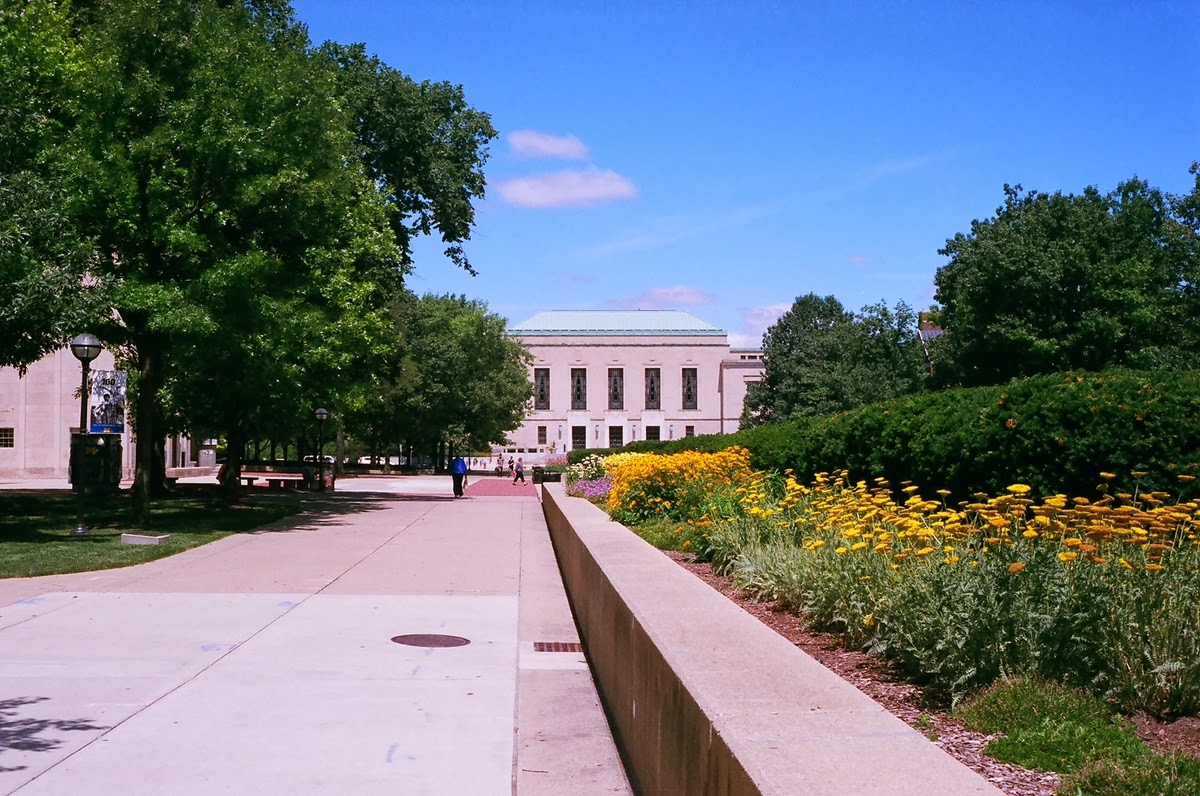
Looking towards the Ruthven Museums Bldg.

Ingalls Mall

You can see that the Color Hawkeye film is excellent.  I did not adjust the scans from the processor. The excellent lens  on the Rollei and the  latitude of the Color Surveillance Film  really made these images pop.


Thursday, October 17, 2013

Finding Your Photographic Voice

Back in 1999, when I started to really get back into photography, I was quite intent on doing macro-photography.  I read a lot of books and manuals and found the books written by John Shaw to be very helpful.  I fell into a trap though.  You see, I confused technique with style and with the "eye" that one develops with experience.  I wanted to shoot photos like John Shaw.  Yes, I got very good at doing macro and nature closeups, but I was essentially trying to produce images like those of Shaw.    I eventually got over that and started reading more about general photography, the history of the medium, and so on.   Being very good at something technically does not equal artistic success or photographs with emotion.
wrenching 1
I see people ask questions like "how do I get the look that (insert name here) gets with his images"? Or "Does anyone know how this photographer achieved this look?"   Of course, those are valid questions about techniques and materials (supposing that was on film), but usually the posers of the question want to shoot images just like the ones they are seeing. They are confusing technique with ability; methods with seeing. My usual response to such questions is to tell the person to (a) ask the photographer, and (b) read as many photographic books as you can, go to galleries, and shoot, shoot, shoot, and shoot, some more.
wooded path
I understand why anyone would want to emulate something that they like.  However, the thing a photographer should be doing is asking herself (or himself) why is she doing this?  Why do you photograph anything?  There are more answers to that question than I have patience for on the keyboard, but a glib one would be "because painting takes too damn long."  It has taken me many years to figure out that I have a style, or voice, if you will.  I have my standard-bearers -- Walker Evans, Edward Weston, David Plowden, Paul Caponigro, Stephen Shore, and others -- photographers whose work I admire and appreciate greatly.  I don't ask "how did they get that shot? or what film they were using.  That is unimportant to me -- what matters is -- what were they trying to say, and what effect does that image have, what message does it convey?  This may be the hardest concept to grasp for a beginner.  One may as well ask what paper Mozart wrote his operas on.  What inspired Mozart (who was a musical genius) to write them, and what did they mean to him?  What effect does the music have on you?  Did it affect others the same way at the time he wrote it?  While viewing a photograph, what does it mean to you?  What did it mean to the photographer? Are there elements to it that when scrutinized, give the image more meaning?  What do you see?
Monstera
I was reminded about how people look at images last night while watching the movie Smoke.  Harvey Kietel's character (Auggie) has been photographing the same street corner in New York at the same time every day, and has hundreds of images in albums.  William Hurt's character (Paul Benjamin) is flipping through the pages and tells  Auggie that they are all the same. Auggie tells him that he's not really looking. Every one is different, just the location is the same.  Finally, Paul finds an image on the corner with his deceased wife in the frame, and breaks down.  It was a great scene, and I think shows part of what photography is about.  Auggie shoots the way he does because it means something to him.  Because the street corner  is shot the same way, same time, every day, there is an absolute honesty to the images.  The only thing that changes is whatever happens to be passing by, the weather, and the light.   Each image has its own story, if we look and actually see what is there.
dismal prospect
So, back to the beginning of this lengthy post.  How do you develop your own voice, your own vision?  It takes time, and it may change over the years.  We are all influenced by our mentors, favorite photographers, the media, our choice of materials, etc.  Shoot every day, or at least try to.  Find out what subjects or situations attract you the most.  Experiment with different techniques and lenses.  Maybe you  will find that a pinhole camera is what you were destined to work with. Maybe not. Try it, anyway. Read. Go out and shoot with a goal in mind.  Go to photo exhibits at museums and be inspired.  Pick up a copy of Lenswork magazine and be inspired.  Don't confuse gear and technique with the final image.  Some of the best images have been taken with fairly simple equipment.  It was a matter of the photographer seeing the image.  If you are using a digital camera, it costs nothing to shoot. However, it will take time to go through the images, so think about what you are doing...slow down.
Wild Carrot
Lastly, I want to plug a book that I found to be very interesting.  It's perhaps the shortest book on photography that I have read, and it took me a while to read it and digest it in small chunks.  Why Photography Matters by Jerry L. Thompson, 2013, MIT Press.  92 pages that are worthy of attention.
Yes it does.
Other books that deserve mention:
Ways of Seeing by John Berger
Tao of Photography - Seeing Beyond Seeing by Philippe L. Gross and S.I. Shapiro
Monochrome In My Pocket by Mark O'Brien (just to show it's NOT the camera).


Wednesday, October 09, 2013

Building A Nation...Again.

If you appreciate the work of Lewis Hine, you may want to buy this sheet of stamps from the US Postal Service.  While these images celebrate the people and the machinery that helped build America, it should not be forgotten that Lewis Hine exposed the system that treated workers and especially immigrant workers, as commodities, not human beings. From the tenements in New York City to the coalmines of Pennsylvania, and the fabric mills in the South, people were left with no social net, no healthcare, no schools, low pay, child labor, and more.  Hine helped raise awareness of the plight of those people through the use of his camera.
It should not be underestimated how bad conditions were at that time.  Striking mine workers and their families were shot by National Guardsmen in Colorado (by order of the Governor) in the late 1800s.  People in New York tenements were dying of diseases caused by overcrowding and lack of sanitation. Girls were working 14 hour days with a few minutes off for a meal.  Ultimately, public opinion was swayed by popular articles and photography, as well as by marches and strikes for better pay and a decent workweek.  The good old days were only good if you had money and social status.
The job isn't finished yet, as GOP Congressmen and certain right-wing groups demonize unions, demonize the poor, deny a living wage, healthcare and more, while the ultra rich get ever more rewards.  This is not too different from what happened a  hundred years ago.  We should learn from history, and yet we don't.  

Thursday, September 05, 2013

Polaroid Joy

Last weekend, Adrienne and I made a trip back to Amenia, NY to visit her family, and to photograph the family cottage on Twin Lakes, CT which was about to be sold.  I brought my Nikon D90, Nikon F3HP, Hasselblad 500C, Nikon 1J1, and my Polaroid 250.  While I spent a lot of time documenting the cottage with my D90, I used the Polaroid quite a bit with the people.  Now, in case you have forgotten, the Polaroid 250 Land Camera is a bellows camera with a nice rangefinder focus, and takes the traditional Polaroid pack film for 3 1/4" x 4 1/4" prints.  Wait! Didn't Polaroid stop selling film? Yes.  But Fuji makes color and black and white pack film for these cameras.  It's Fuji FP100C and FP3000B films that work with the old Polaroid pack film cameras.

As soon as I pulled out the 250, I got all kinds of comments, from "Is that an old Polaroid?"; "That camera must be really old!"; "I used to have one of those."; to "Can you still get film?"  Even better though, was the immediacy of the results and people's appreciation on seeing something they could physically handle.  To me, that is one of the great things about Polaroid images.  They are nearly immediate, and TANGIBLE.  Not some file sitting on a smart phone that's hard to show off, not a file on a hard drive, but a thing - an object - which obviously has substance and value, and can sit on the shelf or on the fridge, or in an album, as a reminder of an event, a person's love, or a place.  There is only that ONE image, and you have it.  (Well, of course, they can now be scanned in, etc., but not if I gave one away.)  I shot 3 packs of the color film, and gave some of the prints to people, and kept the rest to share electronically.   The people that received prints were so appreciative.  That's one of the underestimated things about photography.  The power to capture a moment is one thing, but to hold that moment in your hand as a 2D representation, unchanging, independent of any other device, is one of the reasons photography became so popular. Especially since a drawing takes way too long.
It used to be that people shot Polaroids all the time, and they were a regular part of parties, gatherings, etc.  Today, everyone uses their cell phones.  Oh, you can go to the Internet to see the photos, etc., but having a print of your very own is a more precious thing.
I like the palette of the Fuji color pack film.  It's colorful, and self-limiting -- you don't have to worry about leaving the positive/negative together for too long.  I hope Fuji keeps producing it for quite a while, as this 250 still has a lot of life left in it.

A few examples from the weekend:
 Nick and his dad, Bill, looking over at a Polaroid I had taken of the two of them just minutes before.  Bill carefully took it back to his truck so as not to lose it .
 Blue doors at an old building in Millerton, NY.
 The Murphy clan - all the children of Charlotte (87) and Jim (deceased) Murphy.
Top row - Brian, Andy, Charlotte (my mother-in-law)
Middle - Cathleen, Adrienne (my wife), Elizabeth
Bottom: Bob, Larry.
 Larry and Bob share a story.
 The Amenia Library.  Amenia is in Dutchess County, NY - a largely rural and hilly part of the state.  It took a while to get used to driving there, compared to the flatness of Michigan.
Amenia Burial Ground - a cemetery that is populated by graves from the late 1700s to mid 1800s.
Anastasia, caught in the gravity well of a hammock. Her mom really appreciated a Polaroid.