Showing posts with label Lake Michigan. Show all posts

Tuesday, October 17, 2023

Kodak 2238 and a Rollei 35 TE


I first reviewed Kodak 2238 in 2017, and shot it under winter conditions, where the contrast was already quite high.  Also known as Kodak Panchromatic Separation Film for use in the cine world, it’s a low ISO film that’s rated at 12-25 ISO, and does not require a special low-contrast developer to get a proper negative.  That’s what I like about it, since D-76 and D-96 are my favorite developers.  But the other thing I like about 2238 is it’s ultra-fine grain - nearly grainless, and the way it renders landscape scenes.  I loaded a roll into my Rollei 35 TE, which I’ve owned for well over 20 years.  The Tessar lens in that Rollei 35TE is sharp as can be, perfectly suited for a high-definition film like 2238.

Since 2238 is shot at ISO 25, I limited use to daylight photographs, as my Rollei 35 TE shutter no longer operates at speeds below 1/15 sec.  That’s due to the way these cameras are typically stored - with the shutter cocked and the lens retracted into the body.  Long-term storage like that causes the loss of the slow shutter speeds.  

I shot most of the roll of 2238 on a trip to Ludington State Park, Michigan, in mid-September.  It’s a great little camera to keep in my camera shoulder bag, as it takes up very little space, and I have always had great results from it.  While it does need a battery for the meter, I rarely use the meter, and just go with an external meter of sunny-16 estimates.    

Ludington State Park is on the Lake Michigan shoreline about half-way up the west coast of Michigan’s Lower Peninsula. There are lots of sand dunes, inter-dunal ponds and wetlands, as well as Big Sable Point light house at the northern end of the park.  So, it has great lakeshore access as well as a nice road/trail that runs N to the lighthouse.  I mostly shot that day with my Nikon F3HP, but the trusty little Rollei 35 came out towards the end of my day of shooting. 

The film was developed in FPP D-96 for 12 minutes, and the results were what I expected.  It turns out that the roll of 2238 had been loaded nearly a year prior, when I was in Lexington, VA.  That’s what happens when there’s a small camera in my bag — it sometimes can take a year to shoot with it.  Here are a few shots from that roll, all scanned on my Epson V700.


my favorite of the series


I encourage you to try some of these oddball films like Kodak 2238.  They are not what I’d call general-use films, since they are very slow.  But, for detail-rich landscapes, architecture, and a different take on portraiture, they can yield great results depending on the lens and the lighting.  Another good choice for slow films is Rollei RPX 25, which is readily available and can be easily developed.  

Saturday, September 23, 2023

One Roll Review - Svema MZ3

image courtesy of the Film Photography Project

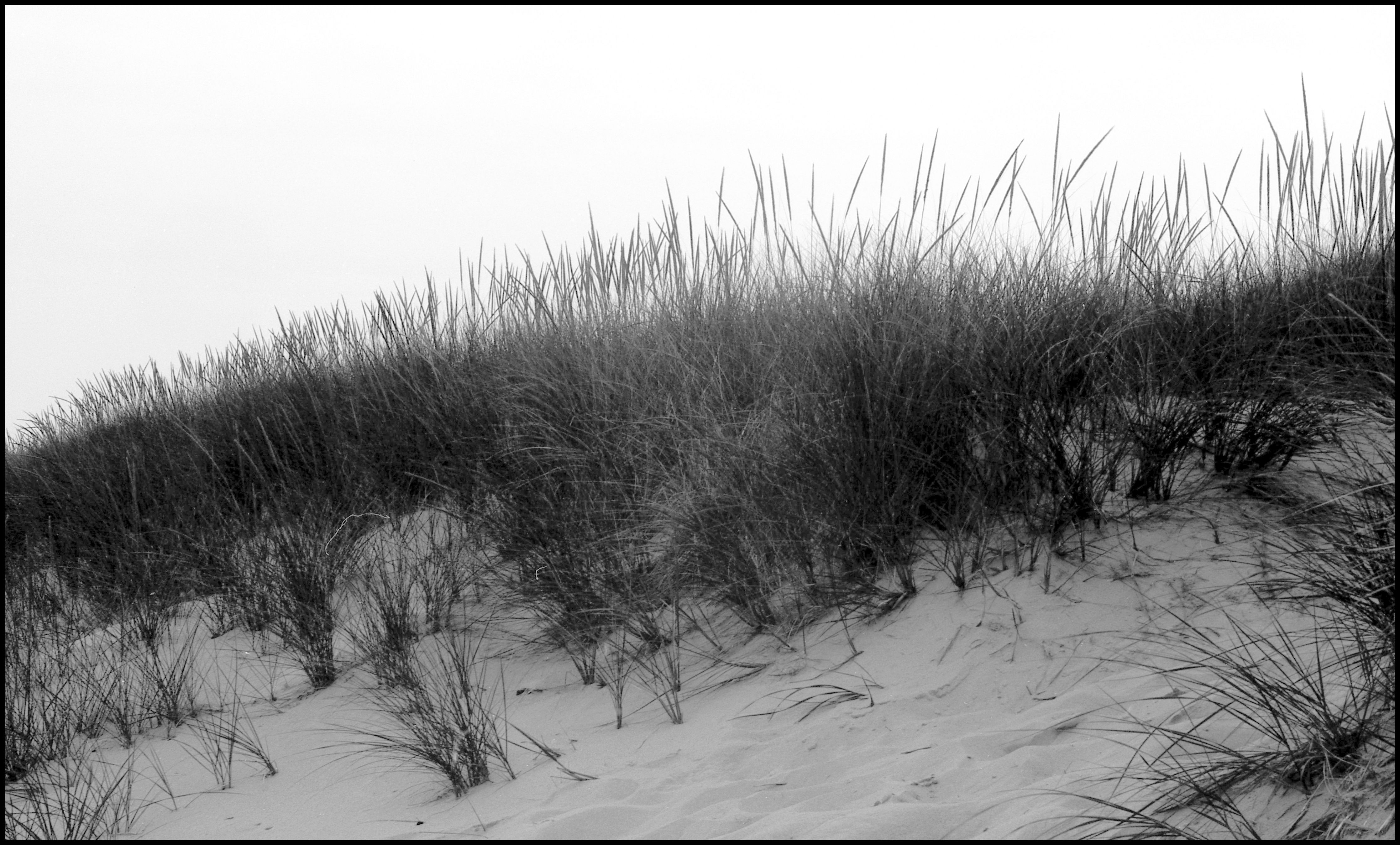
It’s been a few years since I have shot with this film that’s available from the Film Photography Project store. I kept putting off shooting with it until I had a little project.  I decided to put a roll in my camera bag for my trip up to Ludington, MI last week. I knew that I’d have the opportunity to photograph in the dunes near Lake Michigan, so what better use for this ultra-low ISO film?

What is MZ3?

Like several other film stocks available from the FPP store, Svema is the manufacturer of MZ3. It’s an extremely fine-grained blue-sensitive (orthochromatic) film with an ISO of 3. It lacks an anti-halation layer, and the polyester film base is subject to light-piping. Light piping is when the light hitting the exposed film leader is carried by the film base farther into the canister. Usually, it mostly results in some exposure around the sprocket holes, but in severe cases, it can fog the first few frames. Therefore, MZ3 is one of those films that should be loaded either indoors or in the shade, and ought to be stored in opaque film canisters until used. Those new aluminum film cans that I see with some third-party film reloads would be ideal.

Since the MZ3 film is so slow, it’s going to be ideal for landscape, architecture, etc. However, with a fast lens of f/2, one could shoot handheld wide-open on a sunny day. Using sunny-16 as a guide, f/16 in full sun would be about 1/3 of a sec exposure.  The equivalent at f/4 would be 1/30 to 1/60 sec. Years ago, I shot MZ3 with a ND filter to get really long exposures at a busy area in Ann Arbor. Tripod-mounted, of course. 

I loaded the MZ3 into my trusty Nikon F3HP, which I consider to be one of Nikon’s best film SLRs. For me, it’s a great photographic tool that’s never let me down. I used manual exposure and an external light meter to make the photographs on this roll. I also used a tripod, since I was generally shooting at f/16. The ISO dial on the F3 only goes down to ISO 12, and at that setting, the exposure compensation dial only allows about +1.3 stops. So, manual exposure it was. If memory serves correct, most of my shots were around 1/8 sec.

After I returned home, I developed the MZ3 in HC110 dilution H for 9 minutes and 15 seconds. That gave me quite good tonality. Since this is a blue sensitive film, greens are quite dark, providing a lot of contrast between the sand and the vegetation.

light piping along the film rebate at the beginning of the roll

Here are some examples from that roll. Overall, I quite like the results, though some images needed more post-processing than I expected. That’s the fun aspect of these low-ISO oddball films - they are not going to be boring, that’s for sure. I highly recommend that you try this film - and since it does not require special developers to achieve good results, it’s a good choice for a really low-iso film experience.  The MZ3 definitely gave me a look quite different from a 100 ISO panchromatic film.