Showing posts with label 100 ISO. Show all posts

Thursday, August 20, 2020

The Kodak Duex


This camera came from a friend's basement, where it had sat for quite some time.  Other than the usual dust and grime that comes from sitting around, it was in great shape.  There is some internal dust on the lens, but it did not seem to affect the negatives.  It sat in a box for over a year after we moved to NC, and in preparation for a zine on toy cameras, I thought it would be worthwhile to give the camera a try. The Duex was manufactured from 1940-42, and my example came from Canada, and was manufactured there.  It's hard to believe that the camera is about 80 years old.  Yet, it's rather stylish, but still, a pretty simple camera.  

The Duex is one of the few Kodak cameras that shoots 16 images on 620.  The camera is unusual and readily identified by the large Bakelite helical that extends from the body to the proper length for taking photos.  The lens has an aperture of f/11, and the shutter speeds are Instant ( ca. 1/30 sec) and Bulb.  The base of the camera has a tripod socket.  The direct vision viewfinder is centered on the top deck of the camera.  The camera has a surprisingly comfortable feel in the hands, with its rounded, thin body.  

There are a lot of potential toy cameras out there that would be ideal shooters if it were not for the fact that they require 620 film, which was discontinued by Kodak in 1995.  It can be quite frustrating to a novice to pick up a nice vintage camera only to find that a spool of 120 film does not fit into it.  For starters, any camera made by Kodak after 1931 that takes 6x4.5, 6x6, or 6x9 cm images uses 620 film.  It's a different scenario when looking at vintage roll film cameras from Europe, most of which used 120 film.  Of course, I had to re-spool a roll of film to test this camera, but with a changing bag and 2 620 spools it's quite easy. The reason for two 620 is spools is that I spool from the 120 to the 620, but of course, that roll would be backwards if used in the camera. So, I then spool from the first 620 spool to another 620 spool to get the film back into its original state.   All done inside the changing bag, of course.

I took the Duex on a short trip to Marshall, NC and then along the French Broad River.  I shot one roll of Tmax 100, expired in 2000. The images are really quite good, much to my surprise.  I used a tripod on the long exposures, but otherwise, it was handheld.  It's a little disconcerting turning it sideways to shoot in landscape mode, but the camera handles well.  

The following scans are of the Tmax 100, developed in HC-110B for 6 minutes.  HC-110 is recommended for expired films as it seems to keep the base fog down.


Actually shooting with the Duex really changed my mind about the camera.  The images came out great, with very little distortion, and no vignetting.  Certainly much better than a Diana.  This camera now gets my vote as one that people should try shooting with.  Since it has a tripod mount, you can use it in B mode, and if the light is too bright, or you want to go for the long exposure, you can tape a ND filter over the lens. 


Sunday, July 26, 2020

Ultrafine Extreme 100 film - Excellent Value!

Bulk roll packaging (courtesy of Photo Warehouse)
Photo Warehouse, aka Ultrafine Online, has been delivering great film choices for many years, and while I have shot Ultrafine Extreme 100  (UXF 100) quite a few times in the past, I never reviewed it.  I did review its sister film, Ultrafine Extreme 400 in 2018.  That film continues to be my go-to 400 ISO b&w film, and just as COVID hit, I stocked up on several bulk rolls.  I also bought a bulk roll of the UXF 100, and started shooting with it again after a long hiatus.  It hasn't been that long, really, as I have been shooting Kentmere 100, which is what I think the UXF 100 actually is.  Why? I'm 99.9% certain the UXF 400 is Kentmere 400, and after looking at recent negatives and processing times, I'm quite certain that UXF 100 is re-branded Kentmere 100.  That's a good thing, because I have also been happy with my results from Kentmere 100, and the Ultrafine prices for their re-branded films is one of the best film deals out there.  I typically buy Ultrafine-branded b&w film in 100 ft rolls and spool it myself.  If you don't want to buy 100 ft rolls, this film is also extremely affordable at less than $4 per 36 exp. roll!  There is no plastic core with the bulk roll, but I have not experienced any problems while using my Alden film loader.

UXF 100 is a "medium" speed fine-grained panchromatic film that works well in a variety of developers.  My favorite developer for this film is D-76, diluted 1:1, for 11.5 minutes at 20°C.  The film lies extremely flat for scanning, with no curling or warping.  It scans beautifully.  At 100 ISO, it covers a broad array of situations, and has the kind of contrast that I like in a film.  Others have reviewed this film, and they are mostly quite positive.  Alex Luyckx pushed the film to 200 with great results, which is good news for those that like shooting outside the box. 

Ultrafine Extreme 100 is also available in 120, and that has become my preferred 100 ISO film for medium format.  Check out the two quite diverse images below - one from a pinhole camera, and the other from my YashicaMat 124.  In short, this is a budget film that yields excellent results without any quirks, weird developers, or special treatment.  For those that are looking for a film to use in photo classes, I highly recommend  Ultrafine Extreme 100.  The COVID-19 situation has affected the supply chain, so you may want to make sure the film is in stock before your order.

Reems Creek Falls, April 2020, Pinbox Pinhole. UXF 100, 120 size

Flat Iron, Asheville, March 2020, YashicaMat 124, 120 UXF 100

All of the following images were made with a Pentax Spotmatic-F on UXF 100 film. 


Sunday, July 12, 2020

Lomography's Lomo Kino Films - Potsdam and Berlin


It's been quite a while since I reviewed a b&w film from Lomography.  Back in 2011, I reviewed Lady  and Earle Grey films. Since then, Lomography has really expanded their line of film offerings, especially in the color emulsions, some of which I have also reviewed.   Lomography's style of branding and their target audience- young, adventurous and film-curious, has made an impact on how film is marketed.  Few people get excited if I asked them about Fompapan 100, but slap a different brand name on it with attractive packaging, and the film gets sought after.  So too, have Lomography's "new" black and white emulsions, under the branding of Lomography Kino films, come into the hands of people that would never have heard of ORWO cine films.  I'll give Lomography credit -- I like their advertising and how they hype up an emulsion, and that's okay.  If it gets more people interested in trying something new, that's great.  Some may even find that a particular emulsion provides an opportunity to be creative with a result that matches their vision.  

This review will cover the two emulsions that Lomography has released under the "kino" name:  Berlin - ISO 400, and Potsdam - ISO 100.  First of all what exactly does Lomography mean by the "kino" (cinema) label?  Who makes this film?   Here's Lomography's description for the Berlin: 
"A Refined Formula for True Film Lovers
Inspired by the New German Cinema sweeping through Berlin in the 1960s, our original Berlin Kino Film emulsion was an utter blockbuster. However, as German cinema evolved through time, adapting to meet the innovatory spirit of its founding fathers, so did our film formula. Refined and brimming with greater artistic control, the Berlin Kino B&W 400 2019 Formula will allow you to capture moments of your life in an eternalized enchanting monochrome. "

and the Potsdam:

 "A Legendary Roll of German Cine Film Reborn
Inspired by the New German Cinema sweeping through Europe in the 1960s, Lomography’s Kino Films are extracted from rolls of cine film produced by a legendary German company that has been changing the face of cinema since the early 1900s. Originally used to make moody monochrome movies, their gorgeous black and white tones lend a timeless effect to cinematic scenes."  

Certainly attractive descriptions of the cine films that are produced by Orwo - N 74 Plus and UN 54:
"Product description: ORWO N 74 plus (Negative Film) is a high speed black-and-white panchromatic camera film for both outdoor and indoor usage. Its wide exposure latitude makes it especially suitable for use under low light illumination and difficult light conditions. 
Applications include documentary films, news coverage, underwater and industrial cinematography. Use of N 74 plus is also recommended under normal light conditions when greater depth of field is needed. The N 74 plus has improved slippage, extremely low shedding and excellent antistatic qualities.  Compare To: Eastman Double X (250 ASA)"

"Product description:  ORWO Film UN 54 (Universal Negative) is a panchromatic medium speed black-and-white negative camera film for both outdoor and indoor usage. According to the ORWO Instruction 4185 the UN 54 film can be processed as black and white reversal film and be used to produce direct positives.   Compare To:  Eastman PLUS X (80 ASA)"

Now you see the difference between descriptions to two different audiences - the film hobbyist and the professional  cine film user.  Based upon the two different descriptions, which would you choose, not knowing they are the same product?  Lomography's, I am sure.   This is an example of many of the "new" films are coming to market for the 35mm shooter.  Whether it's from Lomography, Cinestill, Film Photography Project, Washi, or others - cine films are finding their way into the hands of avocational and hobbyist photographers, and it's all good.

My experience with these films goes back a few years, as I received samples  of the ORWO N74 Plus and UN 54 films in 2016. I'll compare this latest batch of Lomo films with the ones that I received from ORWO.

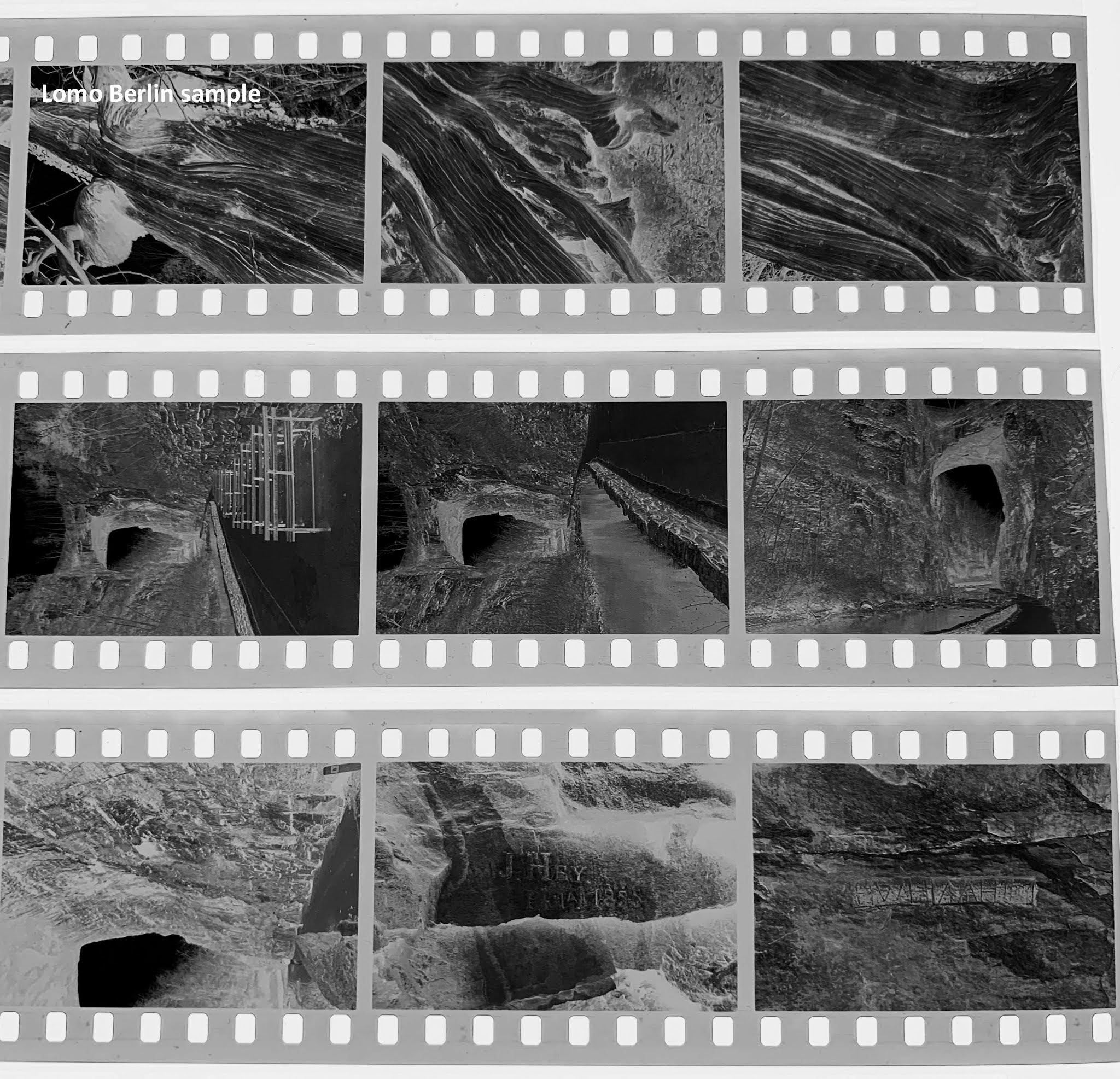
Lomography Berlin Kino 400 - As Lomography touts - "Capture life’s most elusive moments in everlasting monochrome charm with the 2019 emulsion of our iconic black and white cine film."   I had not tried the earlier Berlin emulsion, so I can't comment on it.   Was the prior emulsion "old stock" from ORWO?  Hard to say, so it's all just conjecture, but my film cassettes do state "New Improved Formula!"   I bought them from B&H back in late 2019.  I love the packaging and the fact that Lomography provides developing information.   I shot my first roll in February in my FM3a,  and the second in my Nikon FE2 in June.  I compared those negatives with a roll of actual ORWO N74+ that I shot in 2016.  These are not the same films.  The N 74+ from 2016 has the typical cine sprocket perfs which are rounded, whereas the Berlin 400 2019 has standard 35mm squared-off perfs.  So, is the Berlin 400 I received something else, and NOT N74+?  Some research reveals that Filmotec (the branding for the ORWO cine film) released N-75 in 2019, with some improvements, rated at 400 ISO in Daylight, 320 ISO for Tungsten lighting.  It's also supposed to have  additional anti-halation undercoat (AHU).  That may explain the difference, as well as my 2016 film has "Filmotec ORWO N74 813717 79A06" in the film rebate. The Lomography film has no film information printed in the rebate.  I feel that the film base is quite dark and darker in the two Berlin rolls that I shot, whereas the ORWO N74+ has a lighter gray film base.  The negatives fit nicely into my scanner holder, without cupping or curling, so that is a plus.  Scan-wise, I think the results are very good, though there is some grain when developed in straight D-76.   The one thing I didn't care for was that Lomography uses a two-piece plastic cassette for this film.  I ended up prying it apart in the dark to remove the film, which isn't optimal.   So, I am fairly sure that the Berlin Kino 2019 emulsion is ORWO N75. Is the New Improved Formula batch that I received the same? That I do not know.

Orwo N 74+ from 2016

Berlin sample 2 with darker base, regular sprockets

Berlin sample 1 with dark base, regular sprockets


Lomography Potsdam Kino 100 - Note that because this film can be developed as a negative or a positive film, it has quite a write-up on the Lomography site.   I have not processed it as a positive, but for a cine film, that is a real plus for those shooting the 16mm version.  I shot my first roll in February in my Nikon FM3a, and the second roll in my Pentax Spotmatic F in June. I compared those negatives to a roll of ORWO UN54 that I shot in 2016.  They all appear to be the same film, except that the ORWO has "Filmotec ORWO UN54 512912 14A11" on the film rebate.  I really like this film, as the scans are beautiful, and there is something about the tonality I really like.  The Potsdam film was developed in straight D-76 for 5 min 45 sec, and the UN54 was done in D76 1:1 for 7 minutes. Results are comparable. Standard metal cassettes are used for this film, or at least for the rolls that I purchased.

Potsdam sample

UN 54 from 2016

Overall impressions - I have other 400 ISO films that I like better than the Berlin 400. It's not bad, it's just that I am not liking the darker film base that to my eye, seems like base fog, and the more noticeable grain.  I much prefer Kentmere 400 and HP-5.  The Potsdam film reminds me a bit of Plus-X, and I do like its rendition of shadow areas.  Of the two, it's one that I would purchase again for landscape photography. 

As with any film - there will be people that find Berlin 400 or Potsdam 100 perfect for what they shoot, and others that won't like it as much as some other emulsion, which is one of the great things about shooting with film.  Try them yourself and see what you think.  It's also important to note that I give kudos to Lomography for providing more information on development, along with examples from different developers.  

A few sample images - scanned with my Epson V700 scanner, post processed with Paint Shop Pro 64-bit.

Berlin 400, Natural Bridge, VA Feb. 2020

Berlin 400, Asheville, NC Jan. 2020

Berlin 400, Natural Bridge, VA, Feb. 2020

ORWO N74+, 2016, Nikon FG

Berlin 400, NC, June 2020

Berlin 400, NC, June 2020

ORWO UN 54, Cranbrook, MI, Pentax K1000, 2016

UN 54, MI, Pentax K1000, 2016

Potsdam 100, Dutchess Co., NY, Feb. 2020

Potsdam 100, Sharon, CT. Feb. 2020

Potsdam 100, Asheville, NC June 2020

Potsdam 100, Asheville, NC June 2020

In the end, both of these films are fine films to shoot with, giving one ever more reasons to shoot film!

Not a fan of the plastic 2-piece cassette!

Tuesday, August 16, 2016

Kentmere 100 Film..a bargain, and it's very good.

Over the years, I have shot just about every emulsion of B&W film that is available. Some become "go-to" favorites, and others get used sparingly for specific purposes. Sometimes I come across a cache of a long-discontinued film, such as Kodak Panatomic-X, and use it sparingly, not wanting to use it up right away.   It's downright annoying to really like a certain film and then have it unavailable.  One of my favorite medium-speed monochrome 35mm films is Kentmere 100.  It has fine grain, lies really flat in the scanner, and is readily available in bulk rolls.  Sold by Harman, it is made by Ilford, and is similar in performance to the Ilford FP-4 film.  My favorite developer with it is D76 1:1, but XTOL 1:1 gives a nice result as well.  I could write all sorts of things about the film, but it is probably just easier to show you some photographs:


old bus, Ann Arbor, MI

Robert Beech

Depot Street, Ypsilanti, MI

Hillsdale, MI

Ugly Mug, Ypsilanti, MI

Short's Brewery Window, Bellaire, MI

Birchwood Inn, Harbor Springs, MI

Hocking Hills, OH

I buy Kentmere 100 in bulk rolls, which saves me money.  A roll of 100 ft. is about $40, which prices it far below a lot of films.  The quality is excellent, and if you want to try a roll or two, of course, it is sold in 36 exp. rolls for about $3/roll online.  It is available from all of the typical places such as B&H, Adorama, and Freestyle.  I highly recommend Kentmere 100.


Sunday, January 31, 2016

TIME Machine.

By SqueakyMarmot from Vancouver, Canada  via Wikimedia Commons
Well, sort of. I am going through more boxes of prints and negatives again.  I found this lovely little packet of images from a bona-fide Time camera that I took in March, 2007 on a roll of Kodak Gold 100.  Many things have changed in town since.  The Anberay Apartments on East University Avenue were later torn down and replaced with a high-rise apartment building filled with students spending a ton of $$ to live there.  The Village Apothecary on South University recently closed. Walgreens replaced the bookstore, which was a big loss to anyone needing art supplies.
Yes, a camera is a sort of time machine, and this TIME camera did okay and recorded some images that show some things that are no longer.  The people change daily, but buildings create the landscape, and when the landscape changes, it's all too easy to forget what was once there.  
If you are not familiar with the TIME Camera, it was a dirt-cheap plastic camera made to look like something slightly better. It was given away as a premium for subscribing to Time magazine back in the 1980s.  It has a single-element  fixed-focus 50mm lens with apertures of f/6, 8, 11, and 16.  A metal weight in the bottom gives the camera more heft.    It also has a hot shoe for a flash.  That's it.