Saturday, September 23, 2023

One Roll Review - Svema MZ3

image courtesy of the Film Photography Project

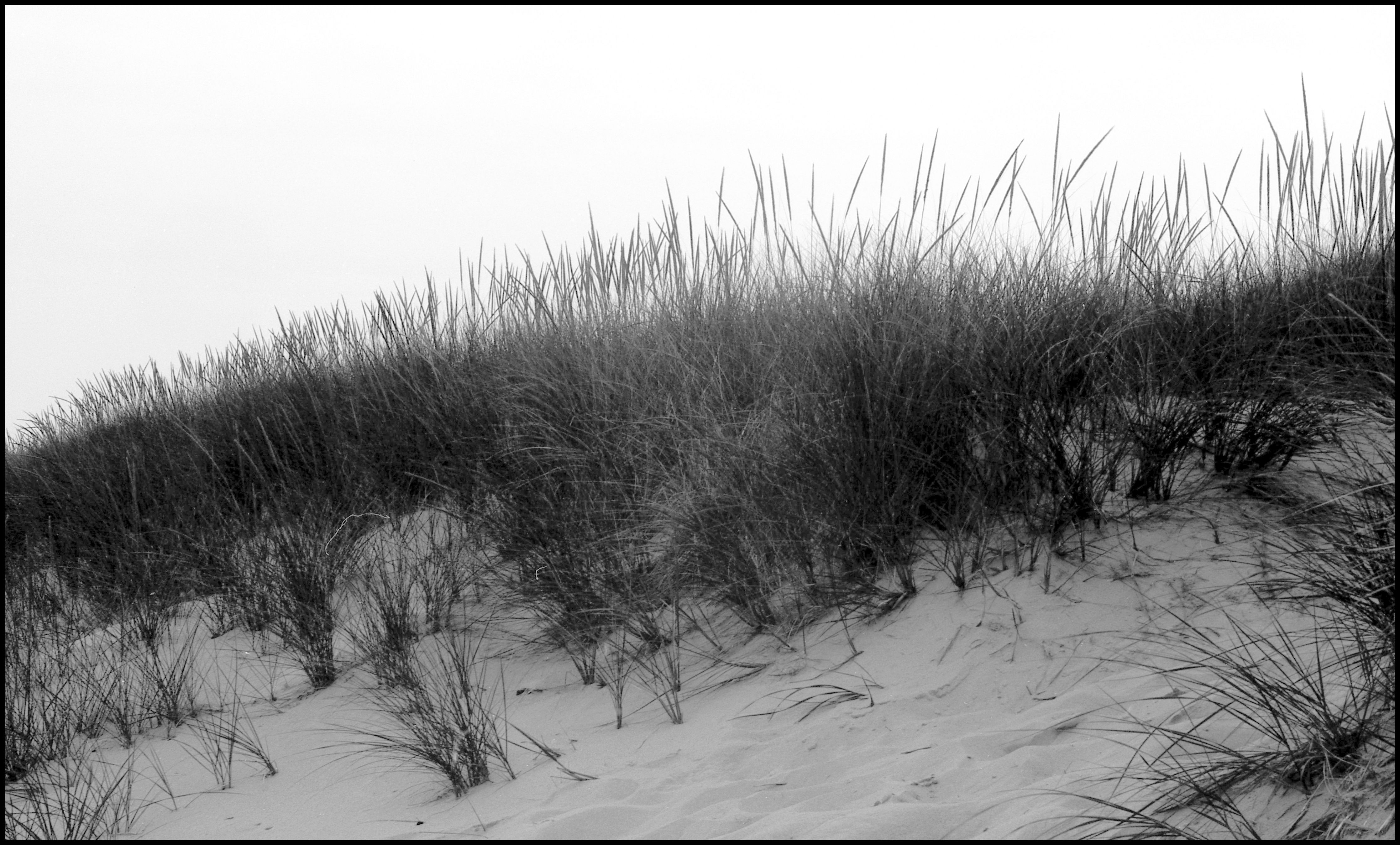
It’s been a few years since I have shot with this film that’s available from the Film Photography Project store. I kept putting off shooting with it until I had a little project.  I decided to put a roll in my camera bag for my trip up to Ludington, MI last week. I knew that I’d have the opportunity to photograph in the dunes near Lake Michigan, so what better use for this ultra-low ISO film?

What is MZ3?

Like several other film stocks available from the FPP store, Svema is the manufacturer of MZ3. It’s an extremely fine-grained blue-sensitive (orthochromatic) film with an ISO of 3. It lacks an anti-halation layer, and the polyester film base is subject to light-piping. Light piping is when the light hitting the exposed film leader is carried by the film base farther into the canister. Usually, it mostly results in some exposure around the sprocket holes, but in severe cases, it can fog the first few frames. Therefore, MZ3 is one of those films that should be loaded either indoors or in the shade, and ought to be stored in opaque film canisters until used. Those new aluminum film cans that I see with some third-party film reloads would be ideal.

Since the MZ3 film is so slow, it’s going to be ideal for landscape, architecture, etc. However, with a fast lens of f/2, one could shoot handheld wide-open on a sunny day. Using sunny-16 as a guide, f/16 in full sun would be about 1/3 of a sec exposure.  The equivalent at f/4 would be 1/30 to 1/60 sec. Years ago, I shot MZ3 with a ND filter to get really long exposures at a busy area in Ann Arbor. Tripod-mounted, of course. 

I loaded the MZ3 into my trusty Nikon F3HP, which I consider to be one of Nikon’s best film SLRs. For me, it’s a great photographic tool that’s never let me down. I used manual exposure and an external light meter to make the photographs on this roll. I also used a tripod, since I was generally shooting at f/16. The ISO dial on the F3 only goes down to ISO 12, and at that setting, the exposure compensation dial only allows about +1.3 stops. So, manual exposure it was. If memory serves correct, most of my shots were around 1/8 sec.

After I returned home, I developed the MZ3 in HC110 dilution H for 9 minutes and 15 seconds. That gave me quite good tonality. Since this is a blue sensitive film, greens are quite dark, providing a lot of contrast between the sand and the vegetation.

light piping along the film rebate at the beginning of the roll

Here are some examples from that roll. Overall, I quite like the results, though some images needed more post-processing than I expected. That’s the fun aspect of these low-ISO oddball films - they are not going to be boring, that’s for sure. I highly recommend that you try this film - and since it does not require special developers to achieve good results, it’s a good choice for a really low-iso film experience.  The MZ3 definitely gave me a look quite different from a 100 ISO panchromatic film.


Thursday, September 07, 2023

Photographic Echoes

Did you ever visit a place, take some photos, and then only later realize the significance of that place in regards to another photographer’s body of work?  It’s not like going to, say, Yosemite, fully aware of Ansel Adams’ photographic legacy.  Nor is it like going to New York City, that has been the subject of many photographers.  How about a “small town”?  

First, a little back story.  I have been slowly working on a project about US-23, aka “The Dixie Highway” that stretches from the tip of the lower peninsula of Michigan, through Ohio, Kentucky, Virginia, Tennessee, North Carolina, Georgia, and ends in Jacksonville, FL.  I’ve done a fair amount of photography along the way, especially in Michigan and Ohio.  I’ve yet to finish the route from NC to FL. Yet, US-23 runs not far past my house in NC, where it shares the road with I-26 and US-19, so I’m always aware of that unfinished journey.

Hopefully, a project that I'll finish

This past April, I was traveling from a photo gathering in Cleveland back to my home in Weaverville, so I took US-23south, and stopped in Portsmouth, Ohio, which I had been through before.  This time, I stopped to walk around and do some photography - with some examples, as seen below.  It’s obvious that Portsmouth was once a more robust place that had fallen on hard times, but is rebounding now, typical of a lot of previous industrial towns along the Ohio River and in the so-called rust belt.  I’ve been through a few of them, and while some will probably not escape more decline, others will persevere and improve.  Portsmouth seems to be in the “improving” stage, and is also positioned in a place where hiking, boating, and other outdoor activities will attract people.  


As I walked around with my camera, it was obvious that towns like Portsmouth have a lot of history, and my feeble attempt with a camera for a few hours was not going to be enough to reveal much of it.  If anything, the flood wall with the murals on the city side was ample evidence of a storied past.  Just as the flood wall is also evidence of the existential threat of the mighty Ohio, it’s also a reminder that people have overcome many obstacles to create a community.

Something nagged at me though, as if I had read something about Portsmouth or a town along the Ohio River before.  Last week, I realized what that was.  Mary Ellen Mark’s photographs in Life Magazine in September, 1989. “Growing Up at 215 Washington Street, Portsmouth, Ohio.”  I had taken photos of that article with my cell phone when I was visiting my wife’s family in Amenia, NY in 2016.  The text, written by Peter Meyer, is direct, unflinching, and a damning indictment of a country that was ruined by Reaganomics during the 1980s.   It’s always the kids that suffer.   The fact that it was someplace in the middle of the country, and a white family possibly made it connect more to the readers.  Had it been a Black family, would there have been anything other than the usual put-downs by the readers?  This excerpt encapsulates the point of the story:

“The children of 215 Washington Street—Chuck, Mike, Jenifer and Tiffany; Carrie, Mike, Jeff and Jamie—are not alone. At last count 13 million American children were growing up poor—one in every five. Since 1969 child poverty rates have risen from 14 to 20 percent, adding three million more youngsters—enough to populate a city the size of Chicago. From the children at 215, we can get an idea of what it is like to grow up poor in America in 1989. Like most American poor children, they are white, they do not live in a metropolitan area, their parents don't own a house, and their family's income is less than what the federal government says is necessary to survive.”

The 1989 article in Life

1989 Life article

The old tenement 215 Washington Street is now gone, and that series of lots, once nothing but grass, is now seeing rebuilding going on.  I checked through Google maps for previous years, and I suspect that the crappy old apartment building was torn down in the 1990s.  I found this really good article from Ohio Humanities dated 2022, that has some good commentary about that 1989 Life article.  Amanda Page offers up her recollection, and it’s a very important follow up.


2022 Google Maps View of 215 Washington St

2019 View of 215 Washington St


Mary Ellen Mark was an astute photographer, and she exposed the plights of the poor and disenfranchised, especially women.  Her photographs for this article are echoes of Walker Evans’ images of the sharecroppers and their families in Hale Co., Alabama.  So, I guess this story has several echoes, not just one.


After reading that story again, I have to wonder how those kids turned out.   1989 wasn’t that long ago.  Just 34 years.   

Monday, August 28, 2023

One Roll Review - Lomochrome Color '92


I have to hand it to the minds at Lomography. Whatever sources they have, or partnerships with film manufacturers, they have been able to come up with some films that simply defy convention and encourage experimentation by photographers.  I'm not sure where this latest release stands in the world of C-41 films that Lomography has come up with, but when I saw it available, I purchased three rolls from the Lomography store.  


First of all, I knew that I wanted to test this film in a camera that has shown reliable results with color films, my Yashica Electro 35CC. With its 35mm f/1.8 lens, this camera is considerably more compact than the big Yashica Electro 35s most people are familiar with.  That's one reason that I use it, and the other is that I like the aperture-priority operation of this camera (even if I don't know what the exact shutter speed will be), and the 35mm lens is perfect for much of the photography that I do.


I already had a roll of Kodak Pro Image 100 in this camera, which was fortuitous, since I could compare the color rendition of the Color '92 with the Pro Image 100.  I shot the roll of Color '92 in Murphy and Asheville, NC.  I shot it at the box speed of ISO 400, and it was developed by Ball Photo in Asheville, and I scanned the negatives on my Epson V700 scanner. Minor corrections were applied post-scan in Corel Paintshop Pro.

The Henn theatre, shot on Pro Image 100

Henn Theatre, shot on Color '92


As you can see, the Color'92 has a bit of a slightly different palette, but nothing like the Lomo Metropolis film.  If anything, it reminds me of some older slide film scans, but with better shadow detail.    In the two photos of the Henn theater in Murphy, NC, the red looks slightly muted compared to the Pro Image 100, but blues are more intense.

Some more images:


The rest are from Asheville, NC


Based on this sample, I'd say that the reds have some cyan that mutes them a bit, and that the film really shines in full sun.   Overall, it's certainly a choice on whether to use it or any other 400 ISO color film.  It's not going to be as obvious a result as say, Lomo Metropolis or Lomochrome Purple. However, I do like the look of this film

Is it worth the extra price over some expired 400 ISO film?  It all depends on what you are looking for. I think the more muted appearance in shade is quite nice.  


Wednesday, August 23, 2023

One Roll Review - SHD 100 Pro


Last month, I stopped into my local photography store - Ball Photo, in Asheville, NC.  I bought a few rolls of film that I hadn’t seen before, and one of them was SHD Pro 100.  I was a little surprised, as I thought that Lucky film in China had disappeared from the scene, so I was certainly curious and eager to try this film.

The box containing the film has an expiration date of October 2023. While there is no mention of the Lucky brand on the box, the web site for the film is www.yangziyicn.com - which took me to a Facebook page.  However, the film is available online at the Reflx Lab website at $5.99/roll, and the information from Reflx Lab states the following:

“The SHD 100 film stock is using the emulsion formula from the time-honored Chinese brand Lucky Film.”

Well, it was many, many years ago that I shot with Lucky film, and if I recall correctly, it suffered a bit from halation.  Not a bad thing, if that’s what you want. Well, what the hell.  I loaded the roll into my Leica M2, and shot the roll on a sunny afternoon along the French Broad River N of Asheville.  I used my Doomo light meter that I keep on my M2.  


The box actually has development times for D-76 and HC-110 printed on one of the flaps. The film cassette is one of those plastic two-piece units that Lomography’s been using.  There is also a separate DX code sticker to go over the paper label if your camera requires DX codes to set the ISO to 100.  

I developed the film in D76 1:1 at 20°C for 11 minutes, rinsed in water for the stop, and fixed for 7 minutes. A couple of observations right away - the film is on a triacetate base and lies flat when dry- which makes it easy to scan on my Epson V700 flatbed.  The sprocket holes don’t seem to be die cut nearly as smooth as other films — maybe it’s the thicker film base, but it’s just an appearance, not something tactile.  

The film is fine-grained and damn, I love it.  I am very happy with the results from this first roll. I did not see any halation problems or artifacts.  I like it so much that I ordered 5 rolls (each roll is 36 exposures) directly from the Reflx Lab web site.

Here are some sample images from this first roll.