Showing posts with label film shooter. Show all posts

Thursday, January 17, 2019

The Canon T60 SLR - A sweet shooter!

Last month, a friend gave me this Canon T60 that she picked up at an estate sale for $10.  I promised her that I would shoot with it.  The Canon T60 was the very last FD-mount SLR that Canon sold.  Note the emphasis on sold.  Canon didn't make it, but Cosina did.  Like a bunch of other manual cameras produced at the end of the reign of manual SLRs, The Canon T60, Nikon FM10, Olympus OM 2000, Yashica FX-7, and Konica TCX, were all made by Cosina.  Whatever is on the outside, it's Cosina inside.  Not that it is necessarily a bad thing, as you'll see.

The Canon T60 appeared in 1990, well after the Canon EOS series had been introduced.  There was enough demand for cheaper alternatives using the FD-mount, that Canon contracted the camera's production with Chinon, and in the process, ended up with a traditional-looking sleek SLR that was certainly quite different from all the other FD-mount cameras, as well as the rest of the T-series.

The GOOD
The T60 is a lovely, all-plastic camera. It is lightweight, and coupled with a standard 50mm f/1.8 FD lens, makes for a sweet carry-around SLR. Unlike most Canon FD-mount cameras, it has a vertical Copal Square shutter, APERTURE-priority and manual control, and requires 2 LR-44 cells to operate.  The vertical metal-bladed shutter keeps it in line with the rest of the T series cameras - T50, T70, and T90.  Unlike the other T-series cameras, it has manual film advance.  Again, this is a Cosina camera, not a Canon! The controls are easy to use, and the camera has a nice feel in the hands.  The viewfinder is pretty good, and the shutter speeds show on the left side of the viewfinder. Focus is with a split-image center spot, surrounded by a microprism collar.

Particulars
ISO settings: 25-1600
Shutter speeds: B, A mode, 1-1/1000 sec. L for locking the camera and turning off the meter.
Exposure Compensation dial: none
Depth of Field Preview: none
Film door has a small window to see what film is loaded.
Self-timer: yes
Tripod socket: yes
Film Advance and Rewind: manual
Flash - ISO hot shoe, for generic flash. No PC socket. The sync speed is 1/60 sec.
Shutter release: ability to use screw in cable release.
Lens Mount - Canon FD and FL(?), metal lens mount.

The BAD
Basically, it's the plastic body.  I am sure if handled properly and not abused, the T60 will be just fine. If the 2 cells lose power, there is no manual mode on the camera, so it's dead until you put in fresh LR-44s. It would make a great "student camera" and certainly does not suffer from the AE-1 squeak and issues with older FD-mount cameras.  As an A-mode camera, I would love it if it had a +/- compensation dial. But face it, this camera was designed for a particular price point, and in that, it succeeds.


RESULTS
The feel of this camera reminded me of the Yashica FX-7 Super, which I really liked.  Its light weight and precise feel of operation really made it a fun camera.  I shot with a Sunpak Auto 311 flash and had great results.  After putting 4 rolls of film through it, I cannot find any fault with the exposures in A mode, or the flash photos at 1/60 sec.  I shot it with Ilford HP-5+, and here are a bunch of examples, including some with the FPP gang in NJ.

grain silo and ladder, Chelsea, MI

BBQ, Chelsea, MI

Alley in Chelsea, MI

Mike Raso with Canon Sure-shot Max

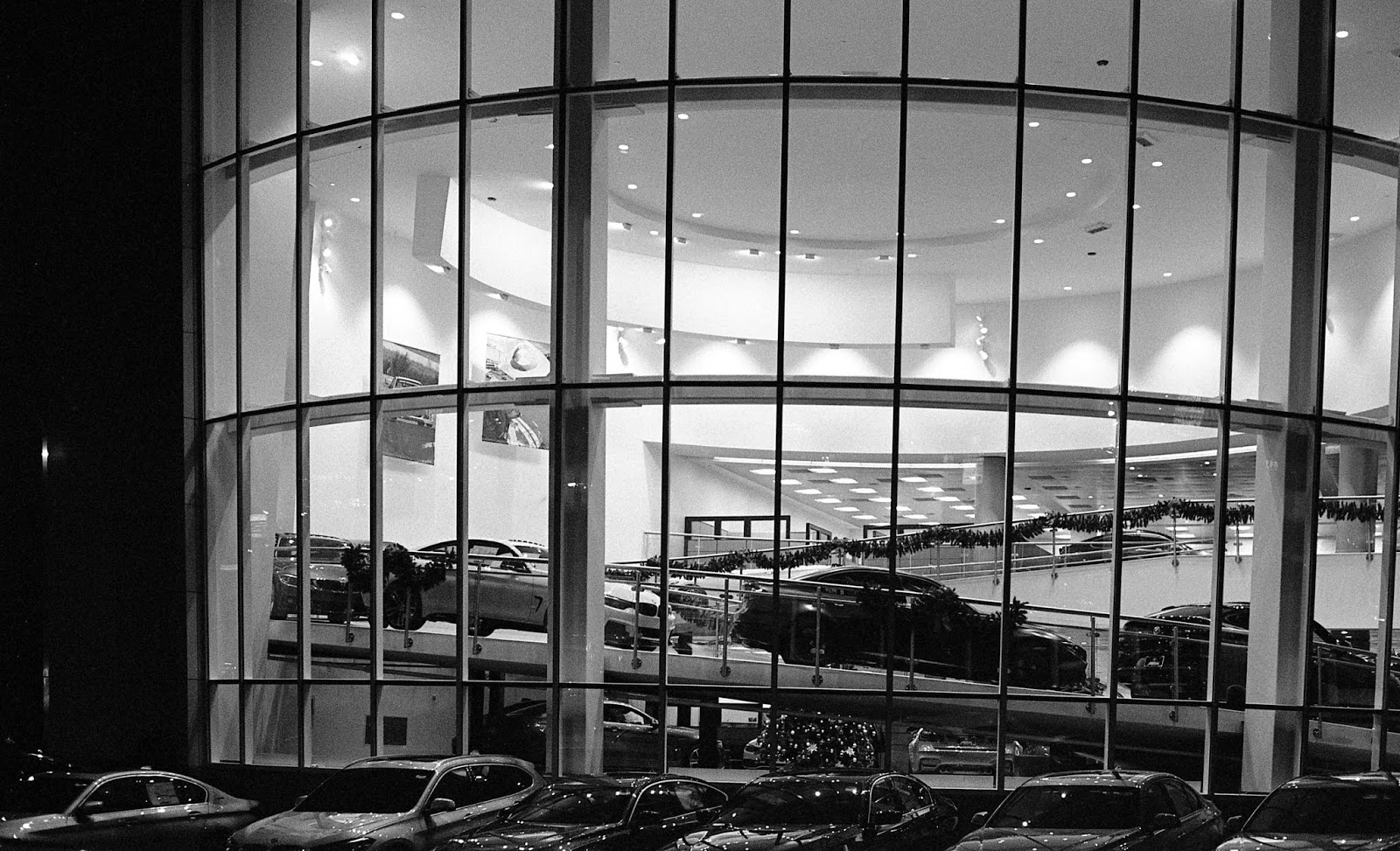
BMW dealership, Wayne, NJ

Obscura Darkroom, NJ

Tick-Tock Diner, NJ

Mat ponders the 4x5

Start them young!  Obscura Darkroom Opening, NJ

Buying one?  This is a more recent camera than any other FD-mount Canon. The FD series of lenses are quite affordable, and typically good quality. The only factor might be the mirrorless uses that could drive up the prices on some of the lenses.  Put a 50 mm lens on it and be done.  The T60 cameras on ebay are usually in the $25-$60 range, depending on lenses, etc.  It's certainly a more ergonomic camera than the T50 and T70 cameras, and not a beast like the T90.  Its sleek, all-black finish will charm you into buying one.  Make sure that you get one that has not been mistreated.


Monday, January 27, 2014

Results from the Autoreflex T

I cheated here -- this is not a flipped mirror shot, it was taken with my Nikon 1J1.
In the previous post I explained my recent acquisition of a Konica Autoreflex T SLR.  I finally finished off the roll of Arista Premiun 400 and developed it in TMax RS developer.  Just looking at the negatives as they dried, told me that the metering was good - at least good enough.

One of the problem with many of these older cameras is that they required 1.35V  Mercury cells for the meters.  Fortunately, I can use Zinc-Air cells in this model without any adapter, and their voltage is plenty close enough. On top of that, some meters lose sensitivity at low EV levels, so while they may function well in daylight, the metering goes to hell in a room. Or, the meter may be non-functional due to corrosion, old solder joints, aged components, etc.  Picking up a camera made in the 1960s and expecting it to work like new seems to be a quality found only with photographers.  Even purely mechanical cameras can have problems caused by old seized lubricants, bad materials used in manufacturing, and things do age.  I know I don't work quite as well as I did 40 years ago.  This particular Autoreflex T seems to work fine, but I still think the metering is a bit suspect indoors.  However, since the shutter speeds are not electronic, I can always shoot in manually, instead of in shutter priority mode.  It certainly has a gratifying solid-sounding shutter and is built very well.

I shot some photos while out in the cold winter temperatures that we have been enduring for the past few weeks in Michigan.  Black and white film is great for winter, especially for subjects that have great contrast, such as snow and anything not snow.
The icy Huron River, just W of Zeeb Road.
On Jan. 18, my friend Cheryl and I checked out the Huron River near Zeeb Road.  There is a nice trail to some nice riffle areas, but i chose to shoot the more placid upstream with its reflections and ice flotsam coming down towards us.

It was only about 15°F, but for some reason I cold chilled more quickly than usual, and Cheryl's Nikon FM2N decided it didn't like the cold either.  I had also brought along my Nikkormat EL, and it too, decided to stop working in the cold!

Cheryl borrowed my tripod to shoot some scenes with her Nikon FM2N. 
I am pleased with the images that I got with the 40mm 1.8 lens.  It seems quite sharp, and I look forward to shooting more with it.

Is the Autoreflex series a good buy?  Back in the 1960s -1985 or so, there were a lot of different SLR brands.  Some makers, such as Nikon , Minolta, Canon, and Pentax were able to retain their following and incrementally improve their SLR bodies and features.  Konica, Yashica, Olympus, Topcon and Miranda all had some outstanding cameras with great glass.  None of them survived as top SLR makers after 1990.  Well, Yashica did, only because of the Contax contract.  Konica's last SLR was made by Chinon, though the Hexanon lenses were probably made by Konica.  Because the AR-mount lenses are so good, they often command a higher premium with people using them on mirrorless cameras.   If you find a good used Autoreflex T or T3, or even a TC, go for it.  You should be able to pick one up in the $30 and less range.

US 23 was closed due to another accident, so the truckers came through town.
As I stated above, older cameras with an unknown history may need to be cleaned, calibrated and freshened up with new mirror foam and door seals.  Most of the Autoreflex cameras required Mercury cells, too.  It's up to you whether or not a CLA costing about $70  is worth the trouble for a camera that you paid $25 for.  On the other hand, if the cosmetics are good, the mechanics are sound, and you want a reliable shooter, look into the Konica Autoreflex series.


My walk home is a lot more fun photographically with the sun up longer.


Youthful dedication.


My office at work.  The exposure looks dead-on.