Showing posts with label camera history. Show all posts

Wednesday, May 11, 2022

A Visit to the Camera Heritage Museum

There are not many museums devoted entirely to cameras, and I have only been to less than a handful of photographic history museums: Eastman House in Rochester, NY; The Argus Museum in Ann Arbor, MI; The American Photographic History Museum in Pittsburgh, PA, and now, the Camera Heritage Museum in Staunton,VA. Two of these museums are dedicated primarily to products of a single manufacturer - Kodak  (and of course, so much more) for Eastman House, and Argus, of course, at the Argus Museum - which has the distinction of being also at the site where the cameras were made.  The latter two museums are of wider representation, and of these, the Camera Heritage Museum by far, has the most diverse and comprehensive collection of cameras that I have seen.  

I stopped in Staunton last year, unaware of there being a camera museum there, and because we arrived late in the day, it was closed.  However, I knew that I would be passing by Staunton again, as it is off Interstate 81, not far from Lexington, VA, and on my way to the Film Photography Project HQ in New Jersey. On May 2, I was able to stop and spend a good deal of time before I had to hop back on the highway to NJ.  I met David Schwartz, the curator, and the person who has amassed a mind-blowing collection of cameras starting in 1968.  Located in the Shenandoah Valley of Virginia, Staunton is a charming place to visit with a lovely downtown with lots of shopping and dining options.  The Museum, which started out as a camera store, is open to the public, and a small fee gets you a self guided tour of the collection, and an Andrew Jackson gets you the curator-led tour, by Mr. Schwartz.  I opted for that, which also comes with a packet of information.  At the outset, I informed David of my experience with the world of vintage photography and intentions of doing a review.

David Schwartz, curator

The Camera Heritage Museum houses close to 7,000 cameras as well as photographs, advertising materials, vintage products and supplies, and other ephemera. There are numbered stations that feature items of importance in the history of photography, and David was of course, well-versed in all of them.  I did learn some things that I was unaware of that had to do with local involvement in the growth of photographic technology, and to see certain cameras that were previously owned by famous photographers was a treat.   While initially overwhelmed by the sheer number of cameras, I soon saw the organization by type and era, and amid all the glittering chrome, I found many wonderful examples of cameras that I had never previously seen in person.  The whole gamut of the history of analog  photography is represented -- from Daguerreotype cameras and images to the end of the development of film cameras.  


My images show - every case is chock-a-block with cameras.  Among those I saw a beautiful, mint-condition Kodak Ektra - the most complex and expensive 35mm camera made by Kodak. American manufacturers were represented by Argus, Kodak, Conley, Ansco, Univex, Perfex, Graphlex, Ciro, Falcon, etc. The German camera makers -- Leitz, Zeiss Ikon, Rollei, Ihagee, and lesser-known firms was well represented, as well as the Japanese Nikon, Canon, Miranda, Topcon, Minolta,Pentax, Ricoh, Olympus, and others.  Stereo cameras from 16mm to 5x7, spy cameras of all sorts, miniature cameras, large format, medium format, wet-plate, dry-plate, Polaroid, folders, box, underwater, and toy cameras. About the only aspect that was under-represented was cine cameras.  However, aside from the Kodak Brownie 8mm cameras, they had an Arriflex that was used by Leni Riefenstahl to shoot movies of the 1938 Olympics and Nazi propaganda films.

Exhibit 13 - Arriflex

It was interesting to see how many different models of the same Kodak camera, such as the Holiday Brownie, were made in the USA, Canada, Brazil, England, France, and Spain. Of course, the many colorful examples of the Art Deco Kodak Beau Brownie were on display, as were the multitudes of Kodak folders, box cameras, Instamatics, and two examples of the fantastic Kodak Ektra 35mm rangefinder.  If you are interested in Twins Lens Reflex - there are plenty to see.  I really got a thrill at seeing an actual Graflex KE-4 combat camera, which took 70mm cassettes.  It looks much like a GIANT Contax II camera, and was sometimes referred to as "Gulliver's Contax."  A Folmer Graflex "Big Bertha" is on display - and at 40 inches long and over 30 pounds, it's hard to imagine using it to photograph baseball games, but it did.  I could go on - there are many examples of famous cameras, and anyone with a love for things photographic will find their favorites at the Camera Heritage Museum.  


I think their exhibit of miniature cameras -spy cameras, such as the various Minoxes, Ricoh 16, Riken Steky, Secam Stylophot, Suzuki Optical Echo-8 (KGB spy camera), Minolta-16s, and a Tessina - is quite comprehensive, as is their collection of stereo cameras.  Whether your interest is in large wooden bellows cameras or the smallest spy camera, or anything in between, you'll enjoy the Camera Heritage Museum.


The Camera Heritage Museum is a 501 C3 non-profit corporation, and while the collection has been growing since the late 1960s, it became a non-profit museum in 2011.  Its location in Staunton, VA meshes with the local history of photography, which goes back to 1847.  There are a number of other historical museums in the area, and of course, the Shenandoah Valley is full of history.  The current building certainly is filled to the brim with photographica, and as a former museum professional, I can see that it will take some money to make the exhibits more attractive to a wider range of visitors.  I really enjoyed talking with David Schwartz, and hope that the museum is able to secure funds to ensure its perpetuity.  It's more than a small regional museum, as it encompasses the history of photography, and has a world-wide collection.  If you have any interest in photography, the museum is definitely worth the visit. The museum accepts donations of photographic items as well as monetary donations. Excess inventory, duplicates, and items that don't fit with their mission are sold on their eBay store - camera-and-palette, which is definitely worth looking up.


The Camera Heritage Museum is located at 1 West Beverley St., Staunton, VA. Take exit 222 off I-81 into the historic downtown. Museum hours are M-F, 9-5, and Saturdays, 9-2.  Phone number is 540-886-8535. Its web address is  www.cameraheritagemuseum.com  Admission is $5 - $20, depending on whether you want a self-guided tour, or a curator-led tour.   


Monday, November 16, 2020

Golden Oldies: Pre-Set Lenses and T-mounts

Over the many years that I have been dealing with camera equipment, it seems that the least desirable (from a selling point) have been pre-set lenses and lenses that have a T-mount.  First of all, let me tell you what I am talking about here.  

Two pre-set T-mount lenses, M42 mount

When you photograph, you set your aperture on the lens and/or adjust your shutter speed until you get the light meter indicator to where it suggests the correct exposure. That’s pretty much how it works with any camera, including digital, unless you have it in complete auto mode, and the camera makes those decisions for you. If you are using an SLR, everything looks the same to you through the viewfinder, unless you push a button or lever to observe the depth of field, which stops down the lens to the chosen aperture. We do it so automatically, that it’s easy to not think about what is actually happening inside the camera.  That’s called open-aperture metering, and even though the lens is wide-open the mechanical or electronic linkages relay all that information to the metering system. When the shutter is fired, the lens then stops down to the selected aperture (assuming that you are not shooting wide-open, of course). It’s been with us since 1963, and adopted by most camera manufacturers by 1971. While cameras have evolved to do just about anything via some electronic adjustment, the basic system of aperture/shutter control is really all you need to control the exposure of an image.

Aperture pin, (indicated by red circle) on a M42 lens

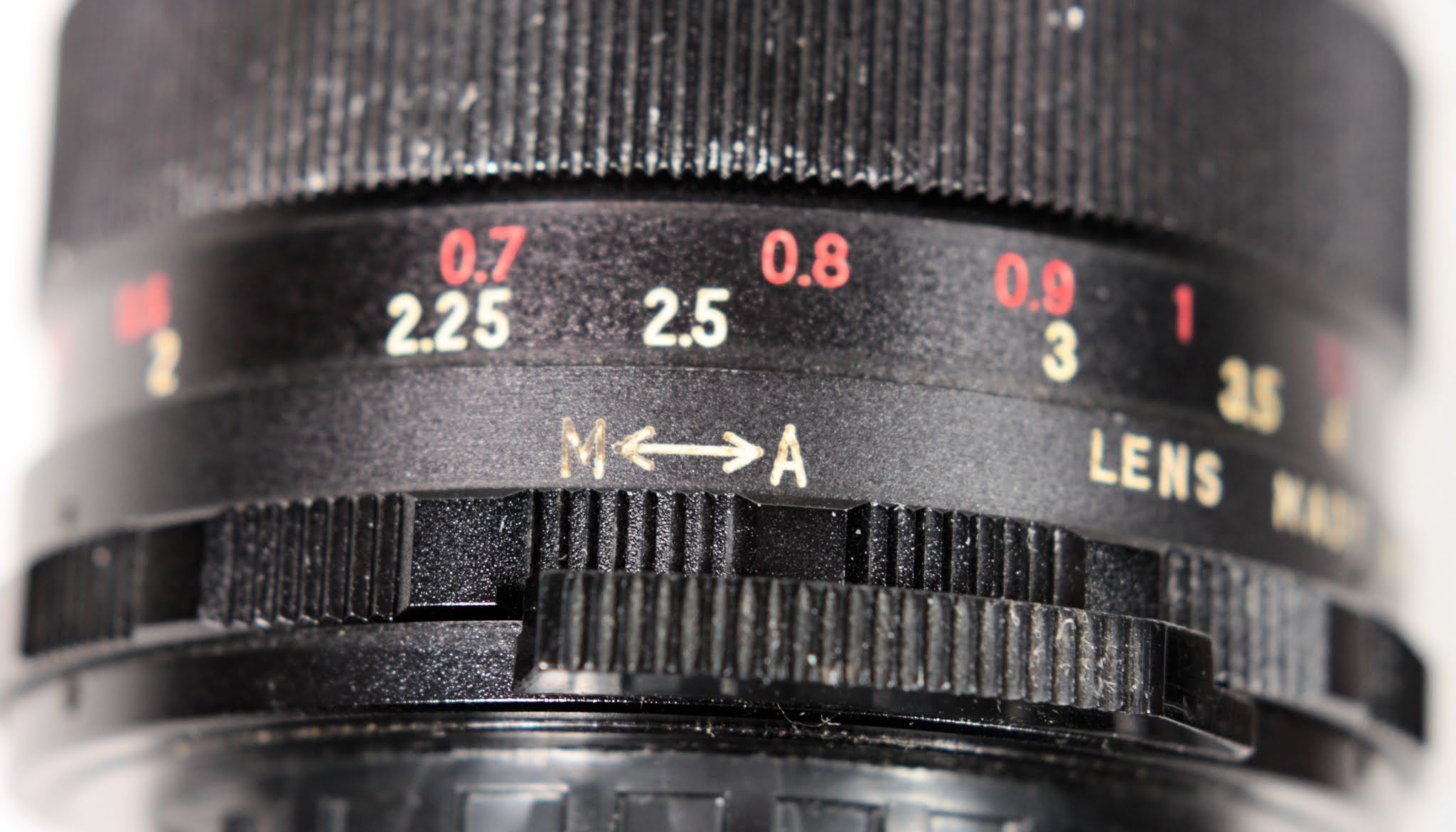
Before the days of open-aperture metering, we had stop-down metering, which means that you set your aperture and pushed a button or lever on the camera to actuate the diaphragm and the light meter.  The problem with that system is that the smaller the aperture, the dimmer the image, making focusing more difficult. If you have used a Pentax Spotmatic, Canon FT QL, Praktica, Zenit, Minolta SR, and any number of M-42 mount cameras, it’s likely that you have used stop-down metering. It’s why many lenses in the early days have an M and an A at the base of the lens. M=Manual, and the aperture is wherever you set it at all times, and the A = Automatic, meaning the aperture changes from wide open to the selected aperture when the shutter is released. Often such lenses have the word "Auto" on them, at least before it became standard on all cameras and lenses.


Three different lenses with A and M control

To actuate the diaphragm in the lens, there needs to be a small pin at the base that is pressed against by an arm or movable plate inside the camera at the moment the shutter button is pressed. Usually, that lever is in front of the mirror. It’s not needed for rangefinder cameras, or twin-lens reflex cameras, because you are not looking directly through the taking lens to focus and compose.  However, on an SLR, you want to have the view as bright as possible, so the lens only stops down when the shutter is released.  

Pre-set T-mount lens has no aperture pin


But wait, what if there is no aperture actuator in the camera or on the lens?  You could still do the manual route and suffer with the dimmer image at smaller apertures, or you could use a pre-set lens. Pre-set lenses have two rings for setting the aperture(usually towards the front of the lens, not at the base). The foremost ring sets your final aperture, and the following ring closes the aperture when you are ready to shoot.  You can view your subject at the full aperture of your lens, and since your shooting aperture is been pre-set, you just close the second ring to shoot. I’ll tell you more about this later on why this is a good thing today. 

Simplified system - shooting aperture at top and
C to close down, O to open up


Final aperture set at f/22, but open to view at f/2.8

Final aperture at f/22
135mm Spiratone lens


T-mount on lens, adapter at right

Now, obviously, the pre-set system is rarely used on modern lenses, but back in the 1950s and 60s, it was pretty common.  It was also used a lot on T-mount lenses, which are third-party lenses made by a variety of manufacturers into the 1970s. The T-mount is a 42mm thread which has a different pitch than the M-42 mount that it is sometimes confused with.  The usual T-mount is a screw mount using a male 42×0.75 (42 mm diameter, 0.75 mm thread pitch) metric thread on the lens with a flange focal distance of 55 mm and a mating female 42mm thread on a camera adapter or other optical component.  The T mount is a mechanical-only mount, meaning it does nothing beyond physically connect the lens to the camera. It does not transfer electrical signals, auto-focus information, or aperture settings. So, the beauty of the T-mount is that you can use one lens with different SLR camera mounts, so long as you have the right T-mount adapter.  The other part of this is that you don’t have to worry about the linkage to an aperture pin, because there isn’t any.  The image below shows a Spiratone 135mm f/3.5 T-mount lens that I have used on M-42, Pentax K, Nikon F, Konica, Leica R, and Minolta SR/MD mount cameras.  You may ask why I would bother.  The aperture in this lens is completely circular due to the many-bladed diaphragm, and it gives very pleasing image. I have used it on digital SLRs, as well.  Since it’s also a pre-set lens. I can easily focus and stop the lens down to any aperture, not pre-determined click stops. 

T-mount lens with a variety of adapters

So, here we are with some lenses from a time when NOTHING was automatic, yet they can still be used today, with the proper adapter, on your film SLR or your DSLR or mirrorless camera.  The beauty of the pre-set lens becomes more apparent when you see the image on your LCD, and adjust the aperture to get exactly what you want in the image.  Since there are no electronic connections, you may have to do all the exposures in Manual mode with some cameras, and Aperture-Priority in others.

I should add that not all T-mount lenses are vintage. Some T-mounts date from the 1980s, and are often seen on mirror telephoto lenses, oddball art lenses, slide copying units, and telescope and microscope adapters. You can also buy new 500mm telephoto lenses that use the T-mount, AND have pre-set apertures. So, the T-mount and pre-set lenses have never really gone away after all these years. The beauty is that you can usually pick up a used T-mount lens or a pre-set lens quite cheaply, and the only factor will be if you can find a T-mount adapter for your SLR. T-mount adapters are easily found for M-42 Pentax screw mount, Pentax K-mount, Nikon F-mount, Olympus OM, Minolta SR, and Canon FL. I think I have seen most pre-set lenses/T-mounts for M-42, as it was a very popular mount before the mid-1970s.


Wednesday, December 05, 2018

The UniveX Minute-16 camera

Yesterday's visit to a local thrift store resulted in an interesting find and a purchase.  I spied a plastic bag with a blue box among a pile of cameras in a case at Treasure Mart.   Curious, I asked the clerk to retrieve it so that I could take a look.  The little box contained a minty Universal Minute-16 camera with all the documentation.  The price was $18!  Normally, I might have passed it over, but after seeing Mark Dalzell’s Tynar 16mm (discussed in FPP Episode 190), I figured it was worth a look.

What is the Minute-16?  Although it looks remarkably like a tiny movie camera, the Universal Minute-16 is actually a still camera that uses 16mm film in special cassettes to produce 11 x 14mm negatives.  Yes, a “spy camera”, which was a popular post-WWII niche camera.  While many people know of the German Minox spy camera, and the Mamiya -16 and Minolta-16, which are quality sub-mini cameras from Japan, the Minute-16 is not well-known, and certainly not up the the standards or complexity of the imported cameras.  Before I go on, let me say a few things about Universal Camera.

A Brief  History of Universal Camera

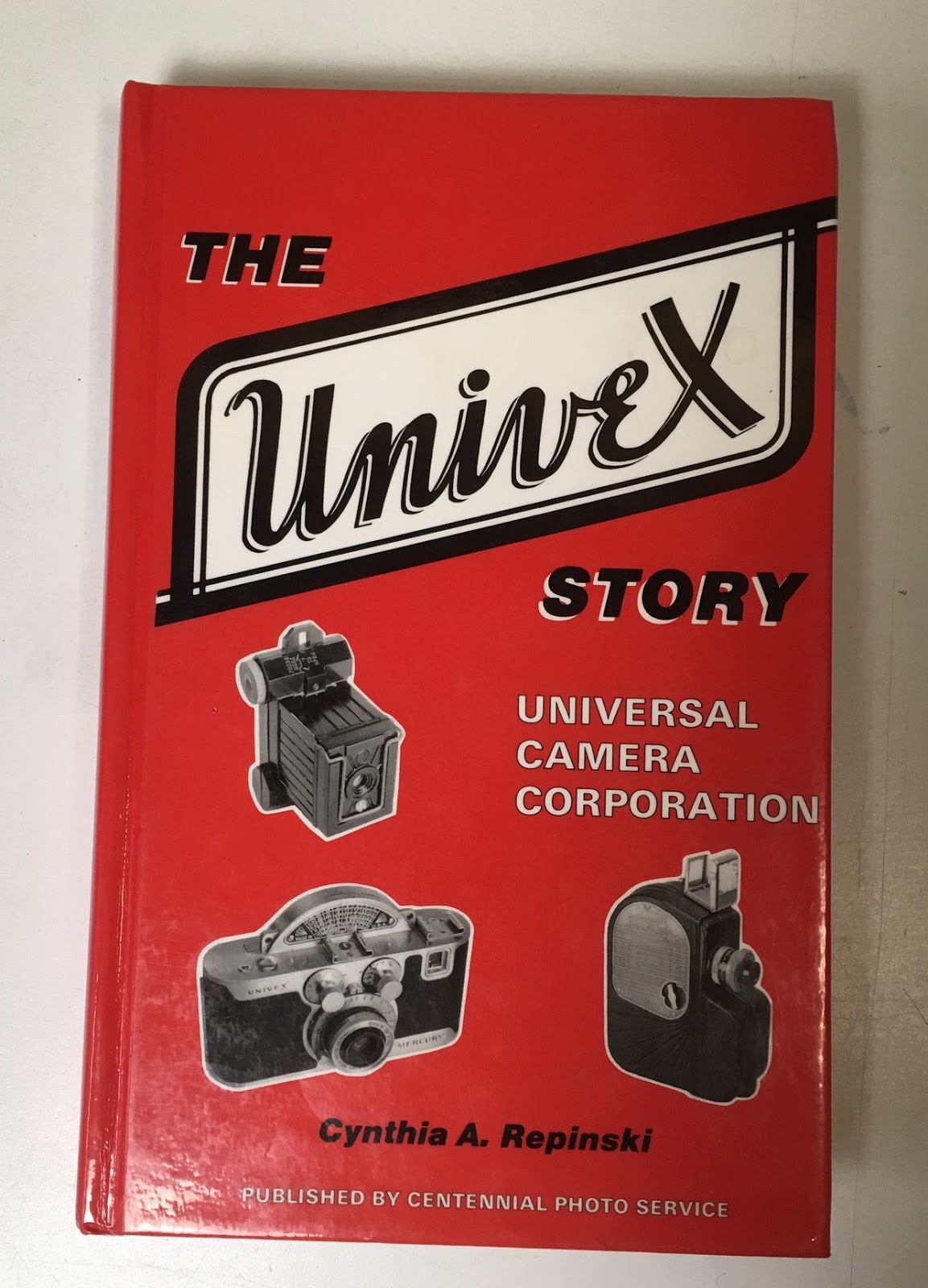
My brief history is extracted from my reading of the excellent book, The Univex Story by Cynthia A. Repinski.  ISBN # 0-931838-17-7, published in 1991 by Centennial Photo Service, 272 pp.

Universal Camera was started in 1932 in NYC, and was immediately successful with their first camera, the Univex  Model A.  Imagine trying to start up a camera company during the Depression!  The Univex Model A was a plastic-bodied tiny box camera that used a size 00 film made by Gevaert to produce 6 images of 1 ½ x 1 ⅛” per roll.  Certainly not an outstanding camera, but at 39 cents, Universal sold millions of them - 15 million, in fact.  The film spools had a v-shaped notch that meant Univex only supplied the film.  Sort of like the razor model of retailing.  While the Model A cameras were simple, the negative was large enough to produce acceptable prints, and at that price, it was the first camera for many young people.

UniveX Model A

After the Univex Model A, Universal designed and sold several different cameras that were more advanced than the Model A, as well as an 8mm movie camera and projector that were priced well below other manufacturers’ offerings.  In 1938, They released the UniveX Mercury Model CC camera.  The camera vaguely resembles a parking meter, and pre- WWII models used a proprietary Univex film load.   Post-war Mercury II cameras used 35mm and produced half-frame images.  From 1938-941, Universal produced a bunch of “candid” cameras, such as the UniveX Iris, UniveX Zenith, UniveX Corsair, and more cine cameras.

The war years were especially profitable for Univex as well as other US camera manufacturers, such as Argus.  Mostly, they were subcontractors to larger companies such as Bausch and Lomb, and produced optical instruments such as binoculars.  While the wars years were profitable, the post-war period saw Univex (as well as Argus and others, but not Kodak) struggle to a degree to provide quality cameras to a more demanding audience.
The Universal Mercury II

Universal’s best camera at the time was the Mercury II, which while odd-looking, was capable of producing good half-frame images on 35mm film.   The other cameras they produced were certainly not high-end.  The Buccaneer was a 35mm rangefinder camera that was supposed to compete with the Argus C3, but at $65, was pricey and not well known.  Universal also tried to capitalize on the interest of those using 120 roll film, and brought to market a series of cameras that were utilitarian and not especially popular - the Meteor, Roamer 63, Roamer I and II, and the Uniflex TLRs.  The Uniflex I and Uniflex II twin lens reflex cameras were actually pretty good, and used 120 film, like the popular (but much more expensive) Rolleiflex.  I had a Uniflex II about a decade ago, and while it worked pretty much as it should, the finish and feel of the camera was certainly not as good as the peer TLRs that came from Japan and Europe, nor as good as an American-made Ciroflex.
Universal Meteor 

Due to a series of unfortunate labor disputes in the late 1940s, Universal’s manufacturing was backlogged with orders, and then, to top it off, a lot of cameras were returned to be fixed.  The company’s reputation suffered greatly, and incurred large debts, loss of some key designers, and the losses mounted as retailers returned unsold merchandise.   For some reason, Universal decided to capitalize on the sub-miniature camera craze (at about the time it started to cool, no less).  They threw all of their capital (raised by selling off a lot of their inventory and parts of the other products) into producing the Universal Minute-16, a “spy camera” that looks like a tiny movie camera, and debuted in November 1949 at a price of $7.95.  A three-pack of the film was $1.00.  By 1952, Universal was bankrupt, and most of its assets were liquidated. However, a tiny remnant of the company reincorporated in Massachusetts and continued to produce the Minute-16 cameras, film, parts, and also do the film processing.  Finally, in 1964, the Universal Company was once again liquidated and all operations ceased.   One thing that had to be a factor in the demise of the Universal cameras - was their non-standard film loads which were made by no other manufacturer than Universal/Gevaert.  Serious photographers shunned the Universal products because of that, and since Kodak, Agfa, and other major film manufacturers didn’t make the Universal films, camera owners could not reap the benefit of the new emulsions from Rochester.  I suspect that a lot of the cameras sold had one or two rolls run through them and the owners put the cameras in the closet and moved onto something better.

Now, back to the Minute-16 (an in minute in size, not minute in time).  
Tiny camera!

First of all, the Minute-16 is tiny. It’s all-metal design gives it some heft.  There is a tripod socket on the bottom of the camera, and the flip up viewfinder is on the top. The shutter speed is 1/50th sec., and the original Minute-16 has three apertures f/6.3, f/11, and f/16.  The later version also has an f/8 setting.  There is no focus adjustment, as the fixed focus goes from 3 feet to infinity.  A lever on the right side is pushed down to advance the film. The shutter release is also on the right side - a simple metal button.   It’s very ingenious, really, and the patented 16mm cassette slips into the camera from the back.  As a tiny camera, the Minute-16 is theoretically pretty good.  There is a tripod socket on the bottom of the camera.   Compare this to the Tynar that Mark Dalzell talks about, and it’s obvious that the Tynar is a bad ripoff of the Minute-16, and even more of a box camera than it looks. The Minute-16 was sold singly, and with various accessories, including a box with every item available for it. I chuckle at the flash, which absolutely dwarfs the camera.


My goal is to find a cassette to load with some 16mm b&w film, just to see if I can get some images from it.  I know that the Minute-16 was plagued with reliability issues, especially regarding the film transport mechanism.  This one appears to be fully functional.  I’ll bet that the original owner ran only the one roll through it, and put it back into the box.  Such was the case for many Univex cameras.  So, if you have a cassette, let me know!