Showing posts with label POTA. Show all posts

Saturday, August 01, 2020

Slow Speed Serendipity

If you have been following Random Camera Blog over the years, you'll konw that I have been experimenting with low-iso films for quite a while.  If you haven't yet purchased a copy of Monochrome Mania Number 1, which is all about low-iso film, I still have some available for purchase and see the link in the sidebar.  
 
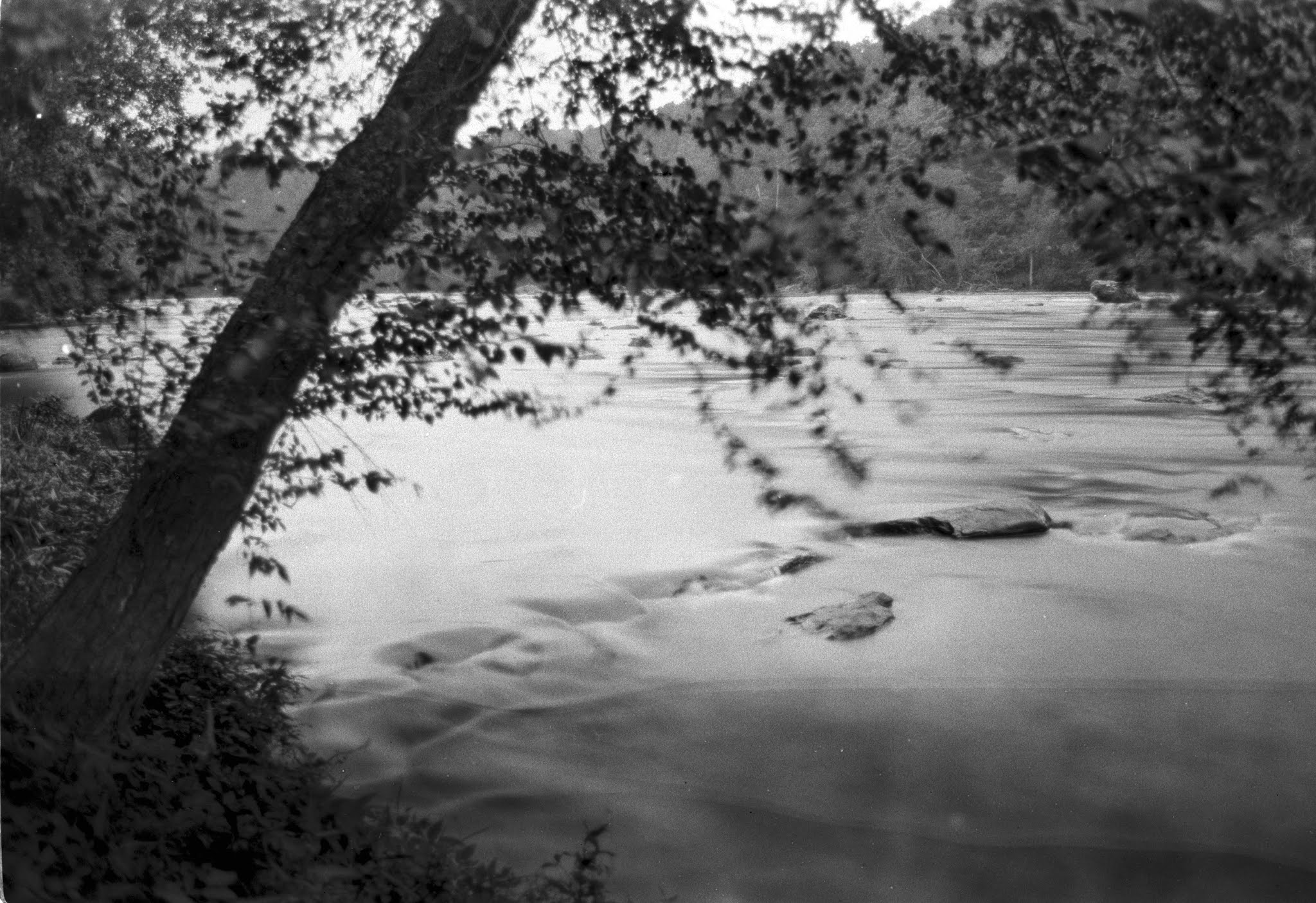
More than 4 years ago, Mike Raso gave me a short roll of what was then the Svema Blue-Sensitive Film at ISO 1.5.  It sat around in the open in a translucent container, in and out of camera bags, and one day in late July, I finally decided to use it while shooting along the French Broad River near Asheville, NC.  I knew that the slow film would enable me to get some nice long exposures of the swift current.With exposures running from 4 to 8 seconds, I hoped that they would have a real smooth appearance to them. Also of note, the film is Blue-sensitive (Orthochromatic) and doesn't see red, so the tonality of the image would be quite different than what you would get with a full-spectrum panchromatic film, such as Ilford Pan-F.

Sometimes I find that my results didn't meet my expectations, and instead of saying "ugh," I take a different tact and see what I can do with the negative.  The film was developed in POTA developer at 24°C for 13 minutes.  Turns out that this roll of Blue-Sensitive film is a victim of light-piping, as the PET film base transmits light like an optical fiber.  With no anti-halation layer, and a clear plastic storage canister, it only compounded the problem, as the film was fogged.  I didn't expect much from the scans. However, I realized that with the fog, imperfections, and long-exposure (ca. ISO 2), they looked like something from a wet-plate collodion negative. 


I'll try this stuff again, as I like the look of the film, but next time I'll get some fresh from the FPP! The newer version of the FPP Blue-Sensitive is at ISO 6, which will still give me the look that I am after.  

Compare the last image with this one, taken with my iPhone XR, to get an idea of how the Orthochromatic film captures the tones.


Thursday, May 23, 2019

TechPan Test with Highly dilute Rodinal

If you have looked through this blog, you'll see that I have long been a fan of Kodak Technical Pan 2415 film.  A few years ago, I acquired a bulk roll of Kodak Technical Pan film that was already in a bulk loader. It has sat around in my basement since then.  Two months ago, I rolled it all up into individual 35mm cassettes, with the intention of selling it on eBay.  But before I can do so, I need to test the film. The expiration date was March, 1990.  So, that film is 30 years old at the very least.  My experience has been that films like TechPan and Kodalith keep pretty well. The low ISO and low grain really helps.  But, unless one develops the films in a low-contrast developer such as POTA, you'll end up with high-contrast black and white negatives with little gradation of gray tones.  In the case of TechPan, I always used the Technidol developer which gave me lovely tonality at ISO 25, with no discernible grain.  Since I have packed up most of my chemicals for an impending move, how could I go about testing the film?  Earlier this week I decided to go ahead and shoot a test roll in my Canon T60, and today, I finally developed the film.  To achieve a low-contrast and keep the gray tones, I used Rodinal.  I used 2 ml of Rodinal in 498ml of water.  I developed for 13 minutes, agitating every minute.  I used a water stop, and fixed in FPP fixer, and the usual water and FPP Archival Wash after fixing. 

As I opened the developing tank, I could see that yes! I did get images.  As I figured, the negatives were "thin", but I knew they should scan pretty well.  This wasn't a stand development, which has been suggested for TechPan in Rodinal.  I wanted to mainly see if the dilution would give me a negative I could scan, and also to see how the film has aged. 

The negatives were scanned on my Epson V700 Photo flatbed scanner, and in post, I was was able to clean the images up and tweak them in my go-to editing software, Corel Paint Shop Pro.


As you can see, these are not too bad, given the TechPan quirks.  I detect some grain, but still, very low. What I do note is some edge fogging, which could be due to the development, my handling, or at worst, the entire roll is like this.  I'll do some more tests to see what is going on.  I think I'll test another roll using Caffenol as a developer, and shoot it with the idea that I want to have a high-contrast negative.   If I find that the next roll is without any problems, I'll probably just sell or trade them direct from here. 

Kodak's Technical Pan Brochure is here.
The Photographer's Formulary sells Developer TD-3, which is a replacement for Kodak's Technidol developer. It does not contain Phenidone.

The formula for POTA is:
Sodium Sulfite - 30 grams
Phenidone  - 1.5 grams
Distilled water to make 1 liter     - heat the water to 30°C to make the Phenidone dissolve.
Develop the TechPan at 20°C 

Develop time is 15 minutes, with 5 seconds of agitation every 30 seconds.  Use water stop bath, and typical fixer.  The suggested ISO is 25, but an ISO of 50 may give acceptable results. 
POTA should be used as soon as possible, and make a new batch each time you want to develop film.
Be careful with TechPan film, as it is a thin emulsion on a Polyester base.  Light piping will occur, so load the film indoors and store in black plastic cans.   TechPan can be an amazing pictorial film, and I hope that I'll be able to make the film available to others.