Wednesday, October 26, 2022

TTArtisans 40mm f/2.8 Macro Lens

Canon EOS M5 with TTArtisans 40mm Macro Lens

Back in early May, I purchased a used Canon EOS M5 from KEH, intending it to replace the long-serving Nikon 1 system that I had owned for nearly a decade.  The 24 MP APS-C sensor on the M5 was certainly an improvement, but so was the availability of lenses in the EOS-M mount.  My first lens for the M5 was the TTArtisans 35mm f/1.4, and while a fully manual lens with no electronic contacts, it worked well in A-mode, and the focus peaking feature on the M5 is a great help with manual focus lenses.  It was several months before I purchased the 15-45mm Canon AF zoom for the M5, and reaped the benefits of auto-focus and the nice zoom range with the image stabilized lens.  However, I still prefer to use prime lenses in much of the photography that I do with this nice mirrorless camera (which is probably being abandoned by Canon as it keeps pushing out the R-series mirrorless).  It suits my needs perfectly, and the one thing that I lacked was a lens for macrophotography.  I’m not into getting adapters to put big 35mm SLR lenses on a petite camera body, which negates the mirrorless camera’s advantages.  When I saw that a macro lens was available from TTArtisans, I knew that it was just the lens that I was looking for.  

beautiful circular aperture

All metal construction

sturdy and substantial lens

52mm front filter ring


With an APS-C sensor, the 40mm is roughly equivalent to 60mm in 35mm full-frame. Since the lens is capable of 1:1 reproduction without any accessories, that sealed the deal for me.  I ordered it from Adorama in NYC, and it was $99 before tax and free shipping. How a lens like this is only $100 baffles me, but if I didn’t like it I could always return it.  One reason these lenses are inexpensive is that they are fully manual with no electronic connections, motors, or "modern" conveniences.  The other reason, I presume, is that they are made in China. The third reason, is that they are available in a number of mirrorless camera system mounts.  

The lens arrived from Adorama in a padded envelope, and is packaged very well in the box from TTArtisans.  The lens barrel is all metal, no plastic, giving it a heft that surprised me.  The focus ring turns smoothly and very precisely - there is no play in the focus, and the aperture click stops from f/2.8-16 feel perfect when handling.  The sort of precise feel that’s missing from modern lenses, in my opinion - because of electronic aperture control.  The lens, when fully extended, is 11.5 cm long, and when at infinity, it is 7 cm in length.  The filter ring is 52mm in diameter.  The working distance at 1:1 magnification is 4 cm.  The all-metal body weighs 388 grams. Compare that to the plastic-bodied 15-45 Canon zoom, which weighs 137 grams! I should note that the TTArtisans 35mm f/1.4 lens weighs 200 grams.  This is a well-constructed, precise lens that will definitely impress you with its build.  Of course, the other half of the equation is - the optics.  I’ve had the lens for about a week, and I’m totally impressed with it.  

Fully extended lens at 1:1


In terms of handling, it’s a great match for the M5 body. Focusing and aperture adjustment are easily performed, and the results from the lens so far are very pleasing.  The maximum aperture of f/2.8 is pretty much what one expects from a true macro lens, and while the minimum aperture is f/16, it matches well with the APS-C sensor size.  Beyond f/16, we would see diffraction starting to make images less sharp.  The aperture is perfectly circular, making for a pleasing bokeh when wide open.  

from the TTArtisan site - 8 elements in 7 groups

As a 40mm lens on the M5, it’s going to also be good for portraits, still-lifes, and of course, it excels as a macro lens.  For really close-up work, you’ll need lots of light if you wish some semblance of depth of field.  Raising the ISO will help in that regard, as I have yet to try external flashes with my M5, but LED light panels can do a pretty good job for many subjects. In my experience, nothing pumps as much light as a burst from a flash unit, so I’ll need to experiment to see what I can do in those situations.  


field of view at 1:1


zoomed and crop of the previous image - loads of detail


Overall, I find no faults with this well-built, affordable lens.  TTArtisans sells it in all popular mirrorless mounts, including Fuji-X, M4/3, Nikon Z, and Sony.  For me, it’s easily carried around on the EOS M5, and is a lot of fun to take outdoors, where subjects abound and it only requires that you look. The TTArtisans 40mm macro lens will open new doors in your photography if you have never shot true macro before!


I really like the results from the EOS M5

I'm a long-time Nikon user, and you might wonder why I didn't switch to a Nikon Z-system mirrorless body.  Price, for one.  I paid less than $400 for the Canon EOS M5. Second, I just don't need a camera for video.  All the newer bodies seem to put video first and foremost in the features, and still photography is almost a second thought.  While the EOS M5 does do good video, it's definitely just part of the features.  In the end, it's a matter of the most bang for the buck, and the EOS M5 got my bucks. 


Saturday, October 08, 2022

Reflx Lab 400D Film Review


A few months ago, I received a package from China with two rolls of film from Reflx Labs.  I’d seen their products on Instagram, and they offered to send me a couple of rolls  to try out. I hoped that I would have gotten this review done sooner, but now that I have developed the second roll, I think I can finally provide some observations on this film.


The Reflx 400Daylight is actually Eastman Vision 250D with the remjet layer removed.  I commend Reflx Labs for providing this information on their website.  There is only one company making ECN-2 film at this time, and it’s Eastman Kodak. While the film is being pushed 2/3 of a stop, the Eastman Vision 3  film has enough latitude to handle the modest push.  

I really like the screw-top aluminum canister that the film cassette is sold in.  That harkens back to the really good old days, and the aluminum canister reminds me of some 1960s Perutz film.  Inside the canister is the roll of film, a keychain ring, and a DX-code sticker to replace the one on the film cassette.  There is a small hole on the end of the spool to attach the keychain, which means you’ll need to ask the film lab to return the cassette if you wish to use it on the keychain.   There’s nothing second-rate about this cute little package, and I loaded up the first roll in my Nikon FE.   I shot that roll at the end of July, and had my local lab (Ball Photo) process the film as C-41.  The results were quite good, though at the time, I thought I was seeing some “light piping” going on.  There was a tiny bit at the beginning of the roll, but further camera testing revealed that I had a slight light-leak by the film door hinge. Argh!!

The second roll was loaded into my Nikon F3HP which does NOT have any light leaks. I shot that roll during my trip to Lexington, VA, and finally developed it with the new Film Photography Project ECN-2 kit.  Even though the remjet has been removed, the ECN-2 chemistry and temperatures are just a bit different from C-41, and are the recommended developer.  It also allowed me to compare colors with the first roll.

The only problems that I have seen with this film are the obvious light-piping early on in the roll, and after going through the images and editing, there are quite a few frames on the second roll that have black hair-like marks in the image.  Dust spots and hairs will show up as white in scans, but emulsion defects will be black.  It could be that these are caused by the remjet removal process, which is done prior to packaging.  They are easily cloned out in editing, but I'd rather not have to do that. This wasn't seen on the first roll, so maybe it's just a random occurrence.

the arrow points to the black lines on the image


Not all were as bad as this - the arrows point to the black lines
on the image.  The next image shows the edited version.


The lowest point on the Blue Ridge Parkway - over the James River in VA


I did not attempt to test the 400D in all types of situations, but shot it as I would any color film, and I think the images I got from the two rolls are very good in rendition - though there are a few times when there is some halation effect - an orange-ish halo around a "hot spot."

It should be no surprise that another seller has done what Cinestill has done. In the world of ECN-2 film stocks, Cinestill figured out a way to remove the remjet coating before packaging the film, so that the film could be processed as C-41.  In addition, Cinestill uprated the Vision 3 500T film to 800 ISO, about 2/3 of a stop.  I typically advise shooting the ECN-2 films at the box speed, but a 2/3 stop push isn’t a big deal.  The Reflx Lab 400D is similarly uprated, and the results show that the push isn’t a problem - at least in my experience. It looks good developed in C-41  as well as the native ECN-2.

Images from Roll 1


note the reddish halation from the bright spots


Images from Roll 2


ghostly sprite from the light piping

Conclusion - overall, I like this film - Vision 250D is an excellent daylight film - which I have always shot at box speed.  The Reflx Lab 400D may need some additional care by the company to avoid the light-piping along the frames and the abrasive marks that I see on roll 2.  As in any secondary sale of a film, there is always the chance that your results may vary if uses or treatment are different from the manufacturer's recommendations.

Saturday, October 01, 2022

Moving from 50mm to 35mm as the “normal” lens


Nikon FE 10 with Series E 35mm f/2.5 lens

For the good part of almost 50 years, I have considered a 50mm lens to be my “normal lens” for a lot of my photography, no matter what 35mm system I used.  For good reason, the 50mm lens was typically the “kit lens” and what was affordable at the time.  My first SLR was an Exakta Exa 2a with a 50mm f/2.8 Meyer-Optik Domiplan.  Cheap at the time (1974), and that's the ONLY lens I had for that camera for nearly a decade.  My second SLR was a Pentax ME in 1983, and I bought it with a Takumar 50mm f/2, and a 135mm f/2.8 lens at Service Merchandise in Ann Arbor, MI.  Again, that 50mm lens was my main lens until the year 2000, when I decided that I was going to get serious about photography. Since then,  the many SLR cameras and systems that I have owned have always had the 50mm prime lens as  my every-day lens.  You name it – Pentax K-mount and M-42 bodies, Minolta SLRs, Olympus, Miranda, Zenit, Nikon, Canon, Yashica, Fujica, Topcon – all had a 50mm lens as the primary lens.  Now, within that 50mm range, are lots of variations, and some amazing glass.  While I most often liked using a 50mm f/1.4 because of low-light shooting as well as shallow depth of field, some of the lenses such as the Minolta 58mm f/1.4 really is a fantastic lens.  However, I am a Nikon guy for the most part (aside from my Pentax Spotmatic love), and my typical lens has been anything from a 50mm f/2 (one of the sharpest lenses on the planet), to the pretty good 50mm f/1.8, to the every-day use 50mm f/1.4, and the 55mm f/1.2 Nikkor – which is a bit of a beast.   Now I have a LOT of different lenses, and use them according to the situation.  However, I'll bet that 70% of my images have been taken with a 50mm lens.  

35mm f/3.5 Super Takumar, Kentmere 400 film

A 50mm lens typically has a field of view of 39°, whereas a 35mm lens has a field of view of 62° - certainly wider, but not as wide as 28mm, which has a field of view of 74°.  A 16mm fisheye lens has a 180° field of view, in case you are interested.  So, with that significantly wider view, the 35mm lens shines in being able to capture more in a scene, if that appeals to you.  For one thing, you don't have to back off as much to get things in the frame, making it a great choice for street photography.  I find that it's also great for natural scenes as well, and for landscapes, it gives a more normal view.

35mm f/2 Super Takumar. Ultrafine Extreme 100 film


35mm f/2 Super Takumar, Ilford HP-5

Previously, the only camera that almost always was paired with a 35mm lens is my Leica M2 and the fantastic 35mm f/1.4 Summilux.  A great travel combo, and that should have told me something, right?  So, I am starting to change.  This summer, I used a 35mm f/3.5 on my Pentax Spotmatic, and really came to appreciate the slightly wider view on my Takumar Trek (see previous posts).  I started using my 35mm f/2 Nikkor on my Nikon bodies, and it's a fantastic lens.  Again, I used it on a recent trip to Lexington for a lot of my photography, and that slightly wider view became my “normal” view. For street photography and landscapes, as well as architecture, 35mm is a great choice.  It's hard to believe that it's taken me this many years to fully grasp how great a 35mm lens is for what I like to shoot.   

Leica M2, 35mm f/1.4 Summilux, Fomapan 100.

For a lot of things, the 50mm range is still very useful, and I'd never give them up.  But for travel, street photography, and the types of subjects that I enjoy, I'll be using 35mm lenses a lot more.    I am a prime lens enthusiast, but if you have a 35-70mm zoom, that'll work too.  In the Nikon world, there are several different 35mm lenses – if one looks at old and new, and in many cases, the lenses have not changed appreciably from non-AI (non Auto Indexing – see my post on Nikkormats for a full explanation) to the AIS versions, except for coatings.  In the auto-focus world, there are fewer choices, and I assume that there have been some changes made.  

35mm f/2 Nikkor, Ilford HP-5


NIKON 35s:

Nikon F with the 35mm f/2.8 and the 35mm f/2 non-AI lenses


    • 35 mm f/2.8 Nikkor  - introduced in 1959, this lens was a non-AI lens.  I have one that I keep on my plain prism Nikon F.  By later standards, it's not the greatest 35, but it's okay.

    • 35mm f/3.5 PC Nikkor – This is a perspective control lens, as the front elements are able to shift along one plane to keep the camera parallel to the subject, so it's a special lens for architecture, and could also be used on a bellows for product photography.

    • 35mm f/2 Nikkor – This faster 35mm lens is optically superior to the f/2.8, and was hugely popular with photojournalists. It's that wider view that aids when closer to the subject, and the more modern AIS version is what I am using.  

    • 35mm f/1.4 – Introduced as a non-AI lens, this was also popular with professionals, and is sharp corner to corner.  A highly regarded lens that remains popular in whatever version. Alas, I have never used one.

All these non-AI versions above were upgraded to AI mounts in 1977. Then again, in 1982, to AIS.  

Nikon FM3A with the 35mm f/2 AI lens

    • 35mm f/2.5 Series E – actually, a nice lightweight and compact lens that works well with the compact bodies such as the FG, EM, and FE10.   

    • 35-70mm f/3.3-4.5 – if you want a short zoom – this is a good choice.  Very sharp at all focal lengths.

    • 36-72mm f/3.5 Series E lens – a short, lightweight constant aperture zoom.  I consider it to be underrated. 

 Nikon AF lenses

    • 35-70mm f/3.3-4.5 AF  and AF-D– A good choice for a carry-all short zoom. 

    • 35mm f/2 AF and AF-D - Excellent, like the manual version, but also focuses closer.  

    • 35-70mm f/2.8 AF and AF-D – a big lens with a 62mm front filter ring, this push-pull zoom is very sharp, and at the 35mm end, it is cable of 1:4 closeups.  Add a diopter on the front for even more magnification.  This is a great lens, though I consider it to be very beefy as short zooms go.

    • 35-80mm f/4.5-5.6 AF-D – A kit lens that Nikon sold with The N50 ad N70 cameras, it's not fast nor great, but like any kit lens, it will do well enough for the users it was intended for.

PENTAX

My favorite SP body with the diminutive 35mm f/3.5


Spotmatic (M-42)

    • 35mm f/3.5 Super-Takumar – compact, and while not fast, it's great!

    • 35mm f/2 Super Takumar  – with a 67mm filter ring, this is not a tiny lens, but it is fast.  I highly recommend it if you can find one.

The two 35s from Asahi Pentax in M-42 mount


M-42 non-Pentax

Due to the longevity and sheer numbers of cameras that used the M-42 mount, you'll find a variety of 35mm f/2.8 lenses available.  They may have the names Albinar, Chinon, Vivitar, Makinon, Soligor, as well as Carl Zeiss Jena Flektogon, Meyer Optik Primagon, etc.  There is a fast 35mm f/1.9 old Vivitar lens that is supposedly very good.  If the thrill is in the hunt, you'll have fun looking for 35mm screw-mount lenses.

Soligor 35mm f/3.5 M-42 mount lens

K-mount

Pentax released a number of lenses in K-M, K-A (to be able to operate in P mode), as well as AF and Digital versions.  I am only listing the manual lenses.

    • 35mm f/2

    • 35mm f/2.8

    • M-35mm f/1.4 (58mm filter ring)

    • M-35mm f/2.8, M-35mm f/2 – both have 49mm filter rings

    • M-zoom 35-70 f/2.8-3.5

    • A-zoom 35-70mm f/4

    • A-zoom 35-70mm f/3.5-4.5

non-Pentax K-mount

    • Tokina SL 35mm f/2.8

    • Chinon  35-70mm f/3.5-4.5 MC Macro zoom

    • Rikenon P Zoom 35-70mm f/3.5-4.5 Macro (maybe the same lens as the Chinon?)

MINOLTA

    • 35mm f/1.8 MD 

    • 35mm f/2.8 MD – I have used one of these, but it's been a while.  Like many MD lenses, it was also made earlier with an MC desgnation.

    • 35mm f/1.4 and 35mm f/2 Maxxum (now Sony Alpha) 

CANON

    • FL-mount (can be used with FD cameras, too)

    • FL 35mm f/2.5 – 58mm filter

    • FL-35mm f/3.5 – 48mm filter

    • FL-35mm f/2.8 “pancake” lens, 48mm filter

FD-mount

    • FD- 35mm f/2 S.S.C.  55mm filter

    • FD- 35mm f/3.5 S.S.C. 55Mm filter

    • FD- 35mm f/28 TILT-SHIFT  S.S.C.  - tilts and shifts – fantastic choice for architecture.  

    • FD -35mm f/2.8 S.S.C. 52mm filter

    • FD- 35-70mm f/3.5 zoom – with its “macro” setting, it can provide some very good close-ups.

EOS-mount 

    • EF- 35mm f/2

    • EF -35mm f/1.4 USM L – expensive!

OLYMPUS

    • OM Zuiko 35mm f/2

    • OM Zuiko 35mm f/2.8

    • OM Zuiko Shift 35mm f/2.8  - a perspective control lens

While I haven't listed every single 35mm lens out there, this list is at least be a starting point.  There are lots of 35-70mm zoom lenses that I have not listed, and that may be a good choice for you, but remember, those zooms won't usually have as large an aperture as a prime lens. 

Last, but not least, Leica R4 with a 35-70mm f/3.5 Vario-Elmar


No matter what 35mm SLR system you use, or rangefinders with the M-39 Leica thread mount  or Leica M mount, there exists a 35mm lens to get you a bit wider view.  


Sunday, September 11, 2022

Looking Back - The Land of Enchantment - 2003

Abiqui near Ghost Ranch, Argus C3, Ilford Pan-F film

Same scene, Nikon FA, 28mm, Fuji Astia


A few weeks ago, I contracted COVID from a visiting friend. It's as if a couple of weeks went missing, in terms of doing anything.  I was really miserable for several days, and even though I was testing negative after a little over a week, my body was still recovering.  It was during that time that I decided that I needed to do something productive, even if I wasn't up to going out and about.  I'd been going through some of my file boxes of older prints and negatives from 2000-2002, winnowing out the crappy stuff and just keeping what I felt was worthwhile. During that process, I realized that hardly anything from my 2003 trip to New Mexico had ever been printed, and none it had been scanned - other than a random photo or two.  I have three 3-ring binders of images from that trip - two are just 35mm slides, and one was only negatives, mostly black and white.  Nineteen years is quite a long stretch of time, and I figured it was a good time to scan in those long-neglected images and re-discover what I photographed on that trip. The other aspect worth mentioning is that as I have presented before - viewing images far removed from the immediacy of an event means that there is less emotional attachment to them, and one can view more objectively as to their merit.  In other words, the images stand on their own if they are good.  

White Sands National Monument. Nikon FM2N, Aga APX 25, red filter


The trip was a family vacation with my wife Adrienne, and our daughter Marjorie, who had also gotten the photography bug from me, and between the two of us, there were perhaps over a dozen cameras.  Somewhere, I have a photo of a table with all the Nikon gear that I had planned to bring, but without seeing it I know that I packed: Nikon FA (used mostly for E-6), Nikon FM2N (black and white), Nikon N60 (C-41), Rollei 35TE, Contax G1, Holga, Kiev 60, Pentax 6x7, Argus C-3, Argus C-4, and a single-use camera.  Of course, there were lenses, filters, tripod, etc.  I know that Marjorie brought her Kiev 80 (Hasselblad 1000 clone), and at least one Nikon SLR and an Argus or two. In hindsight, I should have only brought one medium format camera - and it appears that I used the Kiev 60 quite a bit. We left Michigan on July 9 and returned around July 19.  For some stupid reason, I stopped entering anything into a daily journal of the trip on July 12. So, anything that happened after that-- exact locations, etc., are now just extrapolations from the photographs. Lesson learned - always keep a journal when traveling!  I am very good about that now, but obviously, wasn't then.   Just as a way to try and piece things together, I typed up the notes that I made in 2003, and realized how much is lost when things are not written down.  Nearly 20 years later, there are things that I remember from that trip - all of which are triggered by seeing the images.  Memories are faulty, which is why journals are important.

near Carlsbad, New Mexico, Kiev 60, Ilford SFX 200


Kiev 60, Ilford Delta 100

As I started scanning in the black and white negatives on my Epson V700, I started to appreciate that I actually did do some pretty good photography on that trip. I'd always considered the two binders of slides to be representative of what I saw, and where we visited, but after seeing the monochrome images, I find that those images are far more impactful in terms of mood, landscape complexity, and more meaningful. I'll post some examples here, of course, to illustrate some points.  One of the reasons that I may not have printed many of these images - other than proof sheets of the negatives - was possibly because of the frame spacing issues with the Kiev 60, and also because at that time, my darkroom skills were still fairly limited.  After all, I had only acquired the darkroom in Dec. 2002, as it was included in the house that we purchased.  So, as time went on, the 2003 negatives were hidden away as I did new work. Anyhow, one of the great things about scanning in those negatives is that post-scan editing allowed me to fix problematic frames that I never would have been happy with in the darkroom.  The Kiev 60 frame-spacing issues were never the same from roll to roll. Some rolls were just fine, others had frames nearly overlapping, or at best with about 1 mm of space between them.  I eventually sold the Kiev 60 - and while the exposures I made with it were very good, I didn't like the unpredictability of the frame spacing.  As 6x6 SLRs go, the Praktisix, Pentacon Six, and the Kiev 60 are all quite similar with the same problems. That's really too bad, because the images from them are quite good.

Bisti Badlands, Kiev 60, Kodak Tri-X

Bisti Badlands, Kiev 60, Kodak Tri-X

We put a lot of miles on our 1999 Plymouth Voyager van on that trip, and we traveled quite a bit each day - made possible by the fact that we mostly took interstates and major highways to reach our destinations.  However, when we took secondary roads, that's where the fun was. Some of my favorite photos are of lesser-known sights.  New Mexico is a fascinating state to explore - the people, the places, and the history, as well as the varied topography and geology present innumerable photographic opportunities, and on that trip, we barely scratched the surface. We entered New Mexico at Clovis, and stayed the first night at the Frontier Motel near Roswell.  After that, the only motel I know that we stayed at was the Travel Lodge motel in Santa Fe.  Not keeping a journal was an error I hope never to repeat.

The Frontier Motel in 2003. Nikon N60, 
Kodak Gold 200.

Our visit to Carlsbad Caverns was made even more dramatic by the temperature differential - it was 105°F outside, but mid-50s and high humidity inside the caverns. I actually shot one roll of film inside the caverns - in well-lit examples of the formations. For that I used the Nikon N60 and Agfa Vista 800 color film. I am amazed at how well they came out.  We stayed late to watch the free-tail bats emerge from the mouth of the cavern, and it was quite the experience - thousands and thousands of bats -looking somewhat like a cloud of butterflies.

Inside Carlsbad Caverns - Nikon N60, Agfa Vista 800 film.

We visited Sitting Bull Falls in the Guadeloupe Mountains, and were not disappointed.  The falls was an oasis amidst the Chihuahuan Desert landscape.  While not a roaring waterfall like one might see in the East, the falls cool spray of water created a microclimate of lush vegetation and I'm sure a lot of local wildlife was attracted to the oasis.  At the time, I was really entranced by the Libellula saturata dragonflies that were abundant there. 


Sitting Bull Falls, Nikon FA, Fuji Sensia

Libellula saturata, Nikon FA, Fuji Sensia 

We stopped in the town of Artesia - an area defined by its heavy agricultural use, as well as oil and gas wells. Downtown Artesia features a beautiful city park with fountains, all with historical scenes in ceramics and murals that depict Artesia's history.  

Part of the Heritage Walkway, Artesia. Nikon FA, Fuji Sensia


We drove westward on US 82, went through the amazing mountain village of Cloudcroft, and then after leaving the tunnel through the mountain - came into a completely different desert basin with Alamogordo in the distance. From Alamogordo, we drove N on US-54, and spent some time at Three Rivers Petroglyphs BLM site - incredibly fascinating with its many ancient petroglyphs on the basalt rocks.  The age of these glyphs are thought to be at least 1,000 years old.  

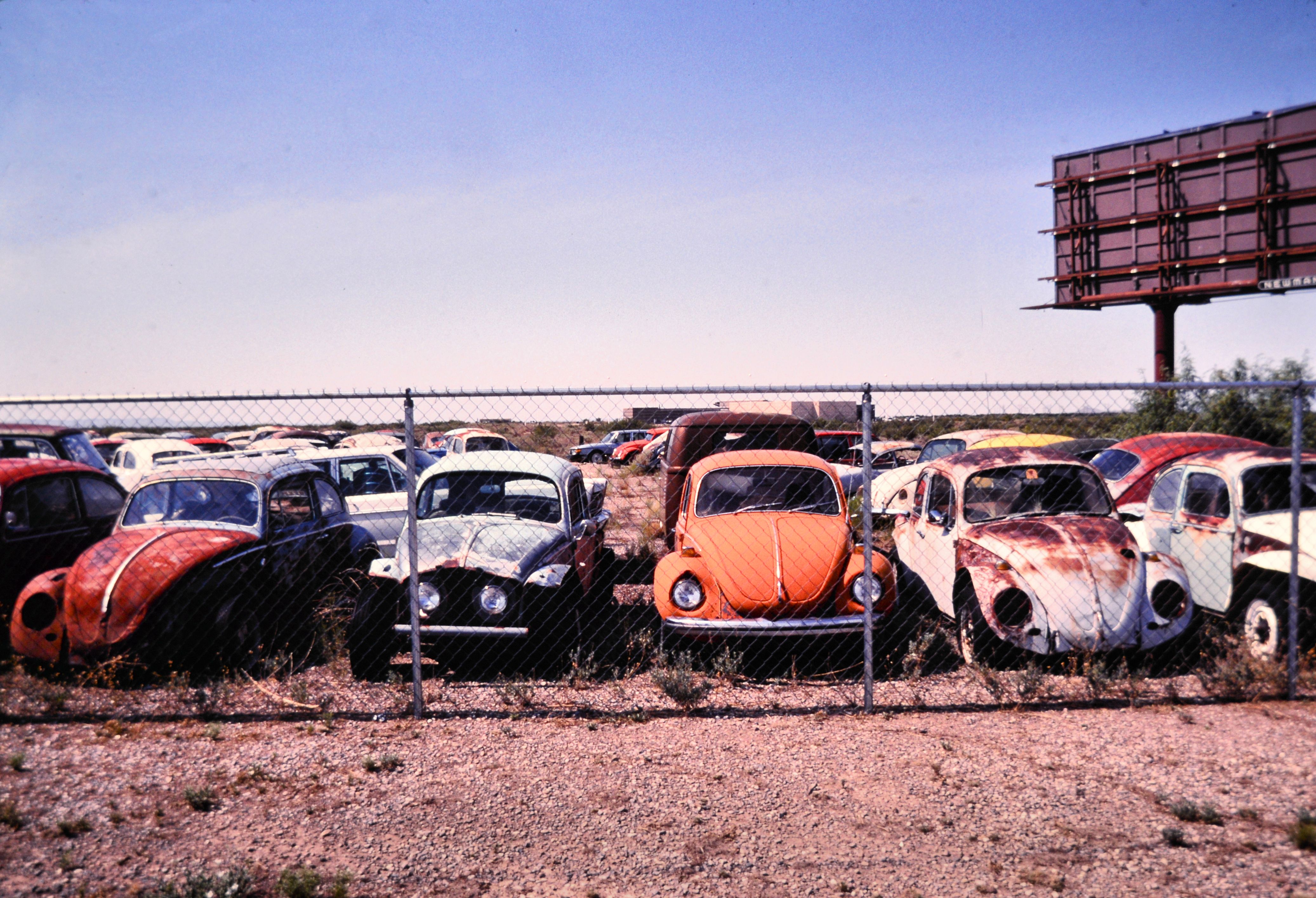
Beetle Yard, Alamogordo, Nikon FA, Kodachrome 64

Bighorn sheep with 3 arrows, Petroglyph. Nikon FM2N,
Ilford Delta 100 film.

From there, we briefly explored the Valley of Fire near Carrizozo - called the Valley of Fire due to the lava flows that were deposited there at a time when indigenous people would have probably seen it happen - about 7000-10000 years ago.  The black flows look quite similar to what one would find on Hawaii. Of course, beyond the black rocks of the Valley of Fire is the Tularosa Valley with the White Sands Missile Range, and White Sands National Monument - which we spent a morning exploring.  I shot a lot of images there with the Kiev 60, and came away with a few really good shots.   It's definitely a place where one should get there either early in the morning or late in the day to take advantage of the lower sun angle over the gypsum dunes.

White Sands NM, Nikon FA, Chromex film

Petroglyphs, Nikon FA, Kodachrome 64

Valley of Fire, Nikon FA, Kodachrome 64

Valley of Fire, Nikon FA, Kodachrome 64

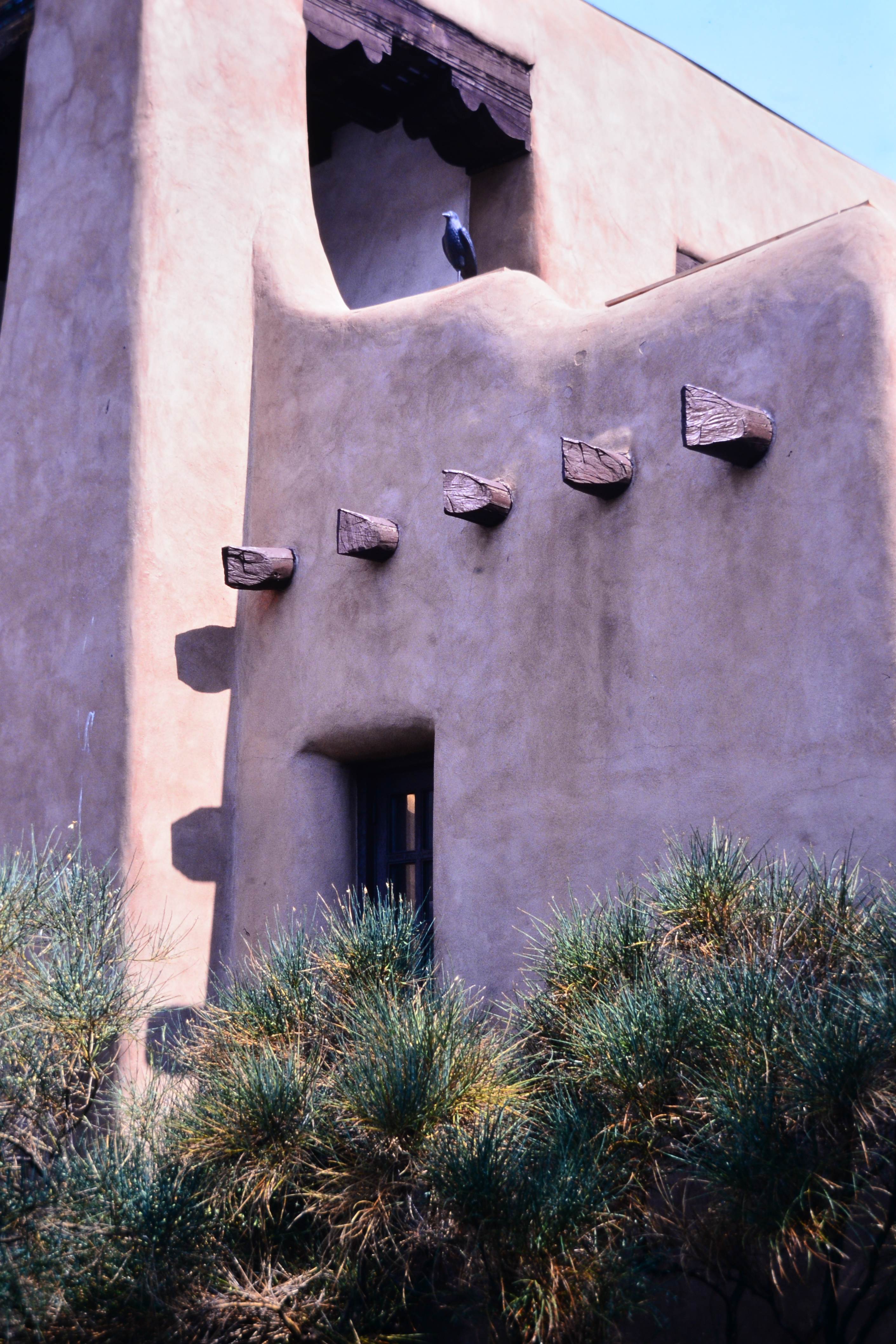
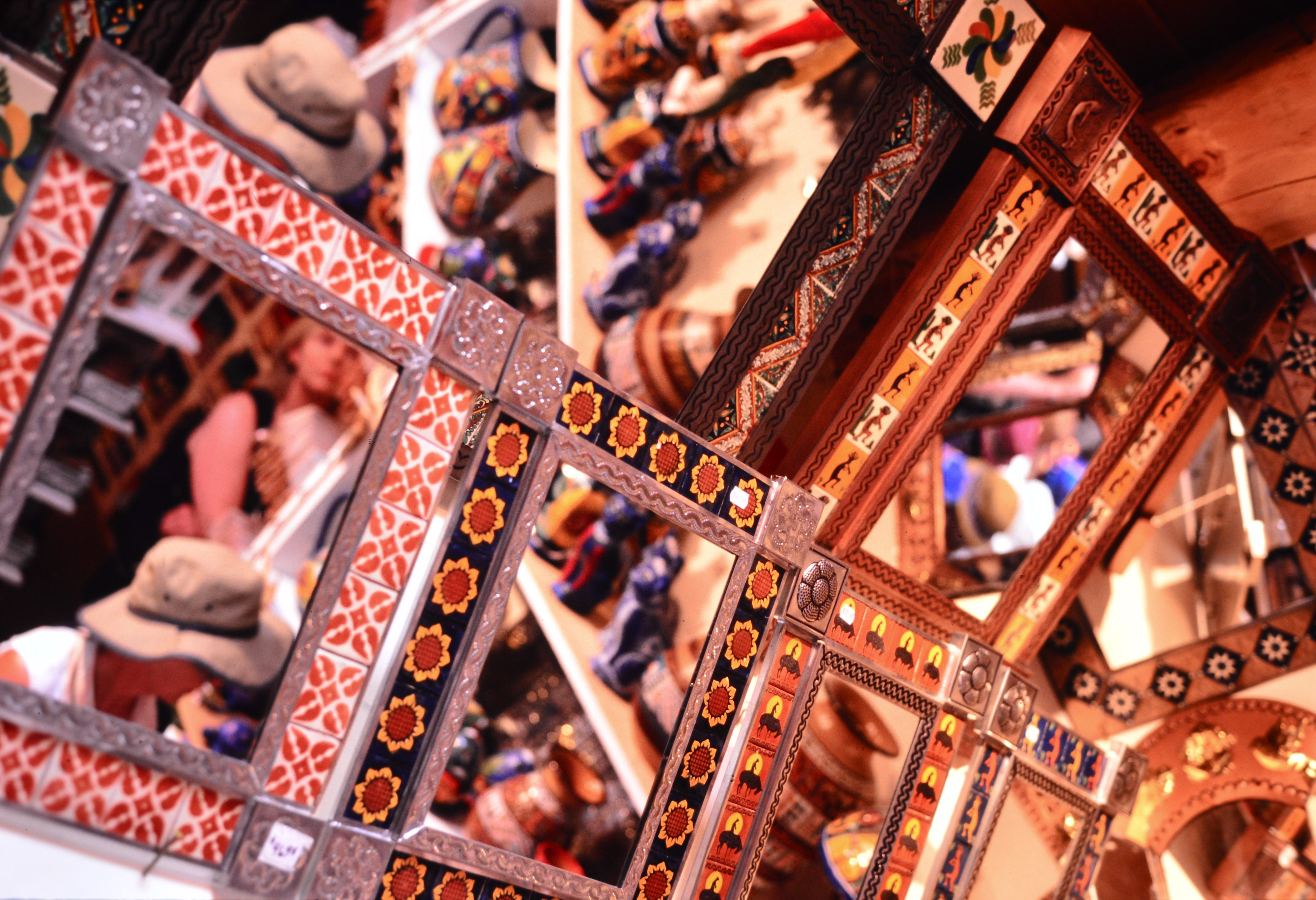
We spent several nights in Santa Fe, making day trips around the area.  Santa Fe remains one of my favorite places due to the adobe architecture, the arts, and the general laid-back atmosphere there.  One of the reasons for going to Santa Fe was a photography-themed month that featured work by many notable photographers.  The Stieglitz exhibit at the Georgia O'keeffe Museum was wonderful, and while I know we visited other galleries there, I don't recall a single one now - and of course, I didn't write it down!  During our stay, we visited Bandelier National Monument, Taos, Ranchos De Taos, Rio Grande Gorge, Abiquiu, and the Ghost Ranch perimeter.  

Santa Fe, Contax G1, Fuji Sensia

San Miguel Mission, Contax G1, Fuji Sensia

Santa Fe, Contax G1, Fuji Sensia

Santa Fe, Contax G1, Fuji Sensia

Santa Fe, Contax G1, Fuji Sensia


A harmonious McD's in Taos, NM. Nikon FA, Kodachrome 64.


the Rio Grande Gorge, Nikon FA, Kodachrome 64.

After we left the Santa Fe area, we traveled NW to the Bisti Wilderness Area.  I'd seen some photos of the Bisti Badlands in an issue of Outdoor Photography, and they were as intriguing and and wonderful as I had hoped. They really looked other-worldly, and would make a great spot for a science-fiction setting.  We didn't see another soul while walking/driving around there, which gave it an even more desolate feeling.  We then drove to the Four Corners monument - which is where CO, UT, AZ and NM meet.  I had been there once before in 1980, and in the 20+ years since, the visitor center and other amenities had sprung up.  The area is within the Navajo Reservation and I think the tribe runs the visitor center.  Since Marjorie had her Kiev 80 with her, people asked her to take their photographs with their cameras - this is well before the iPhone changed how many people took photographs. I, on the other hand, just had a Nikon around my neck, so I guess I didn't look professional enough!   

Bisti Badlands, Nikon FA, Fuji Sensia

Bisti Badlands, Nikon FA, Fuji Sensia


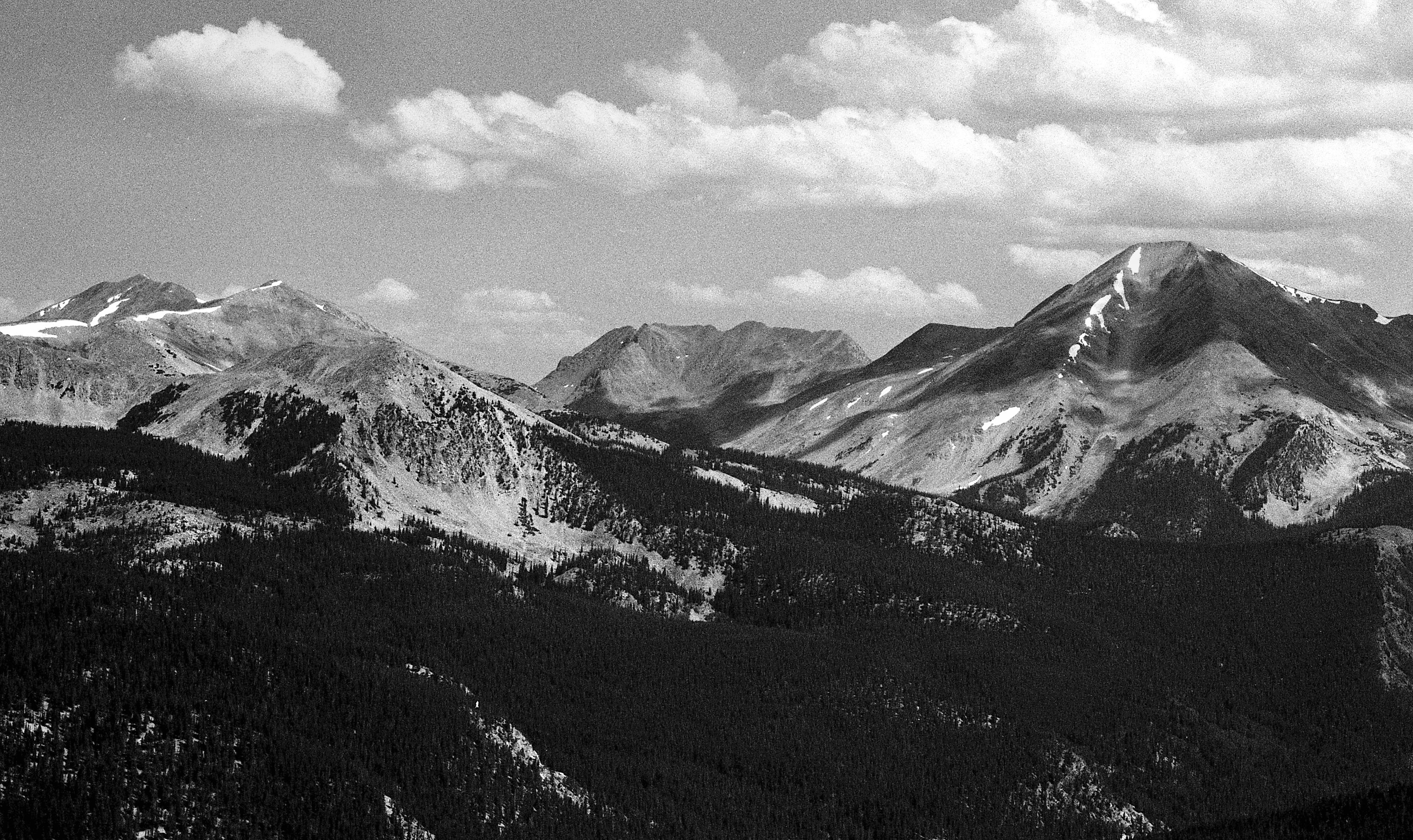
From the four corners, I think we went past Shiprock, to Farmington, and then into Colorado, where we drove on the "Million Dollar" highway from Durango to Silverton.  We eventually went through Monarch Pass, where we took the cable car to the top.  From there, it was a quick trip through Rocky Mountain National Park.  What impressed me most was the afternoon thunder storms - and I did get some good lightning shots with my Rollei 35, until I could hear the car antenna buzzing, at which point I quickly loaded my gear into the van and hoped that we wouldn't get a strike.  

Rollei 35 TE, Kodachrome 64.


We made our way up to Nebraska, to visit Carhenge in Alliance, and drove through the Sand Hills region and after that, it was a dash home on interstate 80.  People talk about "flyover country" and we certainly drove through it.  All the places we went had their own kind of beauty, and whether it was the rolling sand hills of Nebraska, the prairies, the Rockies, the Chihuahuan Desert, or the gypsum flats of New Mexico, there is something to be seen and appreciated. Simply flying in to a city and making day trips to the highlight places does not give you a sense of scale or the same sense of place.  To drive there is to have a much richer experience.  The journey is the reward, said Steve Jobs. He was right.

Carhenge, Alliance, NE. Kiev 60, Ilford HP-5


Carhenge, Nikon FA, Fuji Astia

Carhenge, Nikon FA, Fuji Astia


I just finished digitizing the slides that I shot on that trip, and used my Nikon Df with a Nikon PB-4 bellows and slide copying adapter. The lens, the old 45mm GN F-mount did a great job with the slides.  I'd say that for every sheet of 20 slides, the average number selected to be scanned was 4 per page. Of the slide films used, Kodachome 64, Fujifilm Astia 100 and Sensia 100 were well-represented. 

Somewhere near Carlsbad, NM. Argus C-4, Kodachrome 64.

We have since been through NM several times, and I'd like to go again next year and spend a week on the east side of the state, starting with Las Cruces and working my way north until the Gallup area.  New Mexico is an enchanting place, and to go with my Fujica GL690 and my Horizon 202 would be a lot of fun.  Secondary roads all the way!


Rollei 35TE, Ilford HP-5

Rockies, Nikon FM2N, Ilford Delta 100

 Looking back through the photographs - of which there are hundreds, I have to say that the little Rollei 35TE performed very well.  Of all of the cameras that I used on that trip, the only ones that I still have are the Rolle 35TE, Nikon FM2N, and Pentax 6x7 (though a different body since then), and of course, the Holga,  Argus C4, and C-3.